Southsider
Member
- Joined
- 10 Aug 2015
- Messages
- 937
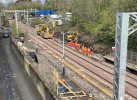
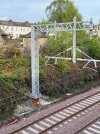
There are guys working on the wires between Giffnock and Clarkston, looks like they are carrying out some adjustments.


Sorry forgot to mention that the last of the wire run was completed last Sunday 6th April. That was on the down line between Robslee and the end of the Run Of at Busy Junction
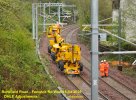
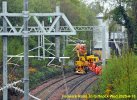

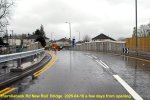
Reopening on 22 April according to the local taxi firm’s facebook page. Over a month ahead of schedule (think it was June).Past by today Sat 12th and there was an Asphalt lorry which had just left the site with another one waiting. Really gearing up for an early completion date within the 14month closure. Some pictures from Friday 11th.
Good Friday initial opening day though has been moved out slightly to after the Holiday weekend
Yes this coming Tuesday. Heard that it was at the clients NRs request so maybe an announcement or not of it taking place. If no announcement it will probably be just a low key affairReopening on 22 April according to the local taxi firm’s facebook page. Over a month ahead of schedule (think it was June).
Edit - East Renfrewshire Council have confirmed that the road will reopen at 10:00 on Tuesday 22/4


Note that update above is dated 17th April 2025, so very much up to date.NR have also published an update: https://www.networkrailmediacentre....-engineering-works-on-track-for-may-reopening

This morning at 10am Thornliebank Bridge reopened.Yes this coming Tuesday. Heard that it was at the clients NRs request so maybe an announcement or not of it taking place. If no announcement it will probably be just a low key affair
what's the state of the wires? Could this be for testing the OLE?Just had an inquisitive look and these are listed as Test with appropriate T head code. But on the 14th there is a light engine move from Millerhill which maybe for testing track, signaling etc
It’s not, the whole East Kilbride branch is closed until mid May. Thornliebank road bridge has reopened.Good to see Thornliebank station back open
Nope ole not finished yet!what's the state of the wires? Could this be for testing the OLE?
Can’t be much left to do, connecting up at Busby junction?Nope ole not finished yet!
The runoff from Busby Junction seems to go most of the way to Thornliebank Bridge. This was built when the Barrhead route was electrified.Can’t be much left to do, connecting up at Busby junction?

Not my field of expertise, but I’d agree that notwithstanding it being insulated from everything, this seems too “permanent“ to be the usual sort of earthing arrangement plus there appears to be one on the other line as well. One of our electrification-minded folks will no doubt explain in due course.Looks like it's attached to the Catenary wire rather than the contact wire, so maybe something to do with the earthing arrangements when isolations are needed? The insulator it's attached to up top looks reasonably permanent. I'm sure somebody will be along to correct me soon enough
Have noticed this at a few of these. They have appeared where there is minimal clearance underneath bridges. I think it is to lower the canterary wire. I'll upload some photos in a day or so to show the arrangements.Not my field of expertise, but I’d agree that notwithstanding it being insulated from everything, this seems too “permanent“ to be the usual sort of earthing arrangement plus there appears to be one on the other line as well. One of our electrification-minded folks will no doubt explain in due course.
could these have something to do with surge arrestors?Have noticed this at a few of these. They have appeared where there is minimal clearance underneath bridges. I think it is to lower the cantenary wire. I'll upload some photos in a day or so to show the arrangements.

Exactly - Surge Diverters (aka Surge Arresters) are precisely what those are.could these have something to do with surge arrestors?
Many thanks for the precise yet concise explanation!Exactly - Surge Diverters (aka Surge Arresters) are precisely what those are.
For those who don't know what the purpose of the Surge Diverter, it acts as an insulator up to a set threshold (typically 300% of the supply voltage).
If that threshold is breached, it becomes a conductor, allowing current to flow safely to earth rather than arcing across the air gaps and damaging the bridge soffit.
Note the little doobry beneath the 2 insulators on the same stovepipe - this doobry is an "actuation counter", which clocks up the number of overvoltage events.
There should also be a "drop-out fuse" between the Surge Diverter and traction earth, but that doesn't appear to have been fitted at the time the picture was taken.
(This has been adapted from the excellent "Overhead Line Electrification for Railways" (6th Edition), Section 10.8.1, page 56; all credit to Garry Keenor)
I'll second thoseMany thanks for the precise yet concise explanation!

I will third it!I'll second those
And I will definitely second that! I have a personally signed copy from Garry.(This has been adapted from the excellent "Overhead Line Electrification for Railways" (6th Edition), Section 10.8.1, page 56; all credit to Garry Keenor)