I sometimes catch the TfW services from Warrington BQ to Manchester and I’ve noticed that quite frequently we’re held at the last signal before Earlestown, and when I check Traksy the block ahead is apparently clear and there’s nothing coming from the single line to cross in front of us. Is this because trains can’t be signalled into the platform if the signal there is red because of something coming across on the Liverpool-Manchester line? (What I believe is known as double blocking.) This would make sense to me because there is virtually no overlap and the consequences of a SPAD there could be a head-on collision. But is this right or is there some other reason?

-
Our new ticketing site is now live! Using either this or the original site (both powered by TrainSplit) helps support the running of the forum with every ticket purchase! Find out more and ask any questions/give us feedback in this thread!
You are using an out of date browser. It may not display this or other websites correctly.
You should upgrade or use an alternative browser.
You should upgrade or use an alternative browser.
Double blocking at Earlestown?
- Thread starter Sheridan
- Start date
- Status
- Not open for further replies.
Sponsor Post - registered members do not see these adverts; click here to register, or click here to log in
R
RailUK Forums
My guess would be that the overlap is too short, so the route to the signal can’t be cleared until the points are changed. As used to be the case with Cheadle Hulme before the junction was rebuilt, you couldn’t previously get a route into either down platform when the points were set for the opposing route.
If I’m right, it’s not “double blocking”, it’s just standard practice. You can’t clear a route to a signal that does not have an empty and adequate overlap. At 20mph the overlap has to be at least 55m (https://www.rssb.co.uk/-/media/Proj...Standards/2020/09/16/10/41/GKRT0064-Iss-1.pdf, outdated).
EDIT https://www.railforums.co.uk/threads/new-chester-to-leeds-service.160794/page-10#post-4060537 implies this too, but isn’t definitive.
In the 1970s my morning train from Poynton was frequently held at the previous signal to Cheadle Hulme, at the end of the goods loop before Ravenoak Road bridge. I became accustomed to peering into the adjacent houses whilst waiting.
https://www.railforums.co.uk/threads/double-blocking.223562/ talks more about what is and isn’t double-blocking.
If I’m right, it’s not “double blocking”, it’s just standard practice. You can’t clear a route to a signal that does not have an empty and adequate overlap. At 20mph the overlap has to be at least 55m (https://www.rssb.co.uk/-/media/Proj...Standards/2020/09/16/10/41/GKRT0064-Iss-1.pdf, outdated).
EDIT https://www.railforums.co.uk/threads/new-chester-to-leeds-service.160794/page-10#post-4060537 implies this too, but isn’t definitive.
In the 1970s my morning train from Poynton was frequently held at the previous signal to Cheadle Hulme, at the end of the goods loop before Ravenoak Road bridge. I became accustomed to peering into the adjacent houses whilst waiting.
https://www.railforums.co.uk/threads/double-blocking.223562/ talks more about what is and isn’t double-blocking.
Last edited:

Chris Hamilton
Member
That’s not double blocking, just a protected overlap for WN543. Something similar happens with GMM399 at the end of Platform 2 at Motherwell (though, made more complex by the length of trains serving Motherwell).
If a train is approaching platform 2 and GMM399 is at danger, then it will be “approach controlled” by GMM423 which is just before the start of the platform. That is, brought almost to a complete stand, until it occupies the berth track circuit at which point GMM423 will clear to a proceed (normally a single yellow, unless a route has since been set straight through the station, see below). This has a couple of caveats though. Because GMM399 is not at the end of Platform 2, and anything more than about 9 carriages would overhang the end of the platform, if the train has not fully occupied one of the preceding tracks (which is the exact length of Plat 2 short of GMM399) to GMM423 without occupying one of the adjacent tracks at the same time, then GMM423 will not clear until the points ahead of GMM399, within its overlap, have been placed to Normal and GMM399 has been cleared to a proceed.
If the train is taking a route towards Uddingston (the Down West Coast Main Line), it is also required to lower Logan’s Road MCB-CCTV in order to get any proceed on GMM399. This means long waits at the crossing if an 11-car Pendolino, or LNER Azuma are sitting at Platform 2. It also means nothing can access Platforms 3/4 from Lesmahagow Junction because the train in Plat 2 is occupying the overlap, and technically fouling the junction (even though it isn’t really).
GMM399 will also not revert to danger until after 345TC (in the platform) has cleared (if the overlap track 343TC has been occupied simultaneousl), as the dispatcher would not be able to give the right away if the front of the train was now occupying the overlap and had returned the signal to danger (as would normally be the case).
Additionally, GMM399 is approach controlled for routes towards Mossend (Down Coatbridge, Down Braidhurst Loop). So even after passing GMM423, trains will still approach GMM399 at danger, even if the route is set, until they occupy 345TC in Platform 2.
It gets pretty complex when the signal cannot be sited with an adequate overlap.
If a train is approaching platform 2 and GMM399 is at danger, then it will be “approach controlled” by GMM423 which is just before the start of the platform. That is, brought almost to a complete stand, until it occupies the berth track circuit at which point GMM423 will clear to a proceed (normally a single yellow, unless a route has since been set straight through the station, see below). This has a couple of caveats though. Because GMM399 is not at the end of Platform 2, and anything more than about 9 carriages would overhang the end of the platform, if the train has not fully occupied one of the preceding tracks (which is the exact length of Plat 2 short of GMM399) to GMM423 without occupying one of the adjacent tracks at the same time, then GMM423 will not clear until the points ahead of GMM399, within its overlap, have been placed to Normal and GMM399 has been cleared to a proceed.
If the train is taking a route towards Uddingston (the Down West Coast Main Line), it is also required to lower Logan’s Road MCB-CCTV in order to get any proceed on GMM399. This means long waits at the crossing if an 11-car Pendolino, or LNER Azuma are sitting at Platform 2. It also means nothing can access Platforms 3/4 from Lesmahagow Junction because the train in Plat 2 is occupying the overlap, and technically fouling the junction (even though it isn’t really).
GMM399 will also not revert to danger until after 345TC (in the platform) has cleared (if the overlap track 343TC has been occupied simultaneousl), as the dispatcher would not be able to give the right away if the front of the train was now occupying the overlap and had returned the signal to danger (as would normally be the case).
Additionally, GMM399 is approach controlled for routes towards Mossend (Down Coatbridge, Down Braidhurst Loop). So even after passing GMM423, trains will still approach GMM399 at danger, even if the route is set, until they occupy 345TC in Platform 2.
It gets pretty complex when the signal cannot be sited with an adequate overlap.
Cricketer8for9
Member
- Joined
- 11 Jan 2015
- Messages
- 961
No up trains can enter platform 4 at East Croydon if the up signal is off at platform 5. Insufficient overlap.

Railsigns
Established Member
- Joined
- 15 Feb 2010
- Messages
- 2,754
The apparently restrictive working at these places isn't necessitated by overlaps being virtually non-existent or insufficient; it's because the overlaps are of such length that they extend through the junction points.
Which means that the overlaps don’t exist when the points aren’t set correctly, surely?The apparently restrictive working at these places isn't necessitated by overlaps being virtually non-existent or insufficient; it's because the overlaps are of such length that they extend through the junction points.
Maybe we’re just arguing about nothing!
Railsigns
Established Member
- Joined
- 15 Feb 2010
- Messages
- 2,754
Either an overlap of sufficient length exists (when a route is set up to the signal) or no overlap exists at all (when no route is set up to the signal). At no time does an overlap exist which is "too short".Which means that the overlaps don’t exist when the points aren’t set correctly, surely?
Maybe we’re just arguing about nothing!
An overlap is a reserved space beyond a red signal that's proved clear in the controls of the previous signal, not merely the distance from the signal to the first potential point of conflict beyond.
Last edited:
Pinus contorta
Member
Its all check railed (from memory) isnt it? So is it something to do with trains are or aren't allowed to pass each other through the station?
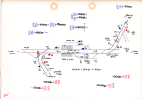
No, it’s the protected overlap for signal WN543 as in post 3 above.Its all check railed (from memory) isnt it? So is it something to do with trains are or aren't allowed to pass each other through the station?
Meaning that you get held at WN548 if the overlap for WN543 is not clear.
Old (1970s) diagram attached, but I don't think the signals have changed much since (clearly the sidings around Newton-le-Willows are no more).
@Railsigns is correcting my terminology above, for which thanks, but we’re both talking about the same thing in the end.
Once the overlap for WN543 is clear, its aspect will be determined by - amongst other things - the aspect of WN537, and WN548 will clear accordingly.
== Doublepost prevention - post automatically merged: ==
"Double blocking", in my potentially imprecise language, is where a signal is held at red when the next signal is red also but with a clear overlap. I don't think this was easy to do in the vintage of signalling at Earlestown, but in more modern implementations it's just part of the software configuration, and it does seem to be implemented relatively frequently now.
Attachments
Last edited:
Pinus contorta
Member
I understand now looking at the diagram
Thanks
Thanks
Thank you too, I’m glad it helped. Stuff I originally did many years ago ….I understand now looking at the diagram
Thanks
- Status
- Not open for further replies.