• Our new ticketing site is now live! Using either this or the original site (both powered by TrainSplit) helps support the running of the forum with every ticket purchase! Find out more and ask any questions/give us feedback in this thread!

Derailment at Wickford - Friday 14th August 2026

Omnishambles

Member
Joined
13 Jul 2019
Messages
204
It looks like a recent renewal site or an area thats received heavy fettlling so that maybe a contributory factor.
Was my first thought too. Interesting to find out as RAIB get into it as to what (if any) works and both the CRT impact and mitigation in place
 
Sponsor Post - registered members do not see these adverts; click here to register, or click here to log in
R

RailUK Forums

Harpo

Established Member
Joined
21 Aug 2024
Messages
3,731
Location
Newport
The train in opposite direction would stop because of either a) OHL power knocked out, b) because the incident train makes an emergency call on the gsmr-radio which brings all trains with a certain distance to a halt.
Also possible that the train in the opposite direction was aware of the derailment before the incident train’s driver who may only have experienced their train coming to a stand for an unidentified reason.

If the opposite train was approaching around the same time there would likely have been a cloud of ballast dust too which would be a big warning. If the train on the opposite road is off, or coming off, there’s no guarantee you’ve got a safe path forward.

That’s not intended to speculate, just to say that there are many more possible scenarios for the passing train.
 

S101

Member
Joined
7 Dec 2025
Messages
98
Location
West Yorkshire
I had understood that these were the definitions - four foot - between the rails, six foot - between adjacent tracks, ten foot - between the track and the edge of the pway/formation. I may have been wrong all these years, though, which is good to know!
Screenshot_20260814-174307.png
The correct definitions.

*Sorry just noticed another person posted the same diagram above.
 

Intercity_225

Member
Joined
13 Jan 2024
Messages
582
Location
March
This quote from a passenger on the train (from https://www.bbc.co.uk/news/live/c68xn77q14jgt) is interesting:
"The train swung wildly for around 10 seconds, like it was about to tilt over."

"It then carried on going for a couple of minutes but there was a horrible vibrating sound, so something obviously wasn't right," he adds.

"Then the train then came to a halt and there was smoke coming from the back carriage."
A couple of minutes?!
 

YorkRailFan

Established Member
Joined
6 Sep 2023
Messages
3,249
Location
York
National Rail released a statement on X saying

https://x.com/nationalrailenq/status/2088311110583628215?s=20 is the link to the statement on X
You can find a full statement on Network Rail's website with more detail as well. As below:
Network Rail has issued the following statement regarding the derailments in Lewes on Thursday 13 August and near Wickford on Friday 14 August.

Martin Frobisher, Group Safety & Engineering Director at Network Rail, said: “We are currently responding to a derailment incident near Wickford station in Essex, and we are working quickly to understand the situation and to provide assistance where needed. Two carriages have derailed but remained fully upright, and there are no significant injuries reported.

“I appreciate the public will be concerned at the news of two derailments of passenger trains over a short period of time, but I want to reassure them that Britain’s railways still rank among the safest in the world, and that safety is always our first consideration on the railway.

“Our thoughts remain with everyone affected by yesterday's significant incident at Lewes. I want to thank the teams from across the rail industry and emergency services who have been working around the clock to provide assistance and support to those who need it, as well as the response from the local community.

"The Rail Accident Investigation Branch is conducting an investigation into the derailment at Lewes, and has investigators on scene at the Wickford incident. We would ask people to avoid speculating on the cause of any incidents until further information is available. We will also conduct our own internal investigations, in which we will look at all possible causes and factors.

“The unprecedented hot and dry weather that we have experienced this summer has presented exceptional challenges to the railway. In response, we have taken several additional proactive steps to manage and mitigate the impact on the railway, including closely monitoring the temperature of tracks, implementing speed restrictions where it is appropriate to do so, and planning track renewals around high temperatures.

“Our continued focus remains on supporting those affected by these incidents, working at pace to understand the causes, and doing all we can to get services back running safely as quickly as possible.”

Notes to Editors
On international comparisons, Britain remains one of the safest railways in Europe and the world. The Office of Rail and Road’s Common Safety Indicators rank Great Britain:
Top 10 in Europe for passenger safety risk (fatalities and weighted serious injuries per passenger train-km): https://dataportal.orr.gov.uk/media/53gnbh44/common-safety-indicators-2024.pdf
1st overall in Europe for whole-system rail safety risk (covering passengers, staff, level crossings, trespass and wider societal harm): https://dataportal.orr.gov.uk/media/53gnbh44/common-safety-indicators-2024.pdf
The investigation will look at all relevant inspections and reports to rail industry from customers.
Reports of bumpy journeys are not uncommon on the railway and they are always followed up with an inspection.
Network Rail is fully cooperating with the Rail Accident Investigation Branch's investigations and it would not be appropriate to speculate whilst those processes are ongoing.

 

RailWonderer

Established Member
Joined
25 Jul 2018
Messages
2,217
Location
All around the network
I note that your profile shows you in Liverpool.
Yesterday Sheffield was 35 degrees. Fair play to Kew Gardens that broke the record for this year at just over 38 degrees but it’s not that much cooler in the ‘North of England’ (as described by some).
Up in Liverpool today it’s been 22c but 35c in London and the counties. A lot of the time the South East is 5-10c warmer than the North West just not yesterday. I don’t want to speculate but I wouldn’t be surprised if buckling rails is a far bigger problem down there.
 

Killingworth

Established Member
Joined
30 May 2018
Messages
6,430
Location
Sheffield
I note that your profile shows you in Liverpool.
Yesterday Sheffield was 35 degrees. Fair play to Kew Gardens that broke the record for this year at just over 38 degrees but it’s not that much cooler in the ‘North of England’ (as described by some).
My car recorded 35 - 36.5 on a journey between York and Sheffield yesterday afternoon. Our planned walk by the Ouse did not take place!
 

Pyromaniac

Member
Joined
26 Aug 2009
Messages
104
Location
Colchester
This quote from a passenger on the train (from https://www.bbc.co.uk/news/live/c68xn77q14jgt) is interesting:

A couple of minutes?

The line between Rayleigh and Wickford has always been fairly rough riding in comparison to other stretches of track.

Interesting that the disruption includes the Braintree branch, this is signed by drivers from the Southend depot which is effectively cut off. This incident may also displace a lot of stock that would normally stable in the vast sidings at Southend Victoria.
 

High Dyke

Established Member
Joined
1 Jan 2013
Messages
4,995
Location
Yellabelly Country
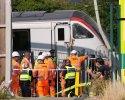
Indeed - unless a train crashed into the back of the derailed train well after the incident (which I am sure would have been reported by now), the photo of the derailed coach should be evidence enough of no other train being involved!
Ah, but that still doesn't stop the keyboard conspiracy theorists. :rolleyes:

The only fact remains is that a train has derailed and the matter is being investigated.
 

Amos390

Member
Joined
22 Jan 2025
Messages
674
Location
Nottingham
What is the line speed at the point that this train derailed between Rayleigh and Wickford?
OpenRailwayMap has 80mph along that stretch, whether it was doing that speed with its proximity to the station (basically was it braking by that point) is another point, and where there any TSRs in place, but 80mph max.
 

450.emu

Member
Joined
21 May 2015
Messages
287
just a quick look at the photos I can see what looks like relatively fresh ballast which gives immediate food for thought to me
I have no clue about these things but doesn't ballast get tamping or packing down after it's laid?
 

Starmill

Veteran Member
Joined
18 May 2012
Messages
27,143
Location
Bolton
Not sure if it has already been quoted above but the BTP statement suggests that nobody has been injured. Which is of great relief if true, although no doubt it will be deeply distressing.
 

Amos390

Member
Joined
22 Jan 2025
Messages
674
Location
Nottingham
I have no clue about these things but doesn't ballast get tamping or packing down after it's laid?
Yeah rail tampers get sent down to pack the ballast together after new ballast is laid, doesn’t mean new ballast will be as tightly packed as old ballast though as during regular working trains pack the ballast more as they pass over, so it could theoretically be a factor I suppose.
 

RUK

Member
Joined
5 Aug 2009
Messages
400
Location
East of England
Thank you for your replies.

Looking at this attached side-on photograph of the de-railed carriage from The Guardian, which they credit to Lucy North/PA, it seems to show some damage and broken-off remnants to an area above the cab door, and also some kind of erosion from scraping of the cab, which has formed holes along the cab-side, and cracks above the (broken) cab-side window, more clearly than in the three-quarter view photograph posted previously.

I doubt that metal would fracture or erode away in that manner, so I presume that those areas are made from some kind of composite material, such as fibreglass? (Given also that what appears to be a metal plate/fitting underneath the cab-side window next to the eroded area hasn’t itself been eroded away.) This surprises me somewhat, because I remember reading that the cabs of the Aventra’s predecessors, the Electrostar, were made of steel (with the rest of the carriage bodies being made of aluminium), and also that people have stated that Class 43’s cabs were no longer up to modern safety standards, due to being made out of fibreglass. I suppose you might want something friable to absorb and dissipate energy from breaking up as a crumple zone, though, rather than something too hard.

I presume that Aventras must be made to the newest safety standards though, given that they are still in production, and that the first order for them was awarded at the beginning of February 2014, so they must have been designed not too long before then. I also remember reading that Bombardier went and re-designed and improved the Aventra design after losing the Thameslink procurement in 2008-2011 to SIEMENS, so presumably the Aventra’s design dates from 2011-2014, or maybe some elements of it from 2008 at the earliest.

The Aventra still being in production also means that spare parts for this damaged Class 720 must still be available at least, or even manufacturing an entire replacement vehicle is possible, if that is found to be necessary - there does look to be some bending of the material, presumably metal, between the cab-side door and the cab.
 

Attachments

  • IMG_1327.jpeg
    IMG_1327.jpeg
    214.1 KB · Views: 425
Last edited:

Amos390

Member
Joined
22 Jan 2025
Messages
674
Location
Nottingham
Thank you for your replies.

Looking at this attached side-on photograph of the de-railed carriage from The Guardian, which they credit to Lucy North/PA, it seems to show some damage and broken-off remnants to an area above the cab door, and also some kind of erosion from scraping of the cab, which has formed holes along the cab-side, and cracks above the (broken) cab-side window, more clearly than in the three-quarter view photograph posted previously.

I doubt that metal would fracture or erode away in that manner, so I presume that those areas are made from some kind of composite material, such as fibreglass? This surprises me somewhat, because I remember reading that the cabs of the Aventra’s predecessors, the Electrostar, were made of steel (with the rest of the carriage bodies being made of aluminium), and also that people have stated that Class 43’s cabs were no longer up to modern safety standards, due to being made out of fibreglass. I suppose you might want something friable to absorb and dissipate energy from breaking up as a crumple zone, though, rather than something too hard.

I presume that Aventras must be made to the newest safety standards though, given that they are still in production, and that the first order for them was awarded at the beginning of February 2014, so they must have been designed not too long before then. I also remember reading that Bombardier went and re-designed and improved the Aventra design after losing the Thameslink procurement in 2008-2011 to SIEMENS, so presumably the Aventra’s design dates from 2011-2014, or maybe some elements of it from 2008 at the earliest.

The Aventra still being in production also means that spare parts for this damaged Class 720 must still be available at least, or even manufacturing an entire replacement vehicle is possible, if that is found to be necessary - there does look to be some bending of the material, presumably metal, between the cab-side door and the cab.
Presuming that damage is as a result of striking the catenary pole to the side there, a lot of damage from quite a small pole.
 

35B

Established Member
Joined
19 Dec 2011
Messages
5,362
Presuming that damage is as a result of striking the catenary pole to the side there, a lot of damage from quite a small pole.
See what happened at Hatfield for what one can do to a train.
 

357

Established Member
Joined
12 Nov 2018
Messages
2,282
Presuming that damage is as a result of striking the catenary pole to the side there, a lot of damage from quite a small pole.
They are very solid and very well secured to the ground.
 

RUK

Member
Joined
5 Aug 2009
Messages
400
Location
East of England
Looking at these photos of what an un-damaged Class 720 cab-side door looks like, it looks to curve outwards a bit from the roof-line, and be flush against the side of the train, and the cab door window is slightly recessed, so perhaps there is some sort of fascia/valance around it:

The door on the damaged cab looks to be in-side the roof-line, and more recessed/not flush with the side of the train on either side - might that mean that the force of the scraping has pushed the door inwards, or is it just that a cosmetic fascia/valance/cover has been ripped off of the surface of the cab door, revealing the actual structure of the door underneath it? I can’t see any broken edges of a fascia/valance/cover on the door itself. If the door has been pushed in, then that might affect egress on that side of the cab (though anyone who might happen to be in the cab could use the internal cab door into the saloon, and exit via the passenger doors, if they couldn’t use the cab door on the other side of the cab).

Looking further, it appears that there might be a crease or dent inwards in the metal of the door above the cab door window of the damaged cab door, as indicated by an apparent slight shadow - though those might just be surface scraping markings, as on the carriage saloon side prior to the cab door.
 

Attachments

  • IMG_1329.jpeg
    IMG_1329.jpeg
    266.3 KB · Views: 255
  • IMG_1328.jpeg
    IMG_1328.jpeg
    128.5 KB · Views: 251
Last edited:

Harpo

Established Member
Joined
21 Aug 2024
Messages
3,731
Location
Newport
Presuming that damage is as a result of striking the catenary pole
More commonly called a ‘structure’ and identified individually as ‘structure number…..’ as shown on each number plate.

== Doublepost prevention - post automatically merged: ==

Yeah rail tampers get sent down to pack the ballast together after new ballast is laid, doesn’t mean new ballast will be as tightly packed as old ballast though as during regular working trains pack the ballast more as they pass over, so it could theoretically be a factor I suppose.
Dynamic Track Stabilisers, or DTS, have been around a long time enabling renewals sites to hand back at, or near to, line speed.
 

saismee

Established Member
Joined
20 Oct 2023
Messages
1,672
Location
UK
The London to Braintree service has been split at Witham and is running as two services. Does anyone know if this is due to crew being unable to come from the Southend depot? It seems a bit pointless to split the service while still seemingly being able to run the same service pattern.

Edit: okay it is certainly not the same level of service.
 

YorkRailFan

Established Member
Joined
6 Sep 2023
Messages
3,249
Location
York
Heidi Alexander has posted a statement on her Twitter/X to reassure the public of the railway's safety:
"I am thinking of those affected by the derailment in Lewes yesterday, as well as those involved by today's derailment in Wickford. The Rail Accident Investigation Branch has been deployed to both sites and is expected to report on the causes in due course. It is important that we do not speculate in the meantime."

"I understand passengers may be concerned about news of two incidents on the network, but the industry has been taking proactive steps to manage the heat for example by closely monitoring track temperatures and putting speed restrictions in place where needed."

"This afternoon, I spoke with Network Rail and other industry partners, including those on the scene at Lewes, to seek assurances that everything possible is being done to avoid similar incidents occurring."

"Our rail network is amongst the safest in the world and whilst incidents like this are thankfully extremely rare, when they do occur, they are taken very seriously."

"Safety is our absolute priority. The industry will ensure that all lessons are learnt and I continue to be briefed on the operational response."
 

bramling

Veteran Member
Joined
5 Mar 2012
Messages
20,301
Location
Hertfordshire / Teesdale
Heidi Alexander has posted a statement on her Twitter/X to reassure the public of the railway's safety:


“I understand, but”.

Not really very reassuring. The industry has been lucky in that there have been three potentially very serious incidents in the space of a few weeks, which in all three cases fortunately didn’t turn out as serious as they might have been.

A dismissive “I understand, but” doesn’t really give much reassurance let alone demonstrate strong leadership.

Clearly if processes were in place, they don’t seem to have proven effective, so people will rightly want to know what is being done to ensure their train won’t be the next one to go leaping off the rails.

With the public sector now being accountable for all of this with the exception of EMR, there’s no scope to hide behind private companies any more.
 
Last edited:

YorkRailFan

Established Member
Joined
6 Sep 2023
Messages
3,249
Location
York
Clearly if processes were in place, they don’t seem to have proven effective, so people will rightly want to know what is being done to ensure their train won’t be the next one to go leaping off the rails.
Reasoning as to why the measures in place weren't enough to prevent these incidents will likely be something looked at by the RAIB. The RAIB will also look at how to prevent such incidents from reoccurring through their recommendations.

I think her statement came across as more reactive rather than proactive. I agree that it would've been better if she had set out some potential next steps, no matter how small those might be, but instead it seems like a "wait for the RAIB" move.
 

millemille

Member
Joined
28 Jul 2011
Messages
407
Location
Derbyshire
Yeah rail tampers get sent down to pack the ballast together after new ballast is laid, doesn’t mean new ballast will be as tightly packed as old ballast though as during regular working trains pack the ballast more as they pass over, so it could theoretically be a factor I suppose.
That's not really how tamping works.

Tamping is a consequence of adjusting the track geometry. The tamper picks up the rail with lifting clamps and lifts and slews the track into the correct position. The tines are then inserted into the ballast while the tamper is still lifting the track and the tines vibrate, to fluidize the ballast and make it behave like a liquid, and pinch, to force the ballast into any voids created under the track as a result of lifting it. The tines are then withdrawn and the tamper then releases the track and the track will remain in the correct position and moves forward to repeat the same process.

Tamping doesn't happen because new ballast is laid, tamping happens because track geometry needs adjustment. New ballast is laid, either because new track is laid, the old ballast is worn out or because there isn't enough ballast available to restore the track to the correct geometry, and the tamper aligns the track.

The way that normal ballast works, the size and shape of the stones causing them to lock together, means that there will be some settlement post tamping, the track is actually slightly over lifted when tamped to allow for this settlement. Track that has been tamped is generally reopened with a TSR (temporary speed restriction) in place while the settlement is allowed to happen and then the TSR is lifted.


== Doublepost prevention - post automatically merged: ==

More commonly called a ‘structure’ and identified individually as ‘structure number…..’ as shown on each number plate.

== Doublepost prevention - post automatically merged: ==


Dynamic Track Stabilisers, or DTS, have been around a long time enabling renewals sites to hand back at, or near to, line speed.
Unless something has changed recently DTS's haven't been used in anger for years.

I was head of engineering support at a UK OTM/OTP operator about 10 years ago and our DTS fleet was sitting around unused, so some of them were repurposed as locomotives and traction units for other machines.

The improvements in tamper technology and the cost of running DTS's after tamping had made them redundant.
 
Last edited:

Top