• Our new ticketing site is now live! Using either this or the original site (both powered by TrainSplit) helps support the running of the forum with every ticket purchase! Find out more and ask any questions/give us feedback in this thread!

Demand Responsive Transport

Status
Not open for further replies.
Joined
1 Aug 2014
Messages
435
I think this is sort of what they are doing in Nottinghamshire. https://www.nottinghamshire.gov.uk/transport/travel-notts/travelling-by-bus/nottsbusondemand

This isn't totally clear but seems to be steering people towards starting or finishing each journey at one of the "designated points" ...
I think you are being too kind to Nottinghamshire. I am pretty sure that they mean that you can book from anywhere to anywhere in the coverage area, with just the caveat that the start and end points both need either to be physical bus stops, or "designated points" (ie "virtual" bus stops).

So nothing special going on there - just burning through their grant funding either oblivious to the financial impossibility of an ongoing service, or consciously enjoying the free money while it lasts and choosing not to think about what comes afterwards.
 
Sponsor Post - registered members do not see these adverts; click here to register, or click here to log in
R

RailUK Forums

signed

Established Member
Joined
13 May 2024
Messages
2,371
Location
ROI
I'd love to see such stats for a DRT scheme where you fix one end, though, e.g. at a supermarket or railway station

This would be in my opinion the best usage of a DRT, no need to cater to unplannable demand. You could cater and adapt your algorithm to train departure times for example.
 

edwin_m

Veteran Member
Joined
21 Apr 2013
Messages
28,602
Location
Nottingham
I think you are being too kind to Nottinghamshire. I am pretty sure that they mean that you can book from anywhere to anywhere in the coverage area, with just the caveat that the start and end points both need either to be physical bus stops, or "designated points" (ie "virtual" bus stops).
From the maps provided, the designated points are generally stops for other services, so there will be a physical stop there already. If there are any exceptions then I imagine bus stops flags would have been added. They are also obvious destinations, or at least interchange points for onward travel, so I'd expect them to have much more demand than the average for bus stops across the zone.
 

duncombec

Member
Joined
3 Sep 2014
Messages
1,148
This could be posted either here or in the Arriva Kent thread, but the Ebbsfleet click operation is to cease after 31 December, replaced by a Go-Coach service:

ArrivaClick in Ebbsfleet was set up as an additional public transport choice in the area. It has attracted passengers, but sadly, not at the level needed to ensure it can be cost-effective for us as a business.

Unfortunately, we had to take the very difficult decision to close the service on December 31, 2024.

Our aim is and always has been to make public transport the best environmentally sustainable option for everyone and we do have an extensive bus network in Kent, so our customers can still rely on our buses to get around.

For more information and details on how to request a refund, please see below [...]

From the 2nd of January, Go-Coach will be providing Ebbsfleet Garden City with a new bus service which will be called the GC1 as a replacement for Arriva Click. This will run daily through out January every 30 minutes.

The Go-Coach page contains an image of a timetable, with a box stating that from "early February", off-peak journeys between 10:05 and 16:05 from Ebbsfleet (and half an hour later from Greenhithe) will be replaced by a demand-responsive service.
 

Tetchytyke

Veteran Member
Joined
12 Sep 2013
Messages
17,446
Location
Isle of Man
If for instance you had a vehicle based at a supermarket that went round the locality picking up and dropping off once an hour, that could also work. But then equally in both of those cases you arguably might as well just run an hourly timetabled bus service instead, because your vehicle is there and fuel isn't the biggest cost, and you'll probably get more people using that than DRT because it's simpler
I agree that DRT only really works where there is one traffic draw and that traffic draw is the focus of the service. The DRT we have here operates like that, a number of buses running from the many tiny villages and hamlets in the north of the island into Ramsey where the supermarkets are.

A scheduled bus service doesn't quite work because, whilst there will be traffic from some of the villages in any given hour, there won't be traffic from all of them. A scheduled bus wouldn't be able to get round all of them in the time allotted to the DRT bus; the advantage of DRT is that you can skip bits of a route.

Our DRT scheme also has certain buses during the day where it will pick up or drop off at the biggest village at set times without needing to pre-book. The route it takes from that village into Ramsey then differs according to demand.
 

ricoblade

Member
Joined
28 Sep 2015
Messages
539
I think this is sort of what they are doing in Nottinghamshire. https://www.nottinghamshire.gov.uk/transport/travel-notts/travelling-by-bus/nottsbusondemand

This isn't totally clear but seems to be steering people towards starting or finishing each journey at one of the "designated points", though it looks like it's actually possible to request anywhere to anywhere within the same zone. The zone maps linked off that page show typically around five designated points per zone, including interchange with trains, fixed route buses, adjacent DRT zones and even planes in one case.
My 1 time experience of this was not good. I was at Askham, which has no scheduled bus service, but there is a bus stop with the NBOD signage and wanted to go to Retford Bus Station (surely a "desgnated point" and I see the NBOD vehicles there all the time).

The app just kept coming up with "no journeys avaialable" and I ended up walking 10 minutes to East Markham to get the 37.

I queried this with NBOD and they just said "services are not always available", which kind of defeats the object! I haven't tried again since (but it doesn't operate in my area north of Retord so wouldn't used it a lot anyway).
 

Trainman40083

Established Member
Joined
29 Jan 2024
Messages
4,528
Location
Derby
My 1 time experience of this was not good. I was at Askham, which has no scheduled bus service, but there is a bus stop with the NBOD signage and wanted to go to Retford Bus Station (surely a "desgnated point" and I see the NBOD vehicles there all the time).

The app just kept coming up with "no journeys avaialable" and I ended up walking 10 minutes to East Markham to get the 37.

I queried this with NBOD and they just said "services are not always available", which kind of defeats the object! I haven't tried again since (but it doesn't operate in my area north of Retord so wouldn't used it a lot anyway).
I guess if you have two people wanting a DRT bus around the same time, one gets disappointed or feels let down. Over time, maybe the number of people prepared to use it declines.
 

Julia

Member
Joined
19 Jun 2011
Messages
379
And yet here we go, with BSIP money seemingly burning a hole in a council's pocket, and no shortage of companies willing to relieve them of it for yet another doomed scheme.
I can't help feeling that DRT is cheaper for councils in the long run, based on experience. Step 1: "Hey, we've cancelled a number of (subsidy-requiring) fixed-timetabled routes and you can have this much more flexible DRT thing instead". Step 2, once people find they can't book for when they want with any regularity, and the catchment areas are weirdly drawn to miss important destinations: "Oh look, nobody uses the DRT, so we can cancel it and use that as justification for not looking into a conventional replacement"
 
Joined
1 Aug 2014
Messages
435
Just chatted with a couple of councillors at a rural county authority about Demand Responsive Transport (DRT). They were well aware of the problems - very expensive, and "flexibility" that translates into such uncertainty that it is no good for many vital use cases, including jobs, education and health appointments.

"But what alternatives are there?" they asked? My least-bad solution is subsidised taxis: they expressed scepticism that there is any legal basis for a local authority (or mayoral combined authority) to run subsidised taxis.

I know that Westlink operated car-sized vehicles at one stage - not sure what their legal status was, and whether that was only permissable as a temporary solution.
Are there any permanent subsidised-taxi operations being run by local (or combined) authorities? Or is there some legislative requirement that says that if an authority wants to fund a taxi-like service, it has to do so by filling perhaps 12% of a 16-seat minibus rather than 50% of a 4-seater taxi?
 

greenline712

Member
Joined
2 Oct 2023
Messages
380
Location
Inside the M25
Just chatted with a couple of councillors at a rural county authority about Demand Responsive Transport (DRT). They were well aware of the problems - very expensive, and "flexibility" that translates into such uncertainty that it is no good for many vital use cases, including jobs, education and health appointments.

"But what alternatives are there?" they asked? My least-bad solution is subsidised taxis: they expressed scepticism that there is any legal basis for a local authority (or mayoral combined authority) to run subsidised taxis.

I know that Westlink operated car-sized vehicles at one stage - not sure what their legal status was, and whether that was only permissable as a temporary solution.
Are there any permanent subsidised-taxi operations being run by local (or combined) authorities? Or is there some legislative requirement that says that if an authority wants to fund a taxi-like service, it has to do so by filling perhaps 12% of a 16-seat minibus rather than 50% of a 4-seater taxi?
Devon CC as a LTA used to run quite a few "Fare Car" services that were a cross between DRT and a bus route. Not many survive, probably because the passengers have stopped travelling (some for obvious reasons!).
The principle is that a "timetable" is published, departing at (say) 0930 and returning at (say) 1230 ... and passengers would need to book by calling the taxi office. No booking, no journey, and presumably no payment, although I don't know that for sure (maybe a retainer?).
There may be a survivor in East Devon .... I'm not sure.
The beauty is that passengers aren't stranded, and it must be much cheaper than DRT. The LTA don't operate it as such, but contract a taxi firm to do so.
I cannot see any reason why a relatively frequent service can't be offered (0900; 1100; 1300). Worth investigating, surely ....
 

Bletchleyite

Veteran Member
Joined
20 Oct 2014
Messages
112,949
Location
"Marston Vale mafia"
The utterly woeful and useless MK Connect has a number of MG5 estates in use as well as the larger vehicles. This recognises that it very rarely makes journeys match up so it genuinely is in practice just a subsidised taxi service even if nominally DRT. My personal take on the service is that it is a complete waste of money and provides few benefits over subsidising fixed routes in an urban area, but rural areas may be different.
 

stevieinselby

Established Member
Joined
6 Jan 2013
Messages
1,663
Location
Selby
The utterly woeful and useless MK Connect has a number of MG5 estates in use as well as the larger vehicles. This recognises that it very rarely makes journeys match up so it genuinely is in practice just a subsidised taxi service even if nominally DRT. My personal take on the service is that it is a complete waste of money and provides few benefits over subsidising fixed routes in an urban area, but rural areas may be different.
DRT in an urban area is absolute lunacy. Sure, you might not always be able to run commercially sustainable services, but it will guaranteed be better value for money for the council to subsidise normal stage-carriage services running on a fixed route and timetable.

In rural areas, it can be trickier. For the most part, I would say that the same still holds true, but I can also see potential good uses for flexi services, where the bus has a fixed departure point and time, but will vary its route depending on where passengers are booked to travel to/from. Beyond that, there don't seem to be many if any DRT operations that carry multiple passengers or groups (ie, I'm not counting 3 passengers making a journey together as "multiple") in enough volume to justify the cost of delivery.

If the service is a de facto subsidised taxi service, albeit often using much bigger vehicles than are needed to carry 1 or 2 people, there is no viable prospect of scheduled services attracting more passengers, and it would be cheaper to just subsidise fares on actual taxis, then that feels like it would be the more sensible choice. You would then have questions about fairness, whether there would be a usage cap, how you would ensure passengers weren't taking advantage of the system – nothing insurmountable, but some potential challenge from residents in areas that do have buses and object to the fact that if they're getting a taxi anywhere they would have to pay full price.

 

izvor

Member
Joined
11 Jun 2014
Messages
570
Location
on the SER
Some local authorities used to issue taxi vouchers for elderly residents. I don't know what the criteria were (age, location, disability), or even whether it was at county or district level. You could choose to use them to pay for all or part of a journey. A good idea, though possibly open to abuse. Also liable to cancellation (which happened round here) at one of the ever-ongoing series of spending cutbacks.

Also of limited use if your nearest town has no taxis - many small town firms have been "Ubered-out" over the years.
 

mattb7tl

Member
Joined
1 Jan 2022
Messages
254
Location
Huddersfield
I've thought about this idea but as an add on for a normal network rather than DRT.

A flat fare for a taxi within a region for holders of week, month, or yearly network passes during certain hours. I think it would have a substantial impact on preventing car ownership among people who already use public transport or people who are not older enough to drive.
 

PeterC

Established Member
Joined
29 Sep 2014
Messages
4,765
Some local authorities used to issue taxi vouchers for elderly residents. I don't know what the criteria were (age, location, disability), or even whether it was at county or district level. You could choose to use them to pay for all or part of a journey. A good idea, though possibly open to abuse. Also liable to cancellation (which happened round here) at one of the ever-ongoing series of spending cutbacks.

Also of limited use if your nearest town has no taxis - many small town firms have been "Ubered-out" over the years.
Some local councils near me offered them as an alternative to a bus pass. The introduction of ENCTS meant that they had to give the pass to all who qualified so the taxi vouchers had to go.
 

izvor

Member
Joined
11 Jun 2014
Messages
570
Location
on the SER
Some local councils near me offered them as an alternative to a bus pass. The introduction of ENCTS meant that they had to give the pass to all who qualified so the taxi vouchers had to go.

Here they were in addition to the senior bus pass (a pack of maybe 20 vouchers per year), but some councils offered a Senior Railcard as an alternative to a bus pass. I guess this is no longer done, for the reason you state.

Agree that DRT services are usually a poor substitute for a regular bus service, and many have bitten the dust over the years. Because they are cheap they are always loved by councillors - especially those for whom buses are just those annoying big things that get in the way of their Range Rovers in narrow country lanes.

I was going to suggest the 99 route (Chichester-Petworth) as an interesting example of a "flexible" route that can divert off the main road, on request, to serve nearby villages. It's been running, apparently successfully, for many years so I was surprised to see that earlier this year it was superseded by a "normal" fixed route, plus an add-on DRT-type service for the larger rural area. BSIP money maybe? Current timetable here.

For more detail on this one see Roger French's always-interesting blog here.

Edit: I now see that Roger's blog is from 2 years ago when the 99 Flex was introduced, but the 99 remained "semi-flexible". Now it appears the 99 is fixed but the 99 Flex remains. Sorry for any confusion - I certainly was!
 
Last edited:

markymark2000

On Moderation
Joined
11 May 2015
Messages
5,091
Location
Great Britain
Devon CC as a LTA used to run quite a few "Fare Car" services that were a cross between DRT and a bus route. Not many survive, probably because the passengers have stopped travelling (some for obvious reasons!).
The principle is that a "timetable" is published, departing at (say) 0930 and returning at (say) 1230 ... and passengers would need to book by calling the taxi office. No booking, no journey, and presumably no payment, although I don't know that for sure (maybe a retainer?).
There may be a survivor in East Devon .... I'm not sure.
The beauty is that passengers aren't stranded, and it must be much cheaper than DRT. The LTA don't operate it as such, but contract a taxi firm to do so.
I cannot see any reason why a relatively frequent service can't be offered (0900; 1100; 1300). Worth investigating, surely ....
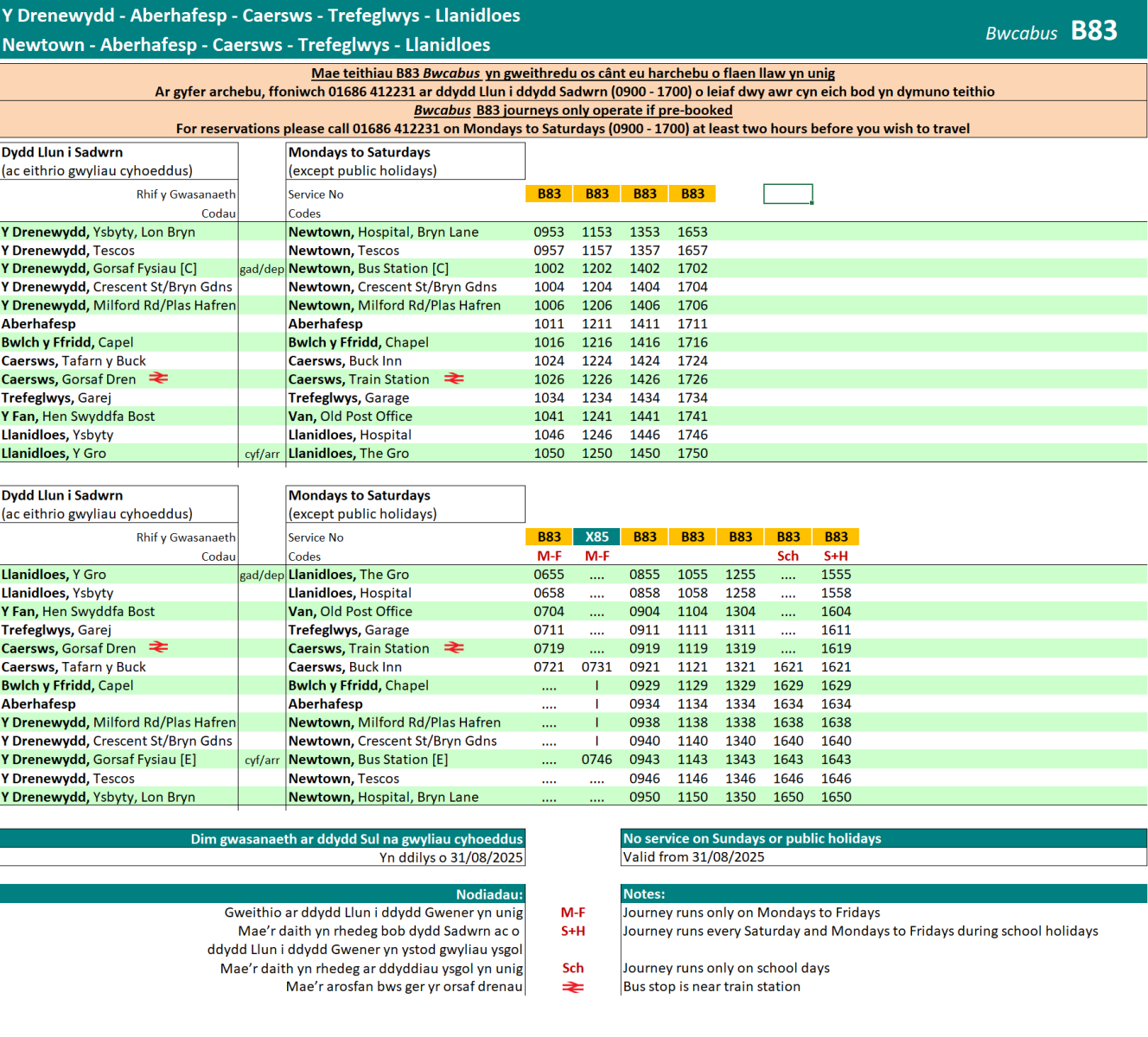
The same happens in Gwynedd and now just expanded in Powys and I think it's a good system.
Gwynedd 69 bus in Bala: https://diogel.gwynedd.llyw.cymru/G..._ar_alw]-[BALA_CLIPA_-_on_demand_Service].pdf
Powys B83 bus between Newtown and Llanidloes: https://www.celtictravel.wales/Bus-Times-Listing.aspx?ID=10
1756770813392.png
B83RequestService.png


The issue with these types of routes is:
1. They rarely appear on journey planners or any normal travel systems because they are hard to program in (it's a scheduled but but only runs if you request it in advance so really it needs to flag up somewhere that you must book this bus. Some authorities therefore don't include them on Traveline, others do but with notes that don't feed through to sites like Google Maps). You tend to only find out about these sorts of routes hidden on councils websites.
2. The other issue is that they are all stuck with archaic booking systems. Why has no one sorted online bookings yet for these kinds of on request buses? Yes they may be aimed at older people and so calling is a great option to have, but it really doesn't help anyone who can use technology as they should just be able to book online then turn up and wait for their bus at the scheduled time. We manage it all for coaches and coach trips, but no one does online bookings for on request timetabled services.
3. You are forced to book so far ahead. Why can't you just pre book upto 1 hour before scheduled departure for the journey? The further ahead you have to pre book, the less people will use it because not everyone knows their plans that far ahead. Even worse for Monday trips as most of these kinds of firms tend not to take taxibus bookings at weekends so you have to book on Fridays before normally 5pm if you want to travel on Monday which is bonkers given plans change and not everyone plans so far ahead.

All of these issues aside, scheduled on request buses seem to be the best of all worlds.
 

edwin_m

Veteran Member
Joined
21 Apr 2013
Messages
28,602
Location
Nottingham
I've thought about this idea but as an add on for a normal network rather than DRT.

A flat fare for a taxi within a region for holders of week, month, or yearly network passes during certain hours. I think it would have a substantial impact on preventing car ownership among people who already use public transport or people who are not older enough to drive.
One option might be where a bus service doesn't run in the evenings, to offer pass holders a limited number of subsidised taxi rides in the evening. This would be for working people rather than pensioners, and means if they needed to stay late after work, they could still get home without having to drive to work or make some other arrangement.
 

slowroad

Member
Joined
23 Jul 2021
Messages
371
Location
Wales
Just chatted with a couple of councillors at a rural county authority about Demand Responsive Transport (DRT). They were well aware of the problems - very expensive, and "flexibility" that translates into such uncertainty that it is no good for many vital use cases, including jobs, education and health appointments.

"But what alternatives are there?" they asked? My least-bad solution is subsidised taxis: they expressed scepticism that there is any legal basis for a local authority (or mayoral combined authority) to run subsidised taxis.

I know that Westlink operated car-sized vehicles at one stage - not sure what their legal status was, and whether that was only permissable as a temporary solution.
Are there any permanent subsidised-taxi operations being run by local (or combined) authorities? Or is there some legislative requirement that says that if an authority wants to fund a taxi-like service, it has to do so by filling perhaps 12% of a 16-seat minibus rather than 50% of a 4-seater taxi?
The system used in (parts of?) rural France is that taxi vouchers are issued to people on low incomes (in Britain this would presumably be people in receipt of income related benefits and/or council tax reduction).
 

stevieinselby

Established Member
Joined
6 Jan 2013
Messages
1,663
Location
Selby
2. The other issue is that they are all stuck with archaic booking systems. Why has no one sorted online bookings yet for these kinds of on request buses? Yes they may be aimed at older people and so calling is a great option to have, but it really doesn't help anyone who can use technology as they should just be able to book online then turn up and wait for their bus at the scheduled time. We manage it all for coaches and coach trips, but no one does online bookings for on request timetabled services.
Most of the DRT systems that have been launched over recent years use one of a few commercial apps – to the extent that it looks very much like the tail wagging the dog, venture capitalists developed an idea for an app and then went out to try to sell it, rather than councils wanting to run on-demand buses and commissioning an app for it. But because of the way these are packaged and sold, they tend to be used on new systems that fit their operating model rather than being adapted to fit systems that councils already have in place.
3. You are forced to book so far ahead. Why can't you just pre book upto 1 hour before scheduled departure for the journey? The further ahead you have to pre book, the less people will use it because not everyone knows their plans that far ahead. Even worse for Monday trips as most of these kinds of firms tend not to take taxibus bookings at weekends so you have to book on Fridays before normally 5pm if you want to travel on Monday which is bonkers given plans change and not everyone plans so far ahead.
Policy varies from one operation to another. Some allow advance booking, some require advance booking, some don't offer advance booking.
I suspect that for a lot of the old school systems, bookings have to be made the day beforehand because someone will then take the list of bookings, work out the schedule for the day, print it out and give it to the driver in the morning. If you allow bookings up to an hour beforehand then you need a way to automagically recalculate the schedule and transmit this information to the driver on the move. Obviously there are ways to do this, but for small outfits that don't have lots of money to splurge on new technology for marginal services, that may not be an attractive option.
 

Russel

Established Member
Joined
30 Jun 2022
Messages
5,390
Location
Lichfield
How many of these DRT service have actually been a success?

There seem to have been quite a few launched over the last couple of years and I wonder how many will still be around in another couple of years.
 

Russel

Established Member
Joined
30 Jun 2022
Messages
5,390
Location
Lichfield
In round numbers, it's a very round number.
Very unlikely that more than a handful of them will survive beyond the original funding grant.

Thought as much, a scheme was launched in Lichfield earlier this year, all day, every day there seems to be two Sprinter minibuses sitting in the bus station, presumably with drivers too, I've never seen them move, how can this be a good use of funds?
 

stevieinselby

Established Member
Joined
6 Jan 2013
Messages
1,663
Location
Selby
Thought as much, a scheme was launched in Lichfield earlier this year, all day, every day there seems to be two Sprinter minibuses sitting in the bus station, presumably with drivers too, I've never seen them move, how can this be a good use of funds?
It isn't!
It's a fundamental contradiction for DRT – if there is enough demand for travel along similar corridors that you get sufficient ride-sharing to make the service financially worthwhile, there's enough demand for a scheduled bus service – if you have enough capacity to meet demand and not leave passengers stranded or unable to book a journey then you will spend most of the time with drivers and vehicles sitting idle – if you keep capacity down to a level where it is in use most of the time then you will be unable to meet the demand for a high number of journeys.

It's very telling that when North Yorkshire introduced DRT, it overlapped with a number of subsidised or council-operated routes that continued running alongside the DRT. Many of them only ran a few journeys a day, or even a few journeys a week. After the trial period, the council cancelled the DRT service and has continued to run the scheduled services, as they gave much better value for money.
 

Nammer

Member
Joined
1 May 2016
Messages
177
We have a DRT in Portsmouth that is absolutely useless. Only serves a very small part of city (Paulsgrove) to the destination (Port Solent). You have to book in advance. A proper timetabled bus would be much better.
 

RT4038

Established Member
Joined
22 Feb 2014
Messages
5,449
How many of these DRT service have actually been a success?

There seem to have been quite a few launched over the last couple of years and I wonder how many will still be around in another couple of years.
It depends what you are defining as success? Are they commercially viable [fares covering costs]? - none; but then relatively few fixed route bus services outside the larger urban areas are either.

I think DRT has a (limited) role - for instance serving the passengers who cannot access fixed route services; and enabling fixed route services not to have to divert away from main roads to reduce walking distances for the elderly and infirm. Keeping costs down by running these in the middle of the day using smaller buses in between Special Educational Needs school services.

It's very telling that when North Yorkshire introduced DRT, it overlapped with a number of subsidised or council-operated routes that continued running alongside the DRT. Many of them only ran a few journeys a day, or even a few journeys a week. After the trial period, the council cancelled the DRT service and has continued to run the scheduled services, as they gave much better value for money.
They may well have cost less money to operate than the DRT (and North Yorkshire may well have not been able to afford to continue it), but whether they are better value for money depends on how much value is attributed to the persons welfare who is not served particularly well by a few fixed journeys per day/week?
 

PeterC

Established Member
Joined
29 Sep 2014
Messages
4,765
The vehicles on the Wycombe scheme track on bustimes and seem to bustle around a lot. How many people are onboard is another matter of course.
 

edwin_m

Veteran Member
Joined
21 Apr 2013
Messages
28,602
Location
Nottingham
It's a fundamental contradiction for DRT – if there is enough demand for travel along similar corridors that you get sufficient ride-sharing to make the service financially worthwhile, there's enough demand for a scheduled bus service – if you have enough capacity to meet demand and not leave passengers stranded or unable to book a journey then you will spend most of the time with drivers and vehicles sitting idle – if you keep capacity down to a level where it is in use most of the time then you will be unable to meet the demand for a high number of journeys.
Also, if its attractive enough to provide a taxi-like service at a bus-like fare, lots of people will want to use it and either it will go way over budget or it will be resource-constrained as above. It only has a chance of succss if it isn't attractive enough for this to haopen.
 
Joined
1 Aug 2014
Messages
435
I tried the approach of asking myself "if DRT is the answer, what is the question". I struggled to find an answer.

DRT is only conceivably good for travel that has high social need. Given the state of public finances, low-to-medium social need isn't going to be enough to justify hefty subsidy.

But DRT is only actually good for travel that has a high tolerance of uncertainty - until a few days or hours beforehand - about whether you will get a ride at the time you wanted, at a different time, or not at all.

Nearly all the major categories of high-social-need transport fail the tolerance-of-uncertainty test. Getting to a job? - you'd be lucky to last a fortnight when each journey request has only about an 80% chance of being met. An outpatient appointment? - good luck when you asking the appointments team to let you come back to them with your preferred time a week ahead of the appointment. Getting to an interview, an exam? Onward travel by train, bus or air where affordability requires you to fix your time several weeks ahead? Forget it.

Shopping is the one application where there is perhaps a reasonable level of tolerance of uncertainty. If someone can't get to the shops on Tuesday morning, then there is a fair chance that they might cope with going on Wednesday afternoon. But the widespread availability of online shopping substantially shrinks the ranks of those for whom travelling to a shop is the only way of keeping fed.

I could only think of one high-need category of use where most non-car-users would find DRT a solution - clothes shopping. What have I missed?
 

Bletchleyite

Veteran Member
Joined
20 Oct 2014
Messages
112,949
Location
"Marston Vale mafia"
I think DRT with a single fixed point can work. It's many-to-many DRT that makes no sense.

A single point could be a railway station (with each run, which can go to multiple places in an area, timed for a particular departure), a supermarket, a hospital or similar. Or even you could have one that picks up somewhere like Windermere station timed for specific trains and does a run around whichever hotels people want to go to/from and gets back for the next train.

But because of VIA's prominence in the market, hardly any of the schemes actually work like that. With many-many DRT too few journeys tend to match up for it to be useful.

The fairly established US model of airport shuttle minibuses is an example of it working pretty well. The airport is of course the single point.
 
Status
Not open for further replies.

Top