• Our new ticketing site is now live! Using either this or the original site (both powered by TrainSplit) helps support the running of the forum with every ticket purchase! Find out more and ask any questions/give us feedback in this thread!

Demand Responsive Transport

Status
Not open for further replies.
Joined
1 Aug 2014
Messages
435
The press release says of the new Inverurie service: "Passengers can request a bus at short notice or ask for a future departure or arrival time".

Well, sort of - according to their site, "Bookings can be made at short notice, on the day of travel, or up to 7 days in advance."

So once again, it's lottery time for the passenger who needs to be sure when they can travel (or whether they can travel at all) more than a week ahead, most obviously:

- anyone trying to choose an appointment time for a hospital consultation, where dates offered are often three to six weeks ahead.
- anyone wanting to use the DRT service to connect with a rail or coach journey with a fixed-time ticket, or any plane journey, where only the most expensive tickets are likely to be available by the time you get to find out when/whether the DRT can take you.

At least it is better than the the Viavan system, where it appears that you only find out whether they can carry you or not a few minutes ahead.
 
Sponsor Post - registered members do not see these adverts; click here to register, or click here to log in
R

RailUK Forums

GusB

Established Member
Joined
9 Jul 2016
Messages
8,112
Location
Elginshire
The press release says of the new Inverurie service: "Passengers can request a bus at short notice or ask for a future departure or arrival time".

Well, sort of - according to their site, "Bookings can be made at short notice, on the day of travel, or up to 7 days in advance."

So once again, it's lottery time for the passenger who needs to be sure when they can travel (or whether they can travel at all) more than a week ahead, most obviously:

- anyone trying to choose an appointment time for a hospital consultation, where dates offered are often three to six weeks ahead.
- anyone wanting to use the DRT service to connect with a rail or coach journey with a fixed-time ticket, or any plane journey, where only the most expensive tickets are likely to be available by the time you get to find out when/whether the DRT can take you.

At least it is better than the the Viavan system, where it appears that you only find out whether they can carry you or not a few minutes ahead.

Goodness me, the service hasn't started yet and the pessimists have come out to play! :rolleyes:

The site also says:
If you wish to travel at a future time you can request a departure or arrival time and you will receive confirmation of your Ready2Go booking.

You may want to choose an arrival time rather than a departure time, for example if you are travelling to attend an appointment. The system will calculate a pick-up time to ensure you arrive on time and you will receive text confirmation of the pick-up time shortly before you are due to be picked up.

So, while you may not be able to book further than 7 days in advance, the likelihood is that you'll be advised whether or not your journey is possible shortly after making your booking. That allows plenty of time to make other arrangements. If this means having to rely on family or friends, then that would probably have been the case before the service existed so nothing is really lost. If they don't have the family and friends option they probably wouldn't be travelling in the first place!

If the only other alternative is a taxi, then there's no guarantee that there will be availability (eg around school start/finish times) and mistakes can be made at the time of booking, no matter how far in advance you book your journey. In that neck of the woods taxi supply can also be limited by oil industry crew-changes.

The article does say that it will be replacing traditional fixed-route services, but fails to mention which ones. How good the new service is will depend on what it is replacing, but give the damn thing a chance to get off the ground before swinging the axe!
 

Typhoon

Established Member
Joined
2 Nov 2017
Messages
3,540
Location
Kent
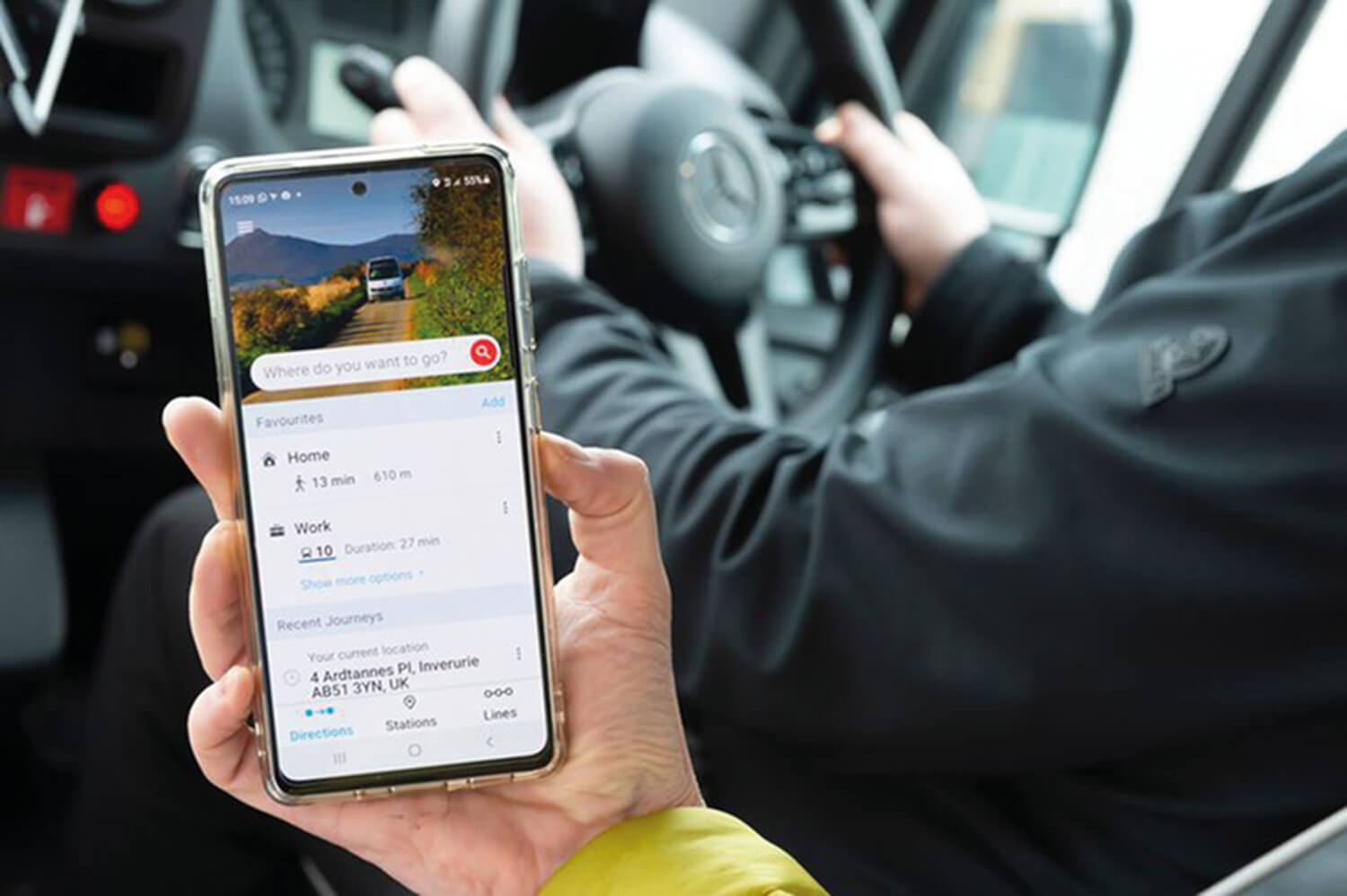
Aberdeenshire Council are introducing a new demand responsive service in the Inverurie area.

I know nothing about the area except the name of the football team so cannot comment on the suitability of DRT for these locations but I notice (as is quite common for such schemes) that the times when the phone lines are available for less than half the time the service operates. In particular, no phone service on a Saturday.

I was initially concerned that it was a rush job but has been advertised for a few weeks on-line so there will be advanced knowledge. However, there are concerns on their Facebook page (3 out of the 7 comments that I am permitted to see) that 'the link does not work'. How accurate that is (if there are only 3 that is not that many really, but I have no idea what is being hidden as not 'most relevant'), I'm not certain but failures in technology (including those of the users) can make a difference in confidence.

If DRT is to take off, I would have thought that this was a suitable area, a quick look at the map shows a rural area with villages rather than towns but some quite decent bus services.
The article does say that it will be replacing traditional fixed-route services, but fails to mention which ones. How good the new service is will depend on what it is replacing, but give the damn thing a chance to get off the ground before swinging the axe!
In a quick trawl, the only one I could find that was not operating next week (according to Bus Times) was the 403, maybe they are seeing how it beds in before making further reductions.
 
Joined
1 Aug 2014
Messages
435
"Goodness me, the service hasn't started yet and the pessimists have come out to play!"

A pessimist is someone who overestimates the chance of something bad happening.

The lack of certainty in when you can travel with DRT isn't something possible-but-unlikely. It is certain that you cannot commit to being in a particular place at a particular time any further ahead than the point at which bookings open. And it is certain that a scheduled bus service, even a relatively infrequent one, does allow you to know when you can travel many weeks ahead.

And taxis also offer pretty good certainty too - if you try to book three months ahead to clash with their school runs, they will say No at the outset, but any decent firm will honour a far-ahead booking once they have taken it.

DRT, in the flavours being offered in the UK, does not offer certainty. And that is a fundamental flaw. Not a pessimistic prediction.

From the analysis I have done on the Derbyshire Connect service around Ashbourne (on the scant data that Derbyshire County Council have bothered to record), DRT services can too readily turn out to run very much like a taxi service, rarely moving more than one travel-together group at any one time. But of course DRT services are more expensive to run than taxis, and their limited advance booking makes them less useful than taxis.

The main attraction of DRT is, I suspect, that the "it could be you" lottery that allocates places automatically imposes a limit on demand. And that means that politicians can avoid making difficult decisions on how to ration limited capacity. If they were to face up to the fact that the funding available for rural transport isn't enough to serve everyone who needs to travel, and define who they think deserves to travel (and/or for which purposes) then subsidised taxi services would often be a better solution.

(On top of the rationing problem, there is also the challenge of managing around the idiotic split in transport responsibilities between councils: buses are a County Council issue, where taxis are a District Council issue)
 

GusB

Established Member
Joined
9 Jul 2016
Messages
8,112
Location
Elginshire
"Goodness me, the service hasn't started yet and the pessimists have come out to play!"

A pessimist is someone who overestimates the chance of something bad happening.

The lack of certainty in when you can travel with DRT isn't something possible-but-unlikely. It is certain that you cannot commit to being in a particular place at a particular time any further ahead than the point at which bookings open. And it is certain that a scheduled bus service, even a relatively infrequent one, does allow you to know when you can travel many weeks ahead.

And taxis also offer pretty good certainty too - if you try to book three months ahead to clash with their school runs, they will say No at the outset, but any decent firm will honour a far-ahead booking once they have taken it.

DRT, in the flavours being offered in the UK, does not offer certainty. And that is a fundamental flaw. Not a pessimistic prediction.

From the analysis I have done on the Derbyshire Connect service around Ashbourne (on the scant data that Derbyshire County Council have bothered to record), DRT services can too readily turn out to run very much like a taxi service, rarely moving more than one travel-together group at any one time. But of course DRT services are more expensive to run than taxis, and their limited advance booking makes them less useful than taxis.

The main attraction of DRT is, I suspect, that the "it could be you" lottery that allocates places automatically imposes a limit on demand. And that means that politicians can avoid making difficult decisions on how to ration limited capacity. If they were to face up to the fact that the funding available for rural transport isn't enough to serve everyone who needs to travel, and define who they think deserves to travel (and/or for which purposes) then subsidised taxi services would often be a better solution.

(On top of the rationing problem, there is also the challenge of managing around the idiotic split in transport responsibilities between councils: buses are a County Council issue, where taxis are a District Council issue)
Surely you can't judge every demand responsive service by analysing just one. It just seems that you're being overly critical of something that hasn't even begun yet. What doesn't work in one area may work in another.

By the way, councils in Scotland are unitary so there's no split between County and District.
 

Dai Corner

Established Member
Joined
20 Jul 2015
Messages
6,990
( @GusB please move to a new thread if appropriate)

The Fflecsi DRT service in Newport, South Wales was expanded last Sunday. Key features are

  • Covers the urban area of the city. The rural areas have had traditional DRT services for some years. The urban area extends beyond the city boundary but the service does not.
  • Mon-Sat daytimes the existing timetabled services run alongside Fflecsi. The app directs users to one of these if possible. I think it only knows about Newport Transport, not Stagecoach.
  • Evenings and Sundays it's just Fflecsi, with I believe four buses out in the evenings and five on a Sunday. There are nine altogether.
  • Bookings can be scheduled, including on a recurring basis. Only the pick-up time though, not drop-off, so useless for work, appointments, connections with trains or other buses etc
I've made four or five journeys so far and only had one fellow passenger. Waits have been quite long in the evening and one scheduled trip just disappeared from the system. I've noted three of the nine vehicles parked up waiting in the bus station in the middle of the day.


Edit: Added the Press Release

Extended fflecsi bus services reaching across Newport​

2 weeks ago Mon 26th Jul 2021

Following the success of the first fflecsi pilot in Wales which launched in two areas of Newport last year (Rogerstone and St Julian’s), Transport for Wales, in partnership with Newport City Council and Newport Bus are undertaking a huge expansion of the fflecsiservice, meaning that a fleet of 9 small brand new low-floor 16-seater buses will now serve the whole of Newport.
This new service will complement and enhance the existing scheduled bus services and will launch this summer.
The fflecsi buses will give many more people across Newport access to public transport, operating from 6:00 am until 11:00 pm (Monday – Saturday) enabling residents to make a much wider range of journeys from early morning until late in the evening. There will also be a Sunday service from 9:00 am until 7:00 pm. The scheme aims to make it easier for residents to get to work, school or appointments, for shopping, meeting friends or connecting with other buses and trains.
You pay on the bus like any other service and fares will be the same as on the scheduled Newport Bus services, concessionary passes and MyTravel Pass are also valid. The biggest difference is that you must book the bus through the app or over the phone. The app or call centre will offer you the best journey solution, whether that is by your local Newport bus or via the fflecsi service.
James Price, Transport for Wales CEO, said: “This innovative service is an important part of Transport for Wales and the Welsh Government’s vision to reduce car usage and promote greener forms of travel, while also supporting the local economy and ensuring access to public transport. We have been pleased with the success of the fflecsi pilot in Newport and are delighted to be able to expand the service with nine brand-new buses.”
Deputy Minister for Climate Change, Lee Waters said: “I am delighted that the fflecsi bus service will now be rolled out across Newport following the success of the service in Rogerstone and St Julian’s. fflecsi is an exciting new scheme looking at the way we operate our transport system differently in Wales. It gives passengers more control over how they get around by providing them with access to reliable and flexible travel, whilst helping to build a greener Wales.”
Scott Pearson, Managing Director for Newport Transport, commented: “Newport Transport is once more at the forefront of public transport initiatives in the UK as the operator of a city-wide network of urban on-demand bus services. The extended fflecsi service will be a useful complement to our scheduled bus network. As the main bus operator in Newport, we are confident that the interaction between fflecsi and the normal scheduled bus services will provide valuable information enabling our Operations Team to review the scheduled bus services for the people who live, work, study, shop and socialise in Newport, to ensure we provide a comprehensive customer demand-led network for the future”.
Councillor Roger Jeavons, Newport City Council’s deputy leader and cabinet member for city services, said: “We believe this is a great opportunity to improve the public transport network in the city and offer our residents enhanced bus services that give more choice and more flexibility with their journeys.
“One of the many positive aspects of fflecsi is that it will complement the scheduled services operated by Newport Bus, not replace them. I’m sure it will be popular with passengers and will have a life beyond the pilot. Newport is leading the way on providing public transport services fit for today and the future.”
To find out more, including details of the services, map of the fflecsi zone and how to book, please visit https://fflecsi.wales
 
Last edited:
Joined
1 Aug 2014
Messages
435
Surely you can't judge every demand responsive service by analysing just one. It just seems that you're being overly critical of something that hasn't even begun yet. What doesn't work in one area may work in another.


Of the many DRT systems in the UK, there may be one or two where it is possible to get a promise of a ride more than 7 days ahead, but of all those that I have seen, the vast majority open bookings 7 days ahead on a first-come, first-served basis. For the others that use the ViaVan app (eg Warwick Uni), you can't make advance bookings at all - so by the time you discover that the vehicles(s) are in the wrong place, or committed to incompatible journeys, then it is too late to make any alternative arrangements to get to your destination on time.

So the lack of certainty is a well established characteristic of DRT in the UK. This is a predictable design feature, and surely we don't have to wait until a service is up and running to be allowed to castigate it for a design feature?

As to loadings, you are absolutely right that one assumption-heavy analysis* isn't the basis to draw safe conclusions. Unless I have missed something, data on usage patterns of existing schemes is completely missing from the DRT narrative. In the red corner, we have minibus makers and software vendors who scent the chance to seduce councillors with the promise that they can offer "the convenience of a taxi for the price of a bus". And in the blue corner? I feel very lonely in looking for some evidence that this Nirvana can be delivered for more than a small proportion of those who were served by the scheduled services that need to be cut to fund DRT.

DRT reportedly delivers well for some urban areas - but not all urban areas: it was tragic to see the Yourbus vehicles drifting near-empty around Oxford before they ran out of money and gave up on the experiment.

In rural areas, some form of demand-response could work well, but it depends on how you run it. If you had a dozen villages, each a short diversion off a main road, then you could offer a service with timed arrival at the hub, offering to serve the first six villages for which passengers made bookings, with exact departure times informed a couple of hours ahead. Those wanting certainty ahead could book as early as they wished. Passengers would enjoy faster journeys with fewer loops through villages where nobody got on or off, and the operator would get more trips out of their vehicles and waste less fuel.

But the "anywhere, anytime" promise of many DRT schemes is where I despair. A scheduled bus service converges demand, but this (seemingly very common) form of DRT promises to disperse it.

Two people, living in the same village, might find themselves on the same 0945 scheduled service as a result of compromising their ideals (A: 0830, B: 1100). Along comes DRT and they are racing each other to by being first to get through and so get their ideal timing nailed down into the schedule. If the second of them doesn't get to make their request until another dozen people have had their go, the schedule may be unable to accommodate them at anything near their target departure time. Even if both A and B do get through quickly, the DRT schedule will involve two visits to their community, and the service is losing the economies of scale that a bus can offer, and behaving more like a taxi.

And where the removed scheduled services were delivered by vehicles and drivers still needed to do school transport runs, you have a very poor "exchange rate" between service journeys removed and DRT services added. The school bus operator doesn't quote much less for cutting out the middle-of-the-day services and so you have to cut a lot of scheduled services to fund each new DRT vehicle and driver.

Fully-flexible rural DRT will deliver a service improvement - but only for the lucky few who win the scrum to get their bookings in first. The fit, healthy and well-equipped will better be placed to sit on the phone (or app) repeatedly trying until they get through than the frail or unwell. So we can add a systematic bias against the most needy to the list of weaknesses.

I'd be delighted to be proved wrong, by a thorough review of how some of the many existing DRT services are delivering. Has anyone seen one? Is there any Masters student about to publish one? Is there any hope that the 17 Rural Mobility Fund trials might have a proper evaluation as part of their specification? (Spoiler alert: I bet not. Government don't want to risk hearing bad news - cutting funds while pretending improvement doesn't need the extra challenge of finding supportive evidence).

My fear is that we about to see the "taxi for the price of a bus" version of DRT crop up again and again in the Bus Service Improvement Plans that rural authorities have to deliver by October, based on no more than the partisan promises of the vehicle and software salespeople.


[* To their shame, Derbyshire CC have only captured daily mileages and daily rider numbers - they have kept no data on how many people were on the vehicle across the day, let alone data on individuals, start/end points and timings].

 

Typhoon

Established Member
Joined
2 Nov 2017
Messages
3,540
Location
Kent
Of the many DRT systems in the UK, there may be one or two where it is possible to get a promise of a ride more than 7 days ahead, but of all those that I have seen, the vast majority open bookings 7 days ahead on a first-come, first-served basis. For the others that use the ViaVan app (eg Warwick Uni), you can't make advance bookings at all - so by the time you discover that the vehicles(s) are in the wrong place, or committed to incompatible journeys, then it is too late to make any alternative arrangements to get to your destination on time.
I would say that the Warwick case is different from most DRT in that there may well be considerable demand built in. As I see it, the main intention is to get students and staff to the University and between campuses, staff being not just teaching staff but admin and estates staff, and others. Situated where it is, it has sometimes struggled in recruitment for lower paid staff but (from the map) it might be able to recruit from estates in the west of the city; they may also be looking to attract students (including mature students) from the more affluent Meriden and Balsall Common. There is also guaranteed support from the University so it is likely to be continually promote it, this being a weakness of some DRTs. Having close links between the Medical School and the hospital may also generate traffic.

According to the Transport for the West Midlands website
You can book immediately or up to 2 days in advance.
I think the limited time for advanced booking is a weakness but there is some certainty that a potential passenger will be OK tomorrow!

The feature
Sometimes the app might suggest it’s quicker to take a normal bus service.
is also useful as it may leave the DRT to those who have no alternatives.

Also, as users are more likely to be younger (passes not valid), they are less likely to struggle with the technology.

None of this guarantees success, but it does have a bit of a start.

Source for quotes On-demand buses in the West Midlands | Transport for West Midlands (tfwm.org.uk)

Declaration of Interest: I went to Warwick, we had a DRT then, a red van that travelled between sites at 5 to the hour in time for lectures/ seminars at 5 past the hour, which is when the demand was particularly when it was raining!
 

MotCO

Established Member
Joined
25 Aug 2014
Messages
6,085
Of the many DRT systems in the UK, there may be one or two where it is possible to get a promise of a ride more than 7 days ahead, but of all those that I have seen, the vast majority open bookings 7 days ahead on a first-come, first-served basis. For the others that use the ViaVan app (eg Warwick Uni), you can't make advance bookings at all - so by the time you discover that the vehicles(s) are in the wrong place, or committed to incompatible journeys, then it is too late to make any alternative arrangements to get to your destination on time.

So the lack of certainty is a well established characteristic of DRT in the UK. This is a predictable design feature, and surely we don't have to wait until a service is up and running to be allowed to castigate it for a design feature?

As to loadings, you are absolutely right that one assumption-heavy analysis* isn't the basis to draw safe conclusions. Unless I have missed something, data on usage patterns of existing schemes is completely missing from the DRT narrative. In the red corner, we have minibus makers and software vendors who scent the chance to seduce councillors with the promise that they can offer "the convenience of a taxi for the price of a bus". And in the blue corner? I feel very lonely in looking for some evidence that this Nirvana can be delivered for more than a small proportion of those who were served by the scheduled services that need to be cut to fund DRT.

DRT reportedly delivers well for some urban areas - but not all urban areas: it was tragic to see the Yourbus vehicles drifting near-empty around Oxford before they ran out of money and gave up on the experiment.

In rural areas, some form of demand-response could work well, but it depends on how you run it. If you had a dozen villages, each a short diversion off a main road, then you could offer a service with timed arrival at the hub, offering to serve the first six villages for which passengers made bookings, with exact departure times informed a couple of hours ahead. Those wanting certainty ahead could book as early as they wished. Passengers would enjoy faster journeys with fewer loops through villages where nobody got on or off, and the operator would get more trips out of their vehicles and waste less fuel.

But the "anywhere, anytime" promise of many DRT schemes is where I despair. A scheduled bus service converges demand, but this (seemingly very common) form of DRT promises to disperse it.

Two people, living in the same village, might find themselves on the same 0945 scheduled service as a result of compromising their ideals (A: 0830, B: 1100). Along comes DRT and they are racing each other to by being first to get through and so get their ideal timing nailed down into the schedule. If the second of them doesn't get to make their request until another dozen people have had their go, the schedule may be unable to accommodate them at anything near their target departure time. Even if both A and B do get through quickly, the DRT schedule will involve two visits to their community, and the service is losing the economies of scale that a bus can offer, and behaving more like a taxi.

And where the removed scheduled services were delivered by vehicles and drivers still needed to do school transport runs, you have a very poor "exchange rate" between service journeys removed and DRT services added. The school bus operator doesn't quote much less for cutting out the middle-of-the-day services and so you have to cut a lot of scheduled services to fund each new DRT vehicle and driver.

Fully-flexible rural DRT will deliver a service improvement - but only for the lucky few who win the scrum to get their bookings in first. The fit, healthy and well-equipped will better be placed to sit on the phone (or app) repeatedly trying until they get through than the frail or unwell. So we can add a systematic bias against the most needy to the list of weaknesses.

I'd be delighted to be proved wrong, by a thorough review of how some of the many existing DRT services are delivering. Has anyone seen one? Is there any Masters student about to publish one? Is there any hope that the 17 Rural Mobility Fund trials might have a proper evaluation as part of their specification? (Spoiler alert: I bet not. Government don't want to risk hearing bad news - cutting funds while pretending improvement doesn't need the extra challenge of finding supportive evidence).

My fear is that we about to see the "taxi for the price of a bus" version of DRT crop up again and again in the Bus Service Improvement Plans that rural authorities have to deliver by October, based on no more than the partisan promises of the vehicle and software salespeople.


[* To their shame, Derbyshire CC have only captured daily mileages and daily rider numbers - they have kept no data on how many people were on the vehicle across the day, let alone data on individuals, start/end points and timings].

I fully agree with your sentiments. I read Roger French's blog and he has visited most DRT schemes; invariabaly he is the only passenger. I do not see how the sums add up - having only one passenger on board is not cost effective since the charge is probably less than a taxi fare, but with higher costs (e.g. more expensive vehicle, back offce services, app etc.).

The only advantage I can see is that a DRT may be able to identify where traffic flows/needs are highest, so that you can timetable a regular bus service to meet these demands, and withdraw the DRT. Instead of a DRT scheme, why not subsidise taxis and let the existing taxi network take the strain - it could be cheaper.
 
Last edited:

Bletchleyite

Veteran Member
Joined
20 Oct 2014
Messages
113,017
Location
"Marston Vale mafia"
I fully agree with your sentiments. I read Roger French's blog and he has visited most DRT schemes; invariabaly he is the only passenger. I do not see how the sums add up - having only one passenger on board is not cost effective since the charge is probably less than a taxi fare, but with higher costs (e.g. more expensive vehicle, back offce services, app etc.).

The only advantage I can see is that a DRT may be able to identify where traffic flows/needs are highest, so that you can timetable a regular bus service to meet these demands, and withdraw the DRT. Instead of a DR scheme, why not subsidise taxis and let the existing taxi network take the strain - it could be cheaper.

I think for DRT to work you need journey synergies, which you just won't get with many-to-many DRT. What would quite possibly work is many-to-one DRT, that is you have for example a bus that is based at a key destination, such as a hospital, and it can do a route taking about an hour once an hour. Then anyone from the vague area it covers can use that bus to get to that central destination.

Many-many DRT is just a more expensive (to operate - if you have two people or more a taxi may be cheaper to the users) taxi service with per-person fares.
 

edwin_m

Veteran Member
Joined
21 Apr 2013
Messages
28,604
Location
Nottingham
I would say that the Warwick case is different from most DRT in that there may well be considerable demand built in. As I see it, the main intention is to get students and staff to the University and between campuses, staff being not just teaching staff but admin and estates staff, and others. Situated where it is, it has sometimes struggled in recruitment for lower paid staff but (from the map) it might be able to recruit from estates in the west of the city; they may also be looking to attract students (including mature students) from the more affluent Meriden and Balsall Common. There is also guaranteed support from the University so it is likely to be continually promote it, this being a weakness of some DRTs. Having close links between the Medical School and the hospital may also generate traffic.

According to the Transport for the West Midlands website

I think the limited time for advanced booking is a weakness but there is some certainty that a potential passenger will be OK tomorrow!

The feature

is also useful as it may leave the DRT to those who have no alternatives.

Also, as users are more likely to be younger (passes not valid), they are less likely to struggle with the technology.

None of this guarantees success, but it does have a bit of a start.

Source for quotes On-demand buses in the West Midlands | Transport for West Midlands (tfwm.org.uk)

Declaration of Interest: I went to Warwick, we had a DRT then, a red van that travelled between sites at 5 to the hour in time for lectures/ seminars at 5 past the hour, which is when the demand was particularly when it was raining!
Doesn't that make it a scheduled service not a DRT? That kind of illustrates the problem in using DRT for students - if it regularly proves impossible to get to lectures on time then people will just make alternative arrangements. There may be scope if students from a range of lodgings around the town all need to get to a lecture at the same time, but again that depends on it being reliable in terms of being bookable at the right time as well as then being punctual.

Similar issues arise for employees, but I wonder if there could be some sort of "semi-DRT" concept. This would identify a group of employees who lived along a logical route and all had to start and finish work at the same time and place, and then run effectively a fixed route to pick all of them up. This would be reviewed every few weeks to see if any of the group had changed their arrangements or any new people were interested in joining, but otherwise it would follow the same route every day (or perhaps vary by day of the week for those that don't work every day). It might also need a guarantee of a taxi at a subsidised rate for anyone who had to start or finish at a different time on a particular day. Perhaps this is getting towards the idea of the "works buses" that used to serve quite a lot of big employers and perhaps a few still do.
 

Dai Corner

Established Member
Joined
20 Jul 2015
Messages
6,990
Similar issues arise for employees, but I wonder if there could be some sort of "semi-DRT" concept. This would identify a group of employees who lived along a logical route and all had to start and finish work at the same time and place, and then run effectively a fixed route to pick all of them up. This would be reviewed every few weeks to see if any of the group had changed their arrangements or any new people were interested in joining, but otherwise it would follow the same route every day (or perhaps vary by day of the week for those that don't work every day). It might also need a guarantee of a taxi at a subsidised rate for anyone who had to start or finish at a different time on a particular day. Perhaps this is getting towards the idea of the "works buses" that used to serve quite a lot of big employers and perhaps a few still do.
Wherever I've worked we called that concept a 'car share'. The driver provides his services for free, or perhaps in return for a favoured parking spot.
 

Typhoon

Established Member
Joined
2 Nov 2017
Messages
3,540
Location
Kent
Doesn't that make it a scheduled service not a DRT? That kind of illustrates the problem in using DRT for students - if it regularly proves impossible to get to lectures on time then people will just make alternative arrangements. There may be scope if students from a range of lodgings around the town all need to get to a lecture at the same time, but again that depends on it being reliable in terms of being bookable at the right time as well as then being punctual.

Similar issues arise for employees, but I wonder if there could be some sort of "semi-DRT" concept. This would identify a group of employees who lived along a logical route and all had to start and finish work at the same time and place, and then run effectively a fixed route to pick all of them up. This would be reviewed every few weeks to see if any of the group had changed their arrangements or any new people were interested in joining, but otherwise it would follow the same route every day (or perhaps vary by day of the week for those that don't work every day). It might also need a guarantee of a taxi at a subsidised rate for anyone who had to start or finish at a different time on a particular day. Perhaps this is getting towards the idea of the "works buses" that used to serve quite a lot of big employers and perhaps a few still do.
Sorry it wasn't serious (I should have used an emoji); I should have pointed out it was in 1969, no phones, no whatever, but we (and the teaching staff) demanded transport because they had timetabled classes a distance away* and the only way of getting the students there on time was to provide some form of transport (they responded to our demands). These were free!

* - shortage of suitable sized teaching spaces, I might have a lecture that ends at 10.55 on one campus and a seminar on the other that started at 11.05. Only affected a couple of faculties, and the University was growing at the time. Walkable in 20 minutes but not much less.
 

PeterC

Established Member
Joined
29 Sep 2014
Messages
4,766
I can understand the initial appeal of DRT when faced with employment at several peripheral business parks, major retail and possibly entertainment in former industrial sites and healthcare concentrated on a non central location. Sadly, as discussed in many posts above, it doesn't work.

A semi-timetabled option for rural areas does sound attractive giving a many-to-few service. So schedule specific runs planned to pick up and drop at say, health centre, town centre and railway station at fixed times. This would give each village on the circuit the potential of a more frequent service but only if required. This could also bring services to hamlets that can't be fitted into a structure of infrequent fixed route services.
 

A0

On Moderation
Joined
19 Jan 2008
Messages
7,751
Further update - the Milton Keynes scheme is useless, only once has a bus been available quicker than walking, and in about 70% of cases nothing has been offered at all.

A trite, meaningless statement.

Doesn't say how many times you've tried to use it, nor whether the journey was even remotely sensible. And the fact the DRT couldn't accommodate you indicates they were probably carrying other passengers who had a journey they could accommodate - that doesn't make it "useless" any more than a local bus which doesn't go where you want it to when you want it to is "useless".
 

Bletchleyite

Veteran Member
Joined
20 Oct 2014
Messages
113,017
Location
"Marston Vale mafia"
A trite, meaningless statement.

Doesn't say how many times you've tried to use it, nor whether the journey was even remotely sensible.

If the offering is that it is available for any journey, then it doesn't matter how sensible it is. But I think "nearest railway station to home in the early evening" is about as sensible a journey as you get, no?

And the fact the DRT couldn't accommodate you indicates they were probably carrying other passengers who had a journey they could accommodate - that doesn't make it "useless" any more than a local bus which doesn't go where you want it to when you want it to is "useless".

It is not fit for purpose if it fails to offer me a journey with that level of frequency. For me it has directly replaced a half-hourly timetabled local bus service, and in comparison it is totally useless. It might be fine against the "hourly shopping bus between school runs" type service, but that's not what it's trying to do here.

Put bluntly, it has singularly failed to respond to demand.

And worse, they have deliberately configured it not to offer anything if the wait would be over an hour, which is no doubt entirely to massage statistics so they can say nobody waited more than an hour for their journey. That would I guess sound familiar to those attempting to see their GP for a non-emergency issue.
 

RT4038

Established Member
Joined
22 Feb 2014
Messages
5,450
A trite, meaningless statement.

Doesn't say how many times you've tried to use it, nor whether the journey was even remotely sensible. And the fact the DRT couldn't accommodate you indicates they were probably carrying other passengers who had a journey they could accommodate - that doesn't make it "useless" any more than a local bus which doesn't go where you want it to when you want it to is "useless".
A Demand Responsive service that is unable to respond to demand is useless.

From what I can see, DRT is giving some people a taxi service at bus fares, and to others is giving no service at all. It does, however, enable politicians to state that a public transport service is available, but actually dampens demand and encourages people not to travel, or make alternative arrangements (by car, by booking a conventional taxi at higher prices, asking friends and relatives for lifts etc).
 

duncanp

Established Member
Joined
16 Aug 2012
Messages
4,856
Another possibility is to have buses running to a fixed route, but have certain journeys only running if a reservation is made.

This example from Northern France shows what I mean, where journeys that have "R" above them in the timetable will only run if someone phones up and makes a reservation for them.


You can see that journeys during the peak hours and midday will always run, but off peak journeys and all journeys on Sunday will only run if a reservation is made.

It gets round the problem of the scrum to reserve a journey, with only the first few to get through being able to travel where and when they want to.

The same company also run some late night services in the outbound direction that will always run to a specified point, but only beyond that point according to demand from passengers. In this way it acts as part bus service, and part taxi service.

I think DRT can only work well if sufficient resources are put into it, which means being able to reserve a journey seven days a week, and being able to get people to where they want to go reasonably close to when they want to go there.
 

The exile

Established Member
Joined
31 Mar 2010
Messages
9,311
Location
Somerset
Another possibility is to have buses running to a fixed route, but have certain journeys only running if a reservation is made.

This example from Northern France shows what I mean, where journeys that have "R" above them in the timetable will only run if someone phones up and makes a reservation for them.


You can see that journeys during the peak hours and midday will always run, but off peak journeys and all journeys on Sunday will only run if a reservation is made.

It gets round the problem of the scrum to reserve a journey, with only the first few to get through being able to travel where and when they want to.

The same company also run some late night services in the outbound direction that will always run to a specified point, but only beyond that point according to demand from passengers. In this way it acts as part bus service, and part taxi service.

I think DRT can only work well if sufficient resources are put into it, which means being able to reserve a journey seven days a week, and being able to get people to where they want to go reasonably close to when they want to go there.
This is also how schemes I have met in Germany worked. My local one was mostly to provide the last couple of “homeward bound” journeys on Sundays to Thursdays, leaving the town at set times ( but only if there was a booking by 30 minutes before) and doing a drop off service within a set distance of the daytime route. They were operated by minibus- taxis at “bus fare + supplement” prices, so no extra vehicles needed. Fridays and Saturdays were normal buses ( on some routes at least)
 

Bletchleyite

Veteran Member
Joined
20 Oct 2014
Messages
113,017
Location
"Marston Vale mafia"
A Demand Responsive service that is unable to respond to demand is useless.

From what I can see, DRT is giving some people a taxi service at bus fares, and to others is giving no service at all. It does, however, enable politicians to state that a public transport service is available, but actually dampens demand and encourages people not to travel, or make alternative arrangements (by car, by booking a conventional taxi at higher prices, asking friends and relatives for lifts etc).

I think what is very clear, as you say, is that a half-hourly fixed-route bus service (that I used to have) done well (yes, I know, Arriva) might attract people out of their cars, but this sort of half-job DRT service has no chance at all of doing that (and even if it does has no road space or pollution advantage over driving, indeed a considerable disadvantage if larger diesel vehicles are used vs. a small car). So by introducing this kind of DRT you're basically providing *only* a service for those who can't drive, don't cycle and can't afford a taxi. This isn't entirely invalid, but it does feel rather like giving up.

== Doublepost prevention - post automatically merged: ==

This is also how schemes I have met in Germany worked. My local one was mostly to provide the last couple of “homeward bound” journeys on Sundays to Thursdays, leaving the town at set times ( but only if there was a booking by 30 minutes before) and doing a drop off service within a set distance of the daytime route. They were operated by minibus- taxis at “bus fare + supplement” prices, so no extra vehicles needed. Fridays and Saturdays were normal buses ( on some routes at least)

You're thinking of Anruf-Sammel-Taxi? (Telephone group taxi)

This is indeed a linear service, its purpose is to do something that can make a lot of sense particularly on longer journeys where there is low evening demand - to put some evening journeys in the timetable just in case someone who commutes by bus has to work late (say), but you have a contract with a taxi company to operate them, and so if they don't operate (as they won't most of the time) they basically cost nowt because the taxi just sits in the general pool and someone takes it as a taxi somewhere else instead. It's also fairly flexible in that if 30 people ring up, you just send more than one taxi (but if that happens more than once you need to think about a bus).

This is I guess quite primitive DRT, but does have a lot of value despite the very low cost (because the cost is simply that of a taxi if it operates).

Evening bus services are a bit of a paradox in a way - most people will never use them, but if they weren't there then they might not use the bus at all because they need them as a backup. AST provides an excellent solution to this - put them in the timetable, but they cost nothing unless anyone actually uses them which they rarely will.

This of course is rather different from "replacing" an all-day half hourly bus service (albeit one that was subsidised) with DRT. Though it might have some useful applications, such as sticking one in the train timetable so there's a later evening return trip on the Conwy Valley or similar - most likely nobody will use it, but if they do want to it's there. You could even integrate it with the railway booking system and just mark it compulsory reservation in the timetable data, so if you do want it you can book it with your ticket.
 
Last edited:

edwin_m

Veteran Member
Joined
21 Apr 2013
Messages
28,604
Location
Nottingham
Wherever I've worked we called that concept a 'car share'. The driver provides his services for free, or perhaps in return for a favoured parking spot.
That's true, but a bus version might have some advantages:
  • Doesn't need a parking space
  • Carries more people in one vehicle, therefore less congestion and probably less fuel consumption and emissions
  • Works if nobody has a car available, or if the some people do have a car but happen not to be working that day
  • Avoids privacy/safety/security concerns about sharing a vehicle with someone you don't know very well
I agree it's questionable whether this would make it a good idea.
 

MotCO

Established Member
Joined
25 Aug 2014
Messages
6,085
Another possibility is to have buses running to a fixed route, but have certain journeys only running if a reservation is made.

This example from Northern France shows what I mean, where journeys that have "R" above them in the timetable will only run if someone phones up and makes a reservation for them.


You can see that journeys during the peak hours and midday will always run, but off peak journeys and all journeys on Sunday will only run if a reservation is made.

It gets round the problem of the scrum to reserve a journey, with only the first few to get through being able to travel where and when they want to.

The same company also run some late night services in the outbound direction that will always run to a specified point, but only beyond that point according to demand from passengers. In this way it acts as part bus service, and part taxi service.

I think DRT can only work well if sufficient resources are put into it, which means being able to reserve a journey seven days a week, and being able to get people to where they want to go reasonably close to when they want to go there.

But on the face of it, is it quite wasteful having a bus and crew on standby just in case someone wants to use it? I note @The exile 's comments below where taxis provide the service in the evening, and this could work rather than having a bus sitting idly by which cannot be used for other services.

In my earlier post, I suggested the use of subsidised taxis rather than DRT, and @The exile 's comments seem to mirror this.
 

Bletchleyite

Veteran Member
Joined
20 Oct 2014
Messages
113,017
Location
"Marston Vale mafia"
But on the face of it, is it quite wasteful having a bus and crew on standby just in case someone wants to use it? I note @The exile 's comments below where taxis provide the service in the evening, and this could work rather than having a bus sitting idly by which cannot be used for other services.

In my earlier post, I suggested the use of subsidised taxis rather than DRT, and @The exile 's comments seem to mirror this.

To be honest, once COVID is done with, getting Uber to switch on Uber Pool in the UK (this allows shared trips with 2 people) would probably do most of the trick with far better availability for those in areas which would get very poor bus services.

Replacing half hourly "mainline" routes, even subsidised, ones with it is silly and wasteful.
 

Jordan Adam

Established Member
Joined
12 Sep 2017
Messages
5,654
Location
Aberdeen
If DRT is to take off, I would have thought that this was a suitable area, a quick look at the map shows a rural area with villages rather than towns but some quite decent bus services.

The article does say that it will be replacing traditional fixed-route services, but fails to mention which ones. How good the new service is will depend on what it is replacing, but give the damn thing a chance to get off the ground before swinging the axe!
The 308, 416 & 452 have been axed entirely, some journeys cut from the 22 and the 41 has been reduced from a 30/60 minute frequency to just 2 buses per day essentially acting as placing journeys. This is covered already in the Stagecoach North Scotland Thread - https://www.railforums.co.uk/threads/stagecoach-north-scotland.169388/post-5248000

Given the geography and nature of the area a DRT is definitely far better suited rather than lower frequency bus services set to fixed routes which can be a long walk for some people or not serve their village at all. It should be noted that Aberdeenshire Council do have experience with these sorts of services through their long running A2B Dial-A-Bus services.
 

edwin_m

Veteran Member
Joined
21 Apr 2013
Messages
28,604
Location
Nottingham
To be honest, once COVID is done with, getting Uber to switch on Uber Pool in the UK (this allows shared trips with 2 people) would probably do most of the trick with far better availability for those in areas which would get very poor bus services.

Replacing half hourly "mainline" routes, even subsidised, ones with it is silly and wasteful.
There have been cities in America that outsourced their public transport provision to Uber, and it really didn't work out. They'd absolutely love for someone to subsidise them, and all the other taxi firms would hate that their competition is subsidised. That's one reason DRT will never be more than a niche mode - along with the related fact that if you give everyone something equivalent to a taxi at a lower fare, everyone will want to use it with all the associated downsides not to mention a huge cost to the public purse.
 

A0

On Moderation
Joined
19 Jan 2008
Messages
7,751
I think what is very clear, as you say, is that a half-hourly fixed-route bus service (that I used to have) done well (yes, I know, Arriva) might attract people out of their cars,

I think what is even clearer is that the half hourly fixed route service you described *clearly* wasn't attracting usage, otherwise it would still be running today. So be honest, how busy was the route? If it rarely had more than a couple of users, then that's a terrible waste of resources and highly polluting to boot if it was using a traditional PCV i.e. 25+ seat bus.
 

Deerfold

Veteran Member
Joined
26 Nov 2009
Messages
13,686
Location
Yorkshire
To be honest, once COVID is done with, getting Uber to switch on Uber Pool in the UK (this allows shared trips with 2 people) would probably do most of the trick with far better availability for those in areas which would get very poor bus services.

Replacing half hourly "mainline" routes, even subsidised, ones with it is silly and wasteful.
There'd have to be some guarantee of availability.

I tried to get an Uber the weekend before last. A driver contacted us on the app, decided he didn't like where we were going and dropped us. No other driver was available and no indication when there would be.
 

Dai Corner

Established Member
Joined
20 Jul 2015
Messages
6,990
There'd have to be some guarantee of availability.

I tried to get an Uber the weekend before last. A driver contacted us on the app, decided he didn't like where we were going and dropped us. No other driver was available and no indication when there would be.
Is there any guarantee of availability with DRT? Our Bletchley Correspondent's experience suggests not.
 
Status
Not open for further replies.

Top