• Our new ticketing site is now live! Using either this or the original site (both powered by TrainSplit) helps support the running of the forum with every ticket purchase! Find out more and ask any questions/give us feedback in this thread!

Dawlish avoiding route?

Status
Not open for further replies.

HSTEd

Veteran Member
Joined
14 Jul 2011
Messages
20,267
To put it in context, it would buy 2 world class hospitals, 20 brand new primary care medical facilities, 20 outstanding secondary schools, enough wind turbines, solar panels and batteries to give every home free energy for thirty years, electrify the entire bus network (with free energy, and run it for free for a decade) and still have enough spare change to pay for every resident of Cornwall to go on a course to learn how to serve a cream tea properly.

What would be better for taxpayers in Plymouth and west thereof, all that, or a journey to Exeter that’s 30 mins quicker for those who don’t want to / can’t drive?
Of course all the hospitals and schools will come with no additional staff so are nothing more than piles of spare parts. At least in terms of relieving overloading on existing systems.

Buildings are not a large portion of the cost of providing these sorts of services

And you should say electricity, not energy. Because you certainly can't do the latter for Cornwall (let alone Devonwall) with only £6bn.

But that's all wandering off the topic.

The Dawlish situation is, ultimately, untenable in the long run.
The repair budget will keep escalating (due to climate change and railway cost growth) and the service will continue to be so slow as to make rail hopelessly uncompetitive west of it.

We fix it now, or we wait until the economic situation is even worse than now. It's a trap in which the railways half withered arm is stuck and it's only going to get tighter.

EDIT: £2.7ish BN for a Dawlish bypass gets you 2.7 state of the art hospitals (Midland Metropolitan Hospital) with no staff and no additional upkeep spending.
 
Last edited:
Sponsor Post - registered members do not see these adverts; click here to register, or click here to log in
R

RailUK Forums

FGWHST43009

Member
Joined
3 Nov 2020
Messages
253
How do you know?
Current journey time is 58 mins for 52 miles, which is an average speed of around 53-54mph, which is pretty slow for an intercity service. Assuming that the new line from Exeter to Plymouth is built to 200kmh or more, it should save around 30 mins of the current journey times. The figures are a rough idea, not concrete journey times. Savings should come from both the maximum speed but also from not having to accelerate and decelerate with varying line speeds
 

takno

Verified Rep - Traksy
Joined
9 Jul 2016
Messages
6,574
The assumption though is that the Dawlish route becomes impassable or sufficiently unreliable as a through route.
This assumption may be speculative and never actually occur , but it's the basic point of most of this particular discussion thread.


So in this scenario it's not an optional extra, it's (x billion) for having a connection to Plymouth and the South West at all

Perhaps the Cornish network and Plymouth could work as a disconnected segment (a bit like Alaska or the Isle of Man?)
Though honestly I'm a bit skeptical, I suspect it would be closed or converted to tourist railways.
I think that is the crux of it. Compared to other lines all around the country, including some substantial single points of failure, the Dawlish route has been extensively surveyed and analysed. The result of that is a really pretty high level of confidence that the route isn't going to become impassable.

Sure, really long term it is at some risk from rising sea levels, but if/when sea levels rise enough to be a factor we will likely be looking at dozens of other routes and some quite large towns being washed away.

Essentially this feels like people jumping on completely evidence-free claims about a line being at risk to support spending billions on other difficult-to-justify projects.
 

FGWHST43009

Member
Joined
3 Nov 2020
Messages
253
As an alternative, would it be possible to move the line away from the cliffs a bit and just put it on a big bridge between Dawlish Warren and Dawlish? Is it possible to increase linespeeds at any point as well?
 

The Planner

Veteran Member
Joined
15 Apr 2008
Messages
19,630
Current journey time is 58 mins for 52 miles, which is an average speed of around 53-54mph, which is pretty slow for an intercity service. Assuming that the new line from Exeter to Plymouth is built to 200kmh or more, it should save around 30 mins of the current journey times. The figures are a rough idea, not concrete journey times. Savings should come from both the maximum speed but also from not having to accelerate and decelerate with varying line speeds
Is this an assumption its non-stop? As if you took the Newton Abbot and Totnes stops out now it would be down to 50 odd minutes. I expect you could easily find other intercity journeys at the same speed, especially XC.
 

FGWHST43009

Member
Joined
3 Nov 2020
Messages
253
Is this an assumption its non-stop? As if you took the Newton Abbot and Totnes stops out now it would be down to 50 odd minutes. I expect you could easily find other intercity journeys at the same speed, especially XC.
It's including the stops at Newton Abbot and Totnes yes
 

Class172

Established Member
Associate Staff
Quizmaster
Joined
20 Mar 2011
Messages
3,887
Location
West Country
...still have enough spare change to pay for every resident of Cornwall to go on a course to learn how to serve a cream tea properly.
Okay you've got my vote.

But how long is "the run"?

10 years?

20? 50? 100?
How long is a piece of string... or in this case, how much heating is going to result from human-induced global warming? Ultimately the return rate of the extreme weather events that effect the line will be influenced by this.
 

WAO

Established Member
Joined
10 Mar 2019
Messages
1,216
The assumption though is that the Dawlish route becomes impassable or sufficiently unreliable as a through route.
This assumption may be speculative and never actually occur , but it's the basic point of most of this particular discussion thread.


So in this scenario it's not an optional extra, it's (x billion) for having a connection to Plymouth and the South West at all

Perhaps the Cornish network and Plymouth could work as a disconnected segment (a bit like Alaska or the Isle of Man?)
Though honestly I'm a bit skeptical, I suspect it would be closed or converted to tourist railways.
Point taken. If we really must have a standby for Dawlish (which I doubt - if the line becomes impassable then the area will probably also become unliveable) then the Teign Valley line to Newton Abbot is about 23 miles. However, Okehampton to Bere Alston via Tavistock(!) is also about 23 miles. Alternatively, a completely new alignment to modern standards (and costs).

Which is better value?

WAO
 

FGWHST43009

Member
Joined
3 Nov 2020
Messages
253
So 28 minutes for 52 miles with 2 station stops? 30 minutes saving sounds a bit heroic to me.
Sorry I should've clarified, the current timing includes both stops, the calculation is assumed non-stop if the line is built from Exeter to Plymouth
 

Bald Rick

Veteran Member
Joined
28 Sep 2010
Messages
35,583
Of course all the hospitals and schools will come with no additional staff so are nothing more than piles of spare parts.

But with brand new buidlings and equipment properly set out they will be much more efficient to operate. I agree the staff cost will change little, but the same staff will get more done, and more effectively.

And you should say electricity, not energy.

I should have said that, yes. Although increasingly it will be more of the former.

The repair budget will keep escalating (due to climate change and railway cost growth)

Will it? Repairs for washouts over the last 11 years have been rather small…


the service will continue to be so slow as to make rail hopelessly uncompetitive west of it.

I don’t see the competitive position changing from today. If anything, increasing road congestion will increase rail’s competitiveness, marginally.

Current journey time is 58 mins for 52 miles, which is an average speed of around 53-54mph, which is pretty slow for an intercity service. Assuming that the new line from Exeter to Plymouth is built to 200kmh or more, it should save around 30 mins of the current journey times.

I meant how do you know that a journey time reduction of that size is going to justify the investment required? Presumably there will need to be investment at Exeter, Plymouth and elsewhere to accommodate all these extra trains?
 

JKF

Established Member
Joined
29 May 2019
Messages
1,285
Train ferry to a new terminal at Exmouth? No less plausible than some of the other ideas out there!
 

brad465

Veteran Member
Joined
11 Aug 2010
Messages
11,381
Location
Taunton or Kent
This article is on the BBC today and is currently the most read article on the site, outlining the recent Dawlish disruption, the canning of the cliff reinforcement project between Parsons Tunnel and Teignmouth, and alternative routes (it focuses on the Dartmoor line but also recognises this route has had its own problems in the same disruptive weather):


Train departure boards were littered with cancellations when Storm Ingrid battered the South West of England last month - and for many, it all felt quite familiar.
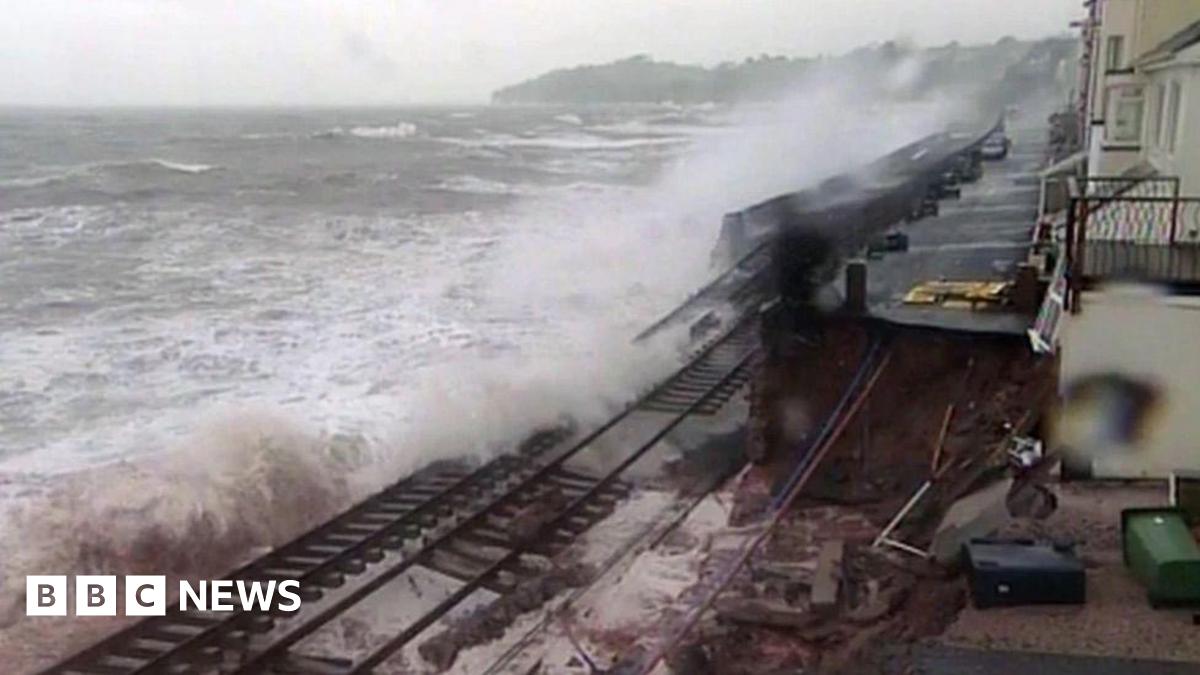
It certainly felt familiar to those who use the section of railway around the coastal town of Dawlish in Devon, where the only line connecting Plymouth and Cornwall with the rest of the UK was left hanging "like a Peruvian rope bridge" during ferocious storms in February 2014.
For some, that description by Plymouth City Council leader Tudor Evans and the images of the collapse 12 years ago came to embody Britain's crumbling Victorian railways.
Cornwall and most of Devon were cut off from the rest of the railway network for eight weeks, causing travel chaos.
Since then, £165m of public money has been spent to try to prevent it happening again. So why, in January 2026, was the same line closed once more, bringing train cancellations for thousands of people during Storm Ingrid?
It raises a question: is something more fundamental going wrong that could plague people across the UK travelling here for work, to see family or for holidays, for years to come?

Anger down the line​

Roads to this region are increasingly choked, and flights are few and far between. So many choose to travel by rail - and this section of line in Dawlish, just along from the Jurassic Coast, holds the key to trains arriving on time, or at all.
The frustration about that not always being the case is clear among commuters at Plymouth rail station.
"A lot of people like myself rely on these trains, and to be honest we feel let down," says Jess, from Totnes.
Commuter Sienna Brewer says "it's affecting everyone with work and university as well as college - people are having longer days out the house because of delays".
"It sometimes gives you the feeling of being cut off from the rest of the country," she adds.
This beautiful but fragile line - which opened in 1846 and runs alongside the sea - remains at the centre of a furious debate about whether it can really withstand the elements, external.
It is a saga that stretches back more than a decade.

The storms that tore through Dawlish in 2014 prompted a five-phase project to build a new sea wall in the town, and a large rock shelter just down the line. Four phases were completed under several Conservative governments until 2024, costing taxpayers £165m.

Much like trains south of Exeter in the recent storm, the project appears to have hit the buffers.

The fifth and final phase was "paused" last summer by the Labour government, with rail minister Lord Peter Hendy warning it "was expected to cost substantially more than the other four phases combined".

As a result, the threat of travel chaos still looms large in one important way.

The disastrous two-month closure in 2014 was caused not by a breach of the sea wall in Dawlish, but by a serious landslip down the line near the neighbouring coastal town of Teignmouth.

It is this stretch of cliffs that phase five would have addressed.

"All ideas have been rejected by Department for Transport (DfT) as too expensive," says local Liberal Democrat MP Martin Wrigley.

Among the ideas floated were moving the railway out to sea or re-profiling the cliffs, he explains.

"We remain with some simple pins and netting trying to prevent a repeat of the mudslide that closed the line for eight weeks… it is rainwater, not waves, that is the risk.

"Until we have a full fix for the phase five cliffs, we run the risk of another sudden catastrophic slip as we had in 2014," he adds.

When forecasters predicted Storm Ingrid would bring 60mph (96km/h) winds last month, the Paddington to Penzance line was closed at Dawlish on the night of 23 January as a precaution, and remained shut for two days.
That was down to a section of old sea wall - not part of the recent improvement works - collapsing in the storm.
The line was closed again overnight three days later, thanks to a large hole at the base of the cliffs between Dawlish and Teignmouth - in the middle of the section of cliffs waiting to be dealt with in the paused phase five works.
It was not quite an eight-week closure this time, but it has set alarm bells ringing.
With an estimated 14 million day trips and four million overnight stays annually in Cornwall, this sort of unpredictable closure would have a huge impact if it coincided with winter school holidays or any wet weather in the summer months.
Back at Plymouth station, Frances Parker says she has not been impacted so far "but it's always a worry about what happens if the line goes down".
"They need to sort it really because everyone is going to worry every time there is a storm."
Jayne Kirkham, Labour MP for Truro and Falmouth, saw first-hand on an early morning train back from Westminster last month how "our train was stopped at Dawlish as waves crashed over the track".
"One of the two lines had been closed by the sea - we had to wait in a queue of trains all relying on the remaining track and eventually crawled forward, after a delay," she adds.

The 2014 closure cost the South West economy an estimated £1.2bn, Wrigley says, and the latest problems will have put another dent in business confidence.
Local lobbying groups have long hoped for more trains which take less than three hours to run between Plymouth and London. According to Great Western Railway (GWR), the average time is currently three hours and 15 minutes. By comparison, trains between Paris and Marseille in France cover double that distance in the same time.

Disruption set to continue?​

And that brings us to another issue - the lack of a plan B if the line crumbles again.
A study carried out by Network Rail into alternative routes, commissioned by David Cameron when he was prime minister, found it came down to a choice between reopening the long-abandoned line linking Plymouth with Exeter via the Dartmoor national park, or several variants on an inland route in South Devon.

All were judged poor value for money so none were ultimately taken forward – though many are still pushing for the Dartmoor route.

Inland rural routes can come with their own issues, as shown by a key branch line connecting Exeter with Barnstaple in north Devon shutting for three weeks, external - and remaining shut now - due to damage from Storm Chandra in January.

For now, at Dawlish, we are stuck with this vulnerable line along the coast.

For its part, Network Rail says the new sea wall in the town faced its "biggest test" yet during Storm Ingrid and "performed as designed by deflecting waves back to into the sea", which meant the line was reopened quickly.

DfT tells us it "will continue to work in partnership with Network Rail to ensure the line remains resilient and is fit for purpose for the communities it serves".

But some think the remaining uncertainty of further closures on this arterial rail line shows the South West is being sidelined.

"I'm not blaming this government, it's been successive governments and they've all failed to invest down here in the South West - but if they want to see growth, then we need to have that infrastructure in place," says Julian Brazil, leader of Devon County Council.

"We're not talking about, 'Oh, can you shave a couple of minutes off the journey time', we just want a line that's reliable and resilient."

 

YorkshireBear

Established Member
Joined
23 Jul 2010
Messages
9,661
This article is on the BBC today and is currently the most read article on the site, outlining the recent Dawlish disruption, the canning of the cliff reinforcement project between Parsons Tunnel and Teignmouth, and alternative routes (it focuses on the Dartmoor line but also recognises this route has had its own problems in the same disruptive weather):

Think it's hyperbole to compare the recent disruption to 2014....

Having spent £165M and it was shut again? Yes for a few days after a major storm. Poorly written article for me that.
 

swt_passenger

Veteran Member
Joined
7 Apr 2010
Messages
34,227
Think it's hyperbole to compare the recent disruption to 2014....

Having spent £165M and it was shut again? Yes for a few days after a major storm. Poorly written article for me that.
I think it, (the just linked BBC piece), is also fundamentally wrong at one point where I think it quotes someone saying the only reason for the 8 week closure was a rock fall towards Teignmouth, whereas it’s fairly common knowledge the sea wall collapsed to the east of Dawlish alongside Sea Lawn Terrace:
The disastrous two-month closure in 2014 was caused not by a breach of the sea wall in Dawlish, but by a serious landslip down the line near the neighbouring coastal town of Teignmouth
IIRC there were major objections to NR’s plans for phase 5 at the Teignmouth end, people didn’t like the beach access or something. Did that delay the decision, which ultimately led to cancellation?
 

Sir Felix Pole

Established Member
Joined
21 Oct 2012
Messages
2,152
Location
Wilmslow
I think it, (the just linked BBC piece), is also fundamentally wrong at one point where I think it quotes someone saying the only reason for the 8 week closure was a rock fall towards Teignmouth, whereas it’s fairly common knowledge the sea wall collapsed to the east of Dawlish alongside Sea Lawn Terrace:

IIRC there were major objections to NR’s plans for phase 5 at the Teignmouth end, people didn’t like the beach access or something. Did that delay the decision, which ultimately led to cancellation?
The plan was to move the line, counter- intuitively perhaps, further out to sea away from the cliff face. This would have meant the loss of Holcombe Beach which drew a storm of objections. It was never fully worked up, however, nor funded - NR then changed tack and decided that securing the cliff was a better plan anyway. This isn't funded either.

During Storm Chandra a hole appeared in the original, unrebuilt, sea wall between Dawlish and Teignmouth so this is still a very vulnerable section and potential future problem area.
 

PeteJB

Member
Joined
25 Jul 2024
Messages
11
Location
Holcombe
A major point missed by the BBC article is that Network Rail are pressing on with cliff survey work for phase 5 anyway. I had a letter from them a couple of weeks ago saying they're putting traffic lights in place on my road this week to shift in a load of equipment. So while it may not be officially funded, it's incorrect to suggest the whole project has simply been abandoned.

Also the hole that appeared was at Sprey Point (where the TEIGNMOUTH sign is), not the sea wall per se. It had no direct impact on the track, however Network Rail had to shut the line to bring in 200 or so tonnes of materials to refill it.
 

grahamshevlin

Member
Joined
14 Jan 2025
Messages
12
Location
Ramsgate
We are in the age of cobbleware tactics, due to the economic impoverishment of the UK following Brexit. The only way that significant sums of money will be found is if a major disaster strikes the coastal line again. The cynic in me believes that even if a major storm was to cause (say) 750m worth of damage, the government would still fund coastal route repairs. The rail infrastructure orgs really do not want to have to deal with the West Oakment bridge issue.
 

SynthD

Established Member
Joined
4 Apr 2020
Messages
2,014
Location
UK
BAM is working with Network Rail in South Devon to ensure that an iconic coastal stretch of railway is safer for trains and passengers. In 2023 BAM completed the construction of a new sea wall at Dawlish, and BAM is now working to protect a nearby section of track from falling cliff debris, as part of a £165 million rail resilience programme.
The cynic in you is finding it impossible to believe that the current way will be the strongest and cheapest way in the future. As the landslip north of Newton Abbott shows, you aren't safe from water by moving inland.
 

grahamshevlin

Member
Joined
14 Jan 2025
Messages
12
Location
Ramsgate
Does the Meldon viaduct need replacing as per NR assessment or can it be repaired to original standards via those who still construct in the same methods?
From what I have read, the viaduct was strengthened at least twice after 1940; once in the War to allow the new Bulleid Pacifics to use it, and again in the 1950s. The line over the viaduct was singled in 1966 until closure in 1968.
Could that singling have been "political" in nature? Sadly, given the obvious shenanigans that BR and the Government deployed in the 1960s to expedite Beeching Report closures, I cannot rule that out.
Since Meldon Viaduct is now a Listed structure, re-using it for a rail line would be legally complicated, and making it strong enough for modern trains may not be technically possible.
 

yorksrob

Veteran Member
Joined
6 Aug 2009
Messages
44,245
Location
Yorks
The solution is to build a nice slimline structure alongside Meldon viaduct, of the sort they have in Switzerland. Increasing convectional storms due to climate change means that flooding can be a risk anywhere, so having two routes to Plymouth is probably the most resilient option.
 

Harlequinuk

On Moderation
Joined
15 May 2025
Messages
329
Location
UK
As Richard Bowker said on Green Signals a while back - unless the main line is shut every year for weeks from flooding, then the money likely wouldnt be found. Personally, the local councils should all come in as stake holders, and front part of the money
 

35B

Established Member
Joined
19 Dec 2011
Messages
5,362
The solution is to build a nice slimline structure alongside Meldon viaduct, of the sort they have in Switzerland. Increasing convectional storms due to climate change means that flooding can be a risk anywhere, so having two routes to Plymouth is probably the most resilient option.
If flooding is the concern, then Cowley Bridge is more of a concern than Dawlish. And there’s a decent sized conurbation that the SR never served which also provides much of the demand through Dawlish.
 

yorksrob

Veteran Member
Joined
6 Aug 2009
Messages
44,245
Location
Yorks
If flooding is the concern, then Cowley Bridge is more of a concern than Dawlish. And there’s a decent sized conurbation that the SR never served which also provides much of the demand through Dawlish.

I'm not saying its perfect, however Okehampton provides the maximum duplication of the Dawlish route, therefore the maximum opportunity to by-pass problems (as well as serving intermediate settlements in its own right).
 

zwk500

Veteran Member
Joined
20 Jan 2020
Messages
18,401
Location
Northampton
I'm not saying its perfect, however Okehampton provides the maximum duplication of the Dawlish route, therefore the maximum opportunity to by-pass problems (as well as serving intermediate settlements in its own right).
Are you suggesting the Dawlish route be retained, in which case bypassing more of the line is a detriment?
Or are you suggesting abandoning the section along the sea wall outright, leaving Newton Abbot and Paignton passengers to change or reverse multiple times on their extremely indirect journeys.
 

yorksrob

Veteran Member
Joined
6 Aug 2009
Messages
44,245
Location
Yorks
Are you suggesting the Dawlish route be retained, in which case bypassing more of the line is a detriment?
Or are you suggesting abandoning the section along the sea wall outright, leaving Newton Abbot and Paignton passengers to change or reverse multiple times on their extremely indirect journeys.

Of course I'm suggesting the Dawlish route be retained. How on earth is by-passing more of the route is a detriment. Are you saying that it's a detriment that the WOE line runs all the way from Waterloo to Exeter, rather than just Yeovil ?
 

Harpo

Established Member
Joined
21 Aug 2024
Messages
3,734
Location
Newport
As I understand it, the railway’s seawall infrastructure at Dawlish is also the town’s flood defences. Outright ‘abandonment’ may not be an option.
 
Status
Not open for further replies.

Top