Smashing 78 runs in the ‘power play’ was deadly, putting the match completely out of Pakistan’s reach!Salt and Buttler's opening stand certainly was just what was needed.

-
Our new ticketing site is now live! Using either this or the original site (both powered by TrainSplit) helps support the running of the forum with every ticket purchase! Find out more and ask any questions/give us feedback in this thread!
You are using an out of date browser. It may not display this or other websites correctly.
You should upgrade or use an alternative browser.
You should upgrade or use an alternative browser.
Cricket
- Thread starter bnm
- Start date
Sponsor Post - registered members do not see these adverts; click here to register, or click here to log in
R
RailUK Forums
In the early hours of Sunday morning the T20 World Cup begins in the USA & Caribbean at 1:30am between USA & Canada from Texas. It will be interesting to see how the tournament goes & what the crowds are like particularly in the matches in USA.
I was there!Third Womens ODI, played at Chelmsford
England 302-5 (50 overs)
Scriver-Blunt 124 not out with 2 x 6 and 12 x 4
Pakistan 124 all out (29.1 overs)
Ecclestone 4.1 - 1 - 15 - 3
Seems like a good team effort with notable English batting and bowling in this match
It was a really good performance from England despite a couple of wickets being given away with poor shot decision. Nat Sciver-Brunt (not Scriver-Blunt!!) was outstanding, only offered one chance in her innings, with very useful contributions from others including Amy Jones and Alice Capsey. The bowling & fielding was superb. The Pakistanis gave it everything, lots of effort, but were outclassed by a better side. A really enjoyable day out.
Must also say how friendly the staff & stewards were - a much better experience than I had at Old Trafford for a Test Match a couple of years ago.

Xenophon PCDGS
Veteran Member
ICC Mens T20 World Cup
Sri Lanka 77 all out (19.2 overs)
Nortje 4 - 0 - 7 - 4
South Africa 80-4 (16.2 overs)
Sri Lanka were 31-1 at one time!
Sri Lanka 77 all out (19.2 overs)
Nortje 4 - 0 - 7 - 4
South Africa 80-4 (16.2 overs)
Sri Lanka were 31-1 at one time!

Busaholic
Veteran Member
- Joined
- 7 Jun 2014
- Messages
- 14,671
What a shambles! Which other world sport played in the open and reliant on dry weather allows a world tournament to take place with next-to-no back up time available? When the Gillette Cup was created in England in the early 1960s as the first one day cricket experience, with every match a knock-out like football's FA Cup, there were two spare days to help ensure a result without reducing overs or other shenanigans. As this game stood, if it had gone to 20 overs Scotland might have felt they had a winning score, whereas if England had been allowed to win by getting the 109 with no penalty for wickets lost in the cause, that would have been a tragedy. So I'm glad, for the sake of both fairness and the underdog, that it ended with 1 point each.England’s match against Scotland was abandoned due to rain in Barbados. In a match reduced to 10 overs per side Scotland set England a score of 90 which after DLS was applied was revised to 109.
SuspectUsual
Established Member
- Joined
- 11 Jul 2018
- Messages
- 6,861
Which other world sport played in the open and reliant on dry weather allows a world tournament to take place with next-to-no back up time available?
The various cricket authorities are hell bent on squeezing more and more games into the calendar - regardless of whether its the right thing to do, there is no way on earth they'd insert reserve days as it would extend the overall length of the tournament
As this game stood, if it had gone to 20 overs Scotland might have felt they had a winning score, whereas if England had been allowed to win by getting the 109 with no penalty for wickets lost in the cause
England's target was increased from 91 to 109 - ie just under 20% - precisely to reflect the fact that they could bat in a more adventurous way and risk losing wickets; DLS is designed to impose a "penalty for wickets lost in the cause". (In this case a smaller part of the increase is also to reflect that Scotland only batted 3.4 overs knowing the game was reduced to 10 overs)
Busaholic
Veteran Member
- Joined
- 7 Jun 2014
- Messages
- 14,671
I'm aware of the 'logic' behind the increased runs required, but it's utterly flawed if the side batting second can afford to lose a wicket in every over bar the last. The chances of England winning would have been reflected in the bookmaker's odds after that truncated innings. Why do so many sides that win the toss in T20 choose to insert the other team now, the more so if there's a chance of weather interruptions? We've gone a long way since Pakistan(?) were given 20 odd runs to make in one over in a World Cup final!The various cricket authorities are hell bent on squeezing more and more games into the calendar - regardless of whether its the right thing to do, there is no way on earth they'd insert reserve days as it would extend the overall length of the tournament
England's target was increased from 91 to 109 - ie just under 20% - precisely to reflect the fact that they could bat in a more adventurous way and risk losing wickets; DLS is designed to impose a "penalty for wickets lost in the cause". (In this case a smaller part of the increase is also to reflect that Scotland only batted 3.4 overs knowing the game was reduced to 10 overs)

43096
On Moderation
- Joined
- 23 Nov 2015
- Messages
- 18,900
Tennis. Which is why Novak Djokovic was playing to gone 3am in Paris this last week.What a shambles! Which other world sport played in the open and reliant on dry weather allows a world tournament to take place with next-to-no back up time available?
SuspectUsual
Established Member
- Joined
- 11 Jul 2018
- Messages
- 6,861
I'm aware of the 'logic' behind the increased runs required, but it's utterly flawed if the side batting second can afford to lose a wicket in every over bar the last. The chances of England winning would have been reflected in the bookmaker's odds after that truncated innings. Why do so many sides that win the toss in T20 choose to insert the other team now, the more so if there's a chance of weather interruptions? We've gone a long way since Pakistan(?) were given 20 odd runs to make in one over in a World Cup final!
Remember that a chasing team losing 6 wickets in a 10 over chase also effectively loses 10% of their opportunities to score (unless anyone is run out going for a second or third run), so England would have needed 109 off 9, not 109 off 10
Busaholic
Veteran Member
- Joined
- 7 Jun 2014
- Messages
- 14,671
Which all goes to show that the games need to run their full course.Remember that a chasing team losing 6 wickets in a 10 over chase also effectively loses 10% of their opportunities to score (unless anyone is run out going for a second or third run), so England would have needed 109 off 9, not 109 off 10
SuspectUsual
Established Member
- Joined
- 11 Jul 2018
- Messages
- 6,861
Which all goes to show that the games need to run their full course.
Ideally yes, but it just can't be guaranteed unless you play every game indoors

Donny Dave
Established Member
Just a minor upset in the T20 world Cup....
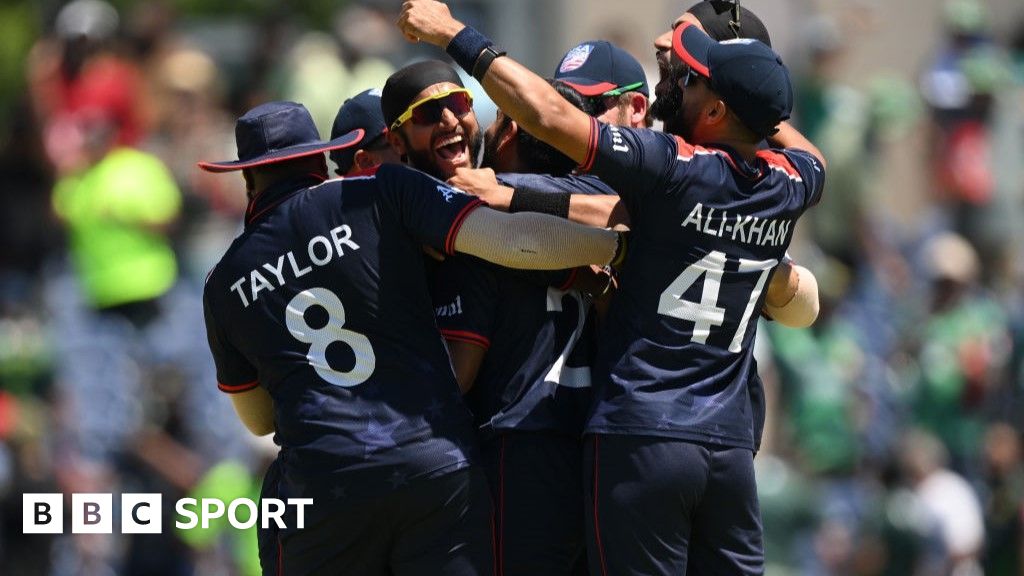
The United States pulled off one of the biggest shocks in cricket history by beating Pakistan in a super over in Dallas.
Pakistan looked to be avoiding embarrassment at the T20 World Cup before Nitish Kumar hit the final ball of the US innings for four to tie the scores at 159.
T20 World Cup results: USA stun Pakistan in World Cup super over
The United States pull off one of the biggest shocks in cricket history by beating Pakistan in a super over in Dallas.
www.bbc.co.uk
Busaholic
Veteran Member
- Joined
- 7 Jun 2014
- Messages
- 14,671
Scotland now have the win they were denied on Tuesday, beating Namibia.
Xenophon PCDGS
Veteran Member
Cricket World Cup...Group 3
Afghanistan 159-6 (20 overs)
Rahmanullah Gurbaz 80 from 56 balls with 5 x 6 and 5 x 4
New Zealand 75 all out (15.2 overs)
Fazalhaq Farooqi.....................3.2 - 0 - 17 - 4
Rshid Khan...............................4 - 0 - 17 - 4
A somewhat unexpected result with one notable batting display and two excellent bowling displays, all by members of the Afghanistan team.
Afghanistan 159-6 (20 overs)
Rahmanullah Gurbaz 80 from 56 balls with 5 x 6 and 5 x 4
New Zealand 75 all out (15.2 overs)
Fazalhaq Farooqi.....................3.2 - 0 - 17 - 4
Rshid Khan...............................4 - 0 - 17 - 4
A somewhat unexpected result with one notable batting display and two excellent bowling displays, all by members of the Afghanistan team.

Howardh
Established Member
- Joined
- 17 May 2011
- Messages
- 9,803
Unless SA collapse batting, this is looking a bit of a hammering for the Netherlands; 35/4 after 10.
== Doublepost prevention - post automatically merged: ==
== Doublepost prevention - post automatically merged: ==
Oh..my...days; NL scraped past 100 which was about 30-40 more than it seemed; but SA are 12/4 chasing!! C'mon Oranje!!Unless SA collapse batting, this is looking a bit of a hammering for the Netherlands; 35/4 after 10.
Last edited:
SuspectUsual
Established Member
- Joined
- 11 Jul 2018
- Messages
- 6,861
England have started terribly, but Warner out off the last ball of the 5th over so maybe there's a chance of a change in momentum. Australia going along at 14 an over
Xenophon PCDGS
Veteran Member
Jacks was one of the opening bowlers, but after his first over went for 22 runs, he was taken off.England have started terribly, but Warner out off the last ball of the 5th over so maybe there's a chance of a change in momentum. Australia going along at 14 an over
Howardh
Established Member
- Joined
- 17 May 2011
- Messages
- 9,803
Can't work out why Bairstow comes in higher than Livingstone?
Xenophon PCDGS
Veteran Member
22 of those runs came off just the one over by Jacks. Why was he chosen to open the bowling?Australia 201-7 have beaten England (165-6) by 36 runs.
++++++++++++++++++++++++++++++++++++++++++++++++++++++++++++++++++++++++++++
Cricket World Cup ... Group 3
West Indies 173-5 (20 overs)
Uganda 39 all out (12 overs)
Hosein 4 - 0 - 11 - 5
Yet another eye-catching result from Group 3
Last edited:
A spur of the moment decision by Butler to put Jacks on, after Ali’s first over of spin conceded only 3 runs. Archer was expecting to bowl and was walking across to do so!22 of those runs came off just the one over by Jacks. Why was he chosen to open the bowling?
England are in a dicey position now. If Scotland win tonight, and they are favourites to do so, then England will need big wins from their last two group games and hope Australia have a big win against Scotland. Otherwise they could be eliminated on net run rate.
Falcon1200
Established Member
How does net run rate work when, for example as in the England/Scotland match, only one team gets to bat? Scotland were able to boost theirs but England never had the chance.
SuspectUsual
Established Member
- Joined
- 11 Jul 2018
- Messages
- 6,861
How does net run rate work when, for example as in the England/Scotland match, only one team gets to bat? Scotland were able to boost theirs but England never had the chance.
I’m 99.9% sure the game is excluded from the NRR calculations but I don’t have time now to search for the relevant regulation
Falcon1200
Established Member
I’m 99.9% sure the game is excluded from the NRR calculations
Thanks, that would be fair.
How does net run rate work when, for example as in the England/Scotland match, only one team gets to bat? Scotland were able to boost theirs but England never had the chance.
If a match is abandoned as a No Result, none of the runs scored or overs bowled count towards this calculation
Falcon1200
Established Member

Rover
Member
I think England WILL be on the plane home, they have been very poor so far.

DarloRich
Veteran Member
Poor show from England in the slogging world cup - could be going out i the group stage at this rate!
Warner played like an Aussie playing England for the last time. Determined to hurt the poms for the final time.
Warner played like an Aussie playing England for the last time. Determined to hurt the poms for the final time.