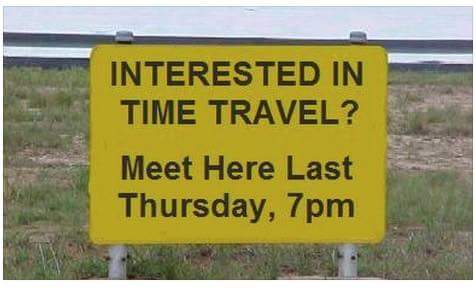
Apart from the "
Grandfather Paradox", I've always thought there are some other practical considerations to time travel. For example, we are all travelling east at about 600mph and orbiting the sun at about 66,000mph.
So if you could go forward ten minutes in time, would you end up out in space doing 66,000mph? If not, how do you absorb the kinetic energy?
It's a little more complicated than that. The 66k-mph is relative to the sun, but takes no account of how the sun moves.
In fact there is no such thing as an absolute velocity. The only thing you have is a velocity relative to something else. A train going past might look to me like it's moving at 50mph (relative to the Earth) but according to the laws of physics, to the people in the train it's the Earth moving (relative to them).
Most common ideas of time travel rely on the idea of someone arriving at 'the same place' but at a different time. In fact there's no such thing as 'the same place at a different time' (If this is confusing think that 'the same place 5 minutes ago relative to you on the ground' would certainly not be 'the same place 5 minutes ago relative to someone inside the train')
If time travel were possible (and it's a big if), then the form it would have to take would be picking some other point in spacetime to which you wish to transport yourself. And presumably if you wished to transport yourself back into the past, you'd have to identify as your destination a point in spacetime that is located on the surface of the Earth at wherever the Earth happened to be at that time.
And as you say, your calculations would have to be extremely precise to avoid arriving part buried in the floor. An even more serious consideration would be what happens to all the air molecules that were located at the same place just before you arrive! If they don't get removed somehow, the experience of having them suddenly inside your body would I imagine be fatal (possibly causing quite a big explosion!). For that reason, I suspect that if time travel became possible, you'd probably have to plan to arrive in space, and take a small spaceship with you to finish your journey with. (Even then it's a bit risky as space isn't completely empty).
Your point about kinetic energy is also interesting. I suspect the solution (assuming momentum is conserved in this hypothetical time travel) would be to plan your arrival to be at an instant in time when the Earth happens to be travelling at the same speed in the same direction as it is at the point where you leave. For trips into the recent past, that would imply arriving on about the same date of a different year. As you go further into the past, that becomes harder to achieve due to the sun's orbit around the centre of the galaxy/



 ) Or I could do the same with a bank vault or a prison!