norbitonflyer
Established Member
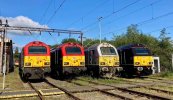
The Deltics lasted 20 years in total.True, but some locos (e.g. some of the Deltics) lasted even less time, although they probably racked up a good few more miles than some of the 67s.
25 years is actually fairly average. There are plenty of classes that were completely extinct within a much shorter timescale
Most of the menagerie of small shunters introduced in the mid-fifties were gone in half that time, many of them without getting TOPS classes, let alone numbers. Of those that did get TOPS classes only Classes 01, 05, 06 (one example of each), and 03 had any examples left in service 25 years after introduction.
Of the larger classes, only classes 08, 09, 20, 31, 37, 47, 56, 59 , 60, 66, 67, 73, 86 and 87 are older than 25 years
Of classes that are now fully withdrawn from regular use, only five classes had any members survive more than 27 years after introduction: classes 76 (30 years), 81 and 85 (both 31 years) and 26 and 33 (both 37 years)
Most first generation DMUs were gone within 30 years, many much less.
A major factor in all this was of course the late-50s Modernisation Plan followed only a few years later by the Beeching cuts, resulting in a large number of trains becoming redundant almost as soon as they had been built (as well as hastening the end of steam - the 9Fs were intended to have a 40-year working life.
When I started spotting in the early 70s, Class 20s and 31s were already seen as old-fashioned, despite being only about 15 years old. Indeed, the BR fleet had an appearance of permanency around that time no genuinley new classes of loco or unit, other than experimental prototypes, were introduced between the Class 50s and 4VEPs in 1967, and the Class 87s in 1973.
Last edited: