
It's easy to criticise in hindsight but don't forget that (a) as far as anyone involved knew the worst weather had already passed; and (b) the previous train had passed along the line between Carmont and Stonehaven and hadn't encountered anything out of order. Taking both of those things into consideration, why would they have any reason to assume anything other than a clear line?Even when there have already been four weather-caused line blockages and three trains stranded in the immediate vicinity?

-
Our new ticketing site is now live! Using either this or the original site (both powered by TrainSplit) helps support the running of the forum with every ticket purchase! Find out more and ask any questions/give us feedback in this thread!
You are using an out of date browser. It may not display this or other websites correctly.
You should upgrade or use an alternative browser.
You should upgrade or use an alternative browser.
Carmont (near Stonehaven) derailment - 12 August 2020
- Thread starter trainmananthon
- Start date
- Status
- Not open for further replies.
Sponsor Post - registered members do not see these adverts; click here to register, or click here to log in
R
RailUK Forums
Really, because the other three stranded trains were likewise the first that had each encountered their blockages, the ones prior to them having passed alright. I don't think it's a hindsight. Infrastructure issues following heavy rain happen afterwards during runoff over saturated ground, not only during the downpour (sorry if this comes over as civil engineering 1.01). The fact that the engineering crew from Story who were working on the bridge piers had abandoned work and were safeguarding their plant on adjacent higher ground shows that there were significant concerns along the line.It's easy to criticise in hindsight but don't forget that (a) as far as anyone involved knew the worst weather had already passed; and (b) the previous train had passed along the line between Carmont and Stonehaven and hadn't encountered anything out of order. Taking both of those things into consideration, why would they have any reason to assume anything other than a clear line?

O L Leigh
Established Member
I see also the various reports have a common thread that it's "all due to climate change", and it was "unprecedented rainfall". While it's undoubtedly true that the climate does change over time, positive and negative (we don't currently have the extreme cold winters of the 1940s, which certainly brought their own issues), there is a tendency to use this as a "not my fault then" excuse, or as a glib reason to increase budgets, rather than just one of the many things to be managed.
I don’t think that’s what’s being said. There have been conversations at various levels within the industry about how the railway is going to cope with extreme weather events and the effects of climate change, even before this tragedy. I really don’t think anyone is burying their heads in the sand or washing their hands of it.
Even when there have already been four weather-caused line blockages and three trains stranded in the immediate vicinity?
And that may be one thing that changes as a result of this investigation, but even if it did it would require quite some degree of prescience that I’m not sure is possible. Signallers are reliant on drivers and other staff to tell them what’s going on out of their sight.
I think we might draw a line under the thread again here. We could spend months going backwards and forwards over this and, to be quite honest, getting nowhere very quickly! The RAIB's further lines of enquiry seem clearly aimed at covering the same ground we're currently hashing out so I suggest we leave it to them for the time being.
If there are an substantive updates that anyone wishes to bring to our attention please feel free to report this post. Similarly once the final RAIB report is published please feel free to report this post to bring it to our attention.
Thanks,
ainsworth74
If there are an substantive updates that anyone wishes to bring to our attention please feel free to report this post. Similarly once the final RAIB report is published please feel free to report this post to bring it to our attention.
Thanks,
ainsworth74
Just a note to say it appears that the full report has been slightly delayed and is now expected in January 2022.
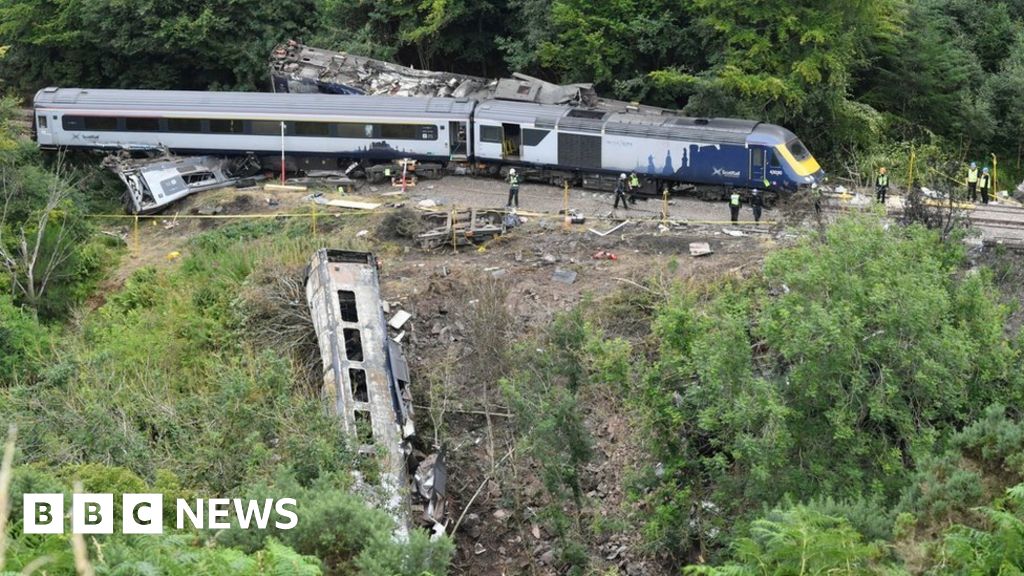
A final report into the fatal train derailment near Stonehaven will not be ready this year, BBC Scotland understands.
Three people died when a train left the tracks after hitting a landslip in August 2020.
An interim Rail Accident Investigation Branch report said a signaller was not aware of any obstruction on the line.
But the final report, which had been expected this autumn, will not be published until January.
Stonehaven derailment: Crash report delayed until 2022
The final report into the crash that killed three people had been expected this autumn.
www.bbc.co.uk
The full report has now been published. An extract is included below and the full report can be found here:
At around 09:37 hrs on Wednesday 12 August 2020, a passenger train derailed near Carmont, Aberdeenshire. The train, reporting number 1T08, was the 06:38 hrs service from Aberdeen to Glasgow, which was returning towards Aberdeen due to a blockage that had been reported on the line ahead. It was travelling at 73 mph (117 km/h), just under the normal speed for the line concerned. After derailing, the train deviated to the left, before striking a bridge parapet which caused the vehicles to scatter. Tragically, three people died as a result of the accident and the remaining six people on the train were injured.
On the morning of the accident there was near-continuous heavy rain at the site of the accident between about 06:00 hrs and 09:00 hrs. The 51.5 mm of rain which fell in this period at the accident site was close to the average rainfall for the month of August in this part of Scotland. Train 1T08 derailed because it struck debris that had been washed out of a drainage trench. This trench, which had been constructed between 2011 and 2012, contained a perforated pipe that had been installed as part of a project to address a known problem with drainage and the stability of a cutting in that area. However, the drainage system and associated earthworks had not been constructed in accordance with the original design and so were not able to safely accommodate the water flows that morning.
RAIB’s investigators found that a low earth bank (bund) had been constructed that ran across a slope leading towards the track. The presence of this bund significantly altered the flow of water such that extreme rainfall would cause a concentrated flow into the steeply sloping section of trench. The evidence indicates that the intensity and duration of this rainfall would have generated water flows into the trench that were sufficient to wash away the gravel fill and the ground immediately surrounding the trench.
No instruction was given by route control or the signaller that train 1T08 should be run at a lower speed on its journey between Carmont and Stonehaven. At that time there was no written process that required any such precaution in these circumstances. Consequently, normal railway rules were applied to the train movement. The RAIB’s investigation found that the ‘route controllers’ (who were responsible for the operational management of Scotland’s railway network) had not been given the information, procedures or training that they needed to effectively manage complex situations of the type encountered on the morning of 12 August 2020.
Recommendations
As a consequence of this accident, RAIB has made 20 recommendations for the improvement of railway safety. The areas covered include:
- better management of civil engineering construction activities by Network Rail and its contractors
- additional standards and guidance on the safe design of drainage systems
- improved operational response to extreme rainfall events, exploiting the full capability of modern technology, and based on a detailed understanding of the risk associated with extreme rainfall
- enhancing the capability of route control offices to effectively manage complex events
- extending Network Rail’s assurance regime to encompass route control offices
- addressing the obstacles to effective implementation of lessons learnt from the investigation of accidents and incidents
- measures to prevent derailed trains from deviating too far from the track (equipment fitted to track and/or trains)
- addressing train design issues identified by the investigation and better understanding the additional risk associated with the operation of older trains.


brad465
Veteran Member
How easy is it to summon individuals of a firm (Carillion) that went bust 4 years ago?I'm only on page 27 of 298 but my lord I hope some of the people involved in building that drain end up in front of a court.

There's a lot to take in on the report. A few key sections I've highlighted early on:
Carillon has obviously gone bust but there are parallels with other major incidents such as Ladbroke Grove (signal sighting exercises) and Hatfield with regards to responsibility bouncing round far too loosely, assumptions being made and communications and processes being rather lax with regards to contracting. The company being bust has been identified here:
Some of the control aspects are obviously telling too in terms of workload, procedures for normal running and the use of gold commands. The growing use of blanket speed restrictions and "do not travel" has been a major reaction to Stonehaven. That being said, most control centres will always been overloaded in severe service disruption and it remains a challenge to step up that additional knowledge resource in a relatively short time-frame and keep those people competent for the 99% of the time they are not required.
a) Although access to enhanced weather forecasting and monitoring technology had been procured, its capabilities were not being fully exploited by the geotechnical asset management and route control teams.
b) Although risk assessment of earthworks has progressed markedly in the last 20 years, it was, and will always be, an imperfect predictor of failure.
c) The railway has insufficient resource to entirely overcome the potential for infrastructure failure.
Carillon has obviously gone bust but there are parallels with other major incidents such as Ladbroke Grove (signal sighting exercises) and Hatfield with regards to responsibility bouncing round far too loosely, assumptions being made and communications and processes being rather lax with regards to contracting. The company being bust has been identified here:
However, the absence of an ongoing corporate structure means that staff who would normally assist evidence recovery were no longer available and this has possibly affected recovery of some evidence.
Some of the control aspects are obviously telling too in terms of workload, procedures for normal running and the use of gold commands. The growing use of blanket speed restrictions and "do not travel" has been a major reaction to Stonehaven. That being said, most control centres will always been overloaded in severe service disruption and it remains a challenge to step up that additional knowledge resource in a relatively short time-frame and keep those people competent for the 99% of the time they are not required.
Last edited:
How easy is it to summon individuals of a firm (Carillion) that went bust 4 years ago?
I'm sure the people themselves didn't also cease to exist. But that would be up to the BTP and Police Scotland to work out if anything does ever happen.

DanNCL
Established Member
I’ve only had a quick look, but from what I’ve seen so far this is even more damming than I expected it to be.
I suspect that, like Clapham did with Mark 1 bodied stock, this report will lead to the demise of Mark 3 bodied stock (and others of similar design, ie class 156) from regular use. I also see there’s a recommendation to consider fitting cabs with seatbelts and airbags, I suspect that recommendation will be implemented.
I suspect that, like Clapham did with Mark 1 bodied stock, this report will lead to the demise of Mark 3 bodied stock (and others of similar design, ie class 156) from regular use. I also see there’s a recommendation to consider fitting cabs with seatbelts and airbags, I suspect that recommendation will be implemented.
I’ve only had a quick look, but from what I’ve seen so far this is even more damming than I expected it to be.
I suspect that, like Clapham did with Mark 1 bodied stock, this report will lead to the demise of Mark 3 bodied stock (and others of similar design, ie class 156) from regular use. I also see there’s a recommendation to consider fitting cabs with seatbelts and airbags, I suspect that recommendation will be implemented.
Seatbelts I can understand, but I am not sure how airbags would be implemented given there's not a steering wheel present and a great amount of equipment is situated directly in front of the driver's seat?
Seatbelts I can understand, but I am not sure how airbags would be implemented given there's not a steering wheel present and a great amount of equipment is situated directly in front of the driver's seat?
In the more visceral section of the report about the mechanism of injuries and fatalities it does describe the driver as having been killed by secondary impact with the windscreen or cab interior. Possibly curtain airbags could be a solution but there is still a lot of empty space for a person to fly around in.
As to seatbelts IMO as a driver I'd rather not, I like that ability to bail out of the seat in case something is coming. Doing that has saved more than a few lives over the years.
There's a couple more key quotes about Carillon deviating from the spec, and with no clear reason as to why. The first is quote from their site engineer (note the point about cost) regarding the specific pipe and material used, the second in the report about unknown earthworks:
There is also considerable statement about the lack of suitable records which might have uncovered the wider problem with the drainage:
"Can you please ask your drainage engineer to explain why this is required? I cannot see what water will be collected by this drain and it will make it much more difficult (and expensive) to install, and it seems to be acting as a carrier pipe for the upper slope drainage anyway?"
No evidence of the decision-making that led to the construction of the bund has been found. Furthermore, there is no evidence that changes such as construction of the bund, moving CP18 from its as-designed position, and/or omission of the connections to CP18 were dealt with as part of a formal design change process.
There is also considerable statement about the lack of suitable records which might have uncovered the wider problem with the drainage:
283 When construction was completed, the remainder of the Carmont drainage system should have been, but was not, entered onto Network Rail’s Ellipse system, to trigger routine inspection and maintenance activities. This did not happen due to a failure to fully implement Network Rail procedures for introducing new assets onto infrastructure as required by standards
287 Neither RAIB or Network Rail could find any trace of the health and safety file for the Carmont drainage works.
292 Neither RAIB nor Network Rail has found any trace of the H&S file or as-built records for the Carmont drainage works. Furthermore, Network Rail has been unable to provide evidence that a H&S file was ever received from Carillion and there is no trace of a H&S file in available Carillion records.

Mcr Warrior
Veteran Member
- Joined
- 8 Jan 2009
- Messages
- 17,263
What I don't quite follow is, given that the train in question was returning to Aberdeen because of the line to the South being blocked, why it was still considered appropriate / prudent to allow it to return Northwards at almost full line speed.
What I don't quite follow is, given that the train in question was returning to Aberdeen because of the line to the South being blocked, why it was still considered appropriate / prudent to allow it to return Northwards at almost full line speed.
Because at the time, there was no requirement to run at a reduced speed due to the weather conditions as poor as they were (which had actually got bright and sunny by the train 1T08 finally departed northbound) and there were no reports of any obstructions in the section to Stonehaven - even if the last report was almost 2 hours prior by that point. The train was not required to run at caution.
The fact there were 4 reports of landslips and flooding in the general area should have perhaps alerted people to the potential of an issue, but this is with sadly the benefit of hindsight
Last edited:
MadCommuter
Member
- Joined
- 4 Oct 2010
- Messages
- 735
Has anyone found details on what the design should have been for the surface run off at the gully? I know the bund shouldn't have been constructed and it concentrated the flow at a particular point, but was there any consideration to dealing with the surface water run off in the original design? My point is that the contractor has made a change without informing the designer, but they had spotted the issue and tried to deal with it, but should have raised it with the designer.
(I'm not tricking to stick up for anyone here, so apologies if it comes across that way)
(I'm not tricking to stick up for anyone here, so apologies if it comes across that way)
No doubt the Engineers from Carillion would be registered with the likes of ICE. They could even still be working in the industry with another company now. So should not be too difficult to track them down.I'm sure the people themselves didn't also cease to exist. But that would be up to the BTP and Police Scotland to work out if anything does ever happen.
Rockhopperr
Member
The entire GRP cab detached from the bulkhead and was destroyed so any safety equipment fitted to it would be carried away with it. The report doesn’t seem to highlight what a major issue this is. This design flaw is a known weak point of the GRP ‘nose cone’.In the more visceral section of the report about the mechanism of injuries and fatalities it does describe the driver as having been killed by secondary impact with the windscreen or cab interior. Possibly curtain airbags could be a solution but there is still a lot of empty space for a person to fly around in.
As to seatbelts IMO as a driver I'd rather not, I like that ability to bail out of the seat in case something is coming. Doing that has saved more than a few lives over the years.
It touches on the fact more modern stock is constructed with a framework around the cab but suggests even this wouldn’t have provided survivable conditions. It’s got to be better than the entire area surrounding the driver going awol though.
O L Leigh
Established Member
Jesus, the poor driver.
I’ve only skimmed parts of the report, in particular regarding the performance of the rolling stock, and it’s the stuff of nightmares. Having recently hit a very large object on the track at around the same speed (although in very different circumstances) I can attest to sturdiness of more modern designs. The cabs of trains these days are built like tanks with the GRP outer skin really just being there for aerodynamics and aesthetics. I had no idea just how little protection the cab of an HST appears to offer the driver before reading this report and can only imagine the terror the driver must have experienced in his last moments.
I feel at least partially vindicated in that some things I’d previously hinted at with regard to the HST design and its performance in crashes is echoed in this report, although I take no pleasure in this. The Ufton Nervet report made recommendations with regard to the crashworthiness of the rolling stock to take forward should the industry decide that the HST continues in service, some of which would not have made much difference here (e.g. obstacle deflectors), and some of which might (e.g. bogie retention). I also cannot help but wonder whether more robust lifeguards to current standards might even have been enough to have prevented the derailment in the first place.
Certainly there’s a lot to read and digest, but for me those were the stand-out points. But I cannot shake the feeling that, in the light of lessons learned following Ufton Nervet, the reduced HST fleet should have received upgrades during the rebuild process aimed at improving crashworthiness such as better couplers and anti-climbers between vehicles.
I’ve only skimmed parts of the report, in particular regarding the performance of the rolling stock, and it’s the stuff of nightmares. Having recently hit a very large object on the track at around the same speed (although in very different circumstances) I can attest to sturdiness of more modern designs. The cabs of trains these days are built like tanks with the GRP outer skin really just being there for aerodynamics and aesthetics. I had no idea just how little protection the cab of an HST appears to offer the driver before reading this report and can only imagine the terror the driver must have experienced in his last moments.
I feel at least partially vindicated in that some things I’d previously hinted at with regard to the HST design and its performance in crashes is echoed in this report, although I take no pleasure in this. The Ufton Nervet report made recommendations with regard to the crashworthiness of the rolling stock to take forward should the industry decide that the HST continues in service, some of which would not have made much difference here (e.g. obstacle deflectors), and some of which might (e.g. bogie retention). I also cannot help but wonder whether more robust lifeguards to current standards might even have been enough to have prevented the derailment in the first place.
Certainly there’s a lot to read and digest, but for me those were the stand-out points. But I cannot shake the feeling that, in the light of lessons learned following Ufton Nervet, the reduced HST fleet should have received upgrades during the rebuild process aimed at improving crashworthiness such as better couplers and anti-climbers between vehicles.
The whole of the earthworks and drainage changes should have been subject to the requirements of The Common Safety Method as required by ROGS. Whilst there is mention of the missing H&S File, I wonder if there is any documentation relative to CSM or that is also missing?

Deltic1961
Member
- Joined
- 30 May 2018
- Messages
- 645
Will this lead to Scotrail withdrawing the HST fleet from use?
I did think at the time the weight of the train may have been a contributing factor due to the age of the HST sets.
I did think at the time the weight of the train may have been a contributing factor due to the age of the HST sets.
No doubt Network Rail will have the documents or the works would not have been signed off and the Contractor paid for the work.The whole of the earthworks and drainage changes should have been subject to the requirements of The Common Safety Method as required by ROGS. Whilst there is mention of the missing H&S File, I wonder if there is any documentation relative to CSM or that is also missing?

cf111
Established Member
- Joined
- 13 Nov 2012
- Messages
- 1,393
This is my initial "big" takeaway from the report too. It's an absolute tragedy that three people died and the only saving grace is that the train was quiet. A modern train would have come out of that in a much better condition.Certainly there’s a lot to read and digest, but for me those were the stand-out points. But I cannot shake the feeling that, in the light of lessons learned following Ufton Nervet, the reduced HST fleet should have received upgrades during the rebuild process aimed at improving crashworthiness such as better couplers and anti-climbers between vehicles.
O L Leigh
Established Member
A modern train would have come out of that in a much better condition.
While this can never be known for certain, the RAIB, referencing Grayrigg, certainly theorise that a more modern train would have performed differently.
Ex-controller
Member
I think a plan for the withdrawal of HSTs is a prudent course of action here, and until that can happen introducing special instructions for those trains formed by them in bad weather (although to be fair, Scotland route is now rightly exceptionally cautious when it comes to applying weather related speed restrictions).
I can vouch for extreme pressures on control staff. 100% that would have been the case. I doubt they could have done much here.
The incident I see parallels with is Grayrigg.
I can vouch for extreme pressures on control staff. 100% that would have been the case. I doubt they could have done much here.
The incident I see parallels with is Grayrigg.
John Bishop
Member
I think this report has substantial implications for the HST fleets. The Unions will be all over this which makes action inevitable. Have a look at the video on YouTube from the RAIB to see the animated version of what happened to the Driver‘s cab. It’s very sobering to watch!Will this lead to Scotrail withdrawing the HST fleet from use?
I did think at the time the weight of the train may have been a contributing factor due to the age of the HST sets.
YorkshireBear
Established Member
- Joined
- 23 Jul 2010
- Messages
- 9,667
What a shock.I see that the RMT are already calling for the withdrawal of HST’s.
They should instead by challenging the proposed cuts to network rail maintenance and contractors having more power to self assure as they have proven to be much more pertinent to this incident. And the fact that control didn't have the experience or training to manage the incident as well as it could have been which may have led to the HST going back at a reduced speed.
This was an incredibly violent crash, with a very unlucky set of circumstances, a 170 may have faired slightly better but it is likely it too would have ended up down the embankment so let's not pretend this is the HSTs fault. There should be a plan for phased withdrawal yes, because they are approaching half a century old and are fuel hungry and slightly less crashworthy. Not because in this one incident they were torn to shreds.
Reducing risk is about making it as low as reasonably practical. Therefore, I would say other parts of this incident are much MUCH more important to improve as they don't just apply to limited trains they apply to the entire network. Removing HSTs as a knee jerk is just being seen to do 'something' simple that actually will make it worse for passengers.
Much as I love them it's hard to argue that, if hidden corrosion and crash performance is an issue, if fleets are to be withdrawn with the current issues in the industry then it would probably be prudent to prioritise the withdrawal of the HSTs - it already seems to be happening on GWR and XC and you can only imagine that ScotRail will follow. The Chiltern mk3s also appear to have a death sentence which really leaves only the Scottish HSTs and the GW sleepers of the mk3s coaches left. The EMUs are mostly on borrowed time anyway and the 15x fleet, hopefully, has plans in place to manage any corrosion.
- Status
- Not open for further replies.