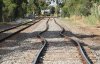
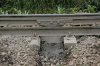
The result is that the formation fails under the sleeper leaving it unsupported, so that as each wheeel passes over, the rail and sleeper dip into the void gap.
It is also possible to get wet spots where the problem does not affect the formation, but is confined to the ballast layer. I have relayed track before now where the concrete sleepers were sitting in little pink baths of water, but the lower part of the ballast let alone the formation was still in good condition.
Wetbeds can form in two directions. They can start from the bottom when the formation is soft and wet, and clay slurry works its way up into the ballast. This blocks the drainage holding water in the track and so softening the formation further. This causes more clay to pump up which then holds even more water. The top will then go off and the extra pounding as trains drop into the dip formed, then further increases the pumping action on the formation, bringing up even more clay. This will eventually erupt on to the surface in a classic formation failure. Usually first showing along the sides of the sleepers under the rails.
Or the formation can be firm but you have a voiding sleeper perhaps in dirty ballast. This grinds both ballast and sleeper into powder, which then sets like concrete. This then holds water which pumps under the trains and also acts as a lubricant encourageing more movement. So generating more water holding powder, which allows the whole process to expand. This will work downwards and can eventually cause formation failure if the subgrade material is of a clayish type material.
Both types of wetbed also tend to spread along the line in the direction of traffic. As the silty water from the first wetbed is pulled by passing trains slip streams to contaminate ballast further along the track. This contaminated ballast is also subjected to extra loading, as wheel sets that have dropped into the dip of the first wetbed bounce back. Off loading the suspension springs as they come out of the dip, before thumping back down onto the track. This can happen several times and you can some times see a series of evenly spaced wetbeds, leading away from the original problem. In a cyclic defect spaced according to the suspension reaction time and speed of the main traffic.
Wetbeds are truely cancer for railway track, and unless they are promptly treated will spread, increasing in both severity and number.
The usual way to tell the difference between the two types is to look at the colour of the material in the wet bed, if it is the colour of ground up ballast and of a chalky consistancy it is just a wetbed and reballasting will get rid of it. Although a drain may also be required to make sure it stays away. However if the wetbed is the same colour as the underlying ground and contains clay like material you have a formation failure. In which case you are looking at a deep dig with both sand, and a drain to cure the problem.
This is just a first stab at deciding what is going on, and before commiting to a course of action for a cure. You would also want to check trial holes, ground penetrating radar, recording train data, the history of the site both in data and the local PW staffs memory etc etc until you are sure you understand what is going on.