furnessvale
Established Member
- Joined
- 14 Jul 2015
- Messages
- 4,909
No. BR got the railways. Docks, canals etc became the DWIE, The Docks and Inland Waterways Executive, later British Waterways. Both of course, together with BRS, British Road Services, were part of BTC, the British Transport Commission.Did they stay in BR ownership after nationalisation?
Sounds like an April Fool articleThe British Rail flying saucer from the 1970s had to be the oddest...
BBC NEWS | UK | British Rail flying saucer plan
news.bbc.co.uk
Sounds like an April Fool article
Two articles on London Reconnections recently about the jetfoils:Interesting. In late 79/early 80 (?), I was an junior engineer with Bovis Civil Engineering, which as a part of the P&O group had been contracted to build a riverside landing stage just downstream of Tower Bridge as a jetfoil terminal. As best I can remember, P&O were planning to run a jetfoil service from the City to Ostend I think, journey time 3 hours, aimed at the business market as easily accessible to the City area. Not sure what the outcome was, or whether it was a success or not. Could it have been taken over by BR, as that brochure is dated 1982?
www.londonreconnections.com
What do Russian hydrofoils, the Thames, the CIA, a secret city in the Soviet Union, and the Caspian Sea Monster have in common? Two mavericks on either side of the Iron Curtain, who made it come together. In London.
www.londonreconnections.com
Several companies expressed interest in operating Jetfoils between London and Oostende, Belgium, including British Rail with Sealink, the Belgian state-owned ferry company Régie des transports maritimes, and the Dutch shipping company J Lauritzen.
Two articles on London Reconnections recently about the jetfoils:
![]()
Soviet fleet on the Thames (Part 1)
What do Russian hydrofoils, the Thames, the CIA, a secret city in the Soviet Union, and the Caspian Sea Monster have in common? Two mavericks on either side of the Iron Curtain, who made it come together. In London. We start in the closed Soviet city of Gorky (later renamedwww.londonreconnections.com
![]()
Capitalist hydrofoils strike back! (Part 2)
This Liquid Highway video succinctly recaps the history of Thames ferries from 1900 on, with the Denny D2 starting at 1.43, and showing a number of the hydrofoils described in Part 1 of this series on innovative Thames transport. Oh, those Russians Part of Airavia's agreement with thewww.londonreconnections.com
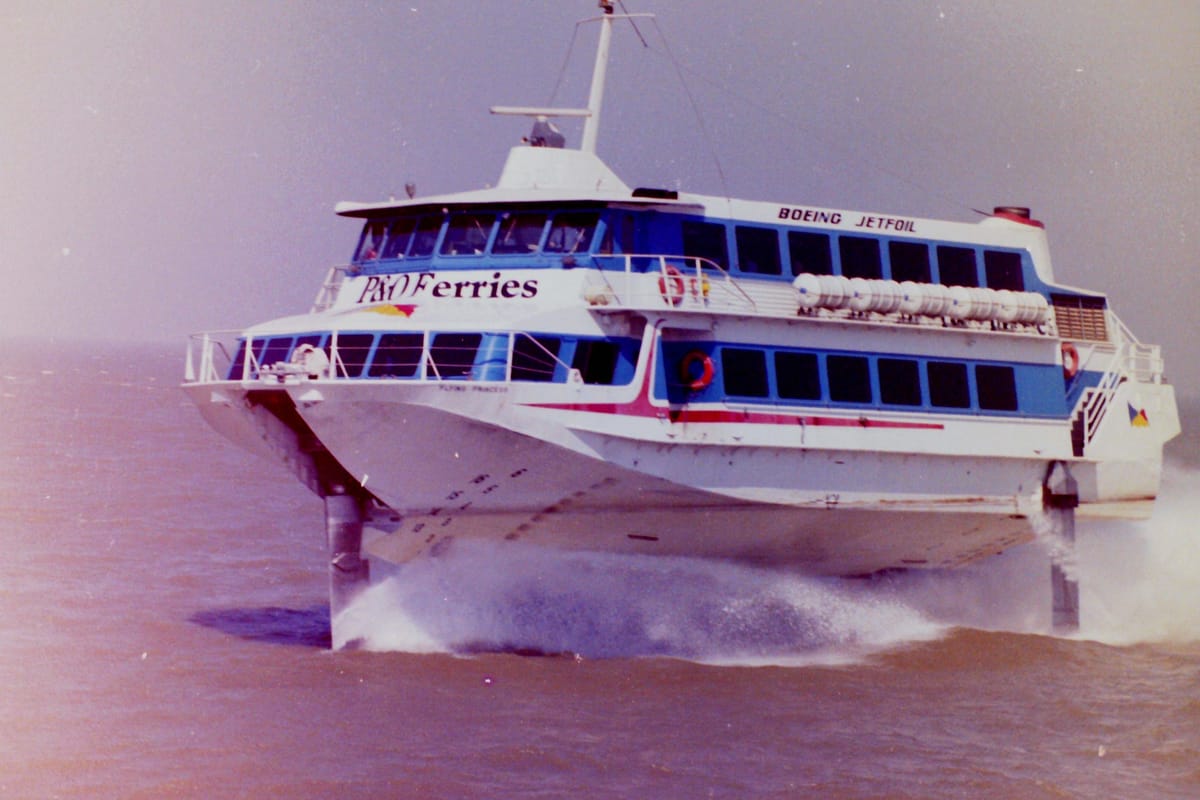
But P&O beat them all to it, albeit on a trial basis, leasing the Flying Princess for a 1 June 1977 Zeebrugge – London service start under the name P&O Jet Ferries. One daily round trip was operated, leaving Zeebrugge in the early morning, and returning from Tower Pier in the late afternoon.
...
Also, the double deck Jetfoil 929 required the bascules of Tower Bridge to be raised for each passage, but at a cost of £6,000 per opening (£28,000 in 2020!).
However P&O suspended operation of this trial service on 25 September 1978, a little earlier than planned, without explanation.
...
Due to delays in relocating their London pier to St Katherine’s Dock, this service restarted on the 29 February 1980, with Jetferry One the first Jetfoil 929-115 and the Flying Princess operating until the second new Jetfoil was delivered, unsurprisingly named Jetferry Two. Once that occurred, the hydrofoils provided three round trips per day with a journey time of 3 hours 45 minutes during the peak season of March to October, starting with morning departures from that arrive at their destination around noon. For the shoulder months of November and February there were two return trips a day, and December to January just one quotidian crossing. The adult single fare was around £22, a price point between existing air and ship-train fares, with airline type meals provided onboard.