• Our new ticketing site is now live! Using either this or the original site (both powered by TrainSplit) helps support the running of the forum with every ticket purchase! Find out more and ask any questions/give us feedback in this thread!

British buses of 70s/80s: white top

ecmlthrash15

Member
Joined
15 Jul 2022
Messages
45
Location
United kingdom
I was a young child in the late 70s/early 80s. Sometimes I would see the odd bus from the national bus company with a white top. Was there any reason for this?

 
Sponsor Post - registered members do not see these adverts; click here to register, or click here to log in
R

RailUK Forums

Joined
23 Nov 2023
Messages
788
Location
Grimsby
It was the "dual purpose" livery i.e. the vehicle could be used as a bus or a coach. It was half red or green as appropriate for the colour the operator used and half white, the top half (including the roof) being the white portion.
 

Thames99

Member
Joined
11 Sep 2023
Messages
339
Location
Reading
Do you mean a white upper deck or a white roof? A white roof would presumably keep the upper deck temperatures down.
 

Roger1973

Member
Joined
5 Jul 2020
Messages
859
Location
Berkshire
I don't remember white roofs being a thing in the 1970s / 80s in terms of keeping the top deck less warm. Although I have an idea that one municipal - possibly seaside - operator went for white roofs in summer, but I can't remember where this was.

As @Pyewipecarshed has said, the half green (or red) / white livery was 'dual purpose' or for vehicles usually used on services that were limited stop 'coach' routes but not 'National Express' services which were fully white coaches.

The style I remember from that era were on London Country's 'Green Line' routes (generally these were from the home counties - e.g. Windsor or Sevenoaks / Tunbridge Wells - in to or across central London, although there was also the orbital 725 / 726 from Gravesend / Dartford to Windsor or Heathrow via Croydon - ancestor of today's TFL X26) - example photo (Transport Library website) here.

That generation of coaches was replaced by coaches in a mainly white but with green band round the waist level livery, example (same source) here.

In to the 80s, there was a bit more flexibility in liveries allowed, with what was sometimes referred to as the 'venetian blind' livery (as in alternate stripes of green / red and white) - Maidstone and District adopted this livery for 'Invictaway' limited stop services from Kent to London. Example (Flickr - not my photo or account) here. At a slightly later stage they adopted a completely 'non corporate image' black livery for these.
 

TheGrandWazoo

Veteran Member
Joined
18 Feb 2013
Messages
23,039
Location
Somerset with international travel (e.g. across th
It does indeed sound like the early NBC era (1973 to c.1983) where the official livery guidelines were leaf green or poppy red* with a white waistband (not always applied, especially on single decks), the all white National coach livery, and the dual purpose livery. Largely applied to single decks**, it would be white roofs and window surrounds and then the main colour below.

DP vehicles had traditionally been bus shell vehicles (Marshall bodied Leopards, ECW bodied REs and MWs, even Leyland Nationals etc) though some were older downgraded coaches. In the mid 1970s, the new bus grant was introduced and that led to a new world of coach shell DPs that were basically enabling operators to have new coaches as long as they met certain stipulations on mileage operated through the year.


* yes - there were a limited number of blue NBC fleets but most disappeared quickly
** yes - there were a few double deckers such as City of Oxford and Alder Valley and these again wore NBC dual purpose livery but they were generally uncommon
 

Statto

Established Member
Joined
8 Feb 2011
Messages
4,116
Location
At home or at the pub
Do you mean a white upper deck or a white roof? A white roof would presumably keep the upper deck temperatures down.

It was nothing to do with that, as already posted, it was the dual purpose livery, were buses had coach style seats, & used on Express routes (Green Line had this livery most of the 70s & until deregulation), & the livery was applied to all single deck buses that had been fitted out to a similar standard not just Nationals, it was just Nationals became standard single deck choice for NBC from mid 70s.
 

TheSel

Member
Joined
10 Oct 2017
Messages
1,171
Location
Southport, Merseyside
Whilst I fully agree that the OP is probably referring to the NBC's 'dual purpose' livery, here's a little oddity. Crosville used to have a number of 'convertible' (to open-top) double deckers - Bristol Lodekka / ECW. Historically, these had been painted cream and black, in line with their coaching fleet, and were generally used on seafront services at Rhyl, Prestatyn and other similar locations.

When the NBC's livery directive came along, these vehicles were repainted all-over green. There was no dispensation even for a white waistband initially. The repainting was done for the 1972 summer season, if my memory serves me correctly. However - it was done whilst the vehicles were in open-topped format, with the detachable roof sections neatly stored away. Someone forgot to paint the rooves. Which meant that, come the end of the summer season, cream roof sections were applied to at least three of these vehicles for winter work, resulting in exactly what the OP refers to - a white (well, faded cream, actually!) roof on a green vehicle. My picture below shows DLG814 (XFM226) at Heswall depot, with another (which must be either DLG813 or 817) just creeping into the shot.

2026-05-25-0001_01.JPG
 

XFeed

Member
Joined
25 Nov 2025
Messages
367
Location
Chester
As a bus fitter with Crosville for 15 years I passed my test on training bus G125, I think it was, and seem to remember a lot of white on it ?
 

TheSel

Member
Joined
10 Oct 2017
Messages
1,171
Location
Southport, Merseyside
As a bus fitter with Crosville for 15 years I passed my test on training bus G125, I think it was, and seem to remember a lot of white on it ?

Yes. Green base and top, and a lot of white, with very large 'DRIVER TRAINING VEHICLE' in red lettering. Seen below at Wrexham in January 1985 (my pic).

2026-05-25-0004.jpg
 

nw1

Established Member
Joined
9 Aug 2013
Messages
9,430
It does indeed sound like the early NBC era (1973 to c.1983) where the official livery guidelines were leaf green or poppy red* with a white waistband (not always applied, especially on single decks), the all white National coach livery, and the dual purpose livery. Largely applied to single decks**, it would be white roofs and window surrounds and then the main colour below.

DP vehicles had traditionally been bus shell vehicles (Marshall bodied Leopards, ECW bodied REs and MWs, even Leyland Nationals etc) though some were older downgraded coaches. In the mid 1970s, the new bus grant was introduced and that led to a new world of coach shell DPs that were basically enabling operators to have new coaches as long as they met certain stipulations on mileage operated through the year.


* yes - there were a limited number of blue NBC fleets but most disappeared quickly
** yes - there were a few double deckers such as City of Oxford and Alder Valley and these again wore NBC dual purpose livery but they were generally uncommon

I remember one of the single-deckers (a National) was allocated to Hindhead - VPF295S. It was eventually repainted (possibly only post-privatisation?) but for a while in late 1984 I remember it appeared on local bus services with the white top. It had more coach-like comfy seats, if I remember right. I have a particular memory of it running a peak-hour 230 Guildford-Manor Way, which made me think it had moved to Guildford depot, but in fact that single journey was Hindhead-operated (and usually a double-decker).

I also remember seeing a white-topped Alder Valley double decker (VR) on 2 November 1984 at Haslemere, was LPFxxxP, can't remember the exact registration. It was doing normal Hindhead duties that day but wasn't a Hindhead vehicle, presumably on loan though not sure from where. Never saw it on any other occasion, including on regular Guildford or Aldershot duties. I recall it only had two numeric blinds so for example the 219 that it was operating was shown simply as 19. Perhaps it was for Aldershot "Londonlink" services?
 
Last edited:

JonathanH

Veteran Member
Joined
29 May 2011
Messages
23,410
I also remember seeing a white-topped Alder Valley double decker on 2 November 1984 at Haslemere, was LPFxxxP, can't remember the exact registration.
Four in that batch LPF594P-LPF597P, delivered at the same time as similarly registered dual purpose Nationals.

LPF597P seems to have been a 'southern' area vehicle as it ended up later with bus seats in the Guildford & West Surrey fleet. There are also pictures online of LPF594P with bus seats in Bee Line colours.
 

Trainman40083

Established Member
Joined
29 Jan 2024
Messages
4,739
Location
Derby
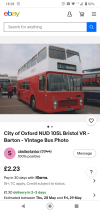
There is a picture of a white top Bristol VR on eBay.
 

Attachments

  • Screenshot_20260525-182845.png
    Screenshot_20260525-182845.png
    1 MB · Views: 51

nw1

Established Member
Joined
9 Aug 2013
Messages
9,430
Four in that batch LPF594P-LPF597P, delivered at the same time as similarly registered dual purpose Nationals.
Yes, now you say that LPF605P is coming back to me as the registration of another dual-purpose National, this one being Guildford based if I remember right.

And this also brings back memories of two once-a-day, selected days only services running down to Chichester and possibly Bognor, the X19 from Aldershot and X71 from Guildford. The former was IIRC Tues/Wed and the latter Sat. The former sometimes used VPF295S, though sometimes used an older coach, while the latter sometimes used LPF605P if I remember right, and again sometimes an older coach, and on one occasion a regular Guildford VR.
 

nw1

Established Member
Joined
9 Aug 2013
Messages
9,430
Alder Valley had the white topped Bristol VRs (LPF-P) but they were repainted into poppy red when cascaded from the Reading to London service, being replaced by CJH-V examples. Another firm that had them was Hants & Dorset, I now remember.

Ah they were Reading-London, so presumably Reading-based. Must have been an emergency short-term transfer when I saw one of them operating Hindhead routes on 2 Nov 1984, I guess.
 

TheGrandWazoo

Veteran Member
Joined
18 Feb 2013
Messages
23,039
Location
Somerset with international travel (e.g. across th
Ah they were Reading-London, so presumably Reading-based. Must have been an emergency short-term transfer when I saw one of them operating Hindhead routes on 2 Nov 1984, I guess.
If it was a P reg in that livery in 1984, they would've been long cascaded from the Reading to London service. In fact, the V regs would've been dislodged as, by that time, the long wheelbase Olympians. The DP VRs then appeared on some of the longer stage carriage routes.
 

nw1

Established Member
Joined
9 Aug 2013
Messages
9,430
If it was a P reg in that livery in 1984, they would've been long cascaded from the Reading to London service. In fact, the V regs would've been dislodged as, by that time, the long wheelbase Olympians. The DP VRs then appeared on some of the longer stage carriage routes.

Ah ok. Maybe it worked as a Reading-Aldershot and then found itself requisitioned to do some Hindhead work for part of the day? I know one of the journeys it appeared on that day involved key school work. Never saw it again after this one occasion.

What was interesting is that it only had two numerical blinds, suggesting its normal work was on two-figure routes perhaps, or even single-figure X-routes (X1, etc). No idea if any such routes operated out of Reading at the time.
 
Joined
23 Nov 2023
Messages
788
Location
Grimsby
What was interesting is that it only had two numerical blinds, suggesting its normal work was on two-figure routes perhaps, or even single-figure X-routes (X1, etc). No idea if any such routes operated out of Reading at the time.
Photos show them with 3-track blinds (link to Flickr below), so it's possible that the one you saw had a jammed or snapped number reel, and therefore only two were in use?
 

nw1

Established Member
Joined
9 Aug 2013
Messages
9,430
Photos show them with 3-track blinds (link to Flickr below), so it's possible that the one you saw had a jammed or snapped number reel, and therefore only two were in use?

Possibly yes. I think I may have had it in my head at the time that one or other of the northern Alder Valley depots used two-figure numbers and have since assumed that this was the reason for the two blinds without thinking of other causes.

Interesting to see a 3xx used for a London service, versus the usual X-numbers or 7xx often used for express services.
 

nw1

Established Member
Joined
9 Aug 2013
Messages
9,430
Think the 7** for expresses was more a Green Line thing at that time (and even now, if used elsewhere, is perhaps more related to branding Airport services). Depends where you come from.

Fair enough, my local NBC companies were Alder Valley (who were generally using X-numbers by the time I became aware of their operations in any detail, i.e. mid-80s), Southdown (who also seemed to use 7xx for longer-distance services, not always express) and London Country/Green Line.
 

TheGrandWazoo

Veteran Member
Joined
18 Feb 2013
Messages
23,039
Location
Somerset with international travel (e.g. across th
Fair enough, my local NBC companies were Alder Valley (who were generally using X-numbers by the time I became aware of their operations in any detail, i.e. mid-80s), Southdown (who also seemed to use 7xx for longer-distance services, not always express) and London Country/Green Line.
Green Line was largely 7** (but with the occasional exception).

In the days of large monolithic bus companies with huge sprawling networks or PTE inspired renumberings, 7** numbers were not uncommon as computing and auditing systems required non duplication of numbers. So you'd see 7** on rural North Norfolk services with Eastern Counties, local and interurban routes with Northern General in Co Durham, and around Otley with West Yorkshire Road car and, as you say, some of the longer Southdown runs such as the famed 700, and the 728/9 from Brighton to Tunbridge Wells.
 

nw1

Established Member
Joined
9 Aug 2013
Messages
9,430
Green Line was largely 7** (but with the occasional exception).

In the days of large monolithic bus companies with huge sprawling networks or PTE inspired renumberings, 7** numbers were not uncommon as computing and auditing systems required non duplication of numbers. So you'd see 7** on rural North Norfolk services with Eastern Counties, local and interurban routes with Northern General in Co Durham, and around Otley with West Yorkshire Road car and, as you say, some of the longer Southdown runs such as the famed 700, and the 728/9 from Brighton to Tunbridge Wells.

Interesting point. It's probably due to the era I first became aware of buses, and recognise it has little foundation in logic and is probably just an idiosyncrasy of mine, but I find duplication of numbers within the same branded operation "messy". I say branded operation, not actual company - so for example duplication of numbers across Bluestar, More and Salisbury Reds is perfectly fine as they are three separate branded entities even though they are all part of GSC.
 

Whisky Papa

Member
Joined
8 Aug 2019
Messages
746
Reading through this thread, am I right in gathering that the only coach-seated double-deckers painted in NBC's dual-purpose livery were Bristol VRs dating from the mid late 1970s? I think the only ones I can recall seeing were a small batch with Hants & Dorset that I encountered on the limited-stop service from Southampton to Fareham (and on to Portsmouth?) during a 1978 holiday.
The only other coach-seated doubles I can recall were the Atlanteans that Ribble used on their limited-stop services out of Manchester, but I don't believe I saw them in anything other than standard poppy red.
 

TheGrandWazoo

Veteran Member
Joined
18 Feb 2013
Messages
23,039
Location
Somerset with international travel (e.g. across th
Reading through this thread, am I right in gathering that the only coach-seated double-deckers painted in NBC's dual-purpose livery were Bristol VRs dating from the mid late 1970s? I think the only ones I can recall seeing were a small batch with Hants & Dorset that I encountered on the limited-stop service from Southampton to Fareham (and on to Portsmouth?) during a 1978 holiday.
There were VRs for Oxford, Alder Valley and M&D plus some retrofit ones for Northern in the official 50/50 red and white.

Can’t recall Atlanteans other than the ex Gay Hostess ones and they were quite old by the time of NBC livery.

Whilst Venetian blind liveries were a thing by the 1980s, Wilts & Dorset received five Olympians in NBC DP livery
 

jp4712

Member
Joined
1 May 2009
Messages
568
Location
Lichfield
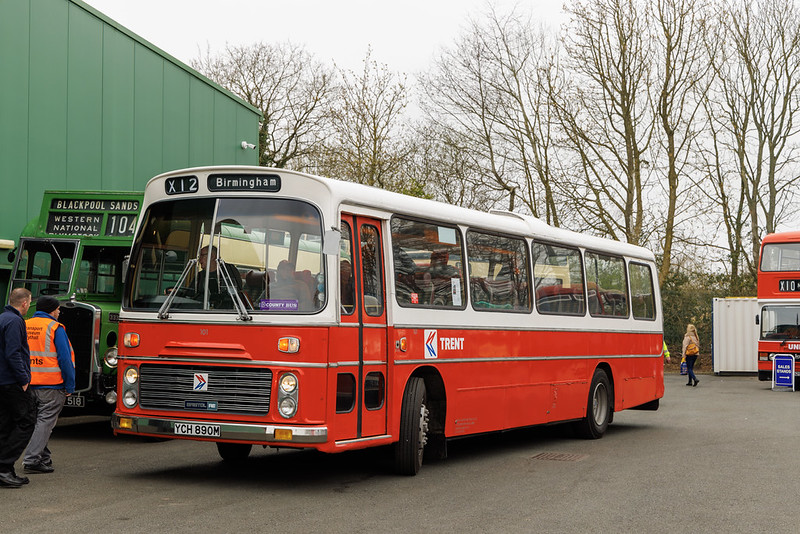
To answer the OP, I believe that what they saw was something like my photo below.

@Whisky Papa both Ribble and North Western had deckers in reversed livery for limited stop services; but when the NBC livery came, all the Ribbles were given standard red bus livery (a shame, as they were very nice inside). The North Westerns - which were a cheat, as inside they were bog-standard buses - were transferred to City of Oxford, where they received standard COMS pre-poppy red livery before the corporate scheme was applied.

Trent 101, Wythall, March 204 by Paul Williams, on Flickr
 

Man of Kent

Member
Joined
5 Jul 2018
Messages
912
There were VRs for Oxford, Alder Valley and M&D plus some retrofit ones for Northern in the official 50/50 red and white.

Can’t recall Atlanteans other than the ex Gay Hostess ones and they were quite old by the time of NBC livery.

Whilst Venetian blind liveries were a thing by the 1980s, Wilts & Dorset received five Olympians in NBC DP livery
None for Maidstone & District, but Southern Vectis painted its batch of convertible open top VRs in half green/half white.
 

Top