ecmlthrash15
Member
I was a young child in the late 70s/early 80s. Sometimes I would see the odd bus from the national bus company with a white top. Was there any reason for this?


Do you mean a white upper deck or a white roof? A white roof would presumably keep the upper deck temperatures down.


As a bus fitter with Crosville for 15 years I passed my test on training bus G125, I think it was, and seem to remember a lot of white on it ?

Yes. Green base and top, and a lot of white, with very large 'DRIVER TRAINING VEHICLE' in red lettering. Seen below at Wrexham in January 1985 (my pic).
View attachment 204804

It does indeed sound like the early NBC era (1973 to c.1983) where the official livery guidelines were leaf green or poppy red* with a white waistband (not always applied, especially on single decks), the all white National coach livery, and the dual purpose livery. Largely applied to single decks**, it would be white roofs and window surrounds and then the main colour below.
DP vehicles had traditionally been bus shell vehicles (Marshall bodied Leopards, ECW bodied REs and MWs, even Leyland Nationals etc) though some were older downgraded coaches. In the mid 1970s, the new bus grant was introduced and that led to a new world of coach shell DPs that were basically enabling operators to have new coaches as long as they met certain stipulations on mileage operated through the year.
* yes - there were a limited number of blue NBC fleets but most disappeared quickly
** yes - there were a few double deckers such as City of Oxford and Alder Valley and these again wore NBC dual purpose livery but they were generally uncommon
Four in that batch LPF594P-LPF597P, delivered at the same time as similarly registered dual purpose Nationals.I also remember seeing a white-topped Alder Valley double decker on 2 November 1984 at Haslemere, was LPFxxxP, can't remember the exact registration.
Yes, now you say that LPF605P is coming back to me as the registration of another dual-purpose National, this one being Guildford based if I remember right.Four in that batch LPF594P-LPF597P, delivered at the same time as similarly registered dual purpose Nationals.
Alder Valley had the white topped Bristol VRs (LPF-P) but they were repainted into poppy red when cascaded from the Reading to London service, being replaced by CJH-V examples. Another firm that had them was Hants & Dorset, I now remember.
If it was a P reg in that livery in 1984, they would've been long cascaded from the Reading to London service. In fact, the V regs would've been dislodged as, by that time, the long wheelbase Olympians. The DP VRs then appeared on some of the longer stage carriage routes.Ah they were Reading-London, so presumably Reading-based. Must have been an emergency short-term transfer when I saw one of them operating Hindhead routes on 2 Nov 1984, I guess.
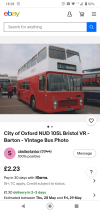
There is a picture of a white top Bristol VR on eBay.
If it was a P reg in that livery in 1984, they would've been long cascaded from the Reading to London service. In fact, the V regs would've been dislodged as, by that time, the long wheelbase Olympians. The DP VRs then appeared on some of the longer stage carriage routes.
Photos show them with 3-track blinds (link to Flickr below), so it's possible that the one you saw had a jammed or snapped number reel, and therefore only two were in use?What was interesting is that it only had two numerical blinds, suggesting its normal work was on two-figure routes perhaps, or even single-figure X-routes (X1, etc). No idea if any such routes operated out of Reading at the time.

 www.flickr.com
Photos show them with 3-track blinds (link to Flickr below), so it's possible that the one you saw had a jammed or snapped number reel, and therefore only two were in use?
240A37
Alder Valley 932 (LPF 595P), a 1976 Bristol VRT/SL3/0501 with Eastern Coachworks HDP41/29F body seen arriving at London's victoria Coach Station 29/5/76
Think the 7** for expresses was more a Green Line thing at that time (and even now, if used elsewhere, is perhaps more related to branding Airport services). Depends where you come from.Interesting to see a 3xx used for a London service, versus the usual X-numbers or 7xx often used for express services.
Think the 7** for expresses was more a Green Line thing at that time (and even now, if used elsewhere, is perhaps more related to branding Airport services). Depends where you come from.
Green Line was largely 7** (but with the occasional exception).Fair enough, my local NBC companies were Alder Valley (who were generally using X-numbers by the time I became aware of their operations in any detail, i.e. mid-80s), Southdown (who also seemed to use 7xx for longer-distance services, not always express) and London Country/Green Line.
Green Line was largely 7** (but with the occasional exception).
In the days of large monolithic bus companies with huge sprawling networks or PTE inspired renumberings, 7** numbers were not uncommon as computing and auditing systems required non duplication of numbers. So you'd see 7** on rural North Norfolk services with Eastern Counties, local and interurban routes with Northern General in Co Durham, and around Otley with West Yorkshire Road car and, as you say, some of the longer Southdown runs such as the famed 700, and the 728/9 from Brighton to Tunbridge Wells.

There were VRs for Oxford, Alder Valley and M&D plus some retrofit ones for Northern in the official 50/50 red and white.Reading through this thread, am I right in gathering that the only coach-seated double-deckers painted in NBC's dual-purpose livery were Bristol VRs dating from the mid late 1970s? I think the only ones I can recall seeing were a small batch with Hants & Dorset that I encountered on the limited-stop service from Southampton to Fareham (and on to Portsmouth?) during a 1978 holiday.
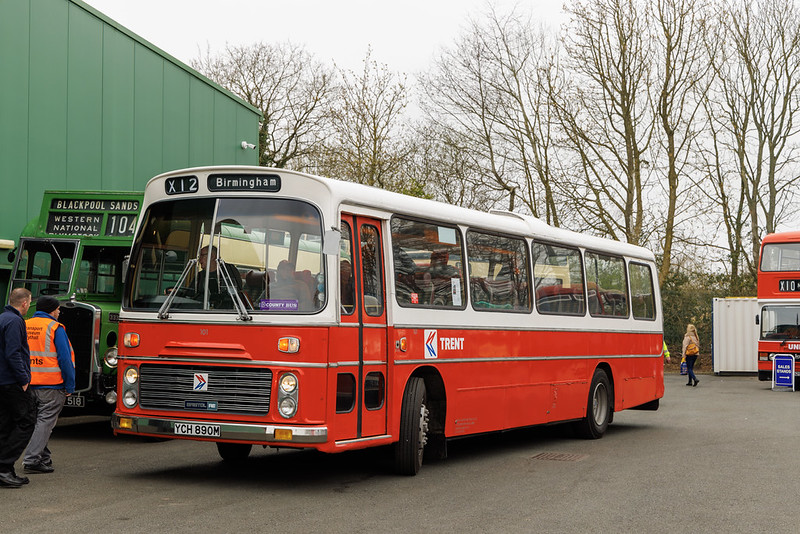 Trent 101, Wythall, March 204 by Paul Williams, on Flickr
None for Maidstone & District, but Southern Vectis painted its batch of convertible open top VRs in half green/half white.There were VRs for Oxford, Alder Valley and M&D plus some retrofit ones for Northern in the official 50/50 red and white.
Can’t recall Atlanteans other than the ex Gay Hostess ones and they were quite old by the time of NBC livery.
Whilst Venetian blind liveries were a thing by the 1980s, Wilts & Dorset received five Olympians in NBC DP livery
If we’re talking non-DP examples, Eastern National had a batch of bus seated VRs but in DP livery for the Southend to London service.None for Maidstone & District, but Southern Vectis painted its batch of convertible open top VRs in half green/half white.