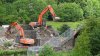
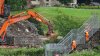
Either in this thread, or possibly one in uk.railway people were questioning why the old tunnel needed filling with concrete only to be bored out again.
The amount of offset between the new and old bores amply demonstrates that, without a uniform fill to dig at, keeping the boring machine on line would be an impossible task.
I think it more likely that the concrete infill is to stop the tunnel collapsing while it's being enlarged - particularly important as trains are using the other bore. I don't see why steering should be a particular problem. It's not like drilling a hole in the wall at home. Though the machine is circular it isn't rotary like the Crossrail ones. There are two cutting heads are controlled by two operators - one for the top half of the face and one for the bottom - and they can cut where they think fit. The machine is moved forward by computer-controlled jacks pushing on the last ring of concrete lining segments (or, at the beginning, on a special structure at the tunnel mouth). If it starts to veer to one side, the jacks on that side push harder to correct it.
--- old post above --- --- new post below ---
A NR press release repeats the Bolton News item about the naming of the machine at Farnworth and has further info:
http://www.networkrailmediacentre.co...ficially-named
The Twitter feed has a couple of new pics:
https://twitter.com/NetworkRailNP
--- old post above --- --- new post below ---
Oldham Chronicle:
http://www.oldham-chronicle.co.uk/news-features/8/news-headlines/93035/tunnel-vision
AN Oldham engineering firm has built a huge machine to widen a Greater Manchester railway tunnel as part of a £1billion regional investment programme.
Tunnel Engineering Services (UK) has designed and made the machine, to widen the 270-metre Farnworth Tunnel near Bolton as part of the electrification of regional train services.
The work is part of Network Rail’s Northern Hub programme to boost infrastructure, stations, journey times and capacity.
The Derker Street business is the only firm in the UK which designs and manufactures such specialist tunnelling machines. The machines can dig, drill and slice at the front, remove spoil with a rear conveyor and line the new tunnel with reinforced concrete.
Farnworth Tunnel is one of the UK’s widest railway tunnelling projects. Currently trains use two narrow tunnels, but after the project’s completion they will share a single, nine metre wide tunnel.
Tunnel Engineering Services (UK) managing director Geoff Clarke said: “Once everything has been assembled, we will test the machine and then disassemble it for delivery on wagons.
“The whole process lasts about two weeks. The sections have to be delivered to Bolton in sequence on 10 abnormal load wagons. They will then be assembled on-site at Bolton.
“Everyone gets a buzz to work on an exciting project like this.”
Last edited: