
• Our new ticketing site is now live! Using either this or the original site (both powered by TrainSplit) helps support the running of the forum with every ticket purchase! Find out more and ask any questions/give us feedback in this thread!

Arresting Runaway Wagons

Status
Not open for further replies.
Joined
21 Feb 2018
Messages
917
British Railways Illustrated Volume 5 No. 5 of February 1996 included an article about the LNWR goods yard at Edge Hill, Liverpool.

In 1850, the Edge Hill yards occupied 40 acres, with room for 1,782 wagons. By 1873, the yards spread over 104 acres and could accommodate 3,215 wagons. In 1894, they were 200 acres in size, with 60 miles of lines with a capacity of 6,828 wagons. At the turn of the 20th century there was still space on the site for further expansion, if required.

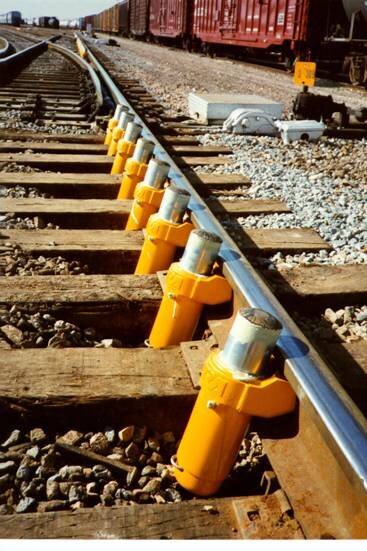
The gradient across the site meant that wagons moved around the site under their own weight. To prevent dangerous runaways a system of hooks attached to heavy chains was employed at key locations across the site.
 
Sponsor Post - registered members do not see these adverts; click here to register, or click here to log in
R

RailUK Forums

Rescars

Established Member
Joined
25 May 2021
Messages
2,540
Location
Surrey
Thanks for sharing this. Chain drag arresters are new to me. Very LNWR, given their enthusiasm for chain brakes! I wonder how the chain was restored (rewound?) into its tank after use.

I recall being taken on a visit to Toton in my youth and watching the retarders at work. Seriously skilled work on the part of the operators in the tower.
 

Harpo

Established Member
Joined
21 Aug 2024
Messages
3,819
Location
Newport
The technical name for the system fitted in 1950s marshalling yards to slow hump shunted wagons as they went into the fans was retarders.
 
Joined
21 Feb 2018
Messages
917
Tinsley Yard near Sheffield was hump- shunted and used retarders to control the wagon speed. It was also computer controlled - in 1964!
I wonder how much processing power the computer had? My experience of computer programming in the late 1970s was that everything had to be input using a pile of cards with punched holes in them, quite a slow process.
 

Flying Phil

Established Member
Joined
18 Apr 2016
Messages
2,084
I wonder how much processing power the computer had? My experience of computer programming in the late 1970s was that everything had to be input using a pile of cards with punched holes in them, quite a slow process.
That was my experience in the early 70's at university! The cards had to be kept in order (a diagonal line drawn across the edge of the stack helped). If there was a mistake on a card, the computer stopped and you had to re punch the card, put the stack back into the computer office, and wait for it to be run through again!!
 

lyndhurst25

Established Member
Joined
26 Nov 2010
Messages
1,589
There’s a video on YouTube showing how the Tinsley automatic system operated. Punched tape and pegs in holes.

 
Last edited:
Joined
21 Feb 2018
Messages
917
There’s a video on YouTube showing how the Tinsley automatic system operated. Punched tape and pegs in holes.

Thank you, Lyndhurst25.

== Doublepost prevention - post automatically merged: ==

I loved watching the film. seeing the shunters (men) at work with the wagons in the old yards/sheds was enlightening.

So much of the Sheffield in the video has gone. I remember using the Harwich Boat train on journeys from Manchester to King's Lynn and it stopping in the station in the early part of the film.
 
Last edited:
Status
Not open for further replies.

Top