Surreytraveller
On Moderation
- Joined
- 21 Oct 2009
- Messages
- 3,905


Maybe the points in the crossover have failedIf all lines are blocked, how are Great Western still able to run?
Yes, but that doesn't mean all lines are blockedOr a third rail problem that doesn’t foul the running lines.
But if all lines are blocked, how come Great Western can still run?Maybe the points in the crossover have failed

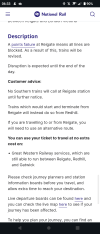
Could be better worded - but the route between Redhill and Reigate is effectively blocked to electric trains if they can't use the crossover to get back out again (or very soon would be....!!)The screenshot of the NR bulletin refers to a points failure.
Southern services have to turn back at Reigate as the third rail ends there. Great Western services continue straight through as they run on diesel. Therefore if the crossover points are stuck in the normal (straight ahead) position, GWR will be unaffected but Southern wil be unable to run.
If so it's only the crossover that's blocked, though, not "all lines".
Probably miswordedYes, but that doesn't mean all lines are blocked
== Doublepost prevention - post automatically merged: ==
But if all lines are blocked, how come Great Western can still run?
If all lines are blocked, how are Great Western still able to run?
There messaging all comes from the relevant operator. NR don’t create the messaging detail.National Rail messaging is often completely wrong. The thing that irks me the most is the 'disruption expected until XX:YY' messages which get pushed back every 5 minutes, it's essentially meaningless.
As far as the travelling public are concerned, the information is serviceable - no Southern services but GWR are running.It's sadly simply incorrect, and has slipped through whatever checking process may exist (or is the result of a lack of such).
'All lines blocked' suggests serious disruption requiring road transport or major diversion.As far as the travelling public are concerned, the information is serviceable - no Southern services but GWR are running.
I am aware of this, it doesn't make my point invalid however.There messaging all comes from the relevant operator. NR don’t create the messaging detail.
To me 'all lines blocked' means no trains can run, If one operator can run and one can't then the lines are not blocked.As far as the travelling public are concerned, the information is serviceable - no Southern services but GWR are running.
I read that message. It's perfectly clear. Instead of concentrating on three specific words read the whole thing. GWR traisn can run; Southern (electric) ones can't.
The first sentence is the most important part of the message, and it would be taken by 99% of people to mean there are no trains at all between Redhill and Guildford. I'm sorry but on this one the messaging is just wrong.I read that message. It's perfectly clear. Instead of concentrating on three specific words read the whole thing. GWR traisn can run; Southern (electric) ones can't.

Concur with @zwk500 that the message should perhaps say instead that "...some lines are blocked..."?I read that message. It's perfectly clear. Instead of concentrating on three specific words read the whole thing. GWR traisn can run; Southern (electric) ones can't.

Incorrect or inaccurate information does not equal a lie. Words mean things!Hard to trust the info when there is a lie in the first sentence.
Perhaps this is something National Rail need to look at, because it creates unnecessary confusion and concern.Quite easy to see how this happened. ‘All lines are blocked’ is what it automatically says when an entire service group is suspended. This doesn’t take into account the fact that other operators and service groups may share the same lines in part or in full. So ideally, you’d want National Rail to have some kind of programming that detects whether or not it is appropriate to say ‘all lines are blocked’ or not depending on if there are any other service groups still running.
Could the information be clearer? Yes absolutely.
Requiring customers to get 2-3rds of the way down a message to understand the fundamentals of the incident shouldn't be acceptable. 'All lines blocked but some trains are able to run' is horrendously unclear, especially to a non-technical audience.But, do I believe most passengers would be able to work out what was happening if they read the information in full? Yes.
However, 'All lines blocked' means that all lines are blocked and they were, in fact, not. So yes, the message 'All lines blocked' is objectively a lie.Incorrect or inaccurate information does not equal a lie. Words mean things!
I doubt someone has specifically typed in ‘all lines blocked’ with regard to this incident. It’ll be a generic message that - ironically - I imagine will have been introduced to make it clear when there is severe disruption to show how bad the situation is and to put passengers off from commencing journeys. So that’s why, personally, I don’t see it as a lie. A TOC has inputted data into a system to say that no trains are running between A and B. The system then generates the message ‘all lines are blocked’ - for me that doesn’t meet the threshold of a lie , but that’s just how I see it.Perhaps this is something National Rail need to look at, because it creates unnecessary confusion and concern.
Requiring customers to get 2-3rds of the way down a message to understand the fundamentals of the incident shouldn't be acceptable. 'All lines blocked but some trains are able to run' is horrendously unclear, especially to a non-technical audience.
However, 'All lines blocked' means that all lines are blocked and they were, in fact, not. So yes, the message 'All lines blocked' is objectively a lie.
As I said above, a headline of 'Some Lines are blocked' would convey the information to passengers that their train might be running, and therefore to keep reading. 'All lines blocked' signals to me that I should start looking for either a pub, taxi or bus.
It's just wrong. Many members of the travelling public will question how ANY trains can run if all lines are blocked. It just introduces doubt about the veracity of all the information.As far as the travelling public are concerned, the information is serviceable - no Southern services but GWR are running.
Are all typos and such lies?Hard to trust the info when there is a lie in the first sentence.
It wasn't a typo' though, it was a clear and simple statement. It was also completely wrong. Whether one calls it incorrect or untrue or a lie doesn't change that fact.Are all typos and such lies?
Typos are spelling errors in single words, not incorrect sentences.Are all typos and such lies?
I doubt someone has specifically typed in ‘all lines blocked’ with regard to this incident. It’ll be a generic message that - ironically - I imagine will have been introduced to make it clear when there is severe disruption to show how bad the situation is and to put passengers off from commencing journeys. So that’s why, personally, I don’t see it as a lie. A TOC has inputted data into a system to say that no trains are running between A and B. The system then generates the message ‘all lines are blocked’ - for me that doesn’t meet the threshold of a lie , but that’s just how I see it.

I would suspect that Southern have selected "All lines blocked" from a drop down list of option, because as far as their services are concerned they are.
NRE messages are created from TOC messages, which without detailed local knowledge easily miss key factors, and thus we end up with messages like this...
This will be exactly what has happened and NRE have recieved the info from Darwin.
Darwin only supplies information about specific trains.
NRE will have had to interpret multiple textual line messages from multiple operators to create an overall message.