• Our new ticketing site is now live! Using either this or the original site (both powered by TrainSplit) helps support the running of the forum with every ticket purchase! Find out more and ask any questions/give us feedback in this thread!

Mk1 Carriages Before Blue/Grey Era

Gloster

Veteran Member
Joined
4 Sep 2020
Messages
12,988
Location
Up the creek
There was a tale mentioned somewhere about a sharp supervisor at Clapham Yard who spotted a chocolate and cream BG , so he nabbed it and put into the Bournemouth Belle rake to give an uniform colour to the Pullman rake !

According to Parkin (p.66) it was W80713; there are a couple of photos on the Internet that appear to show it as the first coach in an Up train at Bournemouth Central. Only a handful of BG were painted in Chocolate & Cream.
 
Sponsor Post - registered members do not see these adverts; click here to register, or click here to log in
R

RailUK Forums

Taunton

Veteran Member
Joined
1 Aug 2013
Messages
12,278
My bold.

S1000S is still around, and seeing it I realise that, because of its origin, it has buckeye couplers and (I think) the rubbing strip of a Pullman gangway - which I hadn't thought of. Unusual for compartment stock - I don't think that LNER compartment stock had buckeyes, and the Southern didn't build any - except possible a small number by Bulleid ???.
I think it was built on the frame of a Mk1 corridor coach, which had these features, whose bodywork was destroyed in the Lewisham accident.
 

Gloster

Veteran Member
Joined
4 Sep 2020
Messages
12,988
Location
Up the creek
I think it was built on the frame of a Mk1 corridor coach, which had these features, whose bodywork was destroyed in the Lewisham accident.

The underframe was from one of the TSO that were second and third in the Ramsgate train: S4377 and S4378 (in order). There remains some uncertainty as to which was used, but S4378 is more probable.
 

E27007

Member
Joined
25 May 2018
Messages
1,040
Into the blue/grey era, the Woodhead line, closed to passenger services January 1970, in the final period before closure, acquired a number of ex-SR coaches in green, the short 5-coach formations of could therefore be a mixture of blue/grey , maroon, green hauled by an EM1 76 or perhaps an EM2 77
 

Gloster

Veteran Member
Joined
4 Sep 2020
Messages
12,988
Location
Up the creek
Into the blue/grey era, the Woodhead line, closed to passenger services January 1970, in the final period before closure, acquired a number of ex-SR coaches in green, the short 5-coach formations of could therefore be a mixture of blue/grey , maroon, green hauled by an EM1 76 or perhaps an EM2 77

Possibly Bulleid Open Seconds: eleven were transferred to the ER in late 1965 and early 1966. At least two lasted into 1969.
 

Peter Mugridge

Veteran Member
Joined
8 Apr 2010
Messages
17,838
Location
Epsom
I've never seen any evidence of any in blue/grey, believe they were allover blue until the end; apart from the one set that was repainted into a pastiche of Southern Railway green, of course.
You are correct; no SUB ever carried blue and grey. ( I became actively interested at the time of the end of the SUBs )
 

45Fox

Member
Joined
17 May 2022
Messages
150
Location
Leicester
Into the blue/grey era, the Woodhead line, closed to passenger services January 1970, in the final period before closure, acquired a number of ex-SR coaches in green, the short 5-coach formations of could therefore be a mixture of blue/grey , maroon, green hauled by an EM1 76 or perhaps an EM2 77

Of course, prior to the closure of the Great Central London Extension as a main line in 1966 (60 years ago yesterday, incidentally) Southern Region green liveried stock was no stranger to Sheffield Victoria, on the York/Bournemouth workings.
 

6PAN

Member
Joined
22 Aug 2026
Messages
17
Location
Hampshire
Correct, given a 'set' code of EH230 (EH = Eastleigh, where IIRC it was based for maintenance reasons) when operating on a boat train service, in the early days of (planning) computerisation. Although this set was the main 'go to' set for Boat train workings to/from Southampton (70s/80's), Mk 1 sets did also have a big impact on boat train workings to/from Southampton Docks, in the form of '8 Set H' or '8 Set J'. These were always referred to as '8 Set H' in the base plan CWN's, and were the sets that were known for their work on the Oxted road, but internally (at Clapham) we had access to two set's of each, but have never seen any evidence of '8 Set J' in any official documents that have survived to this day!
But they were issued as such on STP ACWN's back then, and often ran in conjunction with the Mk2 set when both QE2 and Canberra were in Dock simultaneously.

Getting back to the OPs comment about liveries, as I understand the SR vehicles were all in BR(S) green initially, although all those remaining were B/G by the time I worked with/diagrammed them (mid 70's). Some of those I was familiar with 50 years ago on the job are still around in preservation, which is nice to see!

I remember seeing one of these vehicles in green as the first class coach in a rake of blue/grey Mk1s working London to Brighton via Oxted services in 1967/68.
 

D6130

Established Member
Joined
12 Jan 2021
Messages
9,067
Location
West Yorkshire/Tuscany
My bold.

S1000S is still around, and seeing it I realise that, because of its origin, it has buckeye couplers and (I think) the rubbing strip of a Pullman gangway - which I hadn't thought of. Unusual for compartment stock - I don't think that LNER compartment stock had buckeyes, and the Southern didn't build any - except possible a small number by Bulleid ???.
Do I recall correctly that S1000S was built on a 63ft 5ins underframe, whereas the rest of the BR Standard non-corridor stock was built on 57ft underframes? I think it may have been built on the underframe of a burnt-out or collision-damaged Mark 1 corridor coach....in which case it would have been logical to retain the latter's buckeye couplings? Incidentally, it was used for several years on the Hayling Island branch, until its closure in 1963....whereupon it was transferred to the 'Kenny Belle' set.

EDIT: Just seen the above posts regarding the Lewisham (St Johns) collision.
 
Last edited:

Merle Haggard

Established Member
Joined
20 Oct 2019
Messages
3,919
Location
Northampton
Do I recall correctly that S1000S was built on a 63ft 5ins underframe, whereas the rest of the BR Standard non-corridor stock was built on 57ft underframes? I think it may have been built on the underframe of a burnt-out or collision-damaged Mark 1 corridor coach....in which case it would have been logical to retain the latter's buckeye couplings? Incidentally, it was used for several years on the Hauling Island branch, until its closure in 1963....whereupon it was transferred to the 'Kenny Belle' set.

EDIT: Just seen the above posts regarding the Lewisham (St Johns) collision.

I'm not trying to be a clever-clogs but only the ER and LMR non-gangwayed stock was 57', the SR and WR ones were 64' (65' 5" u/f), with an extra compartment.

Being used to 57' LMS and BR suburban stock on the LMR the SR ones I saw looked very odd; 'lanky' would be the word in those days.
 

Taunton

Veteran Member
Joined
1 Aug 2013
Messages
12,278
I'm not trying to be a clever-clogs but only the ER and LMR non-gangwayed stock was 57', the SR and WR ones were 64' (65' 5" u/f), with an extra compartment.

Being used to 57' LMS and BR suburban stock on the LMR the SR ones I saw looked very odd; 'lanky' would be the word in those days.
I believe the reason behind the 57' non-gangway stock on ER and LMR was just it was necessary to fit the Widened Lines route into Moorgate, which could not handle standard full length vehicles. The same applied to DMUs, leading to both needing to have short-frame 'low density' Cravens units on high loading commuter services, which into Kings Cross and St Pancras could be full length suburban seated ones.
 

Magdalia

Established Member
Joined
1 Jan 2022
Messages
7,387
Location
The Fens
Of course, prior to the closure of the Great Central London Extension as a main line in 1966 (60 years ago yesterday, incidentally) Southern Region green liveried stock was no stranger to Sheffield Victoria, on the York/Bournemouth workings.
The SR and NER each provided a set for this service. The SR set went north on MWFO and south on TThSaO, the NER set went south on MWFO and north on TThSaO. In summer the trains ran through to/from Newcastle.

In black and white photos it is still usually possible to identify whether the train is the NER maroon stock or the SR green stock because the NER maroon stock is lined but the SR green stock is not.

For a short period in August 1966 the NER's set did have a blue and grey coach.

I believe the reason behind the 57' non-gangway stock on ER and LMR was just it was necessary to fit the Widened Lines route into Moorgate, which could not handle standard full length vehicles. The same applied to DMUs, leading to both needing to have short-frame 'low density' Cravens units on high loading commuter services, which into Kings Cross and St Pancras could be full length suburban seated ones.
This is right, 64 foot vehicles were out of gauge on the widened lines.
 

Merle Haggard

Established Member
Joined
20 Oct 2019
Messages
3,919
Location
Northampton
I believe the reason behind the 57' non-gangway stock on ER and LMR was just it was necessary to fit the Widened Lines route into Moorgate, which could not handle standard full length vehicles. The same applied to DMUs, leading to both needing to have short-frame 'low density' Cravens units on high loading commuter services, which into Kings Cross and St Pancras could be full length suburban seated ones.

As is often the way, you more you think about things the less you understand the underlying logic.

The 57' limit applied to the Moorgate line, but only some of the BR Standards were permitted down here - ones specially built with reduced fittings of some sort.

Length seemed to be a 'thing' on the LMS/LMR; there were LMS 54' suburbans too, some with short buffers.

Another oddity was that many dmu (generally, doesn't apply to all) had side buffers and screw couplings within sets, so the gangways were 'BR Standard' not Pullman.

The underframe was from one of the TSO that were second and third in the Ramsgate train: S4377 and S4378 (in order). There remains some uncertainty as to which was used, but S4378 is more probable.

I didn't quote that because sometimes sensitive people on this forum take offence at such detail.

Possibly Bulleid Open Seconds: eleven were transferred to the ER in late 1965 and early 1966. At least two lasted into 1969.

I distinctly remember seeing a Bulleid TSO in B&G but I can't remember where; not sure whether ER or ScR. Bizarrely, I travelled to Maillaig in 1968 on one but that was maroon. Sc1469S rings a distant bell.

//

There was a thread a while ago about B&G on pre-nationalisation stock. Can't remember the title, but M24635M was mentioned and might come up in a search
 

Gloster

Veteran Member
Joined
4 Sep 2020
Messages
12,988
Location
Up the creek
I distinctly remember seeing a Bulleid TSO in B&G but I can't remember where; not sure whether ER or ScR. Bizarrely, I travelled to Maillaig in 1968 on one but that was maroon. Sc1469S rings a distant bell.

S1469 was one of the eleven Open Seconds transferred to the ER and lasted until April 1969, before it went to the Keighley & Worth Valley; at least three of the eleven that went to the ScR lasted into 1970. These coaches (S1462-S1506) were built as Loose Open Thirds between November 1950 and January 1951, so were among the last of the Bulleid hauled coaches.

(This and other information from Bulleid’s S.R. Steam Passenger Stock, Gould, Oakwood, 1980.)

I believe the reason behind the 57' non-gangway stock on ER and LMR was just it was necessary to fit the Widened Lines route into Moorgate, which could not handle standard full length vehicles. The same applied to DMUs, leading to both needing to have short-frame 'low density' Cravens units on high loading commuter services, which into Kings Cross and St Pancras could be full length suburban seated ones.

Which is why, according to Parkin, the 57’ non-corridor stock outlived the standard-length stock. The last non-corridor working was a train to Royston on 30 September 1977.
 

52290

Member
Joined
23 Oct 2015
Messages
729
wasn't the chocolate and cream for the western region meant to be used for their key expresses / named trains? Or have a mis recalled what I've read before.

No doubt the carriages ended up in that livery on other WR trains too after a while
Some of the WR chocolate and cream coaches indeed ended up far from their homes. I remember spotting at Leyland in the 1950's, a couple were attached to the morning Birmingham to Glasgow train during the summer months bringing a bit of colour to our maroon world. What I can't remember is whether they were Mk 1's or not but they came from Plymouth.
 

Taunton

Veteran Member
Joined
1 Aug 2013
Messages
12,278
I believe the Southern stock that moved elsewhere in 1965-6, both Mk1 (in green) and Bulleid, was part of a stock switch-around associated with building the REP/TC units, which were mostly Mk1 hauled stock conversions.

Bear in mind that "pre-nationalisation" designs continued to be built until 1951, and indeed a bit beyond to use up remaining materials stock. When blue/grey came along in 1964 they might be only 13 years old, with plenty of life remaining.
 

30907

Veteran Member
Joined
30 Sep 2012
Messages
21,955
Location
Airedale
Mostly old, often pre-grouping, sets. They were ageing but had not been replaced in the years leading up to Beeching.
Late SECR Birdcage 3-(lavatory) sets, Maunsell 3- and 4- (corridor) sets seem to have been common on the SE and in E Sussex, plus of course push-pull sets with stock of all 3 companies. The SW in Hampshire used ex-LSW lavatory stock right up to 1957, and East Devon had non-corridor 2-sets for a couple of years even after the Mk1s arrived on the Exmouth line.

From memory some of the non-corridors had already been cut-and-shut onto SR 58ft steel frames - which were then reused under the Bulleid-style 2EPBs/HAPs in the (old) 5600 series.

Green Mk1 non-corridors were slotted into Basingstoke peak locals to provide extra seating in the mid 60s, but I didn't realise they ran on Exeter services.
 

Taunton

Veteran Member
Joined
1 Aug 2013
Messages
12,278
Green Mk1 non-corridors were slotted into Basingstoke peak locals to provide extra seating in the mid 60s, but I didn't realise they ran on Exeter services.
These I think were the same vehicles, redundant after the WR handover, who rapidly dieselised routes like the Exmouth branch with an oddball mix of DMUs from elsewhere in the region, and handed anything green back to the Southern, along with as many ex-Southern locos as they could. They were probably only about 10 years old at the time.
 

Gloster

Veteran Member
Joined
4 Sep 2020
Messages
12,988
Location
Up the creek
These I think were the same vehicles, redundant after the WR handover, who rapidly dieselised routes like the Exmouth branch with an oddball mix of DMUs from elsewhere in the region, and handed anything green back to the Southern, along with as many ex-Southern locos as they could. They were probably only about 10 years old at the time.

In 1961 the SR appears to have had four ‘Exmouth’ sets formed Brake Second+Composite+Brake Second, one set of three Seconds and a Mark 1 Brake Second Corridor for the West London Line, and a seven coach set including two Bulleid Composite Corridors on the Central Division. The sets were supposed to be kept in formation.
 

matchmaker

Established Member
Joined
8 Mar 2009
Messages
1,881
Location
Central Scotland
As is often the way, you more you think about things the less you understand the underlying logic.

The 57' limit applied to the Moorgate line, but only some of the BR Standards were permitted down here - ones specially built with reduced fittings of some sort.

Length seemed to be a 'thing' on the LMS/LMR; there were LMS 54' suburbans too, some with short buffers.

Another oddity was that many dmu (generally, doesn't apply to all) had side buffers and screw couplings within sets, so the gangways were 'BR Standard' not Pullman.


I didn't quote that because sometimes sensitive people on this forum take offence at such detail.


I distinctly remember seeing a Bulleid TSO in B&G but I can't remember where; not sure whether ER or ScR. Bizarrely, I travelled to Maillaig in 1968 on one but that was maroon. Sc1469S rings a distant bell.

//

There was a thread a while ago about B&G on pre-nationalisation stock. Can't remember the title, but M24635M was mentioned and might come up in a search
Most first generation DMUs had screw couplings and Scissors gangways. The exceptions were as far as I know the Swindon built Inter City and Trans Pennine units.
 

StephenHunter

Established Member
Joined
22 Jul 2017
Messages
2,917
Location
London
Eastern Region was maroon. This was also applied to the AM9 electric multiple units, which became Class 309 under TOPS.
 

Taunton

Veteran Member
Joined
1 Aug 2013
Messages
12,278
Some of the WR chocolate and cream coaches indeed ended up far from their homes. I remember spotting at Leyland in the 1950's, a couple were attached to the morning Birmingham to Glasgow train during the summer months bringing a bit of colour to our maroon world. What I can't remember is whether they were Mk 1's or not but they came from Plymouth.
This through service was the day Plymouth to Liverpool train, which when we used it from Taunton had the first two coaches through to Glasgow. They were detached at Crewe; by 1962 when locos were changed there for the electric along to Liverpool the Warship (later Class 47 when new) drew them forward and pushed them back into the north end bay to await the train to Scotland which came in next. By the early 1960s this was The Caledonian from Euston. I think these must have stopped at Carstairs, with a connection to Edinburgh, as a significant travel demand, which may have been the main reason for this manoeuvre, was travel by Royal Navy personnel between the bases at Devonport and Rosyth. There was comparable provision on the overnight service as well.

By this time also the stock was always LMR, as it needed to be dual heated for the Liverpool sector.
 

30907

Veteran Member
Joined
30 Sep 2012
Messages
21,955
Location
Airedale
These I think were the same vehicles, redundant after the WR handover, who rapidly dieselised routes like the Exmouth branch with an oddball mix of DMUs from elsewhere in the region, and handed anything green back to the Southern, along with as many ex-Southern locos as they could. They were probably only about 10 years old at the time.
According to Bloodandcustard.com they were different vehicles, from the WR's stash of redundant coaches. Odd but the ways of the WR are inscrutable :)
 

WesternLancer

Veteran Member
Joined
12 Apr 2019
Messages
15,163
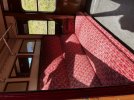
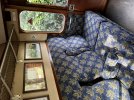
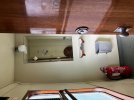
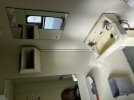
Hoping this thread is a good excuse to upload some pictures of the very nicely restored Mk1 suburban coach I traveled in at the Great Central Railway today.
Composite carriage with toilets for respective 1st and 2nd class corridor compartments.
 

Attachments

  • IMG_7690.jpeg
    IMG_7690.jpeg
    3.9 MB · Views: 42
  • IMG_7689.jpeg
    IMG_7689.jpeg
    4.5 MB · Views: 42
  • IMG_7688.jpeg
    IMG_7688.jpeg
    2.7 MB · Views: 41
  • IMG_7687.jpeg
    IMG_7687.jpeg
    1.9 MB · Views: 42

thesignalman

Member
Joined
9 Jan 2012
Messages
160
[snipped]
The Somerset & Dorset route, Western Region from the late 1950s, nevertheless maintained the longstanding S&D tradition of coaches from the Southern, so they were green to the end, along with locos from the London Midland, which is how responsibilities were divided up in 1930.
I've been looking at photographs available on the net and the majority of colour photographs (which are likely to be late-era views) seem to show stock in maroon, with a few in carmine and cream.

John
 

Acathater

Member
Joined
11 Dec 2025
Messages
715
Location
NorthWest
I've been looking at photographs available on the net and the majority of colour photographs (which are likely to be late-era views) seem to show stock in maroon, with a few in carmine and cream.

John
I would guess that the majority of photos were of weekend summer holiday specials / expresses which would have originated on the LMR and so would use LMR stock
 

thesignalman

Member
Joined
9 Jan 2012
Messages
160
I would guess that the majority of photos were of weekend summer holiday specials / expresses which would have originated on the LMR and so would use LMR stock
My thoughts precisely. Which is why I was a bit puzzled about the comment.

I have found one picture of a 4MT-hauled 4-coach train in green, but that could of course be Bournemouth-based stock. Stopping services were hardly frequent, so there would have only been a few sets in service - perhaps too few to make generalisations. Highbridge services certainly seem to be in maroon.

John
 

Acathater

Member
Joined
11 Dec 2025
Messages
715
Location
NorthWest
My thoughts precisely. Which is why I was a bit puzzled about the comment.

I have found one picture of a 4MT-hauled 4-coach train in green, but that could of course be Bournemouth-based stock. Stopping services were hardly frequent, so there would have only been a few sets in service - perhaps too few to make generalisations. Highbridge services certainly seem to be in maroon.

John
And don't forget that not all Southern coaches were painted green, some remained red. It would seem logical that they wouldn't have regarded repainting coaches on what wasn't "their" core territory as being too important, especially if details of the region boundary revisions and Beeching cuts were in the wind
 

Springs Branch

Established Member
Joined
7 Nov 2013
Messages
1,681
Location
Where my keyboard has no £ key
I believe the reason behind the 57' non-gangway stock on ER and LMR was just it was necessary to fit the Widened Lines route into Moorgate, which could not handle standard full length vehicles. The same applied to DMUs, leading to both needing to have short-frame 'low density' Cravens units on high loading commuter services, which into Kings Cross and St Pancras could be full length suburban seated ones.
I know the thread title refers to before blue/grey, but I wondered if any other BR Standard / Mk.1 passenger coaches - other than the 57' Suburban stock mentioned above which lasted to the late 1970s - were ever painted in overall Rail Blue (as opposed to blue/grey)?

Of course there was plenty of non-passenger BR rolling stock like parcels and newspaper vans in all-over blue, and possibly some DMU and EMU non-driving trailer cars. But did Mk1s in full Rail Blue ever appear anywhere else on LHCS other than those LMR/ER London suburban lines? e.g. as part of the Kenny Belle loco-hauled sets at any time?
 

Taunton

Veteran Member
Joined
1 Aug 2013
Messages
12,278
I have found one picture of a 4MT-hauled 4-coach train in green, but that could of course be Bournemouth-based stock. Stopping services were hardly frequent, so there would have only been a few sets in service - perhaps too few to make generalisations. Highbridge services certainly seem to be in maroon.
Ah, based on personal sighting and riding. And not particularly on summer Saturdays, when indeed the various through trains were LMR stock. The green stock even turned up on Bath Green Park to Bristol TM locals.

I'm always a bit doubtful of old photographs being an accurate representation, as in the days of expensive photography these often concentrated on the unusual and notable, rather than the everyday mundane. Look at how many S&D photos show Bulleid Pacifics or the 2-8-0s, yet outside summer Saturdays there might be days without these on passenger services.
 

Top