Our new ticketing site is now live! Using either this or the original site (both powered by TrainSplit) helps support the running of the forum with every ticket purchase! Find out more and ask any questions/give us feedback in this thread!
Some kind of junction at Berkswell arranged so that anything from the WCML doesn't need to use the HS2 main lines south of Interchange would be an interesting thought.
There may be space on the Birmingham spur to accommodate a Curzon - Interchange - Cov - Rugby - MK - Normal Euston service, whilst also creating some space between New St and International.
With the Midlands hub at Moor St, that would probably move the rail centre of gravity in Birmingham City centre there, even more so than will already happen.
To support growth and new housing developments, it's as simple as that. The rest of the country can recreate London's success only if they recreate the size, scale, and capacity of London's public transport network. That's why every local service in the Birmingham network should have London Underground level frequencies. There isn't demand for that level of transport capacity yet, but it would very quickly materialise as new housing developments spring up around the upgraded transport corridors.
There is a fundamental misunderstanding here. Transport networks do not deliver growth.
When I started my working career in London in the early 1980s, London already had most of its public transport network, yet it was a declining city with a shrinking population. That changed in the late 1980s because of innovation, mainly in financial services, not because of public transport. Where public transport mattered was to ensure that it wasn't a constraint strangling that growth. That's why London got investment in transport, following the growth not leading it, starting with small schemes and culminating in Thameslink and the Elizabeth Line.
The rest of the country can't recreate London's success, because London has unique advantages through its global status, particularly in finance. Birmingham cannot and will not become another London, what you propose really is just fantasy.
I am all for raising regional cities' productivity and prosperity, but there is neither the economic need nor the democratic appetite for anything beyond evolution from today's built environment and population size.
A metropolitan population of 2.5-3.5 million, and focusing high-density mixed-use developments on existing ex-industrial and big-box retail sites will put West Midlands on par with successful European cities like Hamburg.
Transport-wise, full delivery of Midland Metro, electrification of the Snow Hill line and restoring frequency to the pre-Covid 6tph, released capacity from HS2, and full delivery of Midlands Rail Hub will collectively provide a lot of transport capacity allowing a high degree of agglomeration for the whole city region.
What is proposed here is far more realistic. With devolution it will be for the local people of the West Midlands to shape the priorities.
Finally, another example of how growth is not driven by transport is here in Cambridge. There is huge growth here even though local transport is mostly rubbish and there is an acute shortage of housing. Growth in Cambridge is happening because it is a place for innovation, not because of public transport.
The rest of the country can't recreate London's success, because London has unique advantages through its global status, particularly in finance. Birmingham cannot and will not become another London, what you propose really is just fantasy.
There is a fundamental misunderstanding here. Much of London’s unique advantages stem from its scale and density, which themselves are a product of its exceptional public transport network.
Public transport networks and economic growth are tightly coupled, in a chicken-and-egg relationship. Transport investment requires growth to justify the expenditure, while economic growth requires public transport to sustain agglomeration in a central business district.
Furthermore, as the economy shifts ever more towards knowledge-intensive services, this coupling grows even tighter. Industries like technology, academia, and research and development benefit immensely from in-person coordination. There’s a reason most of the highest-paying jobs these days can be found concentrated in close proximity with each other.
The London Docklands is the probably the single best example of transport investment powering economic regeneration. The entire area has been completed transformed by the DLR.
The chicken-and-egg nature of the relationship between public transport investment and economic growth results in strong positive feedback loops: in upwards spirals or upwards spirals.
London’s self-reinforcing success has come directly at the cost of the self-reinforcing failure of every other major city in the UK. Moreover, the brightest spots in the UK economy are places that have bucked the trend and, by tooth and nail, fought for greater investment in their transport infrastructure. Manchester is the obvious example, but this also holds for Edinburgh, Cambridge, and even Birmingham itself.
== Doublepost prevention - post automatically merged: ==
I really like squingo’s ambition for Birmingham and WM, for too long unlike our cotton weaving neighbours to the North, Birmingham has lacked real purpose and strategy for its Public Transport network. It’s got better certainly since the creation of the Strategic WM mayoralty with TfWM and WMRE certainly thinking about the possibilities within a strict fiscal envelope but I still think it lacks a grand strategy and plan some of which squingo articulates well. I’d be intrigued to know if Birmingham and the wider WM county have considered becoming a proper second “city/metro area” with a massively densified population of circa 4-5m rather than sharing it with Greater Manchester as is the current position.
Keeping on topic I’d suggest tunnelling for regionals, expresses and Inter City as suggested by Zomboid (?) is probably as good a way as solving the current local vs regional/IC conundrum that the West Midlands suffers from with two track routes in all directions with the new station underneath the city centre connecting New St and Moor St a bit like some of the Elizabeth Line stations in London.
Wolverhampton to Coventry (Birmingham CrossRail) should be 10tph with all other commuter routes at a minimum 4-6tph. This would encourage densification and development of rail corridors.
The only drawback, ruinously expensive and if we’re honest currently unaffordable.
It'd only be the remaining semi fasts that would be diverted, so 2-3 tph. The no longer relevant Birmingham to Leeds capacity would permit that. XC would still need to go to New St.
As for Canley/ Tile Hill/ Berkswell/ Hampton in Arden, what help do they need?
Some residential land take would be necessary, but this could be accommodated by taking larger blocks, redeveloping them into higher density residential land
It’s not only unpopular, it is not permitted to take more land than is needed for the transport proposal. If it was, the Jubilee extension, HS1, East london Line, Crossrail, East West Rail, and HS2 would have looked quite different.
It might sound expensive up front, but I would not be surprised if a metro tunnel with stations bored from Wolverhampton to Coventry worked out cheaper than attempting to do the same on surface, especially including costs of the legal battles.
By far the best value way to do this is to build a new pair of fast lines to keep relieve the existing route from Coventry to Birmingham, into a new station in Birmingham. (Checks map…)
There is a fundamental misunderstanding here. Much of London’s unique advantages stem from its scale and density, which themselves are a product of its exceptional public transport network.
It didn't help London 50 years ago, when it was a declining city with shrinking population. London started as a port, and from that built its prosperity on finance, starting more than 300 years ago. But the economics come first, without innovative business there isn't the economic growth to fund investment in public transport.
London also has a unique advantage of being the capital city of one of the most centralised advanced economic nations in the world. There can only be one of those.
London's success is not self reinforcing. 40-50 years ago London was a failure, the docks obliterated by containerisation. London's current success is built on the financial innovation since the 1980s, it is a modern phenomenon. I know because I was there and watched it happen.
The London Docklands is the probably the single best example of transport investment powering economic regeneration. The entire area has been completed transformed by the DLR.
No. The London Docklands were transformed by financial innovation. That's what created the demand for office space that could not be accommodated in the City of London. The DLR and the Jubilee Line Extension then came to ensure that the growth from financial innovation wasn't strangled.
The chicken-and-egg nature of the relationship between public transport investment and economic growth results in strong positive feedback loops: in upwards spirals or upwards spirals
It is not chicken and egg: the innovation and economic growth are the cause, the transport investment is an effect.
Cambridge demonstrates that. Apart from two new railway stations (one only just opened) it has achieved economic growth without any significant public transport investment.
Cambridge demonstrates that. Apart from two new railway stations (one only just opened) it has achieved economic growth without any significant public transport investment
Whether we agree with the concept or not, the busways and P&Rs would qualify as public transport investment.
Though that's not the engine of growth. If investment in public transport were the key then the likes of Luton (with it's busway), Sheffield, Nottingham etc would be growing faster than they are.
Late to the thread so forgive me if my scan read has missed something.
This grand scheme needs breaking down into stages. Probably spread over generations.
If Birmingham New Street is still going to be struggling after HS2 is built then :-
Put the Cross city line in a tunnel from Duddeston to somewhere as near to Five Ways as possible. Choose a route not to far from New Street. I have no idea what the geology is or if there are foundations to avoid. That should take the conflicting moves away from the New Street throats.
Maybe later extend the tunnels further out as/when congestion increases on the plain line.
Maybe later put the services from the Bescot direction into the tunnel but where to send them the other side of Birmingham. Possibly pick up the local trains into Moor Street but why bother ?.
Wolverhampton to Coventry (Birmingham CrossRail) should be 10tph with all other commuter routes at a minimum 4-6tph. This would encourage densification and development of rail corridors.
The only drawback, ruinously expensive and if we’re honest currently unaffordable.
I really like squingo’s ambition for Birmingham and WM, for too long unlike our cotton weaving neighbours to the North, Birmingham has lacked real purpose and strategy for its Public Transport network. It’s got better certainly since the creation of the Strategic WM mayoralty with TfWM and WMRE certainly thinking about the possibilities within a strict fiscal envelope but I still think it lacks a grand strategy and plan some of which squingo articulates well. I’d be intrigued to know if Birmingham and the wider WM county have considered becoming a proper second “city/metro area” with a massively densified population of circa 4-5m rather than sharing it with Greater Manchester as is the current position.
I appreciate the predominantly constructive feedback I receive on these threads, but positive feedback every once in a while is truly heartening. I hope that the current devolution trend results in a West Midlands mayoralty with the ambition and the means to achieve truly transformational change to their transport network. I’m just here to supply the ideas.
Keeping on topic I’d suggest tunnelling for regionals, expresses and Inter City as suggested by Zomboid (?) is probably as good a way as solving the current local vs regional/IC conundrum that the West Midlands suffers from with two track routes in all directions with the new station underneath the city centre connecting New St and Moor St a bit like some of the Elizabeth Line stations in London.
Wolverhampton to Coventry (Birmingham CrossRail) should be 10tph with all other commuter routes at a minimum 4-6tph. This would encourage densification and development of rail corridors.
I’m interested in finding the cheapest solution for quad-tracking the two intercity routes through Birmingham city centre. Acting on the assumption that underground city centre stations are the greatest source of expense, we should prioritise the fewest and simplest underground stations possible.
A single city centre station with a single platform per track could fit the bill, and lends itself to the design of a large concourse connecting New Street, Curzon Street, and Moor Street together underground with the new platforms below.
This station would need to serve long-distance intercity services with long dwell times, so extra infrastructure would be needed elsewhere in the surrounding network.
ATO through the city centre corridor could bring headways down to 60 seconds; 4-6 platforms at the shoulder stations at the ends of the tunnel could regulate the service delays imported from across the network; and terminating services at the far shoulder station, rather than the city centre station itself, would further help in regulating the service.
Additionally, Spanish-style platforms with an exit platform and entrance platform on either side of each train could improve passenger flow, limiting the tail risk to extended dwell times from passenger embarkation.
A lot of additional work, for sure, but an extra 4 platforms at each of Wolverhampton, Nuneaton, Worcestershire Parkway, and Birmingham International should surely still be cheaper than building an extra 4 platforms underground in Birmingham city centre.
== Doublepost prevention - post automatically merged: ==
No. The London Docklands were transformed by financial innovation. That's what created the demand for office space that could not be accommodated in the City of London. The DLR and the Jubilee Line Extension then came to ensure that the growth from financial innovation wasn't strangled.
Can you see how the fact that the private company behind Canary Wharf literally contributed funding to the development of the DLR, the Jubilee Line, and the Elizabeth Line undermines your assertion that economic growth and transport development aren’t closely related?
== Doublepost prevention - post automatically merged: ==
Perhaps one of way of breaking it down would be to deliver the two tunnels separately.
I’m convinced that the tunnels should be express tunnels, leaving the surface railway to stopping services, though.
If you start with the crosscountry tunnel, you could build the brimginham central station concourse and 4 platforms underneath, with passive provision for the WCML tunnels to come afterwards. Connect up to the four-track sections west of King’s Norton and north of Duddeston junction, then the south section of Birmingham New Street can entirely serve the cross city line with no conflicts at Proof House Junction. Easily increase the cross city line frequency to at least 12 TPH.
I don’t think that any new quad tracking or grade separation would be necessary, but opens up the opportunity for easy wins from incremental improvements.
Although doing this first would require electrification of the cross country route.
Can you see how the fact that the private company behind Canary Wharf literally contributed funding to the development of the DLR, the Jubilee Line, and the Elizabeth Line undermines your assertion that economic growth and transport development aren’t closely related?
There is a relationship, but it is economic growth cause and transport investment effect.
Canary Wharf could only contribute to the DLR because it would be getting rental income from the big banks taking up the office space. Without financial services innovation, Canary Wharf could not have funded DLR.
This is delusional. Companies like AstraZeneca, GSK, Amazon, Microsoft and Google don't sit in their boardrooms and say let's go to Cambridge because it has a busway and Park and Ride.
Can you see how the fact that the private company behind Canary Wharf literally contributed funding to the development of the DLR, the Jubilee Line, and the Elizabeth Line undermines your assertion that economic growth and transport development aren’t closely related
I think the argument is that economic activity requires transit systems. It doesn't follow that public transport stimulates economic activity by itself.
== Doublepost prevention - post automatically merged: ==
This is delusional. Companies like AstraZeneca, GSK, Amazon, Microsoft and Google don't sit in their boardrooms and say let's go to Cambridge because it has a busway and Park and Ride
No, obviously not. But that was a response to the suggestion that Cambridge hasn't had any public transport investment other than the north/ south stations, when it clearly has.
But that was a response to the suggestion that Cambridge hasn't had any public transport investment other than the north/ south stations, when it clearly has.
I think the argument is that economic activity requires transit systems. It doesn't follow that public transport stimulates economic activity by itself.
I think that the best way of framing it is that investment in public transport infrastructure is by its nature speculative: investments may or may not precipitate growth, and their payoff cannot be known beforehand.
So, yes, it doesn’t follow that public transport investment necessarily causes growth, but I don’t think that captures the sentiment accurately. I would rather say that such investment causes an uncertain amount of growth, potentially very little or none. But equally, it could potentially cause an explosion in economic activity - see how the Elizabeth line instantly overshot even the most optimistic predictions.
I would say that public transport investment does cause growth, because the expected value is more than zero. A lot of variables can affect the result, many outside our control. But in the here and now, on a speculative forum, we can ideate on the potential next big project that might be worth building.
Trust the finance types in Canary Wharf to have a strong grasp on speculative investment - all three of the transport links in the docklands have paid off spectacularly.
This is the speculative forum, so affordability can be set aside for a bit...
If you're going to do anything involving tunnelling through Birmingham, surely the logical thing to do is to to provide entirely new routes for long-distance services. As they, by nature, are not going to be stopping anywhere except at a New St "deep level", the alignment can be chosen purely on the basis of ease and cost, rather than having to ensure that they are routed via population centres / existing nodes. No need for more than one tunnel station (they're expensive) and with the ICs out of the way there's plenty of room for more stoppers without any worry about what they're getting in the way of. I know that's the opposite way around to what has happened in many European cities with their RER / S-Bahn tunnels - but those were mostly occasioned by having the problem of terminus stations not really serving the city centre. Whatever else you can say about New Street, you can't accuse it of either of those faults!
I’m interested the technical challenge of designing a crossrail tunnel for Birmingham that best balances costs against benefits. I’m less interested in debating its necessity, or comparing it to the investments already planned.
If you're going to do anything involving tunnelling through Birmingham, surely the logical thing to do is to to provide entirely new routes for long-distance services. As they, by nature, are not going to be stopping anywhere except at a New St "deep level", the alignment can be chosen purely on the basis of ease and cost, rather than having to ensure that they are routed via population centres / existing nodes. No need for more than one tunnel station (they're expensive) and with the ICs out of the way there's plenty of room for more stoppers without any worry about what they're getting in the way of. I know that's the opposite way around to what has happened in many European cities with their RER / S-Bahn tunnels - but those were mostly occasioned by having the problem of terminus stations not really serving the city centre. Whatever else you can say about New Street, you can't accuse it of either of those faults!
Is that not basically what I’ve proposed? A fast line via an underground central Birmingham from Wolverhampton to Coventry and from Worcestershire Parkway to Nuneaton. Tunnelled where there isn’t space to quadruple the existing corridor.
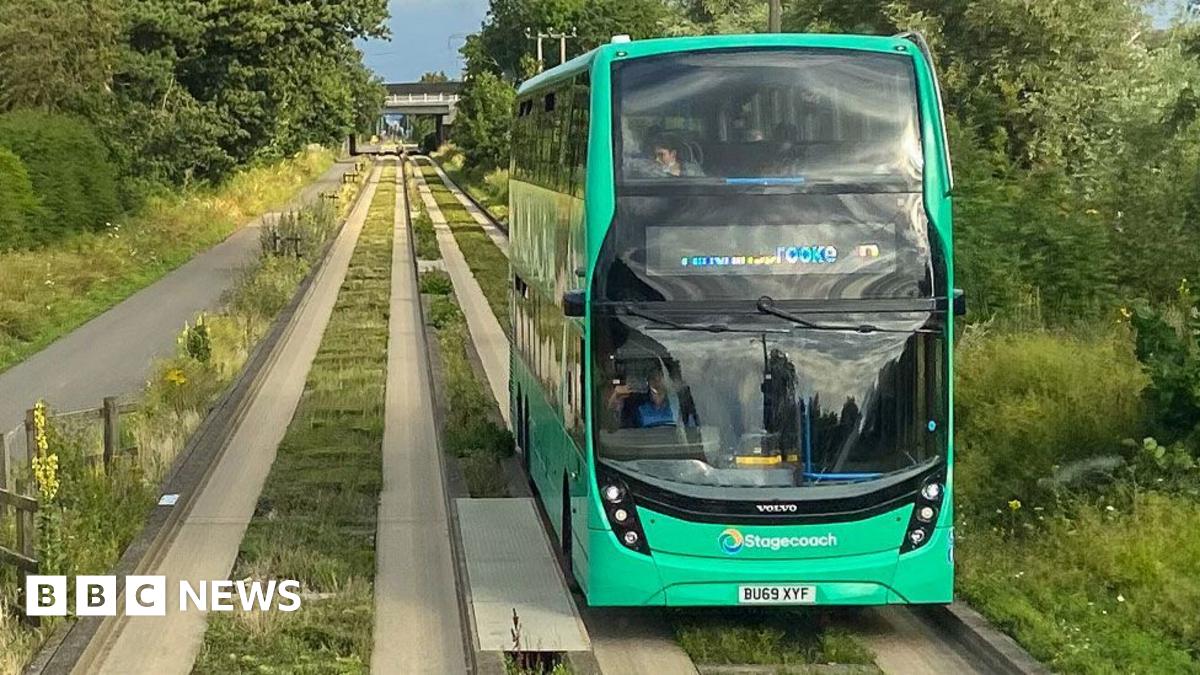
I'm not sure on what criteria the busway can be regarded as a success. The busway has been a failure. It operates with fewer services running at much lower speeds than what was originally proposed. It has become a sadly under-utilised resource, with further service reductions planned:
Bus frequencies will decrease after a reduction in people using the Cambridgeshire Guided Busway.
www.bbc.co.uk
Bus frequencies will decrease on a busway after a "significant" drop-off in the number of passengers linked to safety fencing work.
Cambridgeshire County Council has been putting up fencing along the 16-mile (26km) busway, which links Cambridge, Huntingdon and St Ives, after it was fined £6m in the wake of three deaths.
The speed limit on the network was reduced to a blanket 30mph (48km/h) in October while permanent fencing works were carried out.
Darren Roe, managing director of Stagecoach East, one of the bus operators on the busway, said it supported the safety work, but the extended journey times had led to people "changing their travel patterns".
He said this had resulted in a "significant loss of people travelling on the busway".
A lot of additional work, for sure, but an extra 4 platforms at each of Wolverhampton, Nuneaton, Worcestershire Parkway, and Birmingham International should surely still be cheaper than building an extra 4 platforms underground in Birmingham city centre.
I'm not sure on what criteria the busway can be regarded as a success. The busway has been a failure. It operates with fewer services running at much lower speeds than what was originally proposed. It has become a sadly under-utilised resource, with further service reductions planned
It did really earn the "misguided busway" moniker. But it was investment in public transport for Cambridge, successful or not. Should have been an interurban light railway, though.
== Doublepost prevention - post automatically merged: ==
A 4 platform underground station in a cavern under the bullring is going to be much more realistic and affordable than adding platforms in 4 other locations.
If you're going to do anything involving tunnelling through Birmingham, surely the logical thing to do is to to provide entirely new routes for long-distance services. As they, by nature, are not going to be stopping anywhere except at a New St "deep level", the alignment can be chosen purely on the basis of ease and cost, rather than having to ensure that they are routed via population centres / existing nodes. No need for more than one tunnel station (they're expensive) and with the ICs out of the way there's plenty of room for more stoppers without any worry about what they're getting in the way of.
If the new lines in tunnels are for long-distance services, wouldn't the main underground station want to be under Curzon Street station (or possibly equidistant between New Street, Curzon Street and Moor Street stations)?
If the new lines in tunnels are for long-distance services, wouldn't the main underground station want to be under Curzon Street station (or possibly equidistant between New Street, Curzon Street and Moor Street stations)?
It'd want to be a bit like Moorgate/ Liv St on Crossrail, with exits leading to both New St and Curzon/ Moor St. And probably a central exit into the Bullring.
Trust the finance types in Canary Wharf to have a strong grasp on speculative investment - all three of the transport links in the docklands have paid off spectacularly.
There is a fundamental misunderstanding here. Much of London’s unique advantages stem from its scale and density, which themselves are a product of its exceptional public transport network.
Public transport networks and economic growth are tightly coupled, in a chicken-and-egg relationship. Transport investment requires growth to justify the expenditure, while economic growth requires public transport to sustain agglomeration in a central business district.
Furthermore, as the economy shifts ever more towards knowledge-intensive services, this coupling grows even tighter. Industries like technology, academia, and research and development benefit immensely from in-person coordination. There’s a reason most of the highest-paying jobs these days can be found concentrated in close proximity with each other.
The London Docklands is the probably the single best example of transport investment powering economic regeneration. The entire area has been completed transformed by the DLR.
The chicken-and-egg nature of the relationship between public transport investment and economic growth results in strong positive feedback loops: in upwards spirals or upwards spirals.
London’s self-reinforcing success has come directly at the cost of the self-reinforcing failure of every other major city in the UK. Moreover, the brightest spots in the UK economy are places that have bucked the trend and, by tooth and nail, fought for greater investment in their transport infrastructure. Manchester is the obvious example, but this also holds for Edinburgh, Cambridge, and even Birmingham itself.
== Doublepost prevention - post automatically merged: ==
Would there be enough capacity on the two track approach into Curzon street to relieve the WCML of all fast services?
How would this help the stations between Berkswell and Coventry?
Transport doesn't create economic growth. It unlocks economic growth when the fundamental ingredients are there.
Train-city Glasgow is poorer than bus city Edinburgh. If it was just down to transport Glasgow would be the far richer city.
So the question becomes what fundamentals your transport is trying to unlock. Once we understand that, we can then consider what realistic political appetite there is for achieving.
The built environment is a product of trade-offs between academic efficiency and personal preferences. Transport is but a means to an end. You seem to consider Jubilee-style frequencies and Asian densities as uncompromising ends in themselves. There is no economic need for these and there is no political appetite for such things.
I think that the best way of framing it is that investment in public transport infrastructure is by its nature speculative: investments may or may not precipitate growth, and their payoff cannot be known beforehand.
You mentioned the Elizabeth Line. That was a run away success because it was a desperately needed solution to the demand. It was long overdue.
I can remember a relief line for the Central line being talked of way back in 1987 - almost forty years ago. Look how long it took for that solution to arrive !.
So, yes, it doesn’t follow that public transport investment necessarily causes growth, but I don’t think that captures the sentiment accurately. I would rather say that such investment causes an uncertain amount of growth, potentially very little or none. But equally, it could potentially cause an explosion in economic activity - see how the Elizabeth line instantly overshot even the most optimistic predictions.
I would say that public transport investment does cause growth, because the expected value is more than zero. A lot of variables can affect the result, many outside our control. But in the here and now, on a speculative forum, we can ideate on the potential next big project that might be worth building.
I would say the best chance of getting improvements in Birmingham is looking at solutions that cater for the demand that is already there. Then in a few decades time building on that.
Trust the finance types in Canary Wharf to have a strong grasp on speculative investment - all three of the transport links in the docklands have paid off spectacularly.
The finance types in and around Canary Wharf paid for public transport when they realised it was holding their development back.
If the finance types had a proper grasp they would not have let DLR be built based on short trains with stations close together. Now the DLR have been doubled in length there is the station at Canary Wharf with platforms almost reaching the next station !.
A thought on Intercity. HS2 should have terminated at Wolverhampton with a through station in Birmingham as close as possible to New Street. Fair bit of tunnelling but then use of as much of the ex-Great Western route as possible. That would have abstracted from the current New Street - Wolverhampton intercity route perhaps allowing more stopping service by local trains or even intercity. Then add other routes in decades to come.
Watch out - I am one of those who wonders why Birmingham is not ON the HS2 route to Manchester !.
I'm not sure on what criteria the busway can be regarded as a success. The busway has been a failure. It operates with fewer services running at much lower speeds than what was originally proposed.
It'd want to be a bit like Moorgate/ Liv St on Crossrail, with exits leading to both New St and Curzon/ Moor St. And probably a central exit into the Bullring.
I think if you were doing it properly, it would become a single 'Birmingham Central' station with underground travellators etc. to connect all the platforms together behind the barriers.
Canary Wharf could only contribute to the DLR because it would be getting rental income from the big banks taking up the office space. Without financial services innovation, Canary Wharf could not have funded DLR.
If it were up to the big banks they'd have built a massive car park and urban motorway straight from a nearby airport into whichever location suited their planned development. London Transport proactively coming in and proposing redevelopment of the Isle of Dogs into a public transport-first mixed-use region, and paying for a large portion of it, was a stroke of luck that led to Canary Wharf being a place that's not only successful at efficiently getting large amounts of people in and out of it, but also a place that's quite nice to walk or cycle around in general.
In the event that the market has the money and the power to dictate development, they would opt for the status quo each time - i.e. car-centric out-of-town sprawl that actively worsens the city it's located in. Innovation in business, tech or science doesn't translate to innovation in quality of life for everyone in cities, unless you fancy some half-baked gadgetbahn.
This is delusional. Companies like AstraZeneca, GSK, Amazon, Microsoft and Google don't sit in their boardrooms and say let's go to Cambridge because it has a busway and Park and Ride.
On the other hand, if Cambridge was designed to be as car-friendly as most UK cities then it'd be far less attractive to big companies and potential investors.
If everyone travelling to the Science Park or Biomedical Campus was incentivised (even more than now) to come by car, with no bus, train or cycle links, it would operate much less efficiently and actually make the city worse on average rather than more lively and economically productive.
If Cambridge South wasn't practically forced to be designed in a sustainable and progressive way due to Long Road and Addenbrooke's being essentially full at rush hour, it either wouldn't exist or would, again, be a net negative for anyone living near it.
If there were no Park & Ride sites and we instead had a few dozen multi storey car parks throughout the city then the city would be total gridlock most of the time and would be really unpleasant to live in. This would make it take much longer for people to commute to work at the big companies, making it notably less economically productive.
All these are developments that were developed and funded by the public sector. Maybe it doesn't matter to the higher-ups sitting in the boardrooms, but that's because A: they're very happy with the status quo, and rarely experience what it's like to commute into work in Cambridge in a non-luxury car regularly, and live in a gentrified suburb away from all the negative externalities of their business ventures, and B: they have bigger things to worry about, as (to their luck) sorting out transport access to their company site is not their problem, but instead one for the local authority to sort out (with a pool of tax money that they actively try to avoid contributing to, but I digress).
It's incredibly ignorant to state that investment in sustainable modes of transport doesn't affect things much. It's just that commuting by car, regardless of how long it takes, how healthy it is, and how sustainable it is, is so ingrained in the public mind (noting that many of these big companies are from North America) that the thought of public transport working as an economic multiplier, or even a catalyst, is completely foreign to so many people.
If currently the way things work is that a large company comes in, invests in a city that already has something attractive about it, and then the council/authority has to clean up the mess caused by the negative externalities of this major boost to the local economy (often slowly, with public money, and in an uphill battle against about half the population who either don't know or care about the problem) then what's wrong with planning ahead instead and saving everyone's time and money by making sure that economic growth is possible without (fiscally, but also to an extent literally) choking everyone and everything that's not involved with the local innovation clusters. The reason why there are still significant parts of the UK that are economic basket cases, and that even the productive parts are working more or less at capacity, is partly due to the complete lack of proactiveness of the public sector. Transport improvements shouldn't lag behind clusters of economic growth by years, they should play a major role during the initial establishment of them.
If it were up to the big banks they'd have built a massive car park and urban motorway straight from a nearby airport into whichever location suited their planned development. London Transport proactively coming in and proposing redevelopment of the Isle of Dogs into a public transport-first mixed-use region, and paying for a large portion of it, was a stroke of luck that led to Canary Wharf being a place that's not only successful at efficiently getting large amounts of people in and out of it, but also a place that's quite nice to walk or cycle around in general.
In the event that the market has the money and the power to dictate development, they would opt for the status quo each time - i.e. car-centric out-of-town sprawl that actively worsens the city it's located in. Innovation in the business sector doesn't translate to innovation in quality of life for everyone in cities, unless you fancy some half-baked gadgetbahn.
On the other hand, if Cambridge was designed to be as car-friendly as most UK cities then it'd be far less attractive to big companies and potential investors.
If everyone travelling to the Science Park or Biomedical Campus was incentivised (even more than now) to come by car, with no bus, train or cycle links, it would operate much less efficiently and actually make the city worse on average rather than more lively and economically productive.
If Cambridge South wasn't practically forced to be designed in a sustainable and progressive way due to Long Road and Addenbrooke's being essentially full at rush hour, it either wouldn't exist or would, again, be a net negative for anyone living near it.
If there were no Park & Ride sites and we instead had a few dozen multi storey car parks throughout the city then the city would be total gridlock most of the time and would be really unpleasant to live in. This would make it take much longer for people to commute to work at the big companies, making it notably less economically productive.
All these are developments that were developed and funded by the public sector. Maybe it doesn't matter to the higher-ups sitting in the boardrooms, but that's because A: they're very happy with the status quo, and rarely experience what it's like to commute into work in Cambridge in a non-luxury car regularly, and live in a gentrified suburb away from all the negative externalities of their business ventures, and B: they have bigger things to worry about, as (to their luck) sorting out transport access to their company site is not their problem, but instead one for the local authority to sort out (with a pool of tax money that they actively try to avoid contributing to, but I digress).
It's incredibly ignorant to state that investment in sustainable modes of transport doesn't affect things much. It's just that commuting by car, regardless of how long it takes, how healthy it is, and how sustainable it is, is so ingrained in the public mind (noting that many of these big companies are from North America) that the thought of public transport working as an economic multiplier, or even a catalyst, is completely foreign to so many people.
If currently the way things work is that a large company comes in, invests in a city that already has something attractive about it, and then the council/authority has to clean up the mess caused by the negative externalities of this major boost to the local economy (often slowly, with public money, and in an uphill battle against about half the population who either don't know or care about the problem) then what's wrong with planning ahead instead and saving everyone's time and money by making sure that economic growth is possible without (fiscally, but also to an extent literally) choking everyone and everything that's not involved with the local innovation clusters. The reason why there are still significant parts of the UK that are economic basket cases, and that even the productive parts are working more or less at capacity, is partly due to the complete lack of proactiveness of the public sector. Transport improvements shouldn't lag behind clusters of economic growth by years, they should play a major role during the initial establishment of them.
I don't think anyone is arguing that economic growth is down to just one factor. The question is whether Glasgow is richer or poorer than it would be without its rail network.
The built environment is a product of trade-offs between academic efficiency and personal preferences. Transport is but a means to an end. You seem to consider Jubilee-style frequencies and Asian densities as uncompromising ends in themselves. There is no economic need for these and there is no political appetite for such things.