To be fair, in the event of a nuclear attack, we're all stuffed anyway. I'm quite content for Welsh speakers to have a five minute headstart.This is also nuts - the ideal would be bilingual annoucements or concurrent ones in both languages, but if whatever reason they have to be ordered then the only sensible one to send out first is English. If this were a nuclear attack or whatever you might be talking about thousands of unnecessary deaths.
Which also goes to underline how pathetic this warning was compared to what it ought to be used for.

-
Our new ticketing site is now live! Using either this or the original site (both powered by TrainSplit) helps support the running of the forum with every ticket purchase! Find out more and ask any questions/give us feedback in this thread!
You are using an out of date browser. It may not display this or other websites correctly.
You should upgrade or use an alternative browser.
You should upgrade or use an alternative browser.
Severe Alert from the UK Government
- Thread starter londonteacher
- Start date
Sponsor Post - registered members do not see these adverts; click here to register, or click here to log in
R
RailUK Forums
To be fair, in the event of a nuclear attack, we're all stuffed anyway. I'm quite content for Welsh speakers to have a five minute headstart.
It's not (just) that.
It's a question of how good an idea it is to send warnings out using a method which is only supposed to be used for imminent severe threats in a langauge which the vast majority of recipients cannot understand, leaving them trying to guess what the emergency is and what they should be doing about it.

brad465
Veteran Member
Without meaning to condone idiots, perfection is impossible and certain events only need one or two "bad eggs" in a population of ~70 million to happen, effectively 0.001% of the population. We should absolutely do whatever is necessary to mitigate, such as making sure those who do cause trouble face consequences and regulate/ban certain products and activities, but just passing off blame and being done with it, while comforting to one's mind, doesn't solve anything.The alert wasnt about places already on fire. It was about the fact the whole country is a tinderbox and we could get very similar events nationwide unless people stop being idiots / selfish.
In any case now I think almost everyone who has complained this is an overreaction or unnecessary will have moved on to discussing Jason Arday's sudden death, which has effectively overshadowed the fire situation for now, so this alert won't have the traction it might otherwise have had.

3141
Established Member
Yet you've just highlighted a perfect example of why this method of communication was probably chosen. The Stourbridge incident was all over the mainstream media yesterday. There was plenty of coverage in some of my social media feeds too. Yet you were completely unaware of this. At the same time as the Stourbridge incident was ongoing, a similar, but smaller scale, incident was unfolding in Stoke-on-Trent. Four homes were destroyed by a fire which started on grass in a neighbouring park and rapidly spread to adjoining gardens and homes. There were suggestions it was started by somebody using a disposable barbecue at the opposite end of the park. Far less media coverage - it got a passing mention in coverage of the Stourbridge fires - if I hadn't seen the smoke from across the city, maybe I wouldn't have known about it at all.
My point is two fold. Clearly mainstream media is a much less effective communication tool for important messaging these days. Secondly, this doesn't need to be an active fire to be an urgent issue. The urgent issue here is that everything is so god damn dry that these kinds of fires are starting extremely easily and spreading extremely easily and extremely rapidly. They're causing huge amounts of damage (thankfully nothing yet on the scale of those wildfires we see from abroad) and putting huge pressure on resources. Aerial footage of the Stourbridge incident clearly showed a number of secondary fires, quite some distance from the original fire, presumably caused by embers from the original fire.
This no longer just a few grass fires. This is no longer only affecting the countryside and green spaces. This not about a couple of barbecues. This is our overstretched emergency services telling us all to take a bit of extra responsibility because they may not be able to save us, or our property.
(Apologies for the bit of a rant, it's not all aimed directly at you @pokemonsuper9 )
No, it wasn't a rant, it was a completely justifiable response to some of the selfish and narrow-minded posts on this thread from people whose little world was interrupted yesterday evening by a reminder of the risk of a small and normally innocuous fire getting out of control and leading to serious consequences in the present abnormally dry conditions. Plus the fact that the emergency services are being seriously stretched on dealing with all the problems already going on.
(My bold above).No, it wasn't a rant, it was a completely justifiable response to some of the selfish and narrow-minded posts on this thread from people whose little world was interrupted yesterday evening by a reminder of the risk of a small and normally innocuous fire getting out of control and leading to serious consequences in the present abnormally dry conditions. Plus the fact that the emergency services are being seriously stretched on dealing with all the problems already going on.
From https://www.gov.uk/alerts:
Emergency Alerts is a UK government system that provides warning and advice in a life threatening emergency.
You may get alerts about any type of life threatening emergency, such as:
- wildfires
- severe flooding
- extreme storms
I find it very hard to read that and see how it fits a "reminder" of anything, no matter how important.
The risk of a fire being started is not a life threatening emergency.
If you take that definition then every time I cross a road I'm experiencing a life threatening emergency because I could get run over and killed.
The worst part is that it's a zenith of the UK's obsession with announcements/posters/alerts to nudge people, in stark contrast to authority, policing and enforcement.
How many more serious examples do they need that kindly asking people not to do something doesn't work in this country. It is not the 1960s or 1970s any more
edit: I'm also closely waiting to see how lenient of a sentence that stupid woman who burnt Dovestones with a firework is going to get. She (and the others) needs making a serious example of
How many more serious examples do they need that kindly asking people not to do something doesn't work in this country. It is not the 1960s or 1970s any more
edit: I'm also closely waiting to see how lenient of a sentence that stupid woman who burnt Dovestones with a firework is going to get. She (and the others) needs making a serious example of

It's highly unlikely that your crossing the road would result in tens or hundreds of other people losing their homes or lives though, is it?If you take that definition then every time I cross a road I'm experiencing a life threatening emergency because I could get run over and killed.
gg1
Established Member
No, it wasn't a rant, it was a completely justifiable response to some of the selfish and narrow-minded posts on this thread from people whose little world was interrupted yesterday evening by a reminder of the risk of a small and normally innocuous fire getting out of control and leading to serious consequences in the present abnormally dry conditions. Plus the fact that the emergency services are being seriously stretched on dealing with all the problems already going on.
Exactly, this is the gist of the vast majority of the negative comments I've read here and elsewhere, we're not downplaying the high risk of wildfires, but it's exactly that, a risk. When one is actually burning near your home is the time for an emergency alert.I find it very hard to read that and see how it fits a "reminder" of anything, no matter how important.
The risk of a fire being started is not a life threatening emergency.
If you take that definition then every time I cross a road I'm experiencing a life threatening emergency because I could get run over and killed.
There is the technology to send out localised alerts, they don't have to be sent nationwide.
Okay. Let's limit the message to areas where the fire risk is elevated. This is the current fire risk map for England and Wales:There is the technology to send out localised alerts, they don't have to be sent nationwide.

Link: https://experience.arcgis.com/experience/328554206f114fc98c707bfc1b880cf7
Orange: Very High
Yellow: High

Egg Centric
Established Member
It's the opposite of being selfish and narrow-minded to recognise reality: that if the alert system is used for stuff like this then an increasing number of people will mute it and one day a genuinely time critical alert will be missed by many. That's just basic psychology. You can see people in this thread already who are muting it.No, it wasn't a rant, it was a completely justifiable response to some of the selfish and narrow-minded posts on this thread from people whose little world was interrupted yesterday evening by a reminder of the risk of a small and normally innocuous fire getting out of control and leading to serious consequences in the present abnormally dry conditions. Plus the fact that the emergency services are being seriously stretched on dealing with all the problems already going on.
That is still a very generalised risk map. The Telegraph has a box on some of their pages (sorry cannot link) where you type in your postcode and it gives you a percentage of the risk of wildfires at your address. With my postcode it says the risk is 1.2%.
gg1
Established Member
Okay. Let's limit the message to areas where the fire risk is elevated. This is the current fire risk map for England and Wales:
View attachment 209637
Link: https://experience.arcgis.com/experience/328554206f114fc98c707bfc1b880cf7
Orange: Very High
Yellow: High
To repeat the sentences you removed when you quoted me:
Exactly, this is the gist of the vast majority of the negative comments I've read here and elsewhere, we're not downplaying the high risk of wildfires, but it's exactly that, a risk. When one is actually burning near your home is the time for an emergency alert.
Risk, even when it's high risk, is not appropriate usage of a system designed to be used when there is an imminent threat to life.
If the more proportional response of a press conference and a text message sent to all UK phones had been used instead, do you really think anyone who chose to disregard a message sent by that medium (on top of wildfires being a major news story for the past couple of weeks) would really be swayed to behave differently by yesterday's alert?
It's highly unlikely that your crossing the road would result in tens or hundreds of other people losing their homes or lives though, is it?
No but something is either a life threatening emergency or it isn't.
If the fact that a fire might start near me means that I am currently in a life threatening situation then exactly the same applies to crossing a road.
A risk doesn't somehow turn into an actual emergency because a large number of people would be affected if the risk materialised.
Risk, even when it's high risk, is not appropriate usage of a system designed to be used when there is an imminent threat to life.
If the more proportional response of a press conference and a text message sent to all UK phones had been used instead, do you really think anyone who chose to disregard a message sent by that medium (on top of wildfires being a major news story for the past couple of weeks) would really be swayed to behave differently by yesterday's alert?
Quite.

Including GBNews and the one with Julia Hartman?Typically these stories are picked up by many channels, I don't think anyone is suggesting that the message should have been sent out by only the BBC, more that it is being used as an example.

Indeed. The exercise has been a failure because people are realising if they are turned on the government can wake them up to advise them not to have a barbecue. It's ridiculous. It doesn't matter if anyone agrees that having an alert was a good idea; it's the widespread confusion and annoyance and realisation the government will use this for all sorts of stuff other than events which are an imminent risk to life.It's the opposite of being selfish and narrow-minded to recognise reality: that if the alert system is used for stuff like this then an increasing number of people will mute it and one day a genuinely time critical alert will be missed by many. That's just basic psychology. You can see people in this thread already who are muting it.
This could easily have been done through many other media, as we have done in the past - or even a text to all phones, or a silent alert. Sorry but if I am going to drop everything when bathing my kid to run to my phone it had better be worth it. Better be a missile or a gas leak or something which requires urgent and critical attention. Perhaps even a fire near my home?

Some things struck me as odd.
Regarding languages, I believe the spec actually allows simultaneously delivering multilingual messages and then the recipient's device language setting is used to determine which one to show. In the US, they send the message in over a dozen languages and in a couple of years' time it'll also be sent in American Sign Language, so I can't imagine it was a length limitation. So why does the UK's implementation for Wales send separate messages in Welsh, then later on in English? I agree that while I'm normally indifferent about whether Welsh or English comes first in comms, it would seem pertinent to send in the most-spoken language first. 0.3% of the Welsh population cannot speak English, whereas 75-80%, depending on your source, can't speak Welsh. It might not have made a great difference this time round but it could for flooding or a nuclear attack. If we take it a step further, receiving a message you and most people around you don't understand may even cause panic.
Obviously Scotland's current position relating to Gaelic speakers is very different, but I wonder if they'd send in both English and Gaelic as well?
I found the wording to be a bit lengthy.
On the issue of whether it's misuse of not, I'm not sure where I stand. But a couple of thoughts - one is that I imagine a lot of the people lighting fires already know they shouldn't be but think they're above the rules somehow. In which case, this won't achieve much. The second is that, whether I agree with it being misuse or not, there's a lot of people who did think it was and I imagine quite a few people will now opt out and miss out on messages warning them of imminent danger. On balance, I don't think it should've been sent but I'd probably want to see some assessment of the impact it's actually had (whether positive or negative).
Regarding languages, I believe the spec actually allows simultaneously delivering multilingual messages and then the recipient's device language setting is used to determine which one to show. In the US, they send the message in over a dozen languages and in a couple of years' time it'll also be sent in American Sign Language, so I can't imagine it was a length limitation. So why does the UK's implementation for Wales send separate messages in Welsh, then later on in English? I agree that while I'm normally indifferent about whether Welsh or English comes first in comms, it would seem pertinent to send in the most-spoken language first. 0.3% of the Welsh population cannot speak English, whereas 75-80%, depending on your source, can't speak Welsh. It might not have made a great difference this time round but it could for flooding or a nuclear attack. If we take it a step further, receiving a message you and most people around you don't understand may even cause panic.
Obviously Scotland's current position relating to Gaelic speakers is very different, but I wonder if they'd send in both English and Gaelic as well?
I found the wording to be a bit lengthy.
On the issue of whether it's misuse of not, I'm not sure where I stand. But a couple of thoughts - one is that I imagine a lot of the people lighting fires already know they shouldn't be but think they're above the rules somehow. In which case, this won't achieve much. The second is that, whether I agree with it being misuse or not, there's a lot of people who did think it was and I imagine quite a few people will now opt out and miss out on messages warning them of imminent danger. On balance, I don't think it should've been sent but I'd probably want to see some assessment of the impact it's actually had (whether positive or negative).
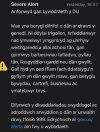
And Welsh is a language where it pays to be concise!Just for posterity, I’ve attached a screen grab of the Welsh version. Checking back, it was actually a further 9 minutes before the English language version arrived.
This. I got mine early on (must have been soon after 1900) but my wife didn't get it until several hours later. That would explain why some English-language alerts in Wales did't arrive until after the Welsh ones.According to the uk.gov website, the messages are sent out on a rolling basis, starting from 1900. I didn't receive mine until about 1950. So it might well be that the English language version takes longer to roll-out than the Welsh language version, considering the numbers involved. I don't see any need for ridiculous conspiracy theories.
== Doublepost prevention - post automatically merged: ==
I think I was overly dismissive above in suggesting a 'boy crying wolf' scenario. I was assuming that no-one with any intelligence or common sense would dream of lighting a barbecue in the open in these weather conditions. However, my daughter was with some friends the other day – educated, professional, parents, age 30+ – who did just that. I'm sure they extinguished it responsibly, and cleared up, but it suggests the warning was needed.
14 minutes for me.Just for posterity, I’ve attached a screen grab of the Welsh version. Checking back, it was actually a further 9 minutes before the English language version arrived.
Sorry but if I am going to drop everything when bathing my kid to run to my phone it had better be worth it.
Even less helpful if when you get there it's in a language you can't read. (And then when you tap on it in the hope of finding out more it just disappears...but I think I can blame my phone for that not the government).
== Doublepost prevention - post automatically merged: ==
I think I was overly dismissive above in suggesting a 'boy crying wolf' scenario. I was assuming that no-one with any intelligence or common sense would dream of lighting a barbecue in the open in these weather conditions. However, my daughter was with some friends the other day – educated, professional, parents, age 30+ – who did just that. I'm sure they extinguished it responsibly, and cleared up, but it suggests the warning was needed.
But that doesn't mean that abusing the emergency alert system was right way to get the message across.
I have seen multiple reports on local internet sites suggesting that since the alert people have been letting off fireworks, using firepits and having barbacues. it would seem that people are doing the opposite after the alert.
I suppose that stands to reason as many people do like to be rebels
I suppose that stands to reason as many people do like to be rebels
What caused this mass lobotomisation !? I absolutely despair. I am so profoundly over this country. I'm actually beginning to seriously detest peopleI have seen multiple reports on local internet sites suggesting that since the alert people have been letting off fireworks, using firepits and having barbacues. it would seem that people are doing the opposite after the alert.

Baxenden Bank
Established Member
- Joined
- 23 Oct 2013
- Messages
- 4,761
Did everyone get the verbal version as well as the text? I can't remember what happened with the test message.
Secondly, surely it would be better if the message stayed on the phone for future re-reading. Especially if it has links to more detailed information, numbers to call etc. You could, and I did, lose it unintentionally. All other texts / emails / messages are kept on my phone unless I proactively delete them, even then with a prompt first 'am I sure I want to delete'.
Secondly, surely it would be better if the message stayed on the phone for future re-reading. Especially if it has links to more detailed information, numbers to call etc. You could, and I did, lose it unintentionally. All other texts / emails / messages are kept on my phone unless I proactively delete them, even then with a prompt first 'am I sure I want to delete'.
Did everyone get the verbal version as well as the text? I can't remember what happened with the test message.
Not me. I'm told that hearing a phone attempt to read out Welsh is particularly amusing.
Secondly, surely it would be better if the message stayed on the phone for future re-reading. Especially if it has links to more detailed information, numbers to call etc. You could, and I did, lose it unintentionally. All other texts / emails / messages are kept on my phone unless I proactively delete them, even then with a prompt first 'am I sure I want to delete'.
That - that is indeed quite odd. They seem to be far too easy to dismiss. This is probably not something the UK government has much control over though.
On my phone it turns out that alerts can be retrieved if you go deep into the settings screens. But it's not exactly obvious.
Baxenden Bank
Established Member
- Joined
- 23 Oct 2013
- Messages
- 4,761
I've had a delve.Not me. I'm told that hearing a phone attempt to read out Welsh is particularly amusing.
That - that is indeed quite odd. They seem to be far too easy to dismiss. This is probably not something the UK government has much control over though.
On my phone it turns out that alerts can be retrieved if you go deep into the settings screens. But it's not exactly obvious.
The feature appears in the same 'menu' as that to turn off alerts.
On mine:
Settings
Notifications
Emergency Alerts
Emergency Alert History
As an aside, it lists 'extreme alerts' (extreme threat to life and property) and 'severe alerts' (severe threats to life and property).
As I took no action as a result of yesterdays message, and I am still living and breathing, I guess the situation is neither extreme nor severe at the present time.

Very generous of you to consider GBNews as a news channel.Including GBNews and the one with Julia Hartman?
== Doublepost prevention - post automatically merged: ==
That's a bizzare method of justifying actions, if we are doing one thing, then all other actions are justifiable. Lets try applying that to other scenarios, how about "if we are ginging people fines for littering, littering must be severe, therefore it is justifiable to execute people for littering".If it wasnt we wouldnt need to be banning the sale of them etc. Sadly people are either complete idiots or are incredibly selfish and so are creating real high risk dangers to large parts of the country.
As a reminder, my position is not "we should have done nothing" but "it would have been more apropriate to communicate this information by more conventional means". Can you show any analysis into how many wildifres we estimate have been prevented by this escalation to a "Severe alert"Given morons arent using their brains and are endangering large portions of the country, yes.
Please tell me where I said that we should only use the BBC? I'm going to have to ask you to desist from making these strawman arguments.Not in a way that would get to everyone. Gone are the days everyone is watching the bbc.
A situation can still be non trivial, but that does not mean it is a trivial use of the system designed for urgent emergency alerts. To give a railway example, fare evasion is a serious issue, however it would not be apropriate to stop all trains on a mainline whenever there is a suspected fare evader.Given the situation it isnt trivial though.
Last edited:
A situation can still be non trivial, but that does not mean it is a trivial use of the system designed for urgent emergency alerts.
The politicians' syllogism:
- We must do something.
- This is something.
- Therefore, we must do this.
Correct but I'd call it the voters' syllogism.The politicians' syllogism:
- We must do something.
- This is something.
- Therefore, we must do this.
3141
Established Member
Yes, I'd noticed people saying they were muting the system. Their logic is amazing: because, in their expert opinion, it wasn't necessary for the system to have been used in this case, they will make sure they don't ever receive an emergency notification in the future.It's the opposite of being selfish and narrow-minded to recognise reality: that if the alert system is used for stuff like this then an increasing number of people will mute it and one day a genuinely time critical alert will be missed by many. That's just basic psychology. You can see people in this thread already who are muting it.
Then they start telling us how much better they would have done it, as if to justify their actions. For example, saying the message should only have gone to the areas with the greatest fire risk - as if no-one from outside those areas would ever travel into one of them, and therefore wouldn't need the warning.
There are some people who apparently resent being reminded that there are situations in which the collective good of the majority may override their individual wish to proceed in their own particular way.
Egg Centric
Established Member
While your faith in the decision making of those sending this out for the "collective good" is touching, itYes, I'd noticed people saying they were muting the system. Their logic is amazing: because, in their expert opinion, it wasn't necessary for the system to have been used in this case, they will make sure they don't ever receive an emergency notification in the future.
Then they start telling us how much better they would have done it, as if to justify their actions. For example, saying the message should only have gone to the areas with the greatest fire risk - as if no-one from outside those areas would ever travel into one of them, and therefore wouldn't need the warning.
There are some people who apparently resent being reminded that there are situations in which the collective good of the majority may override their individual wish to proceed in their own particular way.
doesn't really matter whether they're right or wrong to mute at this point (imo probably not because I think it's worth seeing if there's some proper reflection on this first or if nonsense alerts become a habit).
The point is that both muting and desensitisation are completely foreseeable and by using this system for tosh the government has weakened it. If it continues to do so, it'll render it almost useless.