Incogcyclist79
Member
Literally just been over it, thankfully all lines open now.It is.

Literally just been over it, thankfully all lines open now.It is.
There is now a height restriction ahead warning sign on blue background about 150m before the bridge, which I think is new (although the overhanging vegetation partly hides it as driving towards it), which rather suggests lack of joined up thinking, putting up a sign where bushes partly hide itThat explains why there haven’t been any bridge strikes in the last 2 - 3 weeks!
Google Streetview as of 2024 had signs in place either side of the bridge, but the one on the southbound approach, the second one you pass coming from the A36, was almost completely obscured at that time. I suggest neither sign was newly fitted. The oldest images on streetview are from 2009, and the low bridge sign is slightly nearer the bridge, but clear of vegetation. It looks as though at some point the various signs have been re-sited into a ‘different order’…There is now a height restriction ahead warning sign on blue background about 150m before the bridge, which I think is new (although the overhanging vegetation partly hides it as driving towards it), which rather suggests lack of joined up thinking, putting up a sign where bushes partly hide it
Especially since the hot dry weather, a lot more vegetation has sagged from Network rail land towards the road, making signage and visibility of bridge markings much harder to see.
Clearly Network Rail safety management is not understanding the uncut vegetation blocking visibility of warning signs is resulting in bridge strikes. Really they need to cut a metre wide strip by the road (NR land, the trackbed of former Camerton branch which ran parallel to current live railway). As that strip of vegetation is the problem, and away from live tracks, not clear why it cannot be cut.

Whilst this is not helpful, if you’re driving an HGV, you have no opportunity to turn around by this point if you’re driving a large lorry. It’s a fairly narrow double track road to the bridge, and the junction at the bridge won’t have the clearance for a large lorry to turn around. And you can’t really reverse as you’d be doing that for considerable distance with (no doubt) a line of cars behind you. It’s no wonder many chance it.Google Streetview as of 2024 had signs in place either side of the bridge, but the one on the southbound approach, the second one you pass coming from the A36, was almost completely obscured at that time. I suggest neither sign was newly fitted. The oldest images on streetview are from 2009, and the low bridge sign is slightly nearer the bridge, but clear of vegetation. It looks as though at some point the various signs have been re-sited into a ‘different order’…
View attachment 207639
Alt text, a screen grab from Google Streetview showing hidden low bridge sign.
Whilst this is not helpful, if you’re driving an HGV, you have no opportunity to turn around by this point if you’re driving a large lorry. It’s a fairly narrow double track road to the bridge, and the junction at the bridge won’t have the clearance for a large lorry to turn around. And you can’t really reverse as you’d be doing that for considerable distance with (no doubt) a line of cars behind you. It’s no wonder many chance it.
They need to install some signage further back, possibly as far back at Bath!
However there‘s also a sign immediately after you turn off the A36. (Hence me writing ‘second one you pass’.) I suspect it should be repeated on the A36 though. It’s no good assuming an HGV can turn in what looks like a school entrance.Whilst this is not helpful, if you’re driving an HGV, you have no opportunity to turn around by this point if you’re driving a large lorry. It’s a fairly narrow double track road to the bridge, and the junction at the bridge won’t have the clearance for a large lorry to turn around. And you can’t really reverse as you’d be doing that for considerable distance with (no doubt) a line of cars behind you. It’s no wonder many chance it.
They need to install some signage further back, possibly as far back at Bath!

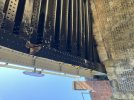
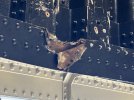
That's the most damage to a bridge metalwork that I ever saw when I worked for the railway and was called to attend (back when I held the "bridge bash" certification) or in connection with my normal duties. So whatever it was, it must have been something substantial.A couple of photos taken today of the damage under the bridge. The vehicle was driving (in all cases) from left to right.
And if they have not, who is responsible for the negligence in failing to protect the public purse. There should be no question about whether or not to chase (and no bankruptcy protection for the guilty parties).I'd love to know how many drivers have been charged by Network Rail for the disruption they've caused?
You can see very similar damage in the current google Streetview image, I think it’s from about 2024. If you’re positioned under the bridge you can look upwards. Looking at the chalked numbers it seems the same place, but it’s been repainted since. But I’d have thought damage like that peeling sheet metal was caused by a hit from the opposite direction, ie coming from the right in the recent photos.That's the most damage to a bridge metalwork that I ever saw when I worked for the railway and was called to attend (back when I held the "bridge bash" certification) or in connection with my normal duties. So whatever it was, it must have been something substantial.
Most bashed bridges that I saw had been hit by the relativity lightweight upper structure of either the wind defector above/behind the cab or the top of the goods/freight compartment. Leaving debris like fibreglass, wood or lightweight metal behind.
Could be somethink overheight was backed out, but something solid like a grab or excavator arm, not a lightweight truck box.But I’d have thought damage like that peeling sheet metal was caused by a hit from the opposite direction, ie coming from the right in the recent photos.
Yes, that damage seems more of a point impact. For certain types of vehicle (or the transported machinery), I suspect the reversing after the initial hit can cause relatively more damage.Could be somethink overheight was backed out, but something solid like a grab or excavator arm, not a lightweight truck box.
The road dips under the bridge so possibly it has been measured as a spot clearance height, than than a 10+m long vehicle where one end is about 20cm higher, thus reducing any error margin.

 www.winsley.org.uk
I’ve tried attaching the above mentioned report below.A Bridge Too Far?
I know many of you would like to know what is happening regarding the repeated strikes by high lorries on the railway bridge, which have caused so much disruption over the past year. I have kept many of you individually updated with my attempts to get something done, but I thought I would share this update with everyone via Parish Council Websites, Facebook pages and WhatsApp groups.
It has been quite a challenge to get Wiltshire Highways, Network Rail and National Highways around a table to have meaningful discussions focusing on solutions. Wiltshire Highways, Atkins and Network Rail engineers finally met face-to-face a couple of weeks ago and have produced a set of slides and meeting notes that they are happy for me to share with residents.
Brief background
In July last year, Network Rail started works to repair the bridge following a major lorry strike. As you know, the B3108 was closed for six weeks and rail services were reduced. When I started to hear concerns raised that the bridge height did not reflect the road gradients properly and that similar strikes would happen again, I contacted Wiltshire Highways to pass on those concerns. I was told that all the calculations had been done correctly and that the bridge had no significant record of strikes in the past.
Then on March 23rd, I was travelling back by train from London when we were informed at Westbury station that there had been a bridge strike further down the line and that all trains to Bath had been cancelled until further notice. I knew immediately that this was our bridge. I subsequently discovered that the strike was exactly like the first one: perhaps our resident and the on-site engineer from Network Rail were right and Wiltshire Highways, God forbid, were wrong?
Current Situation
It was time to get something done. The strikes continued, every one requiring Network Rail to hold trains until an inspection had been done.
The strikes on the 23rd had caused 38 full and 39 partial train cancellations; this was costing Network Rail serious money, NR wanted something done too, and they were prepared to discuss funding risk mitigation measures. One of the many things suggested by residents to me was some sort of sensor activated sign before Winsley roundabout warning high vehicles to turn around. This option was discussed positively by both parties. The estimated cost would be around £25k which NR would fund and WH would install. NR also proposed putting up a similar temporary sign until a permanent sign was installed. This was sounding like something was going to get done, and it still may, however, new options have entered the discussion, which might produce better results, but they will take longer and cost more.
Please read the Meeting Notes and supporting slides below for details.
MEETING NOTES - 9 July 2026
SUPPORTING SLIDES
Essentially, the main problem is that Network Rail Engineers think that the correct height restriction should be 3.9m but WH think that 4.1m is right.
If that sounds intractable, fear not, NR need to get something done and I'm going to make it my mission to get something done, because residents need to get something done!
Thank you to all the residents who have sent in photos and other evidence – some of you will see your work in the links above. In fact, every option they are discussing has been suggested by at least one of you already -
Since the meeting, a further option was suggested by WH – to reduce the surface height of the road (another one of yours). But this would easily cost the most and take the longest of all the options discussed - easy to propose if you're not paying!
So far all I've got done is to get the Yellow Box under the bridge repainted. Next target is to get a mobile warning sign put back in the layby by September
Nigel White,
Unitary Councillor and 'Chivvier-in-Chief'
Email: nigel.white@wiltshire.gov.uk
== Doublepost prevention - post automatically merged: ==
I see that where they’d turn off the A363 into Winsley Rd the height restriction (3 miles away at that point) is different, showing as 4.2m…The reason for some bridge strikes from the east might be truck drivers taking the A363 south from Bathampton, then becoming aware of the weight restriction at Bradford and turning right at Winsley Road.
Looks like this one:I see that where they’d turn off the A363 into Winsley Rd the height restriction (3 miles away at that point) is different, showing as 4.2m…
 news.railbusinessdaily.com
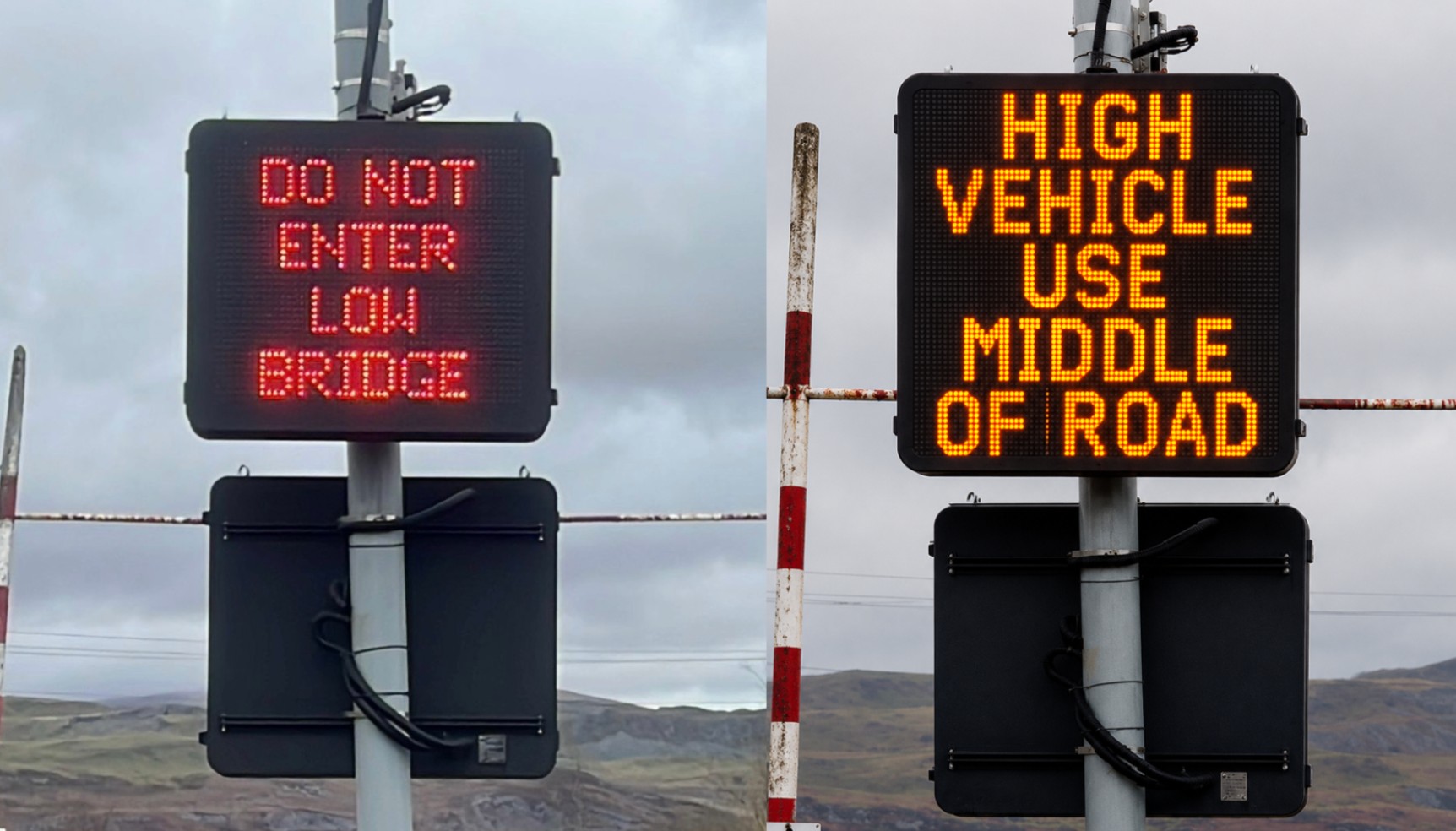
The roadside safety system is designed to reduce the number of over-height vehicles striking low railway bridges and has been developed through the UK Government Department for Transport’s ‘First-Of-A-Kind’ programme.
Not directly related, and not wanting to start a debate about innovation funding, but evidence that a gadget designed to provide the kind of early warning called for here does exist:
BridgeBouncer begins showcase at Global Centre of Rail Excellence site | RailBusinessDaily
The Rail and Station Innovation Company (Rasic) have installed their ‘BridgeBouncer’ system at the Global Centre of Rail Excellence (GCRE) as part of a The Rail and Station Innovation Company (Rasic) have installed their ‘BridgeBouncer’ system at the Global Centre of Rail Excellence (GCRE) as...
And they are not new. Here's a surviving BBC news item from twenty years ago!Not directly related, and not wanting to start a debate about innovation funding, but evidence that a gadget designed to provide the kind of early warning called for here does exist:
BridgeBouncer begins showcase at Global Centre of Rail Excellence site | RailBusinessDaily
The Rail and Station Innovation Company (Rasic) have installed their ‘BridgeBouncer’ system at the Global Centre of Rail Excellence (GCRE) as part of a The Rail and Station Innovation Company (Rasic) have installed their ‘BridgeBouncer’ system at the Global Centre of Rail Excellence (GCRE) as...
Since you don't need anything that complicated to make one, the surprise is that so few have ever been put in. Maybe they just are not very effective, and hard to make reliable enough. Those two in Swindon do seem to be still there, though Google Street View can hardly tell you if it's still operating.Last Updated: Wednesday, 19 October 2005, 20:36 GMT 21:36 UK
Low bridge gets high-tech warning
High-tech height sensors have been added on the approaches to a notorious railway bridge in a bid to stop high vehicles striking it.
The Whitehouse Road bridge in Swindon is one of the most struck railway bridges in the country.
Despite prominent warnings the bridge has been struck 142 times in the past 10 years.
The sensors are designed to flash a warning if a vehicle is too high to fit under the bridge.
A similar device has also been put in place near the Wootton Bassett Road bridge near the Mannington Roundabout.
The signs are a joint initiative between Network Rail and Swindon Borough Council.
There is a link to a PDF list with short descriptions of the winners here.Peak to Peak Measurement Solutions Ltd
Low Power Distributed Multi-Sensor Mesh for Long-Term Remote Monitoring of Rail Bridge Strike Events
Sensing Feeling Limited
BridgeGuard
Rasic Ltd
Bridge Bouncer
Space Data Centres Ltd
BridgeAlert: Low Cost Scalable BLE Beacon Technology For Bridge Clearance Driver Alert System
CGA Simulation Limited
Immersive Bridge Strike Awareness (IBSA)
JR Dynamics Limited
Bridge Strikes Guardian
University of Birmingham
Bridge Aware – Real-Time Prevention, Detection and Mitigation of Bridge Strikes on Rail Bridges.