• Our new ticketing site is now live! Using either this or the original site (both powered by TrainSplit) helps support the running of the forum with every ticket purchase! Find out more and ask any questions/give us feedback in this thread!

Reopenings - the positive narrative the railway industry needs !

Dr Day

Member
Joined
16 Oct 2018
Messages
755
Location
Bristol
The highest prediction was 600,000, and it actually saw 920,000, so more than 50% higher than the upper predicted level.
What is the source of these predictions and actuals please? I’ve never been able to find the final forecasts with the assumptions behind them (service level, journey times, fares, local population/jobs, phasing of stations, year of opening, marketing of the presence of the line, bus/road alternatives etc) which would help understand the reasons behind any under or over forecasting.

The Borders had a very useful piece of post-opening analysis which demonstrated why and where forecasts were out, and overall it was about right but in different places. It would be good to see something similar for Northumberland.
 
Sponsor Post - registered members do not see these adverts; click here to register, or click here to log in
R

RailUK Forums

Zomboid

Established Member
Joined
2 Apr 2025
Messages
2,209
Location
Oxford
Time will tell with Northumberland passenger numbers vs predictions. It isn't unheard of for numbers to stabilise broadly in line with what was anticipated, but with a quicker ramp up.

Either way, it's pretty hard to argue that what's happened so far has been anything less than a success.
 

Bald Rick

Veteran Member
Joined
28 Sep 2010
Messages
35,581
Time will tell with Northumberland passenger numbers vs predictions. It isn't unheard of for numbers to stabilise broadly in line with what was anticipated, but with a quicker ramp up.

The quicker ramp up happens on almost every new line / station.

A cynic might say that the ramp up factors applied are deliberately suppressed just to enable positive headlines after one year.

A different type of cynic might say that as most of these projects run late, the socio-economic shifts that trigger the demand increases happen in line with the original opening date, and therefore the ‘much higher than expected after one year’ is actually ‘in line with forecasts for year three, which is what this should be now’.

Fortunately, I’m not a cynic. o_O
 

zwk500

Veteran Member
Joined
20 Jan 2020
Messages
18,401
Location
Northampton
I’ve never been able to find the final forecasts with the assumptions behind them (service level, journey times, fares, local population/jobs, phasing of stations, year of opening, marketing of the presence of the line, bus/road alternatives etc) which would help understand the reasons behind any under or over forecasting.
Ive not seen the FBC published but the OBC has been. And that predicted 1.4m passengers a year once the scheme was fully open so no idea where @The Ham got his numbers from.
 

Magrar

On Moderation
Joined
20 Jun 2026
Messages
186
Location
Reading
I'll give a concrete example, to see if that moves some of the people who are obviously ecstatic that the forecasts were exceeded, to ponder how this line can actually be seen as a miserable failure (of planning, imagination, leadership), and thus nothing to shout about.

The Ashington terminus has a nice big car park next to it. Why? That space is large enough for multiple doubler decker buses to call at the station, offloading and picking up people just yards from the platform.

It could have even also accomodated a nice large station buidling, warm, dry, with waiting areas and hot food avaiable. Maybe the Ashington tourist office too.

We are told the politicians want joined up transport, we are told the buses and trains in this area will soon all be in public hands. It is said we are aiming to restore if not increase bus ridership levels, as a critical part of the solution to getting people out of their cars. The buses in that area are going electric already.

So why was that terminus designed with the assumption that car drivers are more important than bus users? It may not seem like a long walk to the actual bus station, but in the pouring rain, with kids, luggage, dodging the local crack heads, it's enough to make you not want to do it, if you have the means. What gives them the means if they don't already have it? Economic growth boosted by a train line.
 

yorkie

Forum Staff
Staff Member
Administrator
Joined
6 Jun 2005
Messages
78,188
Location
Yorkshire
I'll give a concrete example, to see if that moves some of the people who are obviously ecstatic that the forecasts were exceeded, to ponder how this line can actually be seen as a miserable failure (of planning, imagination, leadership), and thus nothing to shout about.

The Ashington terminus has a nice big car park next to it. Why? That space is large enough for multiple doubler decker buses to call at the station, offloading and picking up people just yards from the platform.

It could have even also accomodated a nice large station buidling, warm, dry, with waiting areas and hot food avaiable. Maybe the Ashington tourist office too.

We are told the politicians want joined up transport, we are told the buses and trains in this area will soon all be in public hands. It is said we are aiming to restore if not increase bus ridership levels, as a critical part of the solution to getting people out of their cars. The buses in that area are going electric already.

So why was that terminus designed with the assumption that car drivers are more important than bus users? It may not seem like a long walk to the actual bus station, but in the pouring rain, with kids, luggage, dodging the local crack heads, it's enough to make you not want to do it, if you have the means. What gives them the means if they don't already have it? Economic growth boosted by a train line.
We don't do Swiss-style integrated transport in GB, sadly.

However, that doesn't mean the line is anything but a success.

Yes, of course railway lines could be more popular if we had proper feeder bus services, facilities and integrated timetables, but in the absence of that, the line is doing extremely well by GB standards.
 

yorksrob

Veteran Member
Joined
6 Aug 2009
Messages
44,244
Location
Yorks
What is the source of these predictions and actuals please? I’ve never been able to find the final forecasts with the assumptions behind them (service level, journey times, fares, local population/jobs, phasing of stations, year of opening, marketing of the presence of the line, bus/road alternatives etc) which would help understand the reasons behind any under or over forecasting.

The Borders had a very useful piece of post-opening analysis which demonstrated why and where forecasts were out, and overall it was about right but in different places. It would be good to see something similar for Northumberland.

The Borders, famously overestimated those travelling from nearer Edinburgh but underestimated those travelling from further out - which is the way round you'd want it to be surely !
 

The exile

Established Member
Joined
31 Mar 2010
Messages
9,305
Location
Somerset
The Borders, famously overestimated those travelling from nearer Edinburgh but underestimated those travelling from further out - which is the way round you'd want it to be surely !
Especially since much of the housing which was going to provide that ridership on the inner stretch has yet to materialise.

== Doublepost prevention - post automatically merged: ==

Which are nothing to shout about, being the point.

In GB, rail is a second class afterthought, and that's no more obvious than in the left behind north.
Just as a comparison, the reopening of the Hermann Hesse Bahn from Weil-der-Stadt to Calw (edge of the Stuttgart S-Bahn - so far from deprived Baden-Wuerttemberg) is being hailed as a success having carried 25377 passengers in its first month.
 
Last edited:

yorksrob

Veteran Member
Joined
6 Aug 2009
Messages
44,244
Location
Yorks
This is indicative of why the line is nothing worth shouting about. It is clear the estimates of expected demand were way off, so it is clear that whoever is building railways in the UK does not actually understand the travel needs of places like that region, and probably just used assumptions from elsewhere, or massively outdated models full stop.

That they do not truly understand the north-south divide, the need to level up this country, and thus the true, highest potential of a line like this in the modern age. What it could be doing in just 5 years, had the potential been factored in from the start. And which is now locked out due to choices made in the design. Literally locked out in some cases, with all that ugly fencing and the 20th Century views of shared space.

What if the line had been designed and built as a true intensively worked but net zero system? What if the option of tram trains or seamless integration with the Metro, rather than interchange, had been used? What if the stock had space for more than two bikes, or actually allowed ebikes/scooters?

What if the stations were genuinely inviting pieces of functional architecture and multi use community spaces? What if you could get a warm meal there, perhaps a vegan sausage roll, rather than having to leave the station? These things all being factors in why people might choose the train over a car.

What if you could use this line in a storm or artic blast, without requiring a trip to North Face beforehand? Bearing in mind the Newcastle terminus is under cover and has many onward connections entirely protected from the elements. Since a train, being a train, is comfortably ridden in normal clothes, even in harsh weather. Or it can be. Whether this stock is up to the task, is debatable.

And the other stations were all designed to allow a passenger to be dropped off at the door. Sadly by cars or taxis, but in time, if they rip out some of kerbs, replace some of the signage, redraw some of the line painting, that could at least be some form of community owned last mile public transport.

Or just a bus, a proper bus, which currently seem to be excluded from the footprints that I've seen, stopping at the customary arms length distance that has become normalised.

What might the ceiling have been then?

The vision, the ambitiom, the commitment was not there. That's why they ended up with something that looks, feels and sounds like it was built on the cheap, providing the bare minimum, what's already been done elsewhere (and found wanting). Merely yet another bit of railway that looks and feels as outdated as the rest of it.

The difference between the level of innovation for something like the lizzy line, with its self driving three signal type stock, is clear. Yes this could all be rectified in time. But we all know it won't be.

So there will be a level crossing in the middle of Ashington for the next 50, possibly a 100 years. Ironically it will cease to be a drag on the local economy only when the local economy ceases to be car dependant. Something the planners of this line have not really ensured is any more achieveable than it was before.

Those car parks lock in car dependency, and make car ownership something to aspire to. So one day there's always the option of those car owners choosing to skip the train portion of their journey, should it be more convenient. Perhaps because a major road improvement in the region, cuts the journey time. The local Mayor, a Labour Mayor, wants those improvements.

These are all oddly disconnected/muddled design choices, since literally every journey this line offers, was already possible using a bus. Buses that are going electric in the very same year this line eventually opened. Because that's how fast the modern world is changing. So it would have been worth shouting about if the railway was already able to be that dynamic and forward facing.

This is all why it feels like someone massively over-estimated how many of the passengers using this line, would also be using a car. At the moment anyway. That's why the line, counterintuively, with it's belching diesel stock, might not be the choice of travel for a true, hardcore environmentally conscious traveller, who has a dim view (for good reason) of even personal electric car transport. Perhaps negative sterotypes that such people do not even exist in that region, were at work?

The least said about someone not anticipating there would be unexploded bombs or unknown mine workings in this area, so that these compounded truly unpredictable costs (although how unforseeble such things were in the post-Covid Trump world, is debatable), the better.

Put simply, in local political terms, to a left behind Reform voter, or a jumped ship to the Greens voter, does this line feel like the step change this country, this specific region, wants, demands, or was it just more of the same? Even to a Labour voter, was this a wow moment?

Was it perhaps priced in that whatever else was happening in the country, Newcastle and surrounds, are forever safe Labour territory? Due ironically to changing demographics and more eco-friendly attitudes. So doing something, but the bare minimum, would suffice to quell the sort of anti-Labour rebellions now being seen in Sunderland and whatever the local equivalent of Brighton is.

Which is not to say don't do it. But the premise of the thread is, should we then shout about it once it's done?

There are some valid points there, mainly about design choices and constraints in affordability, however bear in mind that we didn't have any reopenings in England throughout most of the privatisation period and now, in the space of a few years, we have a popular route delivering benefits to local people.

The railway is going through a rough patch - HS2 overruns, persistently high fares, reliability issues, all of which cast a pall of gloom over it.

This reopening is a very positive story and the railway industry should absolutely be shouting about it because it has provided what people want of the railway comparatively quickly and cost effectively.

== Doublepost prevention - post automatically merged: ==

I'll give a concrete example, to see if that moves some of the people who are obviously ecstatic that the forecasts were exceeded, to ponder how this line can actually be seen as a miserable failure (of planning, imagination, leadership), and thus nothing to shout about.

The Ashington terminus has a nice big car park next to it. Why? That space is large enough for multiple doubler decker buses to call at the station, offloading and picking up people just yards from the platform.

It could have even also accomodated a nice large station buidling, warm, dry, with waiting areas and hot food avaiable. Maybe the Ashington tourist office too.

We are told the politicians want joined up transport, we are told the buses and trains in this area will soon all be in public hands. It is said we are aiming to restore if not increase bus ridership levels, as a critical part of the solution to getting people out of their cars. The buses in that area are going electric already.

So why was that terminus designed with the assumption that car drivers are more important than bus users? It may not seem like a long walk to the actual bus station, but in the pouring rain, with kids, luggage, dodging the local crack heads, it's enough to make you not want to do it, if you have the means. What gives them the means if they don't already have it? Economic growth boosted by a train line.

I'll agree that the motor car probably takes a bit too much prominence - do we still need such large car parks ? Maybe not, however we live in a car-centric society and it will feature.

The other point is, now that we have an operational passenger railway in the area, it will be so much easier to restructure bus services to feed into it. It will be so much easier to build community/commercial hubs if its decided that they're needed. Just because these haven't appeared now, doesn't preclude them from happening in the future.

My ecstasy remains undimmed.
 
Last edited:

Dr Hoo

Established Member
Joined
10 Nov 2015
Messages
5,604
Location
Hope Valley
Ask the people who live near a popular station that doesn’t have adequate car parking and they’ll tell you.
Precisely. I know that for some unfathomable reason Corby seems to be regarded with derision by many on these Forums (with endless suggestions as to how the service could be made less frequent, slower or involving changing at Kettering) but it has been remarkably successful. However, it is held back by its tiny car park, coupled with zealous enforcement by the local council.
The answer is most emphatically not more bus links, given the low density of much of Corby and the need for buses to wander all round through the estates to scrape up even moderate loadings.
 

Magrar

On Moderation
Joined
20 Jun 2026
Messages
186
Location
Reading
As well as the needless waste, it is much harder politically to rip out a car park next to a station in favour of non-car transport or retail, than it is to design it that way.

The north east has the lowest car ownership on the country. There's no sense in spending the next 20 years trying to use new rail connections to boost car ownership there, only to then try and get all those drivers to leave their cars home, or not have one at all.

Factor in that every extra car on the road makes the buses less reliable, and it makes no sense at all.
 

martin butler

Member
Joined
9 Oct 2018
Messages
847
You would think the idea would be to get people out of their cars and onto public transport, So the answer has to be fast and frequent busses between where the people live and the station, ran by the railway, as a feeder service, connecting with trains, and shown in the timetables also, it could also be a way to link out laying villages back into the network also

== Doublepost prevention - post automatically merged: ==

I think Bodmin Parkway to Padstow would be a great benefit to that part of Cornwall.
That would be a bit of a long way round, unless you run over part of the B&W rly to Wadebridge, thence on to Padstow,

I would prefer it if the line from Barnstable were to be reopened , to Bideford, thence on to halwell, then along the north Cornwall coast to Padstow,
 
Last edited:

Recessio

Established Member
Joined
4 Aug 2019
Messages
1,489
Location
London
Indeed, that is the answer for most reopenings proposed on these pages.
There are certainly Beeching era bus replacements which are wholly inadequate. The Stagecoach 53/63 buses from Cranleigh/Horsham to Guildford, for example. Everyone in Cranleigh and Bramley just drives to Guildford or Godalming stations anyway, snarling up the traffic and making the buses slower for the people who can't drive and have to use the buses. A faster more frequent bus (perhaps only stopping at the former stations) would go a long way to solving the problem without the complete faff of reopening the Cranleigh line.
 

Bald Rick

Veteran Member
Joined
28 Sep 2010
Messages
35,581
There are certainly Beeching era bus replacements which are wholly inadequate. The Stagecoach 53/63 buses from Cranleigh/Horsham to Guildford, for example. Everyone in Cranleigh and Bramley just drives to Guildford or Godalming stations anyway, snarling up the traffic and making the buses slower for the people who can't drive and have to use the buses.

Indeed. A lot easier and cheaper to resolve that through a better bus service than building a new line through Bramley!
 

swt_passenger

Veteran Member
Joined
7 Apr 2010
Messages
34,227
I see we‘ve had the traditional “should have been Metro” angle, regarding the Ashington route. People seem to forget that when it was proposed, there was a political divide. Metro was (and still is) a Tyne and Wear county owned system. Not their responsibility to extend it beyond their county boundary, and you can be pretty sure Northumberland didn’t want to become responsible for any Metro costs. But running on to and using Metro tracks from the obvious junction would apparently have been slower than the existing fast buses. So although proposed informally about 10 years ago, it was never followed up.
 

yorksrob

Veteran Member
Joined
6 Aug 2009
Messages
44,244
Location
Yorks
Indeed, that is the answer for most reopenings proposed on these pages.

Au contraire, fast and frequent buses are ideal for short hops, however they don't tend to come close to a rail reopening as part of the National transport system.

You can get the bus from Bodmin Parkway to Padstow - up and down, round and round, all sorts of unsuitable country lanes. The service isn't remotely comparable to that provided by the surviving branch lines in Cornwall.

I wonder how many public transport users in Ashington and Okehampton feel that a bus service would have been just as good !
 

HSTEd

Veteran Member
Joined
14 Jul 2011
Messages
20,265
I see we‘ve had the traditional “should have been Metro” angle, regarding the Ashington route. People seem to forget that when it was proposed, there was a political divide. Metro was (and still is) a Tyne and Wear county owned system. Not their responsibility to extend it beyond their county boundary, and you can be pretty sure Northumberland didn’t want to become responsible for any Metro costs.
Well I'd reply to this that the obvious solution to this would be for the national government to contract with Tyne and Wear Metro to operate the line, analogously to how they contract with Northern to run the line as it exists.
The only major reason I can see for T&W Metro not wanting to operate it would be that it would lose them money, and if contracted by the government it would not.

Is Northumberland council currently on the hook for the costs of this line?

I'd suggest the same for Merseyrail to Wrexham or Manchester Metrolink to New Mills

But running on to and using Metro tracks from the obvious junction would apparently have been slower than the existing fast buses. So although proposed informally about 10 years ago, it was never followed up.
The journey time advantage is only ten minutes though to Newcastle Central, and in taking this speed benefit they have probably permanently crippled any future growth for the line as it is now directly competing with the ECML for Paths into Newcastle
 

yorksrob

Veteran Member
Joined
6 Aug 2009
Messages
44,244
Location
Yorks
I'm not sure that the "should have been metro" argument bears much relevance to the argument. This was a national rail reopening. It worked and it is popular with local passengers.
 

swt_passenger

Veteran Member
Joined
7 Apr 2010
Messages
34,227
I'm not sure that the "should have been metro" argument bears much relevance to the argument. This was a national rail reopening. It worked and it is popular with local passengers.
Neither do I. But others have mentioned it.
 

The Ham

Veteran Member
Joined
6 Jul 2012
Messages
12,021
Ive not seen the FBC published but the OBC has been. And that predicted 1.4m passengers a year once the scheme was fully open so no idea where @The Ham got his numbers from.


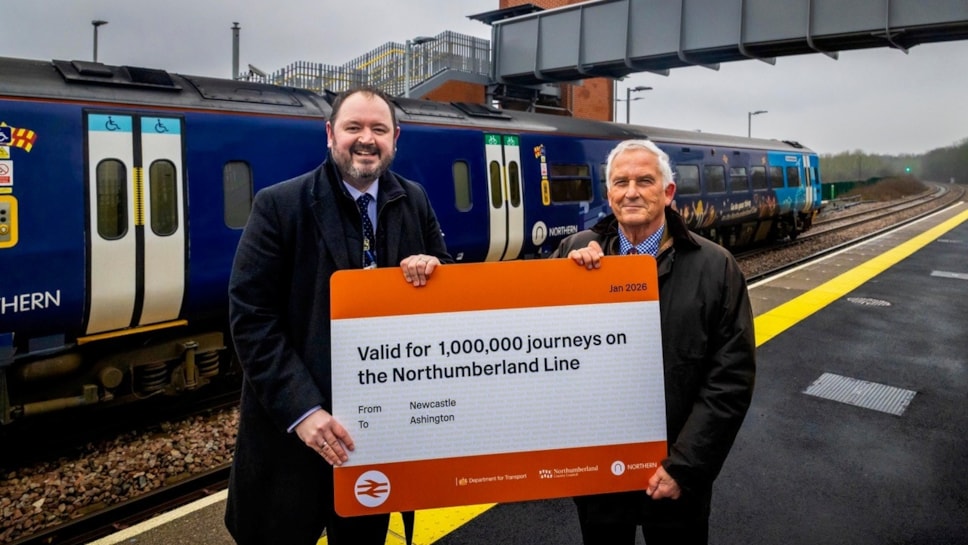
One million passenger journeys made on the Northumberland Line as date for next station opening is announced

Passengers have made more than 1,000,000 journeys on the Northumberland Line, just over a year after it opened.

In terms of the predictions:


P85 has the phase 2 (i.e. 6 stations open) has a higher passenger numbers of 704,000 for 2025 with 1.45 million expected in 2039. The table below covers the main passenger data.

Forecast YearFranchise Demand
Concession
Demand
4 station Opening Year (2024)362,000 journeys442,000 journeys
6 station Full opening (2025)572,000 journeys704,000 journeys
Long-Term Horizon (2039)1,160,000 journeys1,450,000 journeys

(Edit, the column titles were the wrong way around)

So yes, the long term trend is for the 1.4 million, although in the first year it's significantly below that (either the 4 station opening year or the 6 station opening year).

Although, it's coincidental that the line reached 1.4 million in 18 months:


Whilst the stations did not open together on a single day due to delays and complications, as of May 2026, all of the stations on the line are now open, and the route is proving to be immensely successful, with it having carried well in excess of 1.4 million passengers to date, despite only being open for around 18 months.
 
Last edited:

SynthD

Established Member
Joined
4 Apr 2020
Messages
2,014
Location
UK
Are there millennial station openings that are now at the year of their Long Term Horizon, that we can look at for accuracy of predictions? As the question of better calculating short term benefits has gone unanswered, let’s try the vague longer term.
 

yorksrob

Veteran Member
Joined
6 Aug 2009
Messages
44,244
Location
Yorks
Agreed, absolutely nil chance of getting that level crossing reinstated.

It does seem very tail wagging the dog, not reopening a line because of a supposedly dangerous level crossing while inadvertantly pushing everyone onto "perfectly safe" road transport.

== Doublepost prevention - post automatically merged: ==

Are there millennial station openings that are now at the year of their Long Term Horizon, that we can look at for accuracy of predictions? As the question of better calculating short term benefits has gone unanswered, let’s try the vague longer term.

I guess the Borders line and Ebbw vale spring to mind (we didn't get much in England because Tony Blair "didn't do trains" apparently).
 

martin butler

Member
Joined
9 Oct 2018
Messages
847
Indeed, that is the answer for most reopenings proposed on these pages.
I think you are mis-reading my reasoning,

I mean having busses that act as a feeder into rail routes, not an alternative to, linking the areas where people live, with their local station,

Take Bramley, so, are you advocating the road from there to Guildford becomes a red route bus only route, with cars diverted off that road? linking Cranleigh, and Bramley directly with Guildford Stn? because that's the only way a bus can effectible replace a train.
 

Zomboid

Established Member
Joined
2 Apr 2025
Messages
2,209
Location
Oxford
Are there millennial station openings that are now at the year of their Long Term Horizon, that we can look at for accuracy of predictions? As the question of better calculating short term benefits has gone unanswered, let’s try the vague longer term.
Would the 2020-2022 "stay indoors" period mean that any such comparison would have a significant asterisk against it?

Data until 2019 against predictions would be informative, though.
 

Recessio

Established Member
Joined
4 Aug 2019
Messages
1,489
Location
London
I think you are mis-reading my reasoning,

I mean having busses that act as a feeder into rail routes, not an alternative to, linking the areas where people live, with their local station,

Take Bramley, so, are you advocating the road from there to Guildford becomes a red route bus only route, with cars diverted off that road? linking Cranleigh, and Bramley directly with Guildford Stn? because that's the only way a bus can effectible replace a train.
Even as a proponent of reopening the Cranleigh branch, I honestly reckon there's a better chance setting up a guided busway on the route than getting the line reopened.

== Doublepost prevention - post automatically merged: ==

Would the 2020-2022 "stay indoors" period mean that any such comparison would have a significant asterisk against it?

Data until 2019 against predictions would be informative, though.
In my non-railway field, we generally use pre-2019 data, and are now beginning to have enough data in last few years post pandemic to exclude the lockdowns and semi-interpolate between the two sides. I imagine railways would use something similar?
 

Bald Rick

Veteran Member
Joined
28 Sep 2010
Messages
35,581

Top