• Our new ticketing site is now live! Using either this or the original site (both powered by TrainSplit) helps support the running of the forum with every ticket purchase! Find out more and ask any questions/give us feedback in this thread!

DMU "Paytrain" Operated Routes now closed?

nw1

Established Member
Joined
9 Aug 2013
Messages
9,430
How long did "Paytrain" remain as a brand, incidentally?

In the 1980s I remember "Pay Trains" (space between the two words) being referred to in on-train signage directing passengers on how to buy their tickets ("On Pay Trains, ....") Specifically, I remember the Reading-Gatwick/Tonbridge 119s having this signage (even though most stations were staffed?) as well as the 108s used on the Mid-Cheshire route, in both cases in the early-to-mid 80s.
 
Sponsor Post - registered members do not see these adverts; click here to register, or click here to log in
R

RailUK Forums

Gloster

Veteran Member
Joined
4 Sep 2020
Messages
13,034
Location
Up the creek
Did that section survive long enough to become diesel?

I think it did, but only briefly. However, Paytrain hardly seems appropriate to what appears to have been merely a continuation of the old ‘Tickets Sold by Guard’ practice, something that probably applied to many other lines in their last days.
 

Taunton

Veteran Member
Joined
1 Aug 2013
Messages
12,313
Did that section survive long enough to become diesel?
I think Callington was 412xx 2-6-2T tank locos to the end, and closure of the far end of the line coincided with some curve easement around Calstock on the Gunnislake section to allow diesels to operate.

The Callington extension must be notable for almost all its stations being in the middle of nowhere, including the terminus which was separated from the village by a large hill. Callington itself had much more regular buses the short distance to Saltash, from where before the road bridge there were frequent shuttle trains into Plymouth.
 

izvor

Member
Joined
11 Jun 2014
Messages
595
Location
on the SER
Saxmundham-Aldeburgh closed in September 1966, so presumably not.
Thanks, so earlier than I had thought - and the whole Paytrain marketing idea probably later than I had thought too...

In the 1980s I remember "Pay Trains" (space between the two words) being referred to in on-train signage directing passengers on how to buy their tickets ("On Pay Trains, ....") Specifically, I remember the Reading-Gatwick/Tonbridge 119s having this signage (even though most stations were staffed?)
Yes I remember this too, though it must have come after the line went "paytrain" which was in November 1967, and most small stations were de-staffed and demolished around that date. Can't find the bright green publicity though.

I also remember the Setright ticket machines on the Eastern, though not on which line - possibly Southminster? Or Grimsby - Barton-on-Humber, so could we add the spur to New Holland Pier to the list of closed Paytrain lines?

Here's a few leaflets from 1979 which show the extent of the idea around the Eastern & North Eastern. Most have a separate fares leaflet tipped in, but no information on exactly how to buy tickets, so had the requirement to buy all tickets on board (even from staffed stations) been dropped by then?

Paytrain May1979.jpg
 

Gloster

Veteran Member
Joined
4 Sep 2020
Messages
13,034
Location
Up the creek
I think Callington was 412xx 2-6-2T tank locos to the end, and closure of the far end of the line coincided with some curve easement around Calstock on the Gunnislake section to allow diesels to operate.

The Callington extension must be notable for almost all its stations being in the middle of nowhere, including the terminus which was separated from the village by a large hill. Callington itself had much more regular buses the short distance to Saltash, from where before the road bridge there were frequent shuttle trains into Plymouth.

Steam had gone in Devon and Cornwall by mid-1965; Laira, to which four Ivatts had moved after the closure of Friary, closed to steam around May 1964, although the Ivatts had gone in September 1963. I think it was two-car DMUs thereafter until Callington closed in November 1966.
 

Djgr

Established Member
Joined
30 Jul 2018
Messages
3,398
Thanks, so earlier than I had thought - and the whole Paytrain marketing idea probably later than I had thought too...


Yes I remember this too, though it must have come after the line went "paytrain" which was in November 1967, and most small stations were de-staffed and demolished around that date. Can't find the bright green publicity though.

I also remember the Setright ticket machines on the Eastern, though not on which line - possibly Southminster? Or Grimsby - Barton-on-Humber, so could we add the spur to New Holland Pier to the list of closed Paytrain lines?

Here's a few leaflets from 1979 which show the extent of the idea around the Eastern & North Eastern. Most have a separate fares leaflet tipped in, but no information on exactly how to buy tickets, so had the requirement to buy all tickets on board (even from staffed stations) been dropped by then?

View attachment 203959
Pretty sure that you could buy tickets for use on a Paytrain at a staffed ticket office i.e. you could buy a ticket for Cromer at Norwich booking office.
 

Gloster

Veteran Member
Joined
4 Sep 2020
Messages
13,034
Location
Up the creek
I have found a reference that says that dieselisation of the Callington line took place on 7 September 1964: two-car sets on passenger and D6300 on goods (and possibly one or two passenger). The first day went badly when the 05.30 from Callington failed at Gunnislake.

Source: Tamar Valley Trains (John T R Snell, BEH, 2013). N.b. not the RH&DR John Snell; this was a local railwayman.
 

Magdalia

Established Member
Joined
1 Jan 2022
Messages
7,405
Location
The Fens
With help from flickr, here is some 1969 Paytrain publicity:


Joined
23 Nov 2023
Messages
773
Location
Grimsby
New Holland Pier to the list of closed Paytrain lines?
I did think about this the other day, but a look at the Disused Stations website suggests that both New Holland Town and New Holland Pier retained booking offices until closure; the Pier office also sold ferry tickets to anyone who had driven or walked up the pier rather than arriving by train.
 

61653 HTAFC

Veteran Member
Joined
18 Dec 2012
Messages
19,364
Location
Yorkshire
I was going to say Clayton West but I think it might have closed just before the closure of most ticket offices in the area.
Clayton West (and the Huddersfield to Sheffield at the time) were definitely "paytrain" operations. My brother has a timetable poster from c.1979 on his wall with a table detailing the fares.
 

izvor

Member
Joined
11 Jun 2014
Messages
595
Location
on the SER
Pretty sure that you could buy tickets for use on a Paytrain at a staffed ticket office i.e. you could buy a ticket for Cromer at Norwich booking office.
No, at first, on some lines at least, all tickets (possibly excepting seasons) had to be bought on board the paytrain. I remember finding this odd at the time, being refused a ticket at the booking office and being waved through the barrier onto the DMU. But I can't for the life of me remember where. I must have done a few of them.

I'm sure Gerard Fiennes explains the reasoning somewhere (to safeguard and allocate the revenue accurately, at the expense of inconveniencing through bookings) but can't locate that either. Perhaps @Magdalia can confirm/expand? (Nice posters, by the way).
 
Last edited:

35B

Established Member
Joined
19 Dec 2011
Messages
5,536
Possibly in "I tried to run a railway", though I don't have a copy to check.
I don't remember him saying that, but would need to check. The logic makes sense, in a railway era where through ticketing was far less developed than it is today.
 

ac6000cw

Established Member
Joined
10 May 2014
Messages
3,914
Location
Cambridge, UK
He talks about the ideas for the 'basic railway' in chapter 9 of "I tried to run a railway" (when he was General Manager at Liverpool Street in 1966), largely developed in response to a proposal to withdraw passenger services from the East Suffolk line (on which he commuted at the time). One of those ideas was simplifying the fares, to make it practical for a Conductor/guard to handle it all. But I haven't found any more detail than that.
 

Taunton

Veteran Member
Joined
1 Aug 2013
Messages
12,313
I'm sure Gerard Fiennes explains the reasoning somewhere (to safeguard and allocate the revenue accurately, at the expense of inconveniencing through bookings)
You are not really going to get accurate revenue allocation from a Setright bus ticket machine, and although it can print the route and the individual fare on the passenger's ticket, it doesn't record anything other than cash totals and number of tickets issued to balance to the cash paid in..
 

RT4038

Established Member
Joined
22 Feb 2014
Messages
5,459
You are not really going to get accurate revenue allocation from a Setright bus ticket machine, and although it can print the route and the individual fare on the passenger's ticket, it doesn't record anything other than cash totals and number of tickets issued to balance to the cash paid in..
If no through tickets are issued to and from other lines , as long as you complete the waybill with those cash totals and ticket numbers after each trip (or at worst, after each block of work on a particular line), then the revenue allocation to each line is fairly simple? Which, of course, is how bus companies did it in the age of Setright machines.

Setright machines were not popular with the Railway audit department, having no audit roll, which is why the railway fairly swiftly moved to Almex 'A' and Omniprinter machines, which did.
 

Taunton

Veteran Member
Joined
1 Aug 2013
Messages
12,313
If no through tickets are issued to and from other lines , as long as you complete the waybill with those cash totals and ticket numbers after each trip (or at worst, after each block of work on a particular line), then the revenue allocation to each line is fairly simple?
Yes, but you don't get station usage, fare per passenger (as single/return/child etc detail not recorded, so averages can't be calculated, etc). Just overall amounts of the paying-in. It doesn't give origin & destination figures, which is the basis of mainstream travel analysis. Notably all this was provided from classic Edmondson tickets.
 

MarlowDonkey

Established Member
Joined
4 Apr 2013
Messages
1,874
One of those ideas was simplifying the fares, to make it practical for a Conductor/guard to handle it all.
Didn't that spread to other parts of BR? I have this distant memory from the 1960s that only a limited number of destinations were available on the Western Region Thames Valley branches. To go further afield, you would have to indulge in what's now termed split ticketing. I also have this idea that fares were simplified by an abolition of returns, other than day returns. I don't think "returns" in the sense of longer than a day ever came back for some of the stations.
 

Man of Kent

Member
Joined
5 Jul 2018
Messages
911
Yes, but you don't get station usage, fare per passenger (as single/return/child etc detail not recorded, so averages can't be calculated, etc). Just overall amounts of the paying-in. It doesn't give origin & destination figures, which is the basis of mainstream travel analysis. Notably all this was provided from classic Edmondson tickets.
You can get most of that from the audit roll in an Almex.

Presumably the Norfolk ones:

Lynn to Hunstanton
According to "BR Diary 1958-1967" (John Glover, pub Ian Allan) the Hunstanton line was the prototype and started in 1966.
 
Joined
23 Nov 2023
Messages
773
Location
Grimsby
Many of the stations between Hull and Withernsea became unstaffed in 1960, with tickets being issued by the guard on board the DMU.
However this pre-dates the "paytrain" name.
 

Krokodil

Established Member
Joined
23 Jan 2023
Messages
6,597
Location
Wales
This was the case from back in steam train days (this service closed before dieselisation). The GWR had built a number of wooden small halts about a mile or less apart, where the line runs through a narrow, semi-urbanised valley, handled by 0-4-2T tank locos and Auto Trailers. I think the guards' ticket machines were the same as the local buses used. Major stations like Stroud continued with ticket offices and ticket inspection in/out.
It'll date all the way back to the use of steam railmotors
 

nw1

Established Member
Joined
9 Aug 2013
Messages
9,430
With help from flickr, here is some 1969 Paytrain publicity:


Interesting to note the clockface pattern on the line, in contrast to the often rather haphazard patterns that (IIRC) existed on the more rural first-gen DMU-operated lines later.

Despite the clockface pattern it seems they couldn't save it, sadly. Not sure how big Dereham is, and I don't know the area, but it's a bit sad that they made a good attempt at giving the line a "modern" service but could not save it.
 

Djgr

Established Member
Joined
30 Jul 2018
Messages
3,398
Interesting to note the clockface pattern on the line, in contrast to the often rather haphazard patterns that (IIRC) existed on the more rural first-gen DMU-operated lines later.

Despite the clockface pattern it seems they couldn't save it, sadly. Not sure how big Dereham is, and I don't know the area, but it's a bit sad that they made a good attempt at giving the line a "modern" service but could not save it.
I think the somewhat circuitous route from Dereham to Norwich probably didn't help.

The real tragedy was Hunstanton, where Beeching apparently "forgot" about summer traffic.
 
Joined
23 Nov 2023
Messages
773
Location
Grimsby
Interesting to note the clockface pattern on the line, in contrast to the often rather haphazard patterns that (IIRC) existed on the more rural first-gen DMU-operated lines later.

Despite the clockface pattern it seems they couldn't save it, sadly. Not sure how big Dereham is, and I don't know the area, but it's a bit sad that they made a good attempt at giving the line a "modern" service but could not save it.
I'm not familiar with the line, but in many other cases the service couldn't be saved because BR didn't modernise the infrastructure. So, although they saved money by making the stations unstaffed, there would still be signalboxes every few miles and manned level crossings in between, all of which required staffing.
 

45Fox

Member
Joined
17 May 2022
Messages
150
Location
Leicester
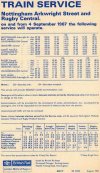
Rugby (Central) - Leicester (Central) - Loughborough (Central) - Nottingham (Victoria originally, replaced by Arkwright Street), the remaining rump service on the Great Central main line.
Between 5th. September, 1966 and 3rd. May, 1969.
I don't know if the 'Paytrain' brand was used but it was definitely worked by DMUs with the guards collecting the fares and using ticket machines (Omniprinter), stations were all unstaffed.
 

Sprinter107

Member
Joined
26 Mar 2019
Messages
1,098
On the Warwickshire Railways site, under Rugby (GC), there is a poster showing the Arkwright Street to Rugby Central service, times and fares. It states tickets must be bought on the train. But doesn't have any PayTrain reference. But it seems it was a PayTrain service in all but name.
 

RT4038

Established Member
Joined
22 Feb 2014
Messages
5,459
On the Warwickshire Railways site, under Rugby (GC), there is a poster showing the Arkwright Street to Rugby Central service, times and fares. It states tickets must be bought on the train. But doesn't have any PayTrain reference. But it seems it was a PayTrain service in all but name.

Fairly unusually, this was a service that had no formal interchange point with any other service (Yes, I know Arkwright Street was not that far from Nottingham Midland, unlike the situation in Rugby), with no through ticketing (which would not have been available, apart from All Line rovers and the like), the revenue through the Conductor ticket machines would have represented all the revenue taken, so no apportionment required.
 

45Fox

Member
Joined
17 May 2022
Messages
150
Location
Leicester
Fairly unusually, this was a service that had no formal interchange point with any other service (Yes, I know Arkwright Street was not that far from Nottingham Midland, unlike the situation in Rugby), with no through ticketing (which would not have been available, apart from All Line rovers and the like), the revenue through the Conductor ticket machines would have represented all the revenue taken, so no apportionment required.

The fairly desultory publicity for this service, posters at the stations and handbills available at nearby staffed stations, stated this regarding ticketing; only available for journeys between stations served by this service, same for season tickets which were available from the other, staffed, stations in Rugby, Leicester and Nottingham (interestingly not apparently Loughborough, though).

Attached is a copy of one of the handbills issued in September 1967, from when Nottingham Victoria closed and the service started operating from a hastily reopened Nottingham Arkwright Street.
 

Attachments

  • images.jpeg.jpg
    images.jpeg.jpg
    56.5 KB · Views: 53

Dore & Totley

Member
Joined
3 Dec 2017
Messages
75
Quick paytrain question, could you buy through tickets from the conductor or could they only sell tickets to destinations served by the train?
 

Top