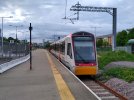
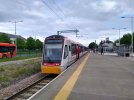
With regards to speculation on the forum a few weeks ago that the 398s were not capable of running on OLE directly and could only use it to charge the onboard batteries, I found the following text in a publicly accessible TFW / Amey document:
The units are powered by 25kV overhead lines via a single pantograph on the middle vehicle, which also charges the batteries that provide traction power when operating over non- electrified parts of the CVL Network, and over the Network Rail Network through Cardiff Central.
Power source modes are:
1. Overhead Line Equipment (OLE): 25kV AC catenary power supply.
2. Permanently Earthed Sections (PES): catenary with no power, OnBoard Energy Supply (OBES) power supply.
3. Catenary-free sections: OBES power supply.
4. Battery charging zones: low power 25kV catenary for battery charging only
All four power source modes will be used on the CVL Network.
I wonder if there are low power zones built into the plans for specific areas (possibly new parts of the network that haven't been built yet such as Crossrail) or if this is simply a contingency i.e. If the OLE is running with reduced power the trains can still operate?
I would say 4 means 398 stationary under simple catenery having its batteries charged. Possibly at a terminus or bay platform.
I would imagine that this refers to short lengths of overhead wiring (or bar) in station platforms for charging purposes as currently installed (only?) in Caerphilly.
Yes, I agree. Furthermore the metal overhead rails above the sidings at Taffs Well depot would seem to be for charging and keeping the batteries topped up.
I have not looked, but I bet there are similar charging rails at Treherbert.
I think it is fairly clear that the bit in bold makes little sense from an electrical point of view as it would require batteries to be simultaneously charging and discharging. (Unless I suppose you took turns with multiple batteries but that would seem somewhat pointless).
Makes sense - in electrical terms the electrons are either flowing one way or the other NOT both ways simultaneously. So the battery is, at any point in time, either being charged OR is discharging.
The "running...directly" bit is perhaps more a matter of semantics, in that there was an argument previously that taking power from the catenary and feeding it to the motors isn't "direct" if it passes through a system which is also capable of charging batteries and drawing power from them even if at a given moment the power is completely bypassing the batteries.
There has been this confusion over the detail of how the tram-trains actually use electricity. As a lay person I think it best to view what happens as a box with a connection to the overhead, a connection with the battery pack and a connection to the traction motors. There obviously will also be a connection giving hotel power to the trams (lights, aircon etc).
I doubt there is a simple direct connection from the overhead to the traction motors bypassing the batteries except via a switch (a drastic simplification) within the aforementioned "box".
The detail of what happens in the box is probably best described by an expert AND then it is up to most of us how well we digest the detailed description.