• Our new ticketing site is now live! Using either this or the original site (both powered by TrainSplit) helps support the running of the forum with every ticket purchase! Find out more and ask any questions/give us feedback in this thread!

HS2 Reset: Evidence to Transport Committee - 9 July 2025 "Total overspend on high-speed rail could be as much as 100%"

The Ham

Veteran Member
Joined
6 Jul 2012
Messages
12,021
There's this from WMCA, which is not all hs2 released capacity, but does base a lot of the plans on it. https://wmre.org.uk/our-strategies/west-midlands-rail-investment-strategy/

== Doublepost prevention - post automatically merged: ==

There was some work from midland connect on their midland engine rail plan, which proposed some extra interventions to make the most of released capacity and some additional hs2 routes https://www.midlandsconnect.uk/media/1593/final-mer-report.pdf

== Doublepost prevention - post automatically merged: ==

The problem is that recasting a timetable can produce winners and losers. Whenever an hs2 planet assumptions report was published, those opposing the project would look for the losers and then claim hs2 would make journeys slower. Such stories featured in Gilligan's early anti hs2 articles and stophs2 campaigning. Somehow, that sort of false argument ended up in "Network North".

Planet assumptions weren't intended to be the end specification, it was conservative in its assumptions and there were a number of different ways the capacity could be used depending on the focus and needs at the time. You couldn't promise a certain spec, though I think they would have done well to brand a new type of high frequency service that would run on wcml post hs2.

Thanks, I was aware of these now you've reminded me.

However, I don't believe something similar was done for other cities, like Manchester (or those on the Eastern Arm).
 
Sponsor Post - registered members do not see these adverts; click here to register, or click here to log in
R

RailUK Forums

Shrop

Established Member
Joined
6 Aug 2019
Messages
1,350
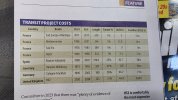
I haven't paid much attention to this thread, but the recent article in Rail magazine did make me think about HS2 spending, as in the title of this thread.
Apologies if I've missed direct comment on this previously, but what are forum members' thoughts on these costs, as presented in the latest Rail magazine?
 

Attachments

  • 20260416_112950.jpg
    20260416_112950.jpg
    3.4 MB · Views: 89

eldomtom2

On Moderation
Joined
6 Oct 2018
Messages
2,360
I haven't paid much attention to this thread, but the recent article in Rail magazine did make me think about HS2 spending, as in the title of this thread.
Apologies if I've missed direct comment on this previously, but what are forum members' thoughts on these costs, as presented in the latest Rail magazine?
That seems to use the data from the Transit Costs Project. They haven't shown the most expensive non-HS2 projects, but frankly showing them makes the disparity between them and HS2 even more obvious:
Lyon-Turin (France): 69% tunnelled, $173m per km
Hokuriku-Tsuruga (Japan): 33% tunnelled, $171m per km
Taiwan High Speed Rail (Taiwan): 18% tunnelled, $168m per km
HS1 (UK): 23% tunnelled, $154m per km
Seoul-Daegu (South Korea): 34% tunnelled, $147m per km
 

SynthD

Established Member
Joined
4 Apr 2020
Messages
2,014
Location
UK
That gives a total cost of £140bn for HS2, which is news to me.
 

mmh

Established Member
Joined
13 Aug 2016
Messages
4,244
The only surprising thing about the title of this thread is that it's only 100%
 

robspaceman

Member
Joined
19 Jan 2010
Messages
74
Location
Shrewsbury
How many of the other HS lines being used for comparison also included the construction of three very large stations in urban areas (two of which in probably the most expensive city in Europe in terms of land value), and one in a semi rural area? No doubting that HS2 was incredibly expensive, and it would still come out on top, but are they really comparing like with like?
 

eldomtom2

On Moderation
Joined
6 Oct 2018
Messages
2,360
How many of the other HS lines being used for comparison also included the construction of three very large stations in urban areas (two of which in probably the most expensive city in Europe in terms of land value), and one in a semi rural area? No doubting that HS2 was incredibly expensive, and it would still come out on top, but are they really comparing like with like?
Well, I do find it unlikely that Euston/OOC/Curzon Street together make up five-sixths of HS2's budget.
 

eldomtom2

On Moderation
Joined
6 Oct 2018
Messages
2,360
That gives a total cost of £140bn for HS2, which is news to me.
It comes from this New Civil Engineer article published in May 2025: https://www.newcivilengineer.com/la...ated-final-cost-continues-to-rise-15-05-2025/
The preliminary report from Wild to the DfT also estimated the final cost of HS2 will be £81bn in 2019 prices, which would mean over £100bn in today’s prices, accounting for inflation.
£81bn in 2019 pounds equals $140bn in 2023 dollars (the per kilometre figures are in dollars, not pounds).
 

FMerrymon

Member
Joined
11 Dec 2024
Messages
362
Location
Reading
That gives a total cost of £140bn for HS2, which is news to me.

Looks like they've taken a per mile calculation and even if so I don't recognise 87.5bn in 2023 prices as a cost, although kore in the ball park of what some are quoting.

== Doublepost prevention - post automatically merged: ==

How many of the other HS lines being used for comparison also included the construction of three very large stations in urban areas (two of which in probably the most expensive city in Europe in terms of land value), and one in a semi rural area? No doubting that HS2 was incredibly expensive, and it would still come out on top, but are they really comparing like with like?

None. French rarely include stations in their budgets at all, run on existing lines into existing Paris terminals and, in at least the tours-bordeaux project, don't even add costs of connections to the existing lines in their headline costs.

I don't recognise that inflated figure for hs2 nor the figures for the comparators.

== Doublepost prevention - post automatically merged: ==

It's the sort of figure the gutter tabloids quote as a cost for HS2.

Unfortunately, also the FT, Times, Guardian...

== Doublepost prevention - post automatically merged: ==

I haven't paid much attention to this thread, but the recent article in Rail magazine did make me think about HS2 spending, as in the title of this thread.
Apologies if I've missed direct comment on this previously, but what are forum members' thoughts on these costs, as presented in the latest Rail magazine?

Who wrote this article? Wolmar?
 

eldomtom2

On Moderation
Joined
6 Oct 2018
Messages
2,360
and, in at least the tours-bordeaux project, don't even add costs of connections to the existing lines in their headline costs.
Can you provide a source for this? I'm sure the Transit Costs Project, where the data comes from, would be happy to have more accurate data.
 

FMerrymon

Member
Joined
11 Dec 2024
Messages
362
Location
Reading
Very little journalism is original work these days. They're all copying each others' homework.

I think using the words journalism and homework in the first place is a stretch. Shocking some of it. That table is in the same spirit

== Doublepost prevention - post automatically merged: ==

It comes from this New Civil Engineer article published in May 2025: https://www.newcivilengineer.com/la...ated-final-cost-continues-to-rise-15-05-2025/

£81bn in 2019 pounds equals $140bn in 2023 dollars (the per kilometre figures are in dollars, not pounds).

OK, that make sense, though, the current expected cost is 66bn at 2019 prices and supercedes any preliminary report. I notice the transit cost project has it wrong on their table and have a slightly lower adjustment for inflation.

== Doublepost prevention - post automatically merged: ==

Well, I do find it unlikely that Euston/OOC/Curzon Street together make up five-sixths of HS2's budget.

The section ooc-euston, excluding ooc station, was 17% of the 2020 hs2 budget. Add in the Northolt tunnel, ooc and the bit into Birmingham, plus Curzon St and add the rolling stock that hs2 includes but others don't and you're looking at a substantial amount of the budget.
 
Last edited:

The Ham

Veteran Member
Joined
6 Jul 2012
Messages
12,021
The section ooc-euston, excluding ooc station, was 17% of the 2020 hs2 budget. Add in the Northolt tunnel, ooc and the bit into Birmingham, plus Curzon St and add the rolling stock that hs2 includes but others don't and you're looking at a substantial amount of the budget.

Just the rolling stock (£2bn) is £8.9 million per km.

Whilst still small compared to the HS2 value, if that sort of extra cost was added to the other schemes it would make them feel a lot worse.
 

FMerrymon

Member
Joined
11 Dec 2024
Messages
362
Location
Reading
Can you provide a source for this? I'm sure the Transit Costs Project, where the data comes from, would be happy to have more accurate data.


https://www.railwaygazette.com/infr...l-inauguration-for-lgv-sud-europe-atlantique/ is the source of the wikipedia article that states similar

Running for 302 km from Saint-Avertin south of Tours to Ambarès-et-Lagrave north of Bordeaux, the high speed line will enable the fastest Paris — Bordeaux journey time to be cut to 2 h 04 min. Revenue services are due to begin on July 2 and traffic is expected to reach 20 million passengers/year.

Total cost of the project is €9bn, of which €7∙8bn has been spent on the new line itself. The LISEA consortium of Vinci Concessions (33∙4%), Caisse des Dépôts (25∙4%), Meridiam (22%) and Ardian (19∙2%) has provided €3∙8bn, with the public contribution comprising €3bn from the French government, local authorities and the European Union as well as €1bn from SNCF Réseau.

A total of €1∙2bn has also been spent by SNCF Réseau on the 38 km of connections between the new line and the conventional network, control centres, capacity enhancements at Bordeaux and remodelling the track layout at Paris Montparnasse station. SNCF Réseau will be responsible for traffic control on behalf of LISEA, which will be responsible for operating and maintaining the new infrastructure until 2061.

The Transit cost project are using the 340km distance for the line (which includes the 38km of connections), but using 7.7bn euro for the cost, which doesn't include connections. So that's incorrect.

They've also got the base year as 2014, which I think theyve taken an average of the construction timeline. That cost has a base year of is 2011 or earlier.

They have Hs2 as the speculated cost, but not the cost that has come from any official source. Should be 66bn, not 81bn.
 

eldomtom2

On Moderation
Joined
6 Oct 2018
Messages
2,360
Just the rolling stock (£2bn) is £8.9 million per km.

Whilst still small compared to the HS2 value, if that sort of extra cost was added to the other schemes it would make them feel a lot worse.
I can confirm that in some cases the Transit Costs Project's HSR database does include rolling stock costs; for example, the Korean Honam HSR's listed cost ($74m per km) does include rolling stock, as confirmed by the source given:
The costs of the new line (including the new trains) are 8.7 trillion Korean Won (7.83 Billion US-Dollar).
If you can prove that in some cases rolling stock has not been included, I suggest you contact them so the error can be corrected. I contacted them about the error FMerrymon mentioned and they were very quick to respond.
 

Shrop

Established Member
Joined
6 Aug 2019
Messages
1,350
Looks like they've taken a per mile calculation and even if so I don't recognise 87.5bn in 2023 prices as a cost, although kore in the ball park of what some are quoting.

== Doublepost prevention - post automatically merged: ==


None. French rarely include stations in their budgets at all, run on existing lines into existing Paris terminals and, in at least the tours-bordeaux project, don't even add costs of connections to the existing lines in their headline costs.

I don't recognise that inflated figure for hs2 nor the figures for the comparators.

== Doublepost prevention - post automatically merged: ==


Unfortunately, also the FT, Times, Guardian...

== Doublepost prevention - post automatically merged: ==


Who wrote this article? Wolmar?
You sound very defensive of HS2, and pretty scathing about those who expose its costs.
So perhaps you could provide some more accurate costs for the table that I posted?
 

FMerrymon

Member
Joined
11 Dec 2024
Messages
362
Location
Reading
You sound very defensive of HS2, and pretty scathing about those who expose its costs.
So perhaps you could provide some more accurate costs for the table that I posted?

Do I, now? See above.

== Doublepost prevention - post automatically merged: ==

If you can prove that in some cases rolling stock has not been included, I suggest you contact them so the error can be corrected. I contacted them about the error FMerrymon mentioned and they were very quick to respond.

Thanks for that. I'd tried pinging them about errors, but I didnt get a reply in those instances.

The issue is using cost per unit distance. At the risk of sounding really defensive of HS2 and scathing of exposing costs, its a really poor comparison due to differences in scope of what costs cover. The costs of land of hs2 phase1 are £3.2bn in 2015 prices. Extrapolated for the distance of LGV tours to Bordeaux its around half the cost of the full line for them. There was something in the TSC last July where Hendy said the land had been allocated for it in the 70s, so whether or not land is included in its costs I've no idea.

Hs2 Phase 1 is almost double the then expected cost per mile of phase2a. Phase 2b west at time of cancellation had a higher cost per mile than phase 1 and more than double phase 2a, despite being largely 140mph and phase2a being mostly 225mph - they had kept elements required for services using Golborne within costs but had removed Golborne whilst looking for alternatives, reducing BCR and increasing cost per mile.

What I'd really like to see is an examination of a roughly standard km of line in open countryside and the breakdown of those costs to compare internationally. Then may be we could learn something. Or perhaps including things like a new large innercity terminus along with london underground improvements and requiring the purchasing of a large swathe of some of the most expensive land in europe is directly comparable to a project with no inner city sections and no stations...

== Doublepost prevention - post automatically merged: ==

Just the rolling stock (£2bn) is £8.9 million per km.

Whilst still small compared to the HS2 value, if that sort of extra cost was added to the other schemes it would make them feel a lot worse.

Exactly
 
Last edited:

Shrop

Established Member
Joined
6 Aug 2019
Messages
1,350
Do I, now? See above.
Let me put it another way. The figures I quoted at post #422 showed just 8 numbers in the final column.
These numbers were what Rail stated were the construction costs per km of various HSR projects. These varied from 9m to 77m for 7 of the projects, but 626m for HS2.
It appears from the responses that there is concern about how these figures were calculated, and indeed the credibility of Rail magazine.
So what I'm asking is for some indication of a more correct version of these 8 figures. Even if approximate, could you or anyone else provide this info?
 

Peter Sarf

Established Member
Joined
12 Oct 2010
Messages
9,567
Location
Croydon
Let me put it another way. The figures I quoted at post #422 showed just 8 numbers in the final column.
These numbers were what Rail stated were the construction costs per km of various HSR projects. These varied from 9m to 77m for 7 of the projects, but 626m for HS2.
It appears from the responses that there is concern about how these figures were calculated, and indeed the credibility of Rail magazine.
So what I'm asking is for some indication of a more correct version of these 8 figures. Even if approximate, could you or anyone else provide this info?
I would like to see the cost per mile for the Northern end of HS2 Phase 1 as far as the delta junction. I suspect that the Southern half of Phase1 cost a lot more per mile of plain line. I still expect the costs to still be higher than Europe sadly but perhaps not by so much.

I also feel there has been much less of an anti high speed rail attitude in Europe so planners could get on with it easier than in the UK.
 

The Ham

Veteran Member
Joined
6 Jul 2012
Messages
12,021
Let me put it another way. The figures I quoted at post #422 showed just 8 numbers in the final column.
These numbers were what Rail stated were the construction costs per km of various HSR projects. These varied from 9m to 77m for 7 of the projects, but 626m for HS2.
It appears from the responses that there is concern about how these figures were calculated, and indeed the credibility of Rail magazine.
So what I'm asking is for some indication of a more correct version of these 8 figures. Even if approximate, could you or anyone else provide this info?

When Euston was redesigned to being 10 platforms the cost of the station (not including the approach tunnels) was said to be £4.8bn, that alone adds £21 million per km to the HS2 costs (even the newer reduced 6 platform station and tunnels from Old Oak Common at £7.5bn is 33 million per km) which other schemes without a central capital city station wouldn't include. Even if they did include those costs land costs around Euston area likely to be around double that of around Gare de Nor.

Projects in the UK are always going to be higher, however if you are comparing a railway mostly in open countryside which doesn't include any city based stations and doesn't include rolling stock that's going to provide a very different answer to another European line which does.

The table provided only gives a limited range of variables (total length, cost, time period, and tunnels).

The point which is being made is that the table is limited when trying to evaluate comparable costs between projects.

Depending on who wrote the article it may be that they wanted the table to give a particular answer which favoured their view of HS2 and so was deliberately selective with what variables they included.

Also, it's not know if general inflation was used to balance the prices to a given year or if construction inflation was used (and they can be very different numbers).

Of course, someone wanting to show something different could be selective in other ways to show that whilst HS2 is more expensive, that's because it includes elements which other projects didn't have.
 

FMerrymon

Member
Joined
11 Dec 2024
Messages
362
Location
Reading
Let me put it another way. The figures I quoted at post #422 showed just 8 numbers in the final column.
These numbers were what Rail stated were the construction costs per km of various HSR projects. These varied from 9m to 77m for 7 of the projects, but 626m for HS2.
It appears from the responses that there is concern about how these figures were calculated, and indeed the credibility of Rail magazine.
So what I'm asking is for some indication of a more correct version of these 8 figures. Even if approximate, could you or anyone else provide this info?

Above, you'll see me pointing out an error in the LGV SEA costs, pointing out an error with the hs2 phase 1 costs, explaining why its an apples to oranges comparison, speculating on further differences, explaining why costs per distance is not a good measure and using the difference in cost per mile of hs2 phases to hammer that point, explaining what I'd like to see as an alternative to compare. One mistake I made in my initial reaction was that the table was in US$2023 per km, but I stand by everything else.

There is a further issue in that many of the comparators are much older too - do you really think the French can deliver a high speed line today for $(2023) 9m a km? The only one that's really comparable in terms of time is LGV SEA. Since 2020, many construction projects have had substantial cost pressures due to increased costs and lower supply of materials, energy, labour. That's hit internationally, so even the French might have struggled to deliver on budget had it been built in the 2020s.

== Doublepost prevention - post automatically merged: ==

I would like to see the cost per mile for the Northern end of HS2 Phase 1 as far as the delta junction. I suspect that the Southern half of Phase1 cost a lot more per mile of plain line. I still expect the costs to still be higher than Europe sadly but perhaps not by so much.

Almost certainly more like phase 2a which would have been around half of phase 1's average. And yes, still very much higher. Just like EWR Bedford Cambridge is significantly more on that metric too.

== Doublepost prevention - post automatically merged: ==

When Euston was redesigned to being 10 platforms the cost of the station (not including the approach tunnels) was said to be £4.8bn, that alone adds £21 million per km to the HS2 costs (even the newer reduced 6 platform station and tunnels from Old Oak Common at £7.5bn is 33 million per km) which other schemes without a central capital city station wouldn't include. Even if they did include those costs land costs around Euston area likely to be around double that of around Gare de Nor.

Yes, 0.5bn on land and 1bn on preparatory works. https://www.nao.org.uk/wp-content/uploads/2023/03/high-speed-two-euston.pdf

Also, it's not know if general inflation was used to balance the prices to a given year or if construction inflation was used (and they can be very different numbers).

They say this, which is likely to be lower than construction inflation:

Costs are adjusted for purchasing power parity (PPP), based on the midpoint of construction. This adjustment is imperfect in countries with rapid changes in the PPP rate due to high inflation, typically in the developing world. Of note, we have not adjusted for inflation so far; since all costs are converted to US dollars, you can inflation-adjust using American inflation rates.

Depending on who wrote the article it may be that they wanted the table to give a particular answer which favoured their view of HS2 and so was deliberately selective with what variables they included.

Exactly, and its something the media keep doing. The FT published an article which completely missed the points about what the scope of costs covered.


From the transit cost project:

What ends up in the total costs of projects varies from project to project: projects vary by number of stations, station volumes, length of platforms, systems, train yards, maintenance facilities, betterments, number of consultants, etc. Thus, comparing projects strictly on a costs per kilometer basis misses important details. We have used this data to help us quickly identify outliers to study in greater detail in our cases section.
Costs include all construction and construction-related expenditures, but not rolling stock or sales taxes. In some cases, rolling stock costs are included in the headline numbers, and we have tried to subtract them whenever possible; in some remaining cases, it was not possible, and we note that the costs include the equipment.

HS2 cost includes rolling stock, so there's another error.
 
Last edited:

eldomtom2

On Moderation
Joined
6 Oct 2018
Messages
2,360
When Euston was redesigned to being 10 platforms the cost of the station (not including the approach tunnels) was said to be £4.8bn, that alone adds £21 million per km to the HS2 costs (even the newer reduced 6 platform station and tunnels from Old Oak Common at £7.5bn is 33 million per km) which other schemes without a central capital city station wouldn't include. Even if they did include those costs land costs around Euston area likely to be around double that of around Gare de Nor.
This would seem to be evidence that the vast majority of HS2's high costs can't be blamed on Euston though, because the difference is much higher than 33 million per km.
 

Shrop

Established Member
Joined
6 Aug 2019
Messages
1,350
Above, you'll see me pointing out an error in the LGV SEA costs, pointing out an error with the hs2 phase 1 costs, explaining why its an apples to oranges comparison, speculating on further differences, explaining why costs per distance is not a good measure and using the difference in cost per mile of hs2 phases to hammer that point, explaining what I'd like to see as an alternative to compare. One mistake I made in my initial reaction was that the table was in US$2023 per km, but I stand by everything else.

There is a further issue in that many of the comparators are much older too - do you really think the French can deliver a high speed line today for $(2023) 9m a km? The only one that's really comparable in terms of time is LGV SEA. Since 2020, many construction projects have had substantial cost pressures due to increased costs and lower supply of materials, energy, labour. That's hit internationally, so even the French might have struggled to deliver on budget had it been built in the 2020s.

== Doublepost prevention - post automatically merged: ==


Almost certainly more like phase 2a which would have been around half of phase 1's average. And yes, still very much higher. Just like EWR Bedford Cambridge is significantly more on that metric too.

== Doublepost prevention - post automatically merged: ==


Yes, 0.5bn on land and 1bn on preparatory works. https://www.nao.org.uk/wp-content/uploads/2023/03/high-speed-two-euston.pdf


They say this, which is likely to be lower than construction inflation:

Costs are adjusted for purchasing power parity (PPP), based on the midpoint of construction. This adjustment is imperfect in countries with rapid changes in the PPP rate due to high inflation, typically in the developing world. Of note, we have not adjusted for inflation so far; since all costs are converted to US dollars, you can inflation-adjust using American inflation rates.


Exactly, and its something the media keep doing. The FT published an article which completely missed the points about what the scope of costs covered.


From the transit cost project:


HS2 cost includes rolling stock, so there's another error.
I don't think it matters how much you compensate for HS2 costs, the figures are still wildly different from those incurred in Europe.
You said the only one that's really comparable is LGV-SEA. This leaves HS2 as being *only* 18 times as expensive per km. So let's assume that the figures weren't balanced to 2023 costs, and afford a 100% inflation since SEA was built.
That still leaves HS2 as being not twice as expensive, nor three times, but NINE times as expensive as SEA.
Now if we try to make things even more comparable, we'd perhaps be comparing SEA with HS2 phase 2a and 2b.
Many people (before 2010) were suggesting building those parts first, precisely so that HS2 could avoid a huge credibility loss.
London-Birmingham, for all of its sacrosanct route capacity justifications, should always have been presented as something other than "HS2 Phase 1".
But there appears to remain plenty of opinion that HS2 was carried out in exactly the right manner, and even with the benefit of all this hindsight, many people would still do everything exactly the same all over again :s
 

Tetchytyke

Veteran Member
Joined
12 Sep 2013
Messages
17,443
Location
Isle of Man
I also feel there has been much less of an anti high speed rail attitude in Europe so planners could get on with it easier than in the UK.
I don't think so at all.

The opposition to HS2 has primarily been because of the route they chose and because of the huge amounts of environmental damage that the choice of that route has caused. It's quite eye-opening to see it when I fly from the Isle of Man to London, HS2 is basically one 120-mile-long concrete scar right across the middle of some very scenic countryside inhabited by wealthy people.
 

Peter Sarf

Established Member
Joined
12 Oct 2010
Messages
9,567
Location
Croydon
I don't think so at all.

The opposition to HS2 has primarily been because of the route they chose and because of the huge amounts of environmental damage that the choice of that route has caused. It's quite eye-opening to see it when I fly from the Isle of Man to London, HS2 is basically one 120-mile-long concrete scar right across the middle of some very scenic countryside inhabited by wealthy people.
Are there any lines in Europe that encounter such features and consequent hostility ?.
 

Top