• Our new ticketing site is now live! Using either this or the original site (both powered by TrainSplit) helps support the running of the forum with every ticket purchase! Find out more and ask any questions/give us feedback in this thread!

Wind Power and UK Energy Use

hwl

Established Member
Joined
5 Feb 2012
Messages
8,258
Not really an issue with curtailment from Solar yet.

This is because of 2 reasons.

The first one is because most utility scale solar is in locations not affected by grid constraints.

The second one is that home / business solar is connected to local DNO grids. At the moment as not very many connections to the DNO have solar, the excess from each DNO connection is very much soaked up by local demand.
One useful option for the future (when solar has grown a lot more) is finally beginning to become an fairly cheap off the shelf product - smart domestic diverters that divert excess solar energy to (hopefully very well insulated) immersion heaters at the moment people only beginning to use them for large domestic when the batteries are full in summer and they would struggle to sensibly add more battery for their own use.

One key element of large solar is that there is normally some battery near by and some nearer end users and this helps optimise being able to absorb as much as possible.

I can see a point in a decades time where half the solar is going to battery early in the afternoon on sunny summer days.
 
Sponsor Post - registered members do not see these adverts; click here to register, or click here to log in
R

RailUK Forums

The Ham

Veteran Member
Joined
6 Jul 2012
Messages
12,036
One useful option for the future (when solar has grown a lot more) is finally beginning to become an fairly cheap off the shelf product - smart domestic diverters that divert excess solar energy to (hopefully very well insulated) immersion heaters at the moment people only beginning to use them for large domestic when the batteries are full in summer and they would struggle to sensibly add more battery for their own use.

One key element of large solar is that there is normally some battery near by and some nearer end users and this helps optimise being able to absorb as much as possible.

I can see a point in a decades time where half the solar is going to battery early in the afternoon on sunny summer days.

They've been around for a few years and whilst (IIRC around £400 installed) they are costly, when you're paying £7,000 to £11,000 for a battery and solar setup the cost shouldn't be too expensive in the scheme of things.

Whilst you are likely to be better off using the gas and getting the export tariff payments, it does protect from future gas spikes and could be useful if the individual does move to an ASHP later.
 

hwl

Established Member
Joined
5 Feb 2012
Messages
8,258
They've been around for a few years and whilst (IIRC around £400 installed) they are costly, when you're paying £7,000 to £11,000 for a battery and solar setup the cost shouldn't be too expensive in the scheme of things.

Whilst you are likely to be better off using the gas and getting the export tariff payments, it does protect from future gas spikes and could be useful if the individual does move to an ASHP later.
Agreed especially on the last point. I can see export tariffs on sunny summer days collapsing somewhat when there is more solar than operators/suppliers know what to do with in a decades time.
"Cheap" - compared to every other item!
 

HSTEd

Veteran Member
Joined
14 Jul 2011
Messages
20,333
Whilst you are likely to be better off using the gas and getting the export tariff payments, it does protect from future gas spikes and could be useful if the individual does move to an ASHP later.
The smart export tariff only guarantees 4.1 pence per unit and gas is now over 5.5 pence per unit. Tariffs with higher rates often come with some less than ideal terms.
 
Last edited:

Bald Rick

Veteran Member
Joined
28 Sep 2010
Messages
35,824
They've been around for a few years and whilst (IIRC around £400 installed) they are costly, when you're paying £7,000 to £11,000 for a battery and solar setup the cost shouldn't be too expensive in the scheme of things.

I was quoted £6k for a 4.4kW system with an 8kW battery recently. System prices have been falling a lot!
 

AndrewE

Established Member
Joined
9 Nov 2015
Messages
7,350
I was quoted £6k for a 4.4kW system with an 8kW battery recently. System prices have been falling a lot!
with the latest shocks I bet that supply relative to demand has changed and you wouldn't get the same quote again, also GivEnergy (quite a big maker of batteries and inverters) is appointing administrators, apparently suppliers have been heavily discounting their kit recently...
 

brad465

Veteran Member
Joined
11 Aug 2010
Messages
11,486
Location
Taunton or Kent
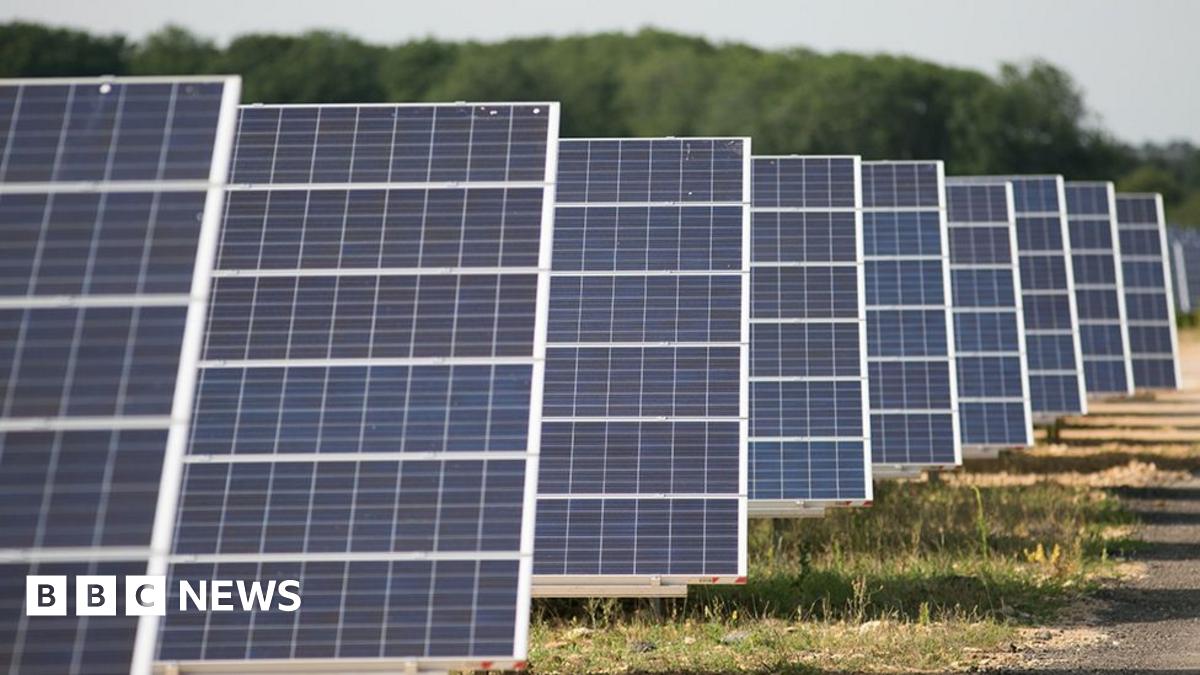
Massive solar farm approved in Lincolnshire. Apparently the solar farm also includes sheep grazing amongst it, so will still act like an agricultural farm:


The UK's largest power-producing solar farm has been approved by the government after a planning inquiry.
The Springwell Solar Farm, between Lincoln and Sleaford, will power 180,000 homes, developer EDF power solutions UK said.
The Department for Energy Security and Net Zero gave the go ahead despite opposition from residents.
Marc Williams from the Springwell Solar Action Group said he was "disgusted" at the decision and vowed to "keep fighting this".
The site, near Navenby, will cover an area the size of 1,700 football pitches and incorporate a battery storage facility.
Energy Minister Michael Shanks said: "We are driving further and faster for clean homegrown power that we control to protect the British people and bring down bills for good.
"It is crucial we learn the lessons of the conflict in the Middle East – solar is one of the cheapest forms of power available and is how we get off the rollercoaster of international fossil fuel markets and secure our own energy independence."
Opponents raised concerns about the loss of farmland, the impact on the landscape and the safety of the lithium-ion batteries.

"I'm fuming," Williams said.

"It shows a completely, complete lack of democratic accountability in this country."

He said Energy Secretary Ed Milliband had "taken no account of the local views of people and he's just ridden roughshod across the community and will basically destroy approximately 4,000 acres just in this area alone".

Local Conservative councillor Rob Kendrick, who spoke against the project at the inquiry, described the decision as "sad news for Lincolnshire and its residents."

"Very disappointed but not surprised," he said.

"There are no beneficiaries in terms of the people of Lincolnshire.

"The landscape will be changed. Tourism is worth £2bn to Lincolnshire and that will be impacted."
 

ainsworth74

Forum Staff
Staff Member
Global Moderator
Joined
16 Nov 2009
Messages
31,100
Location
Redcar
also GivEnergy (quite a big maker of batteries and inverters) is appointing administrators
Oh good that's who manufactured our battery and inverter (though it was Ovo who supplied and fitted the system so presumably still their problem if it goes pop).
 

quantinghome

Established Member
Joined
1 Jun 2013
Messages
2,891
Massive solar farm approved in Lincolnshire. Apparently the solar farm also includes sheep grazing amongst it, so will still act like an agricultural farm:


"There are no beneficiaries in terms of the people of Lincolnshire."
I guess electricity has yet reach Lincolnshire.

"The landscape will be changed."
Yes, the views of the nearby quarry will be forever altered.

"Tourism is worth £2bn to Lincolnshire and that will be impacted."
Yes, all those tourists hot-footing it to <checks map>... Metheringham, and let's not forget Kirkby Green Light Railway!
 

The Ham

Veteran Member
Joined
6 Jul 2012
Messages
12,036
Massive solar farm approved in Lincolnshire. Apparently the solar farm also includes sheep grazing amongst it, so will still act like an agricultural farm:


That's quite normal, farmers get cheap/free grazing, the land owners get their grass cut for free.

Given that the agricultural land is likely lower grade and so wouldn't be used for arable production anyway, so there's likely to be no change in food security (something which is often raised as a concern by those opposed to solar farms near them).
 

hwl

Established Member
Joined
5 Feb 2012
Messages
8,258
also GivEnergy (quite a big maker of batteries and inverters) is appointing administrators, apparently suppliers have been heavily discounting their kit recently...
Oh good that's who manufactured our battery and inverter (though it was Ovo who supplied and fitted the system so presumably still their problem if it goes pop).

There are quite a few companies in the GivEnergy empire. The single company in the wider group that has appointed administrators is one that does the UK sales, distribution and support (including help, funding dev/configuration support for software /firmware and data flows).

Apparently there was a change in ownership a few years ago and the new owner reduced the spending on support and increased it on marketing with long term customer satisfaction heading south as you would expect. It sounds like they hadn't budgeted (or the business model) for on going data and IT support which effectively became a ponzi scheme needing needing a continual stream of new system customers to fund support costs for short while.

The parent, manufacturing, software and oversea distrubution companies aren't affected.

I also suspect the old and new owners didn't anticipate the pace of change in the market with many existing products not competitively fit for the future (which also effects the adaptability / expandability) of many existing systems, hence hardwear and huge software development costs to fund in the future but no user funding model.

I can see them starting again with a new UK sales and distribution which charges on going support fees.

(I had a previous ponder about them but didn't like what I saw...)
 

Nicholas Lewis

Established Member
Joined
9 Aug 2019
Messages
8,010
Location
Surrey
Not really an issue with curtailment from Solar yet.

This is because of 2 reasons.

The first one is because most utility scale solar is in locations not affected by grid constraints.

The second one is that home / business solar is connected to local DNO grids. At the moment as not very many connections to the DNO have solar, the excess from each DNO connection is very much soaked up by local demand.

Australia on the other hand is being affected by this issue due to the much larger share of connections having solar and local grids do sometimes run out of demand for it to supply. This is one reason Australia are pushing for more home batteries.
All but a couple of solar sites, Cleve Hill being one, aren't registered in the Balancing Mechanism so NESO can't instruct them off the grid unlike majority of windfarms which have to be registered as above 50MW. There are moves to bring the threshold down to 10MW so NESO has greater visibility in real time whats happening given the build out of solar.

In terms of the future with 21.8GW of solar now installed as of the start of 2026 along with 10's more GW in build/planning there will come a time when the system will have excess generation as demand is just not moving up at the same rate as generation addition. This is partly due to continuing deindustrialisation neutralising the modest domestic/business growth in EV/heat pumps. Batteries are being added but their build out is again way too low to absorb the scale of excess generation that can potentially arise in low cloud high wind day in summer. So there will come a point whence the operator may have to intervene although if there is too much generation voltage will rise and the inverter control systems will ramp down output. This isn't forced constraints but nevertheless another example of energy wasted.
 

The Ham

Veteran Member
Joined
6 Jul 2012
Messages
12,036
All but a couple of solar sites, Cleve Hill being one, aren't registered in the Balancing Mechanism so NESO can't instruct them off the grid unlike majority of windfarms which have to be registered as above 50MW. There are moves to bring the threshold down to 10MW so NESO has greater visibility in real time whats happening given the build out of solar.

In terms of the future with 21.8GW of solar now installed as of the start of 2026 along with 10's more GW in build/planning there will come a time when the system will have excess generation as demand is just not moving up at the same rate as generation addition. This is partly due to continuing deindustrialisation neutralising the modest domestic/business growth in EV/heat pumps. Batteries are being added but their build out is again way too low to absorb the scale of excess generation that can potentially arise in low cloud high wind day in summer. So there will come a point whence the operator may have to intervene although if there is too much generation voltage will rise and the inverter control systems will ramp down output. This isn't forced constraints but nevertheless another example of energy wasted.

Whilst I'm generally not one to suggest hydrogen for things due to the risk of of being grey hydrogen, if we start to see a lot of negative cost power due to over supply then there could be a better case for green hydrogen plants.
 

Bald Rick

Veteran Member
Joined
28 Sep 2010
Messages
35,824
Solar: equalled last July's record of 14.0GW (achieved on several days in July).

We might be on for a new solar record tomorrow.

== Doublepost prevention - post automatically merged: ==


CCGT: New record low of 0.848GW

We did indeed have a new Solar record on Tuesday 7th, confirmed as 14.414GW at 1130.

Today is looking interesting too - we’ll be over 30GW of wind + Solar around 1300, subject to curtailments. Negative prices nearly all day.
 
Last edited:

jupiter

Member
Joined
9 May 2021
Messages
339
Location
Dorset
This thread, frankly, has been fascinating and the general success story should be much better known.

I guess there are several but can anyone please recommend a website or websites that can give visibility or a snapshot of what’s happening with generation of elec at any given moment?
 

JamesT

Established Member
Joined
25 Feb 2015
Messages
4,882
This thread, frankly, has been fascinating and the general success story should be much better known.

I guess there are several but can anyone please recommend a website or websites that can give visibility or a snapshot of what’s happening with generation of elec at any given moment?
If you put ‘grid watch’ into your search engine of choice you’ll get several different sites with such views.
 

The Ham

Veteran Member
Joined
6 Jul 2012
Messages
12,036
An investing article explaining why renewals don't always make energy prices cheaper (yes it's our old friend the highest cost supplier sets the price):

Why Investing in Wind and Solar to Avoid Gas Shocks Hasn’t Added Up for Some - The New York Times https://share.google/ssn70l8YPskoJNq5u

How Europe’s energy pricing works
Europe’s energy markets work like a cup that needs to be filled every hour. The cup represents all of a country’s energy demand. First, the cheapest form of energy is poured into the cup, then the next most expensive, and so forth. That generally means solar and wind are added to the mix first, then hydroelectric and nuclear power, then gas and coal.

But here’s the catch: European countries’ wholesale electricity prices are determined by the last, most expensive form of fuel that’s added to the mix. In practice, that means using a relatively small amount of fossil fuel energy, like gas, can raise a country’s wholesale electricity prices, regardless of how much cheaper renewables it uses.

“It’s not just about how much gas a country uses in its power supply,” said Chris Rosslowe, senior energy analyst at Ember, a research firm. “It’s about how influential that gas technology is on power prices.”

It goes onto explain how there can be a difference using Spain and Germany as examples:

Spain’s solar push
These pricing dynamics help explain why Spain’s renewables have been so transformative. In 2021, gas prices determined Spanish wholesale electricity prices 52 percent of the time. By 2025, the country had installed so much renewable energy that the number had fallen to 26 percent.

In the first half of 2025, Spain’s wholesale electricity price was about two thirds of the E.U. average, according to data from Ember. Spain now gets more than 40 percent of its electricity from wind and sun, though its grid did suffer a blackout last year that an investigation later found that had been caused by multiple factors.

“Spain is emerging as a good student,” of the Russia-Ukraine energy crisis, said Phuc-Vinh Nguyen, head of energy center at Institut Jacques Delors, a research group based in France.

In Germany, by contrast, gas prices in 2025 set electricity prices slightly more often than they did in 2021, about 35 percent of the time, even though the country has installed more renewable capacity than Spain. This is happening in part because Germany shut down its nuclear power plants and has decommissioned some coal plants, increasing its reliance on natural gas. Italy, which gets most of its electricity from fossil fuels, has seen high wholesale prices in recent weeks, too.
 
Last edited:

edwin_m

Veteran Member
Joined
21 Apr 2013
Messages
28,675
Location
Nottingham
An investing article explaining why renewals don't what's make energy prices cheaper (yes it's our old friend the highest cost supplier sets the price)
Going by what you have quoted, shouldn't that be "sometimes don't make energy prices cheaper"?
 

Nicholas Lewis

Established Member
Joined
9 Aug 2019
Messages
8,010
Location
Surrey
We did indeed have a new Solar record on Tuesday 7th, confirmed as 14.414GW at 1130.

Today is looking interesting too - we’ll be over 30GW of wind + Solar around 1300, subject to curtailments. Negative prices nearly all day.
Negative wholesale prices aren't the true cost consumers pay though. The reason prices go negative is because generators only receive subsidy on energy delivered to the grid so they need to find a buyer and are thus prepared to bid low or negative. This also distorts the market as it allows BESS operators to make a huge arbitrage buying during the day and selling back at the peak at elevated prices. Also interconnector traders are doing nicely as well selling cheap energy back to Europe. Both are effectively taking advantage of the system at consumers expense. The government needs to shut off these holes as they are coming at consumers expense as they cannot avoid paying the true cost.
 

quantinghome

Established Member
Joined
1 Jun 2013
Messages
2,891
This also distorts the market as it allows BESS operators to make a huge arbitrage buying during the day and selling back at the peak at elevated prices.
Isn't that just electricity storage working the way it's meant to? I mean, it costs money to create battery storage (or pump storage, or any other form of storage for that matter), which is then paid back by buying low, selling high. In fact storage is the way to reduce price gouging as without it the low prices would be even lower and the highs even higher.
 
Last edited:

Nicholas Lewis

Established Member
Joined
9 Aug 2019
Messages
8,010
Location
Surrey
Isn't that just electricity storage working the way it's meant to? I mean, it costs money to create battery storage (or pump storage, or any other form of storage for that matter), which is then paid back by buying low, selling high. In fact storage is the way to reduce price gouging as without it the low prices would be even lower and the highs even higher.
The way all the subsidy schemes works is the generator has to find a buyer for their output and its not the government contrary to popular belief. This can be done via the wholesale market or via a PPA (Power Purchase Agreement) depending on the generators preferred risk profile. They will then generate and the metered output is then presented to one of the administration bodies and they will get paid a subsidy for the MWh's generated in the case of ROC(Renewable Output Certificate)/FiT (Feed in Tariff) or the difference if its a CfD (Contract 4 Difference). These costs are added onto consumer bills but not onto the BESS operators who by and large trade in the wholesale market. So they arent paying the true cost of that generated power yet are able to sell it back in the peak when gas generators have turbo boosted the price.

That said you are correct that BESS helps restrict how low the price goes and does clip the peak pricing as its eliminating the really expensive CCGTs from running. However, in CEGB days you would haven't called generation onto the system you didn't need but now we get excess generation because much of it is receiving the income stream i described above and thus has less concern about how low the wholesale price goes. Also this benefits the interconnector traders for the same reason. My contention is this method of operation is costing consumers more than it should if that excess generation had not run.

By the way I have no issue with BESS operating behind the meter this way as the energy wouldn't attract any additional subsidy payment and really given we are close to solar saturation this should have been mandated for all future multi MW and above new builds.
 

hwl

Established Member
Joined
5 Feb 2012
Messages
8,258
Isn't that just electricity storage working the way it's meant to? I mean, it costs money to create battery storage (or pump storage, or any other form of storage for that matter), which is then paid back by buying low, selling high. In fact storage is the way to reduce price gouging as without it the low prices would be even lower and the highs even higher.
I can see storage being driven more by pricing differentials in the future rather than just high prices for delivering (/being able to deliver) in the evening peak.
Pumped Hydro is also seeing much greater use it isn't just about battery.
 

quantinghome

Established Member
Joined
1 Jun 2013
Messages
2,891
Looks like Sofia wind farm has started to generate. That's three wind farms on Dogger Bank up and running. Hopefully they should be all running full throttle by the end of the year.
1776272280694.jpeg
 

Olivine

Member
Joined
4 May 2023
Messages
134
Location
thatcham
Is there any information about why there’s been a sudden uptick this year in electricity demand? Seems to have been a 3.5GW demand increase.
 

Top