• Our new ticketing site is now live! Using either this or the original site (both powered by TrainSplit) helps support the running of the forum with every ticket purchase! Find out more and ask any questions/give us feedback in this thread!

Can shunt signals act as an absolute stop?

Status
Not open for further replies.

Phil25

Member
Joined
17 Sep 2025
Messages
24
Location
Poland
I've always thought that shunt signals do not have the authority to stop movements that were cleared using a main signal, usually a shunt signal that is 'in the way' of a main signal must be cleared or otherwise you won't be able to clear the main signal. I wasn't able to find any documents proving this though and my friend simply told me this, plus personal observations of course. I believe this is the case in a lot of times (see example 1) and I see this mostly at terminal stations. However what I often see as well, especially with model railways, is kind of the opposite. There seems to be no stop board or anything at the end of the platform, unless stop marker is supposed to do the job? (See example 2)

I'd appreciate if someone would clarify this.

Image16.jpg

Example 1 - Holyhead box diagram, a fixed stop signal can be seen at platform 3 next to a stop board
sp_diagram.jpg

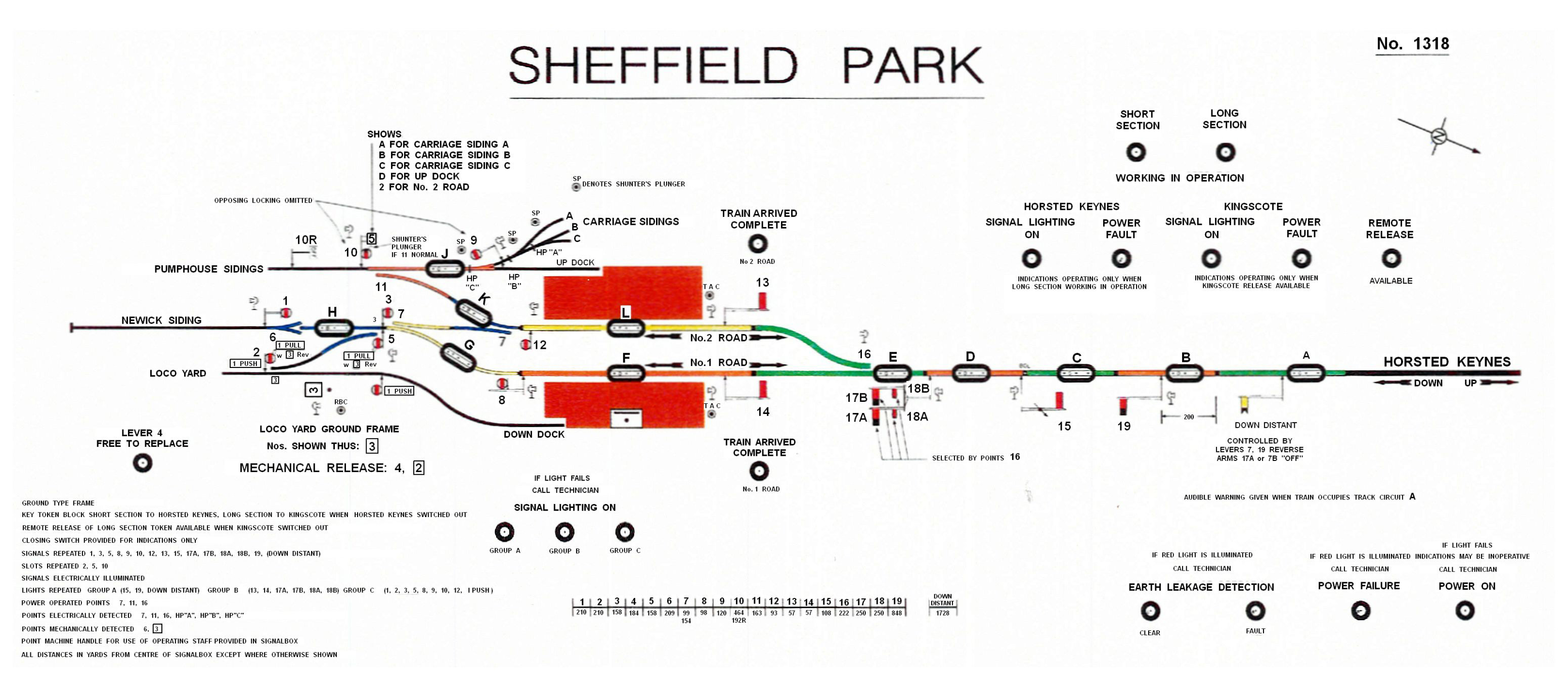
Example 2 - Bluebell Railway, Sheffield Park box diagram, discs 8 and 12
 
Sponsor Post - registered members do not see these adverts; click here to register, or click here to log in
R

RailUK Forums

Gloster

Veteran Member
Joined
4 Sep 2020
Messages
13,028
Location
Up the creek
As far as Holyhead is concerned, the Stop Board applies to the line above it, the Runaround Siding. A train approaching on it must stop and await instructions from whoever is operating the Ground Frame. The Fixed Stop Signal applies to trains running into Platform 3 and is the point beyond which they may not pass: it is a Stop Signal at Stop. However, the signal below, probably a Shunt Ahead arm, will be operated when necessary by the Ground Frame to allow locos to detach and move forward before going along the Runaround Siding. I would presume that it is a signal fixed at Danger as no train will pass it in normal running, but it has a subsidiary.

At Sheffield Park you are probably working to Light Railway rules, which are simpler.
 

172007

Member
Joined
2 Jan 2021
Messages
1,164
Location
West Mids
Quite the debate.

When authorised to pass a signal at danger its Main aspect to Main aspect unless you are specifically asked to stop at a shunt signal / route proving disk.

Now apply the above logic to passing a semephore home signal that is cleared and finding a route proving disk on and the points set correctly.

The the rulebook secton ln reporting signal irregilarities and when to stop omits to use the word semaphone but says you must stop at a "colour light" displaying red.
 
Last edited:

RailwayRookie

Member
Joined
28 Jul 2023
Messages
288
Location
Norfolk
In example 2, I would read that diagram as a train travelling into the platform would recieve the subsidiary arm 18a or 18b depending on route, that would then act as authority up to 8 and 12 respectively.

The clearance of 17a or 17b would imply signals 8 and 12 are off (again respectively) and a suitable route into whichever Sidings is set (also meaning 5 is off if entering the Newick or Loco yard.

If a train was expecting to travel through the implication would be that the subsidiary discs are showing off and a driver  should stop and question it.

The the rulebook secton ln reporting signal irregilarities and when to stop omits to use the word semaphone but says you must stop at a "colour light" displaying red.
It does mention semaphores as their own entity in S7 - 7, (Semaphore signals not showing correctly).

And also notes an incorrect sequence as reportable.. both of which would trip section 1.5 by way of treating a defecting main aspect as being at danger or a defective shunt/sub as being at Normal.
 

30907

Veteran Member
Joined
30 Sep 2012
Messages
21,972
Location
Airedale
The (relatively modern) arrangements at Sheffield Park are described here:
https://www.bluebell-railway.co.uk/bluebell/spark_sig.html
Trains are admitted to the platform under the authority of the main signal not the calling-on arm. The disc reading to Newick Siding is cleared if the loco needs to pass it.

I suppose from a theoretical viewpoint the running line is deemed to end at the south end of the platform, and 17 gives authority only to that point.

The arrangement at Holyhead is unusual - I don't recall seeing anything similar elsewhere (though I am only familiar with SR practice).

I don't think the arrangement at SP has anything to do with Light Railway rules, though I know that Gloster has professional experience so will defer to him.
 

Gloster

Veteran Member
Joined
4 Sep 2020
Messages
13,028
Location
Up the creek
I don't think the arrangement at SP has anything to do with Light Railway rules, though I know that Gloster has professional experience so will defer to him.

I have to say that the situation at Sheffield Park looked unusual and I could only presume that it was due to one of the easements available under Light Railway Regulations. I have no personal experience of Light Railways as I only worked for BR as a signalman, not a signal engineer.
 

Phil25

Member
Joined
17 Sep 2025
Messages
24
Location
Poland
under Light Railway Regulations
Tbh I did a simple google search and it doesn't really mention that Bleubell Railway is a Light Railway.
Trains are admitted to the platform under the authority of the main signal not the calling-on arm.
The clearance of 17a or 17b would imply signals 8 and 12 are off (again respectively)
I simply decided to watch footage of trains entering the station and guess what, it actually looks like the shunt signal was pulled despite the fact that locomotive stopped at the platform. So I assume this theory probably makes sense.
(though I am only familiar with SR practice)
I don't know that much about SR and I know they had a few unique things (like green coaches, discs instead of lamps etc.) but I'm pretty sure in that case it was much simpler because they used stop boards like some other railways. Look at this diagram I found.
251.jpg


Edit: link to the SP video (check 46:42)
 

zwk500

Veteran Member
Joined
20 Jan 2020
Messages
18,618
Location
Northampton
The arrangement at Holyhead is unusual - I don't recall seeing anything similar elsewhere (though I am only familiar with SR practice).
The Main Aspect signals at Holyhead only read to the Buffer stops of P1 or 2, or the Fixed Stop at the end of P3, is that particularly unusual? (the full diagram is available here: https://www.2d53.co.uk/signalling/trackHolyhead2018.htm) The stop boards on the runround lines would only be approachable from a shunt aspect. Note also the tracks with stop boards appear to not have any track circuit indications on the diagram,

Could the Bluebell Railway have a special instruction at Sheffield Park for the setup they have, or was it installed pretty early on when other standards/regulations were in place (like those allowing stop boards at Dover Marine)?
 

westcoaster

Established Member
Joined
4 Dec 2006
Messages
4,507
Location
DTOS A or B
Quite the debate.

When authorised to pass a signal at danger its Main aspect to Main aspect unless you are specifically asked to stop at a shunt signal / route proving signal
This is incorrect. You must stop at any signal displaying a red danger aspect no matter what.
I'll find an example.

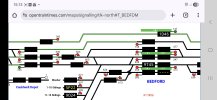
Is the OP talking about Limit of shunt boards or light/ fixed reds.

In the attached picture of Bedford, when approaching from the south and you stop at WH345 on the down slow. If you are asked to pass this at danger, you only proceed to 603 ground position light signal.
You would then recontact the signaller to pass 603 at danger and proceed into the station.
 

Attachments

  • Screenshot_20260211_151339_Chrome.jpg
    Screenshot_20260211_151339_Chrome.jpg
    338.5 KB · Views: 39
Last edited:

RiverDon

On Moderation
Joined
11 Mar 2024
Messages
297
Location
UK
This is incorrect. You must stop at any signal displaying a red danger aspect no matter what.
I'll find an example.

If you look at the rule book S5 section 4.6 it says

If the signaller authorises you to pass a main aspect signal or semaphore stop signal at danger, this allows you to proceed as far as the next main aspect stop signal or semaphore stop signal
ahead, ignoring the aspect displayed by any of these types of signals that are in the route:
• position-light signals not associated with a main aspect signal
• semaphore shunting signals.

However, if the signaller tells you that the train is only authorised to proceed up to a specified position-light or semaphore shunting signal, you must:
• only proceed as far as that signal
• stop at it, whatever aspect is displayed.
 

Belperpete

Established Member
Joined
17 Aug 2018
Messages
3,668
I don't currently have access to my copies of the signalling principles to look up the exact wording, but my understanding is that a main route is defined as from a main aspect to another main aspect signal, or stop board or buffer stop, where the signal is only cleared when the line is clear up to the exit signal. Main routes do not end at shunt signals or limit of shunt. I have known many cases where a fixed red aspect has been provided to allow a main aspect to be used into a goods reception, into a wrong-road platform, etc. rather than a shunt aspect.

Having said that, every rule will have its exceptions. For example, at terminii, the Southern used a yellow main aspect to bring trains into an occupied platform (with green for an empty platform). Such exceptions will usually be defined in the General Appendix.

I suspect that Sheffield Park is one of these exceptions, as the running line will be defined as ending at the platform ends. So the main arms will be used if the platform is empty, and the call-on arm if the platform is occupied.

The Deal case looks to be similar. Although there is a noticeboard of some type at the end of the 4 and 5 road platforms, there is nothing at the end of the 6 road platform. However, the line beyond is not track-circuited, so cannot be part of the passenger running line, and so cannot be part of the route from the signals reading in.

A similar arrangement exists at Porthmadog Harbour, where the main arm (currently main aspect!) is used only if the line is clear up to the "end of running line" board at the end of the platform - it doesn't mean that the line is clear right up to the buffer stop.

The Holyhead platform 3 case is unusual. In this case, the fixed main arm is effectively acting as a stop board. Most similar examples I have seen have been as per platform 1. Anyone know why they did platform 3 in this way? Is the subsidiary arm left off when the ground frame is unattended?
 

Sheridan

Member
Joined
11 Jan 2012
Messages
638
The Holyhead platform 3 case is unusual. In this case, the fixed main arm is effectively acting as a stop board. Most similar examples I have seen have been as per platform 1. Anyone know why they did platform 3 in this way? Is the subsidiary arm left off when the ground frame is unattended?

No, it’s always on in normal use. There’s still plenty of platform for trains to use during the day, and if the full length of the platform is needed for stabling then the signaller will authorise the driver to pass it at danger. It’s only pulled off when the ground frame is attended - usually only if a rail tour, engineering or inspection train needs to run around (these are usually top and tailed to Holyhead but can end up with a single loco if one fails).
 
Status
Not open for further replies.

Top