Avenger20
Member
- Joined
- 8 Aug 2011
- Messages
- 284
Just as an aside, there is still two passengers services per day passing Dalmeny during the closure. 1N79 and 1N80 both continue to run booked route to/from Glasgow Queen Street.


Just FYI and you maybe already know this but it's not being switched on when the line reopens. The wires will be 'permanently' earthed until some later time.The 1B16 Caledonian Sleeper service has left the Dalmeny section, and thus concludes the unelectrified nature of the Haymarket - Dalmeny line.
The line closure has now officially begun. See yous all in 9 days on the other (electrified) side.

I don't think that's right, I just looked at the WON and the closure is on continuously from Haymarket Central Junction to Inverkeithing for the whole period. The only access for trains is to platform 1 at Inverkeithing. Also they are fixing a bridge at Dalmeny station which requires a bit of both platforms to be removed.Just as an aside, there is still two passengers services per day passing Dalmeny during the closure. 1N79 and 1N80 both continue to run booked route to/from Glasgow Queen Street.
Curious. The Scotrail app and RTT both suggest that those services are running as booked but having checked the WON myself you are indeed correct. Will see what happens on Monday.I don't think that's right, I just looked at the WON and the closure is on continuously from Haymarket Central Junction to Inverkeithing for the whole period. The only access for trains is to platform 1 at Inverkeithing. Also they are fixing a bridge at Dalmeny station which requires a bit of both platforms to be removed.

When do we expect the wires to be stollen?Just FYI and you maybe already know this but it's not being switched on when the line reopens. The wires will be 'permanently' earthed until some later time.

I have had too much stollen already this xmas so I don’t mind if some is stolen.When do we expect the wires to be stollen?
Excellent!I have had too much stollen already this xmas so I don’t mind if some is stolen.
I'd have thought they'd be copper myselfWhen do we expect the wires to be stollen?

and was late a delayed the startThe 1B16 Caledonian Sleeper service has left the Dalmeny section, and thus concludes the unelectrified nature of the Haymarket - Dalmeny line.
The line closure has now officially begun. See yous all in 9 days on the other (electrified) side.
only over the weekend it is shortened to Dalmeny this morning as they need the branch for the 20+ engineering trainsI don't think that's right, I just looked at the WON and the closure is on continuously from Haymarket Central Junction to Inverkeithing for the whole period. The only access for trains is to platform 1 at Inverkeithing. Also they are fixing a bridge at Dalmeny station which requires a bit of both platforms to be removed.
Random question but are they doing any work on the Forth Bridge at this time since there's a block? It's not often that they'll have a complete block for this long a period, not sure if there's any deferred maintenance work that they can do at the same time.only over the weekend it is shortened to Dalmeny this morning as they need the branch for the 20+ engineering trains
It would certainly make sense but I fear not sadly!Random question but are they doing any work on the Forth Bridge at this time since there's a block? It's not often that they'll have a complete block for this long a period, not sure if there's any deferred maintenance work that they can do at the same time.
There was work on it over the weekend both to the track over it and on the bridge itselfRandom question but are they doing any work on the Forth Bridge at this time since there's a block? It's not often that they'll have a complete block for this long a period, not sure if there's any deferred maintenance work that they can do at the same time.
Thanks!There was work on it over the weekend both to the track over it and on the bridge itself
That really is great to hear.NR Scotland are increasingly good at carrying out work during a block, unrelated to the primary reason for the block. Indeed not just in Scotland - during the Cumbrian blockade recently they also worked on the OHLE in the Lune Valley.

Is it possible to just drop and re-raise the pantograph through the section, otherwise they'll have to close the bridge in sections as to not completely shut off the A8.I’ve heard from a source that NR is now realising the A8 road bridge next to Edinburgh Gateway station is too low to fit wires… that’ll be fun to work around.

It's possible but you'd have to have magnets to trigger it. AFAIK magnets like these are currently only used in neutral sections to switch the VCB off, not to physically lower the panto.Is it possible to just drop and re-raise the pantograph through the section, otherwise they'll have to close the bridge in sections as to not completely shut off the A8.
Maybe a short section of solid bar conductor, depending on how tight the clearance is?I’ve heard from a source that NR is now realising the A8 road bridge next to Edinburgh Gateway station is too low to fit wires… that’ll be fun to work around.

And the ussual voltage control diverters installed either side of the bridge to reduce flashoverMaybe a short section of solid bar conductor, depending on how tight the clearance is?
Is that the fancy name for surge arrestors around bridges etc?And the usual voltage control diverters installed either side of the bridge to reduce flashover
Existing tunnel and bridge structures can present challenging environments for rail electrification projects. Low bridges, tightly curved tunnels and listed structures often mean that meeting target electrical clearances requires substantial structural alterations. Reconstruction, track lowering or bridge jacking will add significant project costs and disruption for possessions. Many OLE installations under these structures also add an ongoing maintenance burden to prevent leakage and flashovers.
PACE Networks provide a Low Profile Tunnel Solution and a range of bridge arms that will help you to successfully implement smaller overhead line clearances, reducing the need for reconstruction and making significant project cost savings. They are more adaptable to better fit the existing environment, simpler and lighter, meaning they are faster to install, and require less maintenance than alternatives.
Is that the fancy name for surge arrestors around bridges etc?
Yes amongst other thingsIs that the fancy name for surge arrestors around bridges etc?
Like this quoted from the PACE webpage.
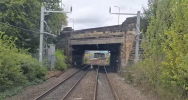
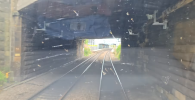
Those aren’t surge arrestorsHere are a couple of screenshots from the video in post #794 of a back cab ride through Edinburgh Gateway in August.
First shows surge arrestors in place on the south side of the A8 bridge (Also visible on Google Streetview).
Second shows the supports for the overhead wires already installed under the bridge.
To me that suggests that this bridge shouldn't be an issue unless there was a big problem with the design which Network Rail have only just realised, but I doubt it.
Its not an arched bridge but im surmising the wire height through the station platforms has to be at a minimum which may be the issue.I’ve heard from a source that NR is now realising the A8 road bridge next to Edinburgh Gateway station is too low to fit wires… that’ll be fun to work around.