They did indeed, those with an Eastern Scottish plate just below the bus stop flag. Eastern also had its own version, a green one for stops served only by them.Being of a certain vintage, I can remember having it drummed into me that once someone had rung the bell to request a stop “you mustn’t ring it again” as it would confuse the driver (thus being the transition era to opo). If only it still applied - drivers must now get fed up with near incessant ringing by people taking no heed of what’s going on around them.
== Doublepost prevention - post automatically merged: ==
Though the “green buses” only stopped at selected stops.

-
Our new ticketing site is now live! Using either this or the original site (both powered by TrainSplit) helps support the running of the forum with every ticket purchase! Find out more and ask any questions/give us feedback in this thread!
You are using an out of date browser. It may not display this or other websites correctly.
You should upgrade or use an alternative browser.
You should upgrade or use an alternative browser.
Quirky or quaint practices on buses in the past
- Thread starter Springs Branch
- Start date
- Status
- Not open for further replies.
Sponsor Post - registered members do not see these adverts; click here to register, or click here to log in
R
RailUK Forums

TheGrandWazoo
Veteran Member
No, they were shown in the timetable booklet. I think it was because the 26 was a service United had since the 1920s (and might have run through at some point?) but the 30 was gained only in 1971. Only logical reason I can think of.Maybe the 26 had a timed connection, whereas the 30 wasn't suitably timed.
In my home town, Sunderland, some Corporation bus routes could involve quite intricate interworking between bus routes.
For example, in theory -
Service 1 was Grangetown - Town Centre - Dene Estate
Service 7 was Town Centre - Docks
Service 15 was Town Centre - High Barnes
Service 25 was Town Centre - Witherwack Estate
And during the daytime a bus left Grangetown as a Service 1 to Town Centre and Dene Estate but returned from Dene Estate as Service 15 to Town Centre and High Barnes. Then return from High Barnes as Service 25 to Town Centre and Witherwack Estate
But then in the evening the bus left Grangetown as a Service 7 to Town Centre and Docks, returning from Docks as Service 1 to Town Centre and Dene Estate.
Not too sure how the poor passengers were supposed to know which bus was which. This stopped in about 1974 after Tyne and Wear PTE came into existance.
For example, in theory -
Service 1 was Grangetown - Town Centre - Dene Estate
Service 7 was Town Centre - Docks
Service 15 was Town Centre - High Barnes
Service 25 was Town Centre - Witherwack Estate
And during the daytime a bus left Grangetown as a Service 1 to Town Centre and Dene Estate but returned from Dene Estate as Service 15 to Town Centre and High Barnes. Then return from High Barnes as Service 25 to Town Centre and Witherwack Estate
But then in the evening the bus left Grangetown as a Service 7 to Town Centre and Docks, returning from Docks as Service 1 to Town Centre and Dene Estate.
Not too sure how the poor passengers were supposed to know which bus was which. This stopped in about 1974 after Tyne and Wear PTE came into existance.
when the last boarder has got their first foot on the platform, please. By the time the driver has processed the bell signal and let the clutch in, the boarder will be firmly on the platform on their way to the lower saloon or the staircase. (A bit more latitude given to those of advancing years....)Passengers walking to the exit ready for their stop and conductors belling the driver as soon as the last boarder has got both feet off the platform.

daodao
Established Member
Being of a certain vintage, I can remember having it drummed into me that once someone had rung the bell to request a stop “you mustn’t ring it again” as it would confuse the driver (thus being the transition era to opo). If only it still applied - drivers must now get fed up with near incessant ringing by people taking no heed of what’s going on around them.
== Doublepost prevention - post automatically merged: ==
Though the “green buses” only stopped at selected stops.
In my home town, Sunderland, some Corporation bus routes could involve quite intricate interworking between bus routes.
For example, in theory -
Service 1 was Grangetown - Town Centre - Dene Estate
Service 7 was Town Centre - Docks
Service 15 was Town Centre - High Barnes
Service 25 was Town Centre - Witherwack Estate
And during the daytime a bus left Grangetown as a Service 1 to Town Centre and Dene Estate but returned from Dene Estate as Service 15 to Town Centre and High Barnes. Then return from High Barnes as Service 25 to Town Centre and Witherwack Estate
But then in the evening the bus left Grangetown as a Service 7 to Town Centre and Docks, returning from Docks as Service 1 to Town Centre and Dene Estate.
Not too sure how the poor passengers were supposed to know which bus was which. This stopped in about 1974 after Tyne and Wear PTE came into existance.
a similar arrangement happened in Luton in the 1960s
Service 29 Airport - Town Centre -Priestleys
Service 30 Priestleys -Town Centre - Limbury
Serivice 31 Limbury - Town Centre - Airport
Each route only operated in one direction.
Leicester Corporation used to link routes across the city centre but each outer destination had it's own number so the route had two different numbers depending on direction.

Fawkes Cat
Established Member
- Joined
- 8 May 2017
- Messages
- 5,341
Something similar seems to happen today in Henley-on-Thames - see https://www.henleytowncouncil.gov.uk/services/bus-services/a similar arrangement happened in Luton in the 1960s
Service 29 Airport - Town Centre -Priestleys
Service 30 Priestleys -Town Centre - Limbury
Serivice 31 Limbury - Town Centre - Airport
Each route only operated in one direction.
Leicester Corporation used to link routes across the city centre but each outer destination had it's own number so the route had two different numbers depending on direction.
The Henley Hopper was commissioned by Henley Town Council following Reading Buses’ decision to withdraw from the contract. It runs Monday to Friday from 9am to 2pm with 3 routes across the town.
It is a friendly and efficient service operated by TK Travel, an award-winning family firm based near Burghfield, on behalf of Henley Town Council. The Henley Hopper is not profit-making and is supported through housing developer financial contributions and subsidy from Henley-on-Thames Town Council, which has been supporting the routes since Oxfordshire County Council removed all its bus subsidies as a cost-cutting measure in 2016.
What appears to happen (and sorry, I don't seem able to cut and paste) is that the 153 runs a loop from/to the Market Place, and becomes the 151 doing a different loop, which becomes the 152 on a 3rd loop. Layover for 7 minutes and repeat.
And unusually for a subsidised service, supported by the Town (i.e. Parish) Council.
Merle Haggard
Established Member
Being of a certain vintage, I can remember having it drummed into me that once someone had rung the bell to request a stop “you mustn’t ring it again” as it would confuse the driver (thus being the transition era to opo). If only it still applied - drivers must now get fed up with near incessant ringing by people taking no heed of what’s going on around them.
In Northampton in my childhood, on both United Counties and the Corporation, it was absolutely taboo for passengers to ring the bell. Similarly, on U.C. Lodekkas with manual doors one had to wait at a stop until the conductor opened them - I tried to do it myself once, the conductor rushed down the stairs and shut it before opening it again, to prove the point.
Similarly with opening sliding windows; travelling on a very stuffy South Wales Transport Regent (shed-bashing) a passenger cautiously asked the conductor to open a slider, clearly passengers were not allowed to do it themselves.
JKP
Member
Drivers of front entrance buses often used to wedge a piece of card when on schools work to avoid this issue.Some drivers of the school bus would go mad, probably only used to charter work where there's someone in charge. Usually once the ones at the back figured out it caused chaos they then did it more.
Became less of a thing once that charter company took over the route all days and we got drivers more prepared for school work.

pokemonsuper9
Established Member
Wedge a piece of card where?Drivers of front entrance buses often used to wedge a piece of card when on schools work to avoid this issue.
Falcon1200
Established Member
Old buses and coaches being repurposed by their operators as breakdown vehicles, used to be relatively common but I don't think I've seen one this century.
I recall seeing in a book, many many years ago, a feature about deroofed double deckers being used to cut back overhanging trees. Given how often buses strike tree branches nowadays I suspect this practice has long since ceased!
Pinus contorta
Member
Still did it on the Isle of Wight in mid 2000's . Dont live there now so can't comment.I recall seeing in a book, many many years ago, a feature about deroofed double deckers being used to cut back overhanging trees. Given how often buses strike tree branches nowadays I suspect this practice has long since ceased!
Gloster
Veteran Member
Still did it on the Isle of Wight in mid 2000's . Dont live there now so can't comment.
Son of Vlad was still around a couple of months ago.

GusB
Established Member
Was the General Manager one Sir Humphrey Appleby, perchance?I have a vague half-memory of quaintly-flowery notices on some buses. One was "Passengers are respectfully requested to refrain from smoking" instead of plain "No smoking" (even when there were "stubbers" on the sea-backs!). Another was "Passengers desirous of alighting are asked to advise the driver by operating the bell-push" instead of "Ring bell to stop bus".

I certainly haven't seen any bus-derived tow vehicles recently, but they were fairly common.Not technically 'on buses' but:
Old buses and coaches being repurposed by their operators as breakdown vehicles, used to be relatively common but I don't think I've seen one this century. Does anyone know if there are any still in use?
There's a tidy ex-Midland Scottish example in preservation:
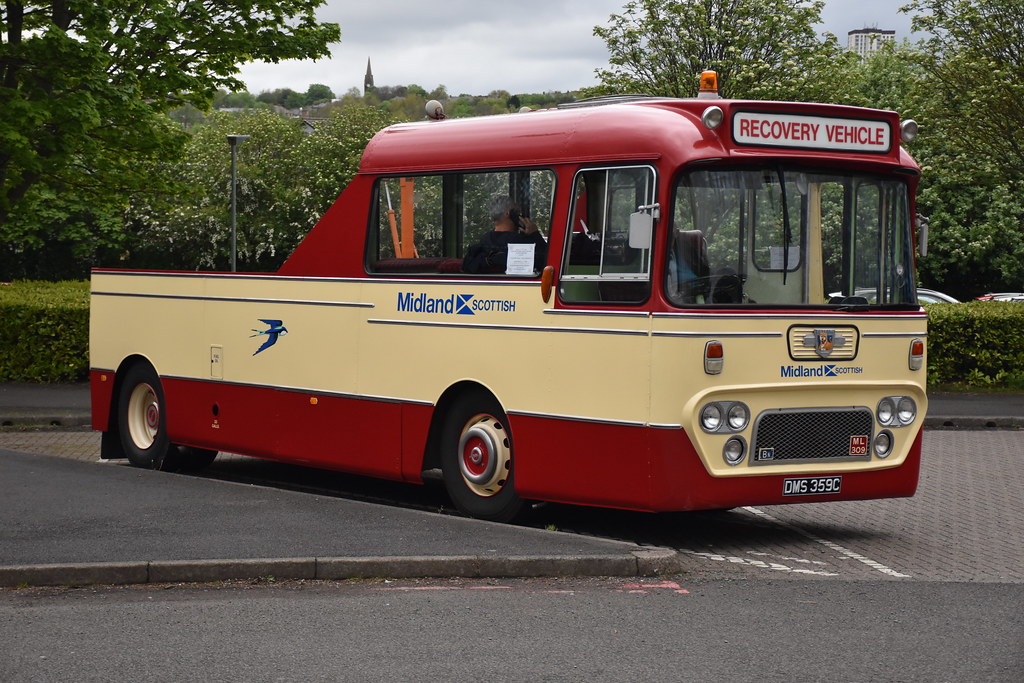
DMS359C
Seen in the coach park at Gateshead Metrocentre for the North East Bus Preservation Trust 2024 Rally is former Midland Scottish Recovery Vehicle in the form of Alexander Y-type bodied Leyland Leopard DMS359C.
 www.flickr.com
My local depot used an old Leyland Bull for years, followed by a more modern Leyland lorry (not sure what it was, but it had the Ergomatic cab). For a time they actually used withdrawn Albion Vikings as tow vehicles without any conversion.
Merle Haggard
Established Member
I have a vague half-memory of quaintly-flowery notices on some buses. One was "Passengers are respectfully requested to refrain from smoking" instead of plain "No smoking" (even when there were "stubbers" on the sea-backs!). Another was "Passengers desirous of alighting are asked to advise the driver by operating the bell-push" instead of "Ring bell to stop bus".
Someone I know bought an RELL from Belfast Citybus, originally from round here. By contrast, we counted 26 different prohibition type notices, all expressed very strictly! Matters such as the dire outcome if you can't produce a ticket to an Inspector. It seemed like a single notice above the entrance door saying 'Go away, you're a nuisance' would have saved a lot of signs...

And at the risk of sounding socially divisive you could be led blindfold onto the bus and know instantly the blindfold was removed which of those two you were on just by looking at and listening to your fellow passengers!My experience in Edinburgh in the 1970s was the city buses were generally known to the public by number, including some well-known combinations such as north/south through the city being referred to as "you want the 23 and 27 to get there".

izvor
Member
Another quirky practice I remember is crew/driver swaps in the middle of nowhere. Two buses passing on a wide, open road, pull up short of each other and drivers leap out and swap buses. Not an urban practice hopefully! I remember it in eastern England, maybe United Counties or Eastern Counties, or Lincolnshire Road Car, in NBC days. Anywhere else? Does it still happen anywhere? Interesting way of mitigating if one of the buses is running late - provided the road is suitable of course. In the Fens you could spot the other bus a mile away!
TheGrandWazoo
Veteran Member
Going back to my Wensleydale example, they would do swaps on a Saturday, one in Leyburn market place but a couple in the village of Bellerby. Almex machines unclipped, running boards and fare tables grabbed, and vehicles swapped.Another quirky practice I remember is crew/driver swaps in the middle of nowhere. Two buses passing on a wide, open road, pull up short of each other and drivers leap out and swap buses. Not an urban practice hopefully! I remember it in eastern England, maybe United Counties or Eastern Counties, or Lincolnshire Road Car, in NBC days. Anywhere else? Does it still happen anywhere? Interesting way of mitigating if one of the buses is running late - provided the road is suitable of course. In the Fens you could spot the other bus a mile away!
Last edited:
Statto
Established Member
Someone I know bought an RELL from Belfast Citybus, originally from round here. By contrast, we counted 26 different prohibition type notices, all expressed very strictly! Matters such as the dire outcome if you can't produce a ticket to an Inspector. It seemed like a single notice above the entrance door saying 'Go away, you're a nuisance' would have saved a lot of signs...
Driving for Belfast Citybus in the troubles would have been fun, daily risk of riots, hijackings & so on, & the buses were quite convenient method for the rioters to block roads with.
I certainly remember Crossville doing this in mid Wales in the early 70s. On one occasion, on the last journey of the day, the two buses swapped passengers and turned around.Another quirky practice I remember is crew/driver swaps in the middle of nowhere. Two buses passing on a wide, open road, pull up short of each other and drivers leap out and swap buses. Not an urban practice hopefully! I remember it in eastern England, maybe United Counties or Eastern Counties, or Lincolnshire Road Car, in NBC days. Anywhere else? Does it still happen anywhere? Interesting way of mitigating if one of the buses is running late - provided the road is suitable of course. In the Fens you could spot the other bus a mile away!
Now this is a bit niche, but around the same time my school journey involved one of the Aldershot & District's 34, 34A, 34B or 48A services which at that time had a common section of route between Woking and West End. They were mainly operated by Dennis Loline III vehicles, which were half-cabs with a front entrance and a sliding door operated by the driver. There was a small window between the driving cab and the platform where passengers stood waiting to alight (at the front of the downstairs saloon).I don't know if it was universal, but when I went to secondary school in about 1965 it was nearly an hour's journey each way on one or more London Country (Country Buses?) RTs.
The bell signals were 1 ring from anybody for a request stop, 2 for "right away" (obviously from the conductor only) and 3 from the conductor/conductress: "Full up: ignore people at request stops!" I was very glad that I boarded before it became F&S.
During weekdays and Saturdays, these routes were almost wholly the preserve of Woking depot. Conductors would use a coin from their change bag to tap on the small window between the platform and the driving cab, one for stop and two for go; the bell was never used. In the absence of a single tap approaching stops where no-one was waiting, the driver would glance over their left shoulder to see if anyone was waiting to alight. And self-despatch from stops if necessary.
On Sundays much of the work on these routes was allocated to Guildford depot and it was only when I travelled on Sundays that I realised that the practice appeared to be unique to Woking depot. Of course, there may be forum members who know of a similar practice at Aldershot, Alton, Hindhead etc.
I did say it was a bit niche...
Merle Haggard
Established Member
On the subject of bell pushes E..C.W. bodied buses for the Tilling group had an arcane feature. The pushes down the saloons had 'PUSH ONCE' on them, but the one on the platform and at the top of the stairs (on rear entrance d.d. buses) were plain. The former sounded a buzzer in the cab, and the latter a bell. The idea was that the 2 bells right away could only be sent from a position where the platform could be seen, so the driver should only start on hearing a bell, not a buzzer.
This was carried to its logical extreme on early FLF-types (the forward entrance Lodekka); at the head of the stairs there were two pushes at the top of the stairs above the window line, one plain and one marked 'PUSH ONCE'. I am not sure that conductors. let alone passengers, appreciated that distinction...
This was carried to its logical extreme on early FLF-types (the forward entrance Lodekka); at the head of the stairs there were two pushes at the top of the stairs above the window line, one plain and one marked 'PUSH ONCE'. I am not sure that conductors. let alone passengers, appreciated that distinction...
Early 1970s Ribble: X21 Preston-Carlisle and X21 Carlisle-Preston draw up in the laybys on the A6 at Shap Summit. Each driver stows Setright machine etc in its box, put their change machines under one arm, and walk across the road to exchange buses. Great fun in a snowstorm, not that rare at this location. OMO operation, rare on Ribble internal express services at this time, using Leyland Leopard 49 seat DPs.Another quirky practice I remember is crew/driver swaps in the middle of nowhere. Two buses passing on a wide, open road, pull up short of each other and drivers leap out and swap buses. Not an urban practice hopefully! I remember it in eastern England, maybe United Counties or Eastern Counties, or Lincolnshire Road Car, in NBC days. Anywhere else? Does it still happen anywhere? Interesting way of mitigating if one of the buses is running late - provided the road is suitable of course. In the Fens you could spot the other bus a mile away!
TheGrandWazoo
Veteran Member
There was a practice where Crosville and SWT jointly operated the X52 Aberystwyth to Swansea service which involved a vehicle swap at somewhere like Llanwrda. This saw a Crosville vehicle driven by an SWT driver and vice versa.I certainly remember Crossville doing this in mid Wales in the early 70s. On one occasion, on the last journey of the day, the two buses swapped passengers and turned around
I believe whilst the Crosville vehicle was parked up, it wasn’t unknown for the SWT vehicle to be nabbed for use on Aber locals before vehicles swapped back in the evening
JKP
Member
The jointly operated 508 by Eastern Scottish and United provided 3 journeys each way between Galashiels and Newcastle via Jedburgh and Otterburn. On the last journey of the day the United bus from Newcastle met the Eastern Scottish bus from Galashiels at Otterburn, turned around and swopped passengers.Another quirky practice I remember is crew/driver swaps in the middle of nowhere. Two buses passing on a wide, open road, pull up short of each other and drivers leap out and swap buses. Not an urban practice hopefully! I remember it in eastern England, maybe United Counties or Eastern Counties, or Lincolnshire Road Car, in NBC days. Anywhere else? Does it still happen anywhere? Interesting way of mitigating if one of the buses is running late - provided the road is suitable of course. In the Fens you could spot the other bus a mile away!
On one memorable snowy day in the winter of 1981-82, I had the pleasure of travelling on the first journey northbound on this route, on a Northern bus seated Leyland National between Ponteland and St Boswells, a distance of 60 miles. Coming down the hairpins from Carter Bar was an interesting experience which the driver handled superbly.
In 1969 I caught a bus from Burnley to Skipton. The bus was a coach seated Leyland Atlantean which I think had come through from Manchester. Burnley had its own municipal bus service jointly with neighbouring Colne and Nelson (BCN). When the conductor came round to collect the fares I found that I could only pay for the journey as far a Colne. Once we had passed the town boundary, the conductor came round again to collect fares to places on to Skipton. I believe the service was jointly run between Ribble and BCN so this was probably a way of ensuring the BCN got its share of the revenue.
Old Walter
Member
The mention of the Hindhead area reminded me of a couple of oddities from the late 1990s. One was Woodside Road in Chiddingfold which the evening and Sunday 71 would serve but no main daytime route did! The Sunday 19 was similar serving roads that had no main route as well but the details escape me as I never got to travel on the Sunday version of the route. I recall the turning point for the 19 at Churt involving reversing into a very narrow lane next to an awkwardly shaped old building. I gather that’s not totally unusual though as the 51 in Selsey reversed into Seal Road and I believe still does.I remember travelling on lightly-loaded double-deckers in the Alder Valley Hindhead area in the late 80s during the middle of the day (obviously during half-term or holidays).
I don’t remember Alder Valley in great detail but the interworking and creativeness of the Stagecoach Hants & Surrey schedules during the 1990s was quite remarkable! It was all over the network too, from the combinations of 18/19/60/71/92 on the Haslemere side (and even then the 19 was heavily linked to the 17 at Aldershot) to the completely mixed up Camberley & Farnborough routes linking with Aldershot on/off routes 49/50/56. Some routes largely stayed on their own such as 1, 4/5, 20/20A but there was still a lot going on. A grand old time!
Last edited:
Anywhere else in Britain, an X would most likely indicate some sort of limited stop or express service. But in Manchester, "X" meant anything a bit different to the normal route.
London trams were similar - although they seem more often to have shown either just the service number or 'EX' (as in 'Extra') rather than (for example) 36X
Leicester Corporation used to link routes across the city centre but each outer destination had it's own number so the route had two different numbers depending on direction.
Leeds tram routes also worked on the basis that the number was for the destination on the other side of the city - the network meant that any inbound tram was following the same route to the city centre, so if you just wanted the city centre, it didn't matter what tram you got on. The inter-working might vary at different times of day / week, or there may be two destinations to / from one terminus at some times, so there could be two trams showing (for example) '9 Dewsbury Road' setting off from different north Leeds terminus points around the same time, and alternate trams from Dewsbury Road terminus might be heading to different north Leeds destinations so would show different service numbers.
Tom Gallacher
Member
I guess the proliferation of rear engined buses put paid to this kind of extended lifetime.Not technically 'on buses' but:
Old buses and coaches being repurposed by their operators as breakdown vehicles, used to be relatively common but I don't think I've seen one this century. Does anyone know if there are any still in use?
TheGrandWazoo
Veteran Member
More a case of bus companies finding it easier, cheaper and legally compliant to subcontract it out.I guess the proliferation of rear engined buses put paid to this kind of extended lifetime.
- Status
- Not open for further replies.