Another quirky practice I remember is crew/driver swaps in the middle of nowhere. Two buses passing on a wide, open road, pull up short of each other and drivers leap out and swap buses. Not an urban practice hopefully! I remember it in eastern England, maybe United Counties or Eastern Counties, or Lincolnshire Road Car, in NBC days. Anywhere else?
I certainly remember Crossville doing this in mid Wales in the early 70s. On one occasion, on the last journey of the day, the two buses swapped passengers and turned around.
Not in the middle of nowhere and definitely within an urban area - for many years Lancashire United Transport's Service 1 between St Helens and Atherton (via a circuitous, mostly urban route) was jointly operated by LUT (the majority) and St Helens Corporation buses (2 or 3 vehicles).
To avoid dead running and to get each operator's vehicles in the 'right order' for garage runs at the end of the day, on Mon-Sat mornings the first couple of journeys from both Atherton and St Helens directions were timed to meet each other at Haydock (at 05-something), exchange passengers, then turn around and return whence they came. I'm guessing it was easier to manage this passenger exchange with well-trained regulars at stupid-o'-clock in the morning than with the last buses in the evening, which might be well-loaded with drinkers, cinema crowds and the like.
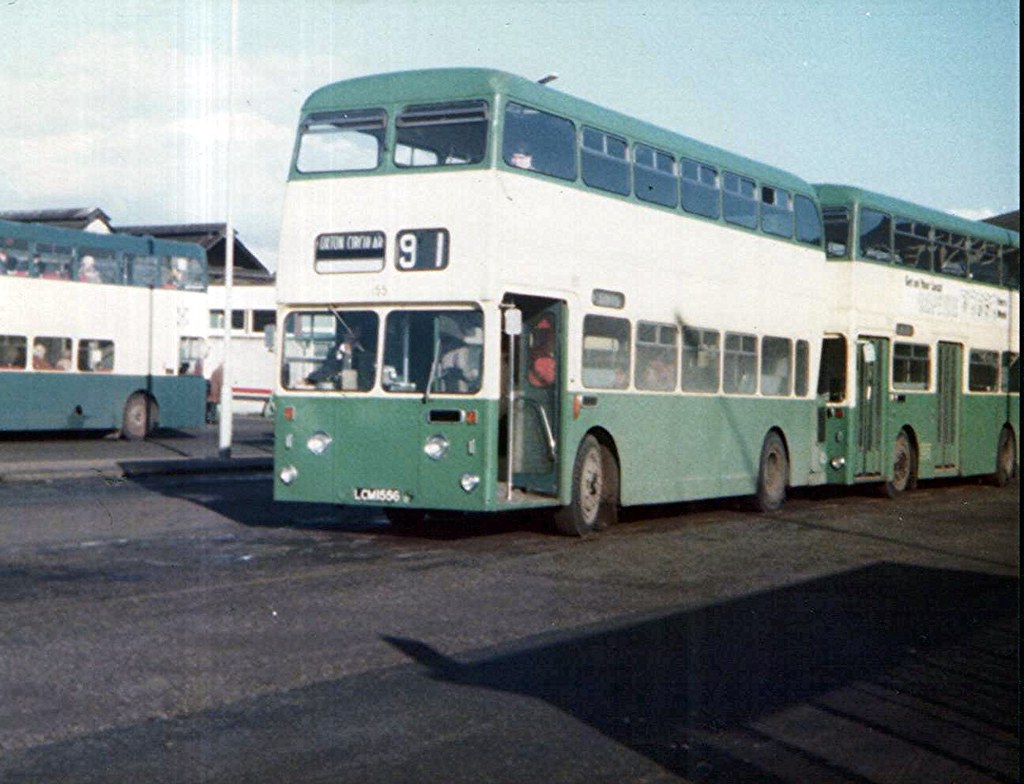
Now this is a bit niche --[snip]-- operated by Dennis Loline III vehicles, which were half-cabs with a front entrance and a sliding door operated by the driver. There was a small window between the driving cab and the platform where passengers stood waiting to alight (at the front of the downstairs saloon). --[snip]-- Conductors would use a coin from their change bag to tap on the small window between the platform and the driving cab, one for stop and two for go; the bell was never used.
This practice was repeated in north-west England - again in Lancashire United land - on LUT's front-entrance Guy Arab Vs.
The conductor would tap on the same small window between front platform and cab to signal the driver to stop. Two taps for go were occasionally given, but in general the driver 'self-dispatched'. Likewise, use of the bell by passengers was unofficially
verboten on any front entrance buses.
I once got roundly abused by the driver of a LUT Daimler Fleetline, on the day I was a bit late getting up from my upper-deck seat approaching my stop and 'doing him a favour' by ringing the bell just as I was about to stumble down the stairs. The conductress was only slightly more conciliatory - she reminded me that if he needed a bell, she was the one to give it to him.
In my younger years, when LUT still had some back-loading Guy Arabs on the road, I had been a bit surprised by all the ding and ding-dinging which occurred on one of these types. Obviously more necessary to use bell signals with a rear platform.
On any front entrance bus, the drill when wanting off was to make your way to the front platform a reasonable but not excessive time before your stop. If the conductor was there, they'd tap the communicating window. If s/he was away collecting fares (or maybe even couldn't be bothered), it was a point of workmanlike pride that the driver would always notice you and stop.
For elderly passengers who might find it hard to walk to the front platform of a moving bus, they'd call out "next stop please" to the conductor and the cab window would be tapped. You certainly didn't ring the bell yourself!
The little window could be used for communication in both directions. A firm thud from the driver's left elbow on there was code to the conductor "inspector boarding at next stop".