• Our new ticketing site is now live! Using either this or the original site (both powered by TrainSplit) helps support the running of the forum with every ticket purchase! Find out more and ask any questions/give us feedback in this thread!

London Underground and TfL Fast Trains

Status
Not open for further replies.

cle

Established Member
Joined
17 Nov 2010
Messages
5,652
Passenger behaviour isn't a function of pure time, it's a function of generalised time. Different elements of time have different weightings (in-vehicle times, wait times, crowded vs uncrowded times), and this is why transport modelling uses generalised journey times. Journey times under different ambience conditions attract different weighting adjustments. This isn't word salad, it's transport modelling 101. And modelling isn't for modelling's sake - modelling parameters are extensively calibrated to reflect and predict real-life passenger behaviour.

I do agree this is getting away from the topic.
And no disrespect meant - I rate you as a poster here and the other place. But it was getting a bit abstract!

FWIW - I think the literal topic is interesting. When have twin track tube lines had differing stopping patterns? Met did some odd ones.

Skip stopping is that - it’s seen a lot on through running in Tokyo during the metro stretches - quite odd to see fasts skip although the stock is all so co-mingled with the various private and JR networks. NYC has J/Z in peaks and formerly 1/9 - more literal skip stopping than a hierarchy of flighted patterns like in Japan.

I don’t know where in London that would be pathable or worth it. District east of Whitechapel? Wimbledon branch?
 
Sponsor Post - registered members do not see these adverts; click here to register, or click here to log in
R

RailUK Forums

edwin_m

Veteran Member
Joined
21 Apr 2013
Messages
28,694
Location
Nottingham
If I recall correctly the Piccadilly or its predecessors had some trains miss some stations in the early years. This was probably related to the very close station spacing, ultimately resolved by closing several of them.
 

NCT

Established Member
Joined
18 Apr 2025
Messages
2,299
Location
London
And no disrespect meant - I rate you as a poster here and the other place. But it was getting a bit abstract!

FWIW - I think the literal topic is interesting. When have twin track tube lines had differing stopping patterns? Met did some odd ones.

Skip stopping is that - it’s seen a lot on through running in Tokyo during the metro stretches - quite odd to see fasts skip although the stock is all so co-mingled with the various private and JR networks. NYC has J/Z in peaks and formerly 1/9 - more literal skip stopping than a hierarchy of flighted patterns like in Japan.

I don’t know where in London that would be pathable or worth it. District east of Whitechapel? Wimbledon branch?

I come back to the question I always ask - what's the problem your solution is trying to solve?

For a fast route into Central London from any of the District line termini, you don't use the District line. SWR/EL/C2C serve that purpose. The kind of journeys people do use the District line for, western branches to South Ken; Stepney to Temple, the distances aren't long enough to warrant faster journeys through skip stopping. Complex routes like the District line rely on simplicity to mitigate against inherent performance issues. The operation relies on being able to change terminus at Earl's Court, which in turn relies on instilling a passenger culture of 'take the first train and change'. If say Wimbleware are all stops and Victoria - Wimbledons are skip stop on the branch, you lose that essential flexibility.
 

NorthKent1989

Established Member
Joined
13 May 2017
Messages
2,172
Until the 1960s th District line did used to skip stations in the central London area, West Brompton was often skipped on the Wimbledon service, while Richmond and Ealing services would skip South Ken and Gloucester Road, even in the 1980s Cannon Street was often skipped
 

35B

Established Member
Joined
19 Dec 2011
Messages
5,528
Until the 1960s th District line did used to skip stations in the central London area, West Brompton was often skipped on the Wimbledon service, while Richmond and Ealing services would skip South Ken and Gloucester Road, even in the 1980s Cannon Street was often skipped
Which suggests that the gains from skip stopping were pretty thin, and at least offset by the hassles.
 

mr_jrt

Established Member
Joined
30 May 2011
Messages
1,578
Location
Brighton
The Northern Line also used to have skip-stopping. Brent (later Cross) station as-built had platform loops, that were abandoned relatively quickly, but still. IIRC, there were provisional plans when the 1938 stock were being planned that platforms at major stations would be extended, but at minor ones a carriage would be left in the tunnel (at some places the first, and at others the last, to spread loadings). I suspect (but can't recall accurately right now, if that extended (pun intended) to actual skip-stopping as well. Ultimately, it wasn't needed and we ended up with the vanilla all-stations stopping patterns we have today.
 

London Trains

Established Member
Joined
9 Oct 2017
Messages
1,227
Sometimes skip stopping is a way of segmenting the passenger loads.
Why is there any need to "segment" the passenger loads? Having more services stop at all or most stations naturally spreads out passenger loads, as passengers will not aim for a specific "fast" service and will use the line as a true turn up and go service.

You only have to go as far as the other side of the Elizabeth Line between Stratford and Shenfield to see that this works perfectly - all Elizabeth Line services call at all stations, and Greater Anglia don't serve any of the intermediate stations apart from Romford.

As mentioned earlier, conflicting freight paths is the main reason for the needless array of stopping patterns in West London, and I would go as far as to pretty much guarantee that TfL would not specify such a mix of stopping patterns being used if there weren't any pathing issues on the GWML.
 

cle

Established Member
Joined
17 Nov 2010
Messages
5,652
There would never be any cause on the Abbey Wood branch - unless extended and the outer reaches had alt patterns (eg a stopper to Dartford and a semi to Gravesend) - on Shenfield, if it was ever increased maybe you could have fast Stratford-Ilford. But doesn’t really solve much.

I remember the old Southends were all - Stratford Ilford Romford and then stations.
 

Mgameing123

Member
Joined
29 Apr 2023
Messages
1,057
Location
Denmark
Why is there any need to "segment" the passenger loads? Having more services stop at all or most stations naturally spreads out passenger loads, as passengers will not aim for a specific "fast" service and will use the line as a true turn up and go service.

You only have to go as far as the other side of the Elizabeth Line between Stratford and Shenfield to see that this works perfectly - all Elizabeth Line services call at all stations, and Greater Anglia don't serve any of the intermediate stations apart from Romford.

As mentioned earlier, conflicting freight paths is the main reason for the needless array of stopping patterns in West London, and I would go as far as to pretty much guarantee that TfL would not specify such a mix of stopping patterns being used if there weren't any pathing issues on the GWML.
But wouldn’t it be better to just provide fast services if that’s what customers want?
 

35B

Established Member
Joined
19 Dec 2011
Messages
5,528
But wouldn’t it be better to just provide fast services if that’s what customers want?
Which passengers, and using what capacity? The issue is that the Relief Lines on the GWML are shared infrastructure, and is required to support freight operations. Likewise, on the GEML, there's a clear boundary and therefore the limited capacity can be used more effectively.
 

SynthD

Established Member
Joined
4 Apr 2020
Messages
2,048
Location
UK
Why is there any need to "segment" the passenger loads? Having more services stop at all or most stations naturally spreads out passenger loads, as passengers will not aim for a specific "fast" service and will use the line as a true turn up and go service.
Acton is the notable example/problem on this line. You want passengers to further stations to be on different trains to Acton people to make it fairer for everyone.
 

Mgameing123

Member
Joined
29 Apr 2023
Messages
1,057
Location
Denmark
Which passengers, and using what capacity? The issue is that the Relief Lines on the GWML are shared infrastructure, and is required to support freight operations. Likewise, on the GEML, there's a clear boundary and therefore the limited capacity can be used more effectively.
Well I can imagine the folks from towns like Langley or Maidenhead don’t want an all stations train into Central London.
 

Horizon22

Established Member
Associate Staff
Jobs & Careers
Joined
8 Sep 2019
Messages
11,010
Location
London
but - “ambient adjusted generalised journey time” is word salad, or really, a bit pretentious and not remotely logical.

Time is time. It’s longer. A nicer train or comfortable temperature doesn’t generalize journey time. It’s experience.

It isn’t - it’s basic transport planning and transport modelling. It models real world behaviour where people are not always purely rational beings - one example being where people will wait a fair amount of time for a direct service despite being slower overall.

== Doublepost prevention - post automatically merged: ==

Well I can imagine the folks from towns like Langley or Maidenhead don’t want an all stations train into Central London.

Correct. And to compare it to Shenfield is a bit of a false equivalency as Reading is a lot further from London. The journey time is 15 minutes between Maidenhead and Reading alone.

== Doublepost prevention - post automatically merged: ==

As mentioned earlier, conflicting freight paths is the main reason for the needless array of stopping patterns in West London, and I would go as far as to pretty much guarantee that TfL would not specify such a mix of stopping patterns being used if there weren't any pathing issues on the GWML.

Yes, it would also be easier to explain and would stop the weird issues with Taplow and Iver getting an irregular service pattern compared to the other stations west of Hayes and Harlington.
 

London Trains

Established Member
Joined
9 Oct 2017
Messages
1,227
Well I can imagine the folks from towns like Langley or Maidenhead don’t want an all stations train into Central London.
I don't think anyone has suggested the Reading services should serve all stations though, just that the Elizabeth Line stopping patterns in West London should be simplified down to only two patterns, either all stations or "semi-fast" skipping Acton ML, West Ealing and Hanwell - all Reading/Maidenhead services would fall into the semi-fast category. Also bear in mind the current peak time "fasts" which run non-stop from Ealing Broadway to West Drayton are timetabled to take exactly the same amount of time as the standard services stopping at Southall and Hayes do, so there isn't any time penalty from this simplification anyway.

== Doublepost prevention - post automatically merged: ==

Correct. And to compare it to Shenfield is a bit of a false equivalency as Reading is a lot further from London. The journey time is 15 minutes between Maidenhead and Reading alone.
Maidenhead is only a couple of miles further out than Shenfield, so Maidenhead and Shenfield are a fair equivalency - Maidenhead to Reading is really only a part of the Elizabeth Line for local connections to/from West London, as well as operational convenience.
 
Last edited:

bramling

Veteran Member
Joined
5 Mar 2012
Messages
20,411
Location
Hertfordshire / Teesdale
The Underground has experimented with variable stopping patterns at times. Except where there have been multiple tracks, the result has been to add confusion which has more than offset the possible gains. And even then (Met, I’m looking at you), this isn’t always simple.

For those of us who know the Tube like the back of our hands, we forget how confusing it can be for irregular travellers who haven’t got the Tube map imprinted and don’t know the lines off by heart. The present system works because basically every train stops everywhere and we make up in frequency what we lose in speed.

I agree in principle, with one exception which is the perennial pressure for the Piccadilly Line to stop at Turnham Green at all times. The arrangement there is quite easy to understand with the stopping pattern being differentiated on the basis of different lines, and the time saving for Piccadilly Line journeys is (IMO) worthwhile as it allows a good length of fast running.

I’d also prefer the Met to revert to the situation where the majority of Amersham / Chesham trains run fast. Again, the saving here is worthwhile.

== Doublepost prevention - post automatically merged: ==

Which suggests that the gains from skip stopping were pretty thin, and at least offset by the hassles.

As ever it depends on your perspective. For anyone who has used the Underground on the rare occasions when trains miss multiple stops (mainly strike days or during Covid) it makes such a difference in terms of time. Golders Green to Euston with just two stops was a completely different experience.

From experience, people do tend to go for faster services where the option is available. I’ve always thought part of the rationale for that isn’t just speed, but also to avoid the nuisance of being disturbed at every station by people getting on and off.
 
Last edited:

cle

Established Member
Joined
17 Nov 2010
Messages
5,652
I do wish they’d bite the bullet and just do Turnham Green all day/week too.

Also bear in mind the current peak time "fasts" which run non-stop from Ealing Broadway to West Drayton are timetabled to take exactly the same amount of time as the standard services stopping at Southall and Hayes do, so there isn't any time penalty from this simplification anyway.
These should call at Hayes minimum ideally - have you seen latest usage numbers? Southall not far behind either, with 15m+ between them both. They def need more services overall. The bay is ripe for something if freight could be reliably decreased / re-allocated.
 

Mgameing123

Member
Joined
29 Apr 2023
Messages
1,057
Location
Denmark
I don't think anyone has suggested the Reading services should serve all stations though, just that the Elizabeth Line stopping patterns in West London should be simplified down to only two patterns, either all stations or "semi-fast" skipping Acton ML, West Ealing and Hanwell - all Reading/Maidenhead services would fall into the semi-fast category. Also bear in mind the current peak time "fasts" which run non-stop from Ealing Broadway to West Drayton are timetabled to take exactly the same amount of time as the standard services stopping at Southall and Hayes do, so there isn't any time penalty from this simplification anyway.

== Doublepost prevention - post automatically merged: ==


Maidenhead is only a couple of miles further out than Shenfield, so Maidenhead and Shenfield are a fair equivalency - Maidenhead to Reading is really only a part of the Elizabeth Line for local connections to/from West London, as well as operational convenience.
Ehh but I’d say to still have trains that do that fast Paddington to Slough only calling at Ealing Broadway and West Drayton run because the trains are VERY busy.
 

35B

Established Member
Joined
19 Dec 2011
Messages
5,528
As ever it depends on your perspective. For anyone who has used the Underground on the rare occasions when trains miss multiple stops (mainly strike days or during Covid) it makes such a difference in terms of time. Golders Green to Euston with just two stops was a completely different experience.

From experience, people do tend to go for faster services where the option is available. I’ve always thought part of the rationale for that isn’t just speed, but also to avoid the nuisance of being disturbed at every station by people getting on and off.
I’m familiar with the tension of speed vs comfort, and have made various choices at different times. However, as a service provider, the objective is to maximise benefits to the maximum number of people. For an urban rapid transit system, that leans towards all stops.

What’s interesting is which exceptions we’re discussing. Turnham Green is a problem that would evaporate if it were removed from the Piccadilly map (Stamford Brook and Ravenscourt Park don’t get mentioned, after all), while the outer reaches of the Met take us back to whether the Met was properly part of the Underground or a main line railway.

That then gives us the core issue for the Elizabeth Line (and also Thameslink). The core section is unquestionably urban rapid transit, but the outer sections are less obviously so. That means compromises have to be made - hence places like Maidenhead getting stopping services when they might (on distance grounds) feel they deserve fast services.
 

Horizon22

Established Member
Associate Staff
Jobs & Careers
Joined
8 Sep 2019
Messages
11,010
Location
London
These should call at Hayes minimum ideally - have you seen latest usage numbers? Southall not far behind either, with 15m+ between them both. They def need more services overall. The bay is ripe for something if freight could be reliably decreased / re-allocated.

Those peak services are crowd busters more than anything else.

There just isn’t really the capacity to increase the service any more nor is it possible to remove freight from a key corridor between GWML and the WCML and GEML (via North London) to key freight terminals. Also access to Acton Yard.

== Doublepost prevention - post automatically merged: ==

That then gives us the core issue for the Elizabeth Line (and also Thameslink). The core section is unquestionably urban rapid transit, but the outer sections are less obviously so. That means compromises have to be made - hence places like Maidenhead getting stopping services when they might (on distance grounds) feel they deserve fast services.

Maidenhead does get fast peak trains run by GWR and 2tph that is fast from Slough to Paddington off-peak.
 

PeterC

Established Member
Joined
29 Sep 2014
Messages
4,782
I remember the old Southends were all - Stratford Ilford Romford and then stations.
3 tph on the Electric Lines plus 3 tph stopping to Gidea Park. There was a totally different service pattern in the peaks with a lot of switching between Electric and Main.

The current frequency on the Electrics would make skip stopping pretty pointless.
 
Last edited:

Horizon22

Established Member
Associate Staff
Jobs & Careers
Joined
8 Sep 2019
Messages
11,010
Location
London
3 tph on the Electric Lines plus 3 tph stopping to Gidea Park. There was a totally different service pattern in the peaks with a lot of switching between Electric and Main.

The current frequency on the Electrics would make skip stopping pretty pointless.

Which is one good point not mentioned yet regarding not running “fast trains”; running all stops actually helps increase capacity by having an even interval across the board running to maximum headway.
 

cactustwirly

Established Member
Joined
10 Apr 2013
Messages
8,424
Location
UK
I was just referring to the Elizabeth Line stopping patterns, for which I think there should only be two, either all stations or "semi-fast" skipping Acton Main Line, West Ealing and Hanwell.

For GWR though, there should also only be two stopping patterns, either non-stop to Reading or "semi-fast" only stopping at Slough, Maidenhead and Twyford - ideally they need to sort out the issues which prevent the Didcot services from calling at Slough in the peaks.
The issue is line capacity, they are booked to cross over to the reliefs at Maidenhead East junction so can't have trains stopping on the mains at Slough during the peak.

Off peak trains are booked to cross over at Dolphin Junction
 

z444z

Established Member
Joined
17 Apr 2022
Messages
1,219
Location
London
Maidenhead does get fast peak trains run by GWR and 2tph that is fast from Slough to Paddington off-peak.
They aren’t all that fast though, 33m to Paddington vs the Elizabeth line’s 42m despite only stopping once whereas the Elizabeth line calls at 8 intermediate stations!
 

Horizon22

Established Member
Associate Staff
Jobs & Careers
Joined
8 Sep 2019
Messages
11,010
Location
London
They aren’t all that fast though, 33m to Paddington vs the Elizabeth line’s 42m despite only stopping once whereas the Elizabeth line calls at 8 intermediate stations!

By “fast” I mean “fewer stops” in this regard!
 

z444z

Established Member
Joined
17 Apr 2022
Messages
1,219
Location
London
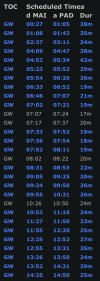
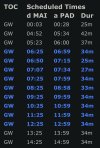
Were you referring to GWR’s fast services or Elizabeth line ones? As if the former they are much quicker than that:

20 minutes: Train 1, Train 2, Train 3
Ignore me, I forgot what time of year it is, they’re scheduled to take longer over Christmas/NY it seems (first image is 01/12/2025, second image is today)
 

Attachments

  • IMG_2593.jpeg
    IMG_2593.jpeg
    279.4 KB · Views: 4
  • IMG_2594.jpeg
    IMG_2594.jpeg
    169.2 KB · Views: 4

The exile

Established Member
Joined
31 Mar 2010
Messages
9,439
Location
Somerset
Citation needed here on the cause and stats of any delays. I’d say the Central & Northern run worse
Isn’t the keyword in the original statement “known”. Perception of unreliability is likely to be higher where there are different destinations and to grow the n inverse in proportion to the distance the split is from the centre. Thus someone travelling southbound on the Victoria Line only notices disruption if they arrive just in time for the gap as any train will do. Compare with someone heading to anywhere west of Earls Court on the District.

== Doublepost prevention - post automatically merged: ==

But wouldn’t it be better to just provide fast services if that’s what customers want?
If you ask “do you want a faster service” then everyone will say yes. If you ask “would you wait 20 minutes on a cold platform for the fast service that will save you 8 minutes?” The answer might be more nuanced.
 
Last edited:

Bald Rick

Veteran Member
Joined
28 Sep 2010
Messages
35,898
But wouldn’t it be better to just provide fast services if that’s what customers want?

If you ask “do you want a faster service” then everyone will say yes. If you ask “would you wait 20 minutes on a cold platform for the fast service that will save you 8 minutes?” The answer might be more nuanced.

Or:

“Do you want a fast service twice an hour, or a stopping service that takes 10 minutes longer every five minutes?”
 
Status
Not open for further replies.

Top