• Our new ticketing site is now live! Using either this or the original site (both powered by TrainSplit) helps support the running of the forum with every ticket purchase! Find out more and ask any questions/give us feedback in this thread!

TfL anti fare evasion effort intensifies

Status
Not open for further replies.

Tetchytyke

Veteran Member
Joined
12 Sep 2013
Messages
17,443
Location
Isle of Man
I think it's highly situation dependent. A significant proportion of Liverpool Street passengers at peak time will be working in well-paid City jobs. Whilst a few of them do engage in fare evasion, the vast majority don't.

Compare that with places in the middle or outer suburbs and the position is quite different. For three of the LU suburban stations that I have used regularly, I have almost always encountered somebody pushing through the barriers or tailgating whenever I've used them.
Even at a 3% fare evasion rate you will usually encounter someone doing it at busy times. I've seen it at Canning Town every single time I've used the station. But usually you'll only see 3 or 4 people doing it. When you think that a single Jubilee Line train can easily disgorge 100 people at that station in the peak times, 3 people doing it is still only 3%. It's just that they're visible. You don't notice the other 97 people tapping out as normal.

My experience is that jumping or tailgating the barrier is more common when it is busy. I used to see it every day at Archway when I lived around there, but only in the busy times. Getting off the late evening trains with only a handful of other people, I never saw it.

Exactly. And LU is no better. The potential consequences may be high, but the chances of getting caught are very low, especially if prepared to front it off.

TFL are adept at catching the likes of a student who has borrowed granny’s freedom pass, but that’s only half the story.
The types of fare evasion investigations that bring in the big money are the types of fare evasion investigations that fly under the surface. We see the same thing with the TOCs. Data analysis and plain-clothes investigators bring in the big bucks.

Big ostentatious revenue blocks don't bring in anywhere near the same sorts of money. They'll initially catch people but the criminals in an area will know about a big ostentatious revenue block basically as soon as the hi-vis jackets come out. Last time I went through Highbury and Islington I knew about the big ostentatious revenue block before I'd even got off the train- two lads were talking about it on the train, complaining.

Now there's a public good in causing fare evaders some inconvenience, but that's all it will cause them. It didn't deter those two lads on the Overground from Stratford.

If nothing is done about feral behaviour including ticket less travelers forcing themselves on we will end up with public transport not being for law abiding citizens. Then the law abiding citizens will ask why they should pay for others.
It comes back down to money and, more accurately, the willingness to spend it.

Back in the late 80s and early 90s, London was far far worse than it is now. I remember going into St Pancras and women were openly soliciting on the platforms. Anyone who thinks that London transport now is feral clearly never experienced the North London Line or the line north of Queens Park on the Bakerloo and Watford DC, especially in the early to mid 1990s.

That's not to dismiss your concerns or those of your granddaughter, more to point out that there's nothing new under the sun. I'm not sure if the new walk-through trains on Thameslink make me feel safer or not. On the new trains you can see and hear someone eight carriages away carrying on, whereas on the 319s you couldn't. You'd be blissfully unaware of them before but, on the other hand, you can see them coming now so can prepare yourself better.

The way you sort it out is through visible staff presence. Overground's solution to the Silverlink mess was to bring in more staff and to make them visible. It worked. But over the last 10-15 years we've seen staff presence in London start to decrease again. Station staff numbers have been culled, Johnson's controversial closure of LU ticket offices was just the start of 10 years of headcount cuts by stealth through 'natural wastage'. This has predominantly affected outer-suburban stations.

If you don't have a visible staff presence then other people fill the vacuum. But successive administrations have told us that there are too many staff on the trains and we need to cut costs.

I personally think it is telling that SWR don't have the same issues with anti-social behaviour as the other TOCs in London (although they're not entirely without issue, such as on the Chessington branch). Some of that is probably down to demographics, of course, as SW London is wealthier than SE London. But SWR have a guaranteed second member of staff on every train, whereas the other TOCs do not.
 
Sponsor Post - registered members do not see these adverts; click here to register, or click here to log in
R

RailUK Forums

Titfield

Established Member
Joined
26 Jun 2013
Messages
3,208
Yes I am of the view that a visible presence deters a high % of potential trouble makers and chancers.
 

Fawkes Cat

Established Member
Joined
8 May 2017
Messages
5,246
Thanks for the inspiration to pass the time on a Christmas train journey... The numbers bounce around a little depending on if you count DLR as well as tube, and the passenger figures I had were older, though the order of magnitude is clear. But let's look at the very latest...

Based on https://content.tfl.gov.uk/travel-i...mates-of-total-travel-and-mode-shares-acc.pdf there's 2.6m tube/DLR journeys a day in 2024.

https://tfl.gov.uk/corporate/transp.../foi-request-detail?referenceId=FOI-0335-2526 says fare evasion is 4.7% on the tube, 4.8% on the DLR - so 123,500 journeys scammed a day assuming a figure between the two.

https://tfl.gov.uk/corporate/transp.../foi-request-detail?referenceId=FOI-2150-2526 has 1292 people caught on the tube / DLR from 16 Aug - 9 Sep, 24 days in total, so 54 people a day.

54 as a percentage of 123,500 is approximately 0.0437%.

So current percentage of getting away with it on a single journey is 99.96%, you could just push through barriers on a daily commute for about 4.5 years before having a 50% chance of being caught - and end up paying £50 rather than £8k's worth of travelcards.
Thank you.
 

jon0844

Veteran Member
Joined
1 Feb 2009
Messages
30,837
Location
UK
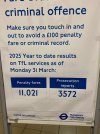
Indeed, and the consequence for those pushing through (i.e no digital record) are so low it encourages evasion. TfL even proudly show how few people they've caught via posters at tube stations, but the numbers are laughably low. If you evade your fare on a tube journey, you have a 99.97% chance of getting away with it. A £50 fine vs a £4 ticket at those odds??

Gates being pushed/bumped is recorded if the alarm sounds, and staff should be counting push-throughs hourly and reporting them. That might be why you don't see staff rushing to do something when it's happening every few minutes.

More serious incidents will require a more detailed log or report to BTP, but TfL in particular seem good at reviewing CCTV and getting details from that based on a report - so the staff member doesn't need to try and remember exactly what happened, exactly when it happened, where the person came from and went to, and what they were wearing/carrying.
 

Mattplans

Member
Joined
27 Sep 2024
Messages
695
Location
London, UK
Even at a 3% fare evasion rate you will usually encounter someone doing it at busy times. I've seen it at Canning Town every single time I've used the station. But usually you'll only see 3 or 4 people doing it
This might actually be one of the worst stations on the jubilee line for it, actually. And that's on the line that has Stratford and London Bridge. Perhaps there's no expectation to pay when travelling from a DLR station without barriers.
More serious incidents will require a more detailed log or report to BTP, but TfL in particular seem good at reviewing CCTV and getting details from that based on a report - so the staff member doesn't need to try and remember exactly what happened, exactly when it happened, where the person came from and went to, and what they were wearing/carrying.
Yes - a man was routine fare evader at Wembley Park was recently convicted. Not sure what about him made him stand out, but I previously would have assumed this type of routine fare evasion where you push through the barriers was very difficult to track. This conviction does undermine some of the arguments made here
Yes I am of the view that a visible presence deters a high % of potential trouble makers and chancers.
The average person especially young can easily differentiate a RPI from the ordinary gateline worker, knowing not to evade when revenue or the security are present.
 

Krokodil

Established Member
Joined
23 Jan 2023
Messages
6,524
Location
Wales
Now there's a public good in causing fare evaders some inconvenience, but that's all it will cause them.
Seeing a visible presence keeps everyone else in line. Make the odd example of a scumbag and the generally law-abiding aren't going to be tempted to think "I'm not going to bother paying any more, nobody else does". Keeps us just on the right side of anarchy.
 

Horizon22

Established Member
Associate Staff
Jobs & Careers
Joined
8 Sep 2019
Messages
10,942
Location
London
So current percentage of getting away with it on a single journey is 99.96%, you could just push through barriers on a daily commute for about 4.5 years before having a 50% chance of being caught - and end up paying £50 rather than £8k's worth of travelcards.

Only you are much more likely to be highlighted / reported as a repeat fare offender doing it at the same origin and destination for months if not years on end, so this doesn’t hold true.

I do wonder what the average fare value evaded is though, even if this may be unknowable. You can work some sort of figure from those caught, but it may be too small a subset.
 

saismee

Established Member
Joined
20 Oct 2023
Messages
1,675
Location
UK
Seeing a visible presence keeps everyone else in line.
It's always fun to have a bit of confrontation in front of paying passengers as they all rubberneck immediately. Especially good when security/BTP get involved and start escorting people towards their MG11s, or straight out of the building.
 

Starmill

Veteran Member
Joined
18 May 2012
Messages
27,143
Location
Bolton
The only onboard ticket checks I have ever experienced have been on DLR (regularly) and Overground (not regularly but often enough to deter any silly thoughts).

In all my long life I've never had a ticket check on an Underground train.

Judging from many comments on here there seems to be the completely impractical idea that TfL should reduce fare avoidance to zero. That will never happen. They'll aim, as every transport undertaking does, to have enforcement at a level which deters the casual impulse to cheat, but doesn't cost a disproportionate sum to carry out.

That's exactly how every police force in the UK (and most of the world) deals with any form of crime. We cannot expect TfL to do different with what is essentially quite minor crimes.

I'll repeat what I've said twice already. We are hyper aware of obvious cheating, but ignore the vast majority in the background who quietly pay and don't come to our attention.

Liverpool Street LUL station doesn't just deal with City workers! It links to just about everywhere else in London, so assumptions about passenger wealth, are just that, assumptions.

I'll go back to my Walthamstow example. It's a wealthier place than it used to be, but its inhabitants still reflect a wide spectrum of incomes, and I doubt that there are many in the upper decile of incomes. The ones I saw on Friday reflected that and they easily outnumbered by 30 to 1 or more, the obvious fare dodgers. London is a huge city with literally millions of people daily using TfL services. It would be odd if we didn't spot some abusers within that horde.

Lastly, the purists on here don't seem to appreciate the deterrent effect of obvious revenue checks. The BTP officer dealing with an offender is not "one taken out of the line". They are visibly doing their job. Same for security or revenue staff. That is both reassurance for law abiders and deterrence for the tempted.

I suspect that TfL's enhancement of revenue protection will do what is required. It will be noticed, as contributers here have witnessed. That will actually reduce the problem, possibly to an affordable/ tolerable level.

I do agree though that they, and the railway, need to ensure that passengers always feel safe. The graffiti issue, and the presence of beggars on trains, both need to be controlled.
London Underground do have revenue control operations, but if they're at the ticket gates, and you're not looking out for them, you probably won't notice them. I've had my discount card inspected by them quite a few times after entering the ticket gates.
 

The_Van

Member
Joined
28 Nov 2011
Messages
188
Location
The Stort
I've never had a ticket checked on a tube train but regularly encountered a revenue block between the jubilee and the victoria lines at Green Park
 

Peter Sarf

Established Member
Joined
12 Oct 2010
Messages
9,573
Location
Croydon
Such a good point. You'll always get this behaviour but I feel like very little effort is made to curb it, which means that more and more people will either a) also engage in this behaviour or b) not use public transport as they feel unsafe.
It feels to me like it is now running away exponentially/
Even at a 3% fare evasion rate you will usually encounter someone doing it at busy times. I've seen it at Canning Town every single time I've used the station. But usually you'll only see 3 or 4 people doing it. When you think that a single Jubilee Line train can easily disgorge 100 people at that station in the peak times, 3 people doing it is still only 3%. It's just that they're visible. You don't notice the other 97 people tapping out as normal.

My experience is that jumping or tailgating the barrier is more common when it is busy. I used to see it every day at Archway when I lived around there, but only in the busy times. Getting off the late evening trains with only a handful of other people, I never saw it.


The types of fare evasion investigations that bring in the big money are the types of fare evasion investigations that fly under the surface. We see the same thing with the TOCs. Data analysis and plain-clothes investigators bring in the big bucks.

Big ostentatious revenue blocks don't bring in anywhere near the same sorts of money. They'll initially catch people but the criminals in an area will know about a big ostentatious revenue block basically as soon as the hi-vis jackets come out. Last time I went through Highbury and Islington I knew about the big ostentatious revenue block before I'd even got off the train- two lads were talking about it on the train, complaining.

Now there's a public good in causing fare evaders some inconvenience, but that's all it will cause them. It didn't deter those two lads on the Overground from Stratford.


It comes back down to money and, more accurately, the willingness to spend it.

Back in the late 80s and early 90s, London was far far worse than it is now. I remember going into St Pancras and women were openly soliciting on the platforms. Anyone who thinks that London transport now is feral clearly never experienced the North London Line or the line north of Queens Park on the Bakerloo and Watford DC, especially in the early to mid 1990s.

That's not to dismiss your concerns or those of your granddaughter, more to point out that there's nothing new under the sun. I'm not sure if the new walk-through trains on Thameslink make me feel safer or not. On the new trains you can see and hear someone eight carriages away carrying on, whereas on the 319s you couldn't. You'd be blissfully unaware of them before but, on the other hand, you can see them coming now so can prepare yourself better.

The way you sort it out is through visible staff presence. Overground's solution to the Silverlink mess was to bring in more staff and to make them visible. It worked. But over the last 10-15 years we've seen staff presence in London start to decrease again. Station staff numbers have been culled, Johnson's controversial closure of LU ticket offices was just the start of 10 years of headcount cuts by stealth through 'natural wastage'. This has predominantly affected outer-suburban stations.

If you don't have a visible staff presence then other people fill the vacuum. But successive administrations have told us that there are too many staff on the trains and we need to cut costs.

I personally think it is telling that SWR don't have the same issues with anti-social behaviour as the other TOCs in London (although they're not entirely without issue, such as on the Chessington branch). Some of that is probably down to demographics, of course, as SW London is wealthier than SE London. But SWR have a guaranteed second member of staff on every train, whereas the other TOCs do not.
I do not recall people brazenly shouting down staff and refusing to be stopped back in the 1980s through to about 2015 or later.

Feral -
Today on a bus about 14:00. A kid with his Mother and a dog. Kid shouting back at the driver "what are you going to do about it" & "you cannot stop me".

It is so openly confidently anarchic.

I suspect social media is telling kids they can get away with it.
There needs to be some harsh and visible punishment.
MAYBE Not a criminal record BUT something painful that has an immediate effect not a long lasting burden when they wise up and try to be responsible adults. MAYBE it is time to re-visit types of appropriate punishment.
I've never had a ticket checked on a tube train but regularly encountered a revenue block between the jubilee and the victoria lines at Green Park
For me the most common is checks on the tram, usually when going round some/all off the loop in Croydon.
Busses less common despite that being my most common journey.
Cannot remember a check on a train - except intercity.
 

jon0844

Veteran Member
Joined
1 Feb 2009
Messages
30,837
Location
UK
People were being told not to allow others to tell them what to do, and go out and get what you want/deserve, in the 90s (perhaps earlier).

The kids today are the children of these people and never stood a chance.
 

Peter Sarf

Established Member
Joined
12 Oct 2010
Messages
9,573
Location
Croydon
People were being told not to allow others to tell them what to do, and go out and get what you want/deserve, in the 90s (perhaps earlier).

The kids today are the children of these people and never stood a chance.
That sounds familiar.

All about rights but no responsibilities.
 

Tetchytyke

Veteran Member
Joined
12 Sep 2013
Messages
17,443
Location
Isle of Man
I do not recall people brazenly shouting down staff and refusing to be stopped back in the 1980s through to about 2015 or later.
I think, with respect, that you're looking back through rose-tinted spectacles. None of this behaviour is new and, at least in my opinion, it isn't even as bad as it used to be.

The Bakerloo and Watford DC were pretty much lawless north of Queens Park, and the North London Line wasn't much better. Same with the South London Line through Peckham Rye and Denmark Hill.

Social media means one sees more of it, [social media platform of choice] is full of reels of people doing low-level naughty things. Some are bragging and some are criticising but one still sees it, still gets that cortisol spike, still gets that general feeling of unease when on public transport. Because social media is full of images of people behaving like that its very easy to believe it is more prevalent than it is.

And then certain politicians leap on to it because they don't agree with the politics of the current London mayor, everything gets amplified again in the media- London's main newspaper being owned by a right-wing Russian not helping here- and suddenly it becomes fact that London is lawless.

I totally get why your granddaughter is nervous. I remember coming up to London in the late 80s and early 90s with my dad to go trainspotting, going out past Wembley yard on the Watford DC and going out past Hither Green or Stewarts Lane; especially out on the Watford DC, it always felt lawless And I do remember the ladies on St Pancras station and my dad telling me not to look towards them. I remember how tatty the tube stations were. Maybe it is just because I'm an adult now, but London really doesn't feel like that anymore to me.

People were being told not to allow others to tell them what to do, and go out and get what you want/deserve, in the 90s (perhaps earlier).

The kids today are the children of these people and never stood a chance.
Definitely earlier. The teddy boys slashing people, the Mods and the Rockers kicking seven shades of poo out of each other on Brighton Beach. Nothing is new in life. And the threat of the birch didn't stop them then, either.

London Underground do have revenue control operations, but if they're at the ticket gates, and you're not looking out for them, you probably won't notice them. I've had my discount card inspected by them quite a few times after entering the ticket gates.
I think this is part of the issue. TfL go more for the discreet operations because they are the way you catch the prolific offending and the misuse of high value travel cards. They are there and if you are a prolific offender they will stop you, but they're very good at blending into the background.

The big ostentatious revenue blocks don't really give the same bang for the buck. They'll catch the odd opportunistic evader, but not much more than that; the prolific offenders know they're there within minutes of pitching up. So from a revenue perspective they take up a lot of staff time and they don't really achieve much.

The main benefit of the big ostentatious revenue block is that people who are paying their fare see that they are being checked. And that is an important benefit, visible staff visibly checking fares. But it doesn't translate so well on to the bottom line.
 

sigma421

Member
Joined
10 Oct 2015
Messages
54
The main benefit of the big ostentatious revenue block is that people who are paying their fare see that they are being checked. And that is an important benefit, visible staff visibly checking fares. But it doesn't translate so well on to the bottom line.
I think this is a big part of the issue. If the mission that TfL's revenue protection people are being given is 'prevent as much loss as possible with a budget of £X' then I'd imagine spotting people using short faring tricks to commute to work, travelling daily on their mum's freedom pass/kid's Zip card or whatever is far more effective in terms of revenue recovered per pound spent than stopping some kids who maybe only travel once a fortnight vaulting the barrier. However, in terms of how people feel about the network and stopping them from feeling like mugs for paying the fare, there are benefits to the occasional visible enforcement operation.
 

Mawkie

Established Member
Joined
17 Feb 2016
Messages
1,242
The big ostentatious revenue blocks don't really give the same bang for the buck. They'll catch the odd opportunistic evader, but not much more than that; the prolific offenders know they're there within minutes of pitching up. So from a revenue perspective they take up a lot of staff time and they don't really achieve much.
The recent multi-agency blockade at Waterloo included Revenue, BTP, and the Met - sniffer dogs and a knife arch completed the set up. Dozens of fraudulently used freedom passes confiscated, child zip cards used by adults, ticket irregularities reported, a drug dealer arrested, knife arch proved fruitful too. As is often the case, fare evaders are often happy to commit other crimes too!

As seen on the channel 5 show, those that arrive at the station with a visible revenue block, see the block and turn back towards the platform are soon apprehended by the plain clothes officers waiting on the paid side of the barriers.

It's a win win win situation.
  • Staff are delighted.
  • Passengers are happy that something is being done.
  • LU is happy to combat fare evasion.
 

saismee

Established Member
Joined
20 Oct 2023
Messages
1,675
Location
UK
soon apprehended by the plain clothes officers waiting on the paid side of the barriers.
I don't think most people realise how many plain clothes officers are on these blocks... it's probably about 5:1 plain clothes to uniform, and they are everywhere.

These are mostly for stopping drug and weapons trafficking though, and the extra police are just a bonus for revenue protection.
 

The_Van

Member
Joined
28 Nov 2011
Messages
188
Location
The Stort
I don't think most people realise how many plain clothes officers are on these blocks... it's probably about 5:1 plain clothes to uniform, and they are everywhere.

These are mostly for stopping drug and weapons trafficking though, and the extra police are just a bonus for revenue protection.
I saw a GA one at Tottenham Hale recently, as you say there were lots of plain clothes on the platforms behind the check at the barrier. Anyone seeing the block and turning back was immediately apprehended
 

Farang

Member
Joined
17 May 2018
Messages
144
Feral -
Today on a bus about 14:00. A kid with his Mother and a dog. Kid shouting back at the driver "what are you going to do about it" & "you cannot stop me".
Not just feral kids. About a week ago I saw an old man shamble onto a bus and past the driver making no effort to touch in. The driver tapped on his window a couple of times - no reaction and he had a schedule to keep so we drove on. The old man exited the bus a couple of stops later and shambled across the busy road looking neither left nor right, trusting the cars would stop. An unusual way to live your life.
 

Tetchytyke

Veteran Member
Joined
12 Sep 2013
Messages
17,443
Location
Isle of Man
As seen on the channel 5 show, those that arrive at the station with a visible revenue block, see the block and turn back towards the platform are soon apprehended by the plain clothes officers waiting on the paid side of the barriers.
Yep, there are loads of plain clothes staff in addition to the obvious revenue staff in hi-vis.

My point is more that these blocks very quickly lose their power. When they first set up they will catch people. But pretty much as soon as they're set up the message will go out that they're there. It made me smile how I knew there was a revenue block at Highbury and Islington before I'd got off the train because two lads were talking about it. They stayed on the train, weirdly.
 

Peter Sarf

Established Member
Joined
12 Oct 2010
Messages
9,573
Location
Croydon
I think, with respect, that you're looking back through rose-tinted spectacles. None of this behaviour is new and, at least in my opinion, it isn't even as bad as it used to be.

The Bakerloo and Watford DC were pretty much lawless north of Queens Park, and the North London Line wasn't much better. Same with the South London Line through Peckham Rye and Denmark Hill.

Social media means one sees more of it, [social media platform of choice] is full of reels of people doing low-level naughty things. Some are bragging and some are criticising but one still sees it, still gets that cortisol spike, still gets that general feeling of unease when on public transport. Because social media is full of images of people behaving like that its very easy to believe it is more prevalent than it is.

And then certain politicians leap on to it because they don't agree with the politics of the current London mayor, everything gets amplified again in the media- London's main newspaper being owned by a right-wing Russian not helping here- and suddenly it becomes fact that London is lawless.

I totally get why your granddaughter is nervous. I remember coming up to London in the late 80s and early 90s with my dad to go trainspotting, going out past Wembley yard on the Watford DC and going out past Hither Green or Stewarts Lane; especially out on the Watford DC, it always felt lawless And I do remember the ladies on St Pancras station and my dad telling me not to look towards them. I remember how tatty the tube stations were. Maybe it is just because I'm an adult now, but London really doesn't feel like that anymore to me.


Definitely earlier. The teddy boys slashing people, the Mods and the Rockers kicking seven shades of poo out of each other on Brighton Beach. Nothing is new in life. And the threat of the birch didn't stop them then, either.


I think this is part of the issue. TfL go more for the discreet operations because they are the way you catch the prolific offending and the misuse of high value travel cards. They are there and if you are a prolific offender they will stop you, but they're very good at blending into the background.

The big ostentatious revenue blocks don't really give the same bang for the buck. They'll catch the odd opportunistic evader, but not much more than that; the prolific offenders know they're there within minutes of pitching up. So from a revenue perspective they take up a lot of staff time and they don't really achieve much.

The main benefit of the big ostentatious revenue block is that people who are paying their fare see that they are being checked. And that is an important benefit, visible staff visibly checking fares. But it doesn't translate so well on to the bottom line.
Interesting. In my spotting days starting in 1974 I would often go to London alone (14 yo - would/should I let a kid do that now ?) from Strood via the North Kent Lines, Bakerloo and the Euston - Watford line as far as Willesden (then walk into Old Oak Common from the canal). That did not bother me. But I also covered Kings Cross, St Pancras, Euston and Paddington and I agree the Euston Road from Euston to Kings Cross could be viewed as a bit of a brothel.
I think this is a big part of the issue. If the mission that TfL's revenue protection people are being given is 'prevent as much loss as possible with a budget of £X' then I'd imagine spotting people using short faring tricks to commute to work, travelling daily on their mum's freedom pass/kid's Zip card or whatever is far more effective in terms of revenue recovered per pound spent than stopping some kids who maybe only travel once a fortnight vaulting the barrier. However, in terms of how people feel about the network and stopping them from feeling like mugs for paying the fare, there are benefits to the occasional visible enforcement operation.
I do think the value of revenue protection is more than just avoiding the revenue otherwise lost. It is also keeping the network pleasant and usable for those who do pay for the use of the network.
The recent multi-agency blockade at Waterloo included Revenue, BTP, and the Met - sniffer dogs and a knife arch completed the set up. Dozens of fraudulently used freedom passes confiscated, child zip cards used by adults, ticket irregularities reported, a drug dealer arrested, knife arch proved fruitful too. As is often the case, fare evaders are often happy to commit other crimes too!

As seen on the channel 5 show, those that arrive at the station with a visible revenue block, see the block and turn back towards the platform are soon apprehended by the plain clothes officers waiting on the paid side of the barriers.

It's a win win win situation.
  • Staff are delighted.
  • Passengers are happy that something is being done.
  • LU is happy to combat fare evasion.
Indeed nipping things like fare dodging in the bud re-enforces the idea that worse things will not be tolerated.
Not just feral kids. About a week ago I saw an old man shamble onto a bus and past the driver making no effort to touch in. The driver tapped on his window a couple of times - no reaction and he had a schedule to keep so we drove on. The old man exited the bus a couple of stops later and shambled across the busy road looking neither left nor right, trusting the cars would stop. An unusual way to live your life.
Ah yes I have had that as a driver. For many, especially younger, you can tell they are looking out of the corner of their eye to check just in case the driver did not see them. Game of chicken perhaps. Trouble is while the driver watches out for that another pedestrian might also unsuspectingly become part of the risk equation.
 

Mattplans

Member
Joined
27 Sep 2024
Messages
695
Location
London, UK
My point is more that these blocks very quickly lose their power. When they first set up they will catch people. But pretty much as soon as they're set up the message will go out that they're there. It made me smile how I knew there was a revenue block at Highbury and Islington before I'd got off the train because two lads were talking about it. They stayed on the train, weirdly.
There's a case in the disputes forum of someone who unfortunately got caught in this block.
 

island

Veteran Member
Joined
30 Dec 2010
Messages
17,906
Location
0036
Fare payment is basically optional on the Southeastern Dartford lines. The few gated stations are open more often than not, or people push through or tailgate.

And when you see what happens with people like Andrew Clark, who challenged a queue jumper at a Sainsbury's in Beckenham, found the offender waiting outside for him, and ended up dead, you quickly learn not to interfere.
 

jon0844

Veteran Member
Joined
1 Feb 2009
Messages
30,837
Location
UK
I think, with respect, that you're looking back through rose-tinted spectacles. None of this behaviour is new and, at least in my opinion, it isn't even as bad as it used to be.

The Bakerloo and Watford DC were pretty much lawless north of Queens Park, and the North London Line wasn't much better. Same with the South London Line through Peckham Rye and Denmark Hill.

Parts of the North London Line were so bad that people simply didn't use it at night. When London Overground came along, there was a massive transformation and I don't think people are scared now.

People talk of 'no-go areas' now, but I think there were bigger issues years ago than there are now. Now a lot of no-go areas are just in the heads of far-right people who want to convince us that if you go to London you're going to be stabbed five times, blown up, have your phone stolen and end up with all your money gone (well, the latter is likely true due to high prices....!).
 

Tetchytyke

Veteran Member
Joined
12 Sep 2013
Messages
17,443
Location
Isle of Man
Fare payment is basically optional on the Southeastern Dartford lines. The few gated stations are open more often than not, or people push through or tailgate.

And when you see what happens with people like Andrew Clark, who challenged a queue jumper at a Sainsbury's in Beckenham, found the offender waiting outside for him, and ended up dead, you quickly learn not to interfere.
Andrew's killer was a bus driver (which is even scarier) and only got five years inside for it. He'll be out in three. No remorse, nothing. Even I, part of the tofu-eating wokerati, thinks it should have been at least double that.

I agree, though, stay out of it. And I don't blame any gateline staff for taking the same approach.
 

Mattplans

Member
Joined
27 Sep 2024
Messages
695
Location
London, UK
Fare payment is basically optional on the Southeastern Dartford lines. The few gated stations are open more often than not, or people push through or tailgate.
I think people like to vastly overestimate the amount of fare evasion on these lines. Seeing RPIs recently for the first time in a long time, and they don't seem to be encountering much trouble. In fact, I'd imagine the Dartford lines probably has lower fare evasion compared to the Hayes line, SEML and CML. At least on a train to Dartford via Sidcup, Bexleyheath or Greenwich you will encounter more than 3 gated stations. You can take a train to Orpington from Victoria or London Bridge, and it doesn't matter if you go via Herne Hill or Grove Park - the only gated station is Orpington (some of the day) and Bromley South/Lewisham. For Lewisham, with a station with that many exits, there's bound to be an open gateline somewhere.

I can say from personal experience using Falconwood, Welling and Bexleyheath stations I have honestly never seen someone push through or tailgate the barriers at this station. Maybe it's the time I travel at. The fare evader is far more likely to make their way to the down platform where the staff have no doubt left the barriers open there. :lol:


I think people look at these stations - the same with DLR - and assume because of the lack of barriers that it must be very attractive to fare evaders. Of which, it is. But my anecdotal experience of seeing revenue on the DLR and Southeastern doesn't really support these assumptions. Not to say it doesn't happen - because of course it does. Looking at the stations on the Hayes Line, and the line via Grove Park, and the Bromley South line which have zero or one barriers for the entire line, you'd want to assume that fare evasion is astronomically high, especially for those travelling between neighbouring stations. Who, besides school kids who are lucky enough to school in neighbouring areas, is really using these services on a mass scale without paying? Is there any hard evidence to show that this is really the case? The sort of fare evader that likes to see an open/unbarriered station would be described by TfL as 'opportunistic'. But the major destinations on any route are barriered. We can see this type of fare evader doesn't like to do the agressive act of pushing the barrier or tailgating.
 

jumble

Established Member
Joined
1 Jul 2011
Messages
1,483
TfL clearly have a policy of prosecuting Fare Evasion ...full-stop. Basically get the Fare Evaider in Court.

The Train Operating Companies seem to have adopted an alternative approach with the MG11 and looking back at Historical fares purchased and then basically under the title of "Out of Court Settlement" offering a price . Take it or leave it ...if you leave it then we might go for a court hearing ...

I think it remains to be seen which is the most effective method of trying to punish fare evasion, and which process delivers a better financial result for the Operator (which could very well be H.M Government
I am not so sure
Seems like only 30% ish of fare dodgers were reported for prosecution let alone taken to court in the poster (and I am informed that under 18s and over 60s don't seem to be prosecuted)
 

Attachments

  • TFL3.jpg
    TFL3.jpg
    537.5 KB · Views: 42

Starmill

Veteran Member
Joined
18 May 2012
Messages
27,143
Location
Bolton
I think this is part of the issue. TfL go more for the discreet operations because they are the way you catch the prolific offending and the misuse of high value travel cards. They are there and if you are a prolific offender they will stop you, but they're very good at blending into the background.

The big ostentatious revenue blocks don't really give the same bang for the buck. They'll catch the odd opportunistic evader, but not much more than that; the prolific offenders know they're there within minutes of pitching up. So from a revenue perspective they take up a lot of staff time and they don't really achieve much.

The main benefit of the big ostentatious revenue block is that people who are paying their fare see that they are being checked. And that is an important benefit, visible staff visibly checking fares. But it doesn't translate so well on to the bottom line.
Indeed so. Presumably TfL feel that getting a few serious cases convicted, such as someone travelling many times over for free on a pass that's not theirs, provides a lasting deterrent, as well as any costs and compensation which the court may see fit to award. As you say perhaps that translates less well onto people otherwise than those who come out of it with the criminal record.
 
Last edited:
Status
Not open for further replies.

Top