Tetchytyke
Veteran Member
Even at a 3% fare evasion rate you will usually encounter someone doing it at busy times. I've seen it at Canning Town every single time I've used the station. But usually you'll only see 3 or 4 people doing it. When you think that a single Jubilee Line train can easily disgorge 100 people at that station in the peak times, 3 people doing it is still only 3%. It's just that they're visible. You don't notice the other 97 people tapping out as normal.I think it's highly situation dependent. A significant proportion of Liverpool Street passengers at peak time will be working in well-paid City jobs. Whilst a few of them do engage in fare evasion, the vast majority don't.
Compare that with places in the middle or outer suburbs and the position is quite different. For three of the LU suburban stations that I have used regularly, I have almost always encountered somebody pushing through the barriers or tailgating whenever I've used them.
My experience is that jumping or tailgating the barrier is more common when it is busy. I used to see it every day at Archway when I lived around there, but only in the busy times. Getting off the late evening trains with only a handful of other people, I never saw it.
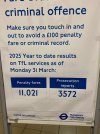
The types of fare evasion investigations that bring in the big money are the types of fare evasion investigations that fly under the surface. We see the same thing with the TOCs. Data analysis and plain-clothes investigators bring in the big bucks.Exactly. And LU is no better. The potential consequences may be high, but the chances of getting caught are very low, especially if prepared to front it off.
TFL are adept at catching the likes of a student who has borrowed granny’s freedom pass, but that’s only half the story.
Big ostentatious revenue blocks don't bring in anywhere near the same sorts of money. They'll initially catch people but the criminals in an area will know about a big ostentatious revenue block basically as soon as the hi-vis jackets come out. Last time I went through Highbury and Islington I knew about the big ostentatious revenue block before I'd even got off the train- two lads were talking about it on the train, complaining.
Now there's a public good in causing fare evaders some inconvenience, but that's all it will cause them. It didn't deter those two lads on the Overground from Stratford.
It comes back down to money and, more accurately, the willingness to spend it.If nothing is done about feral behaviour including ticket less travelers forcing themselves on we will end up with public transport not being for law abiding citizens. Then the law abiding citizens will ask why they should pay for others.
Back in the late 80s and early 90s, London was far far worse than it is now. I remember going into St Pancras and women were openly soliciting on the platforms. Anyone who thinks that London transport now is feral clearly never experienced the North London Line or the line north of Queens Park on the Bakerloo and Watford DC, especially in the early to mid 1990s.
That's not to dismiss your concerns or those of your granddaughter, more to point out that there's nothing new under the sun. I'm not sure if the new walk-through trains on Thameslink make me feel safer or not. On the new trains you can see and hear someone eight carriages away carrying on, whereas on the 319s you couldn't. You'd be blissfully unaware of them before but, on the other hand, you can see them coming now so can prepare yourself better.
The way you sort it out is through visible staff presence. Overground's solution to the Silverlink mess was to bring in more staff and to make them visible. It worked. But over the last 10-15 years we've seen staff presence in London start to decrease again. Station staff numbers have been culled, Johnson's controversial closure of LU ticket offices was just the start of 10 years of headcount cuts by stealth through 'natural wastage'. This has predominantly affected outer-suburban stations.
If you don't have a visible staff presence then other people fill the vacuum. But successive administrations have told us that there are too many staff on the trains and we need to cut costs.
I personally think it is telling that SWR don't have the same issues with anti-social behaviour as the other TOCs in London (although they're not entirely without issue, such as on the Chessington branch). Some of that is probably down to demographics, of course, as SW London is wealthier than SE London. But SWR have a guaranteed second member of staff on every train, whereas the other TOCs do not.