• Our new ticketing site is now live! Using either this or the original site (both powered by TrainSplit) helps support the running of the forum with every ticket purchase! Find out more and ask any questions/give us feedback in this thread!

Stadler preffered bidder for new Enterprise

superalbs

Verified Rep - Superalbs Travels
Joined
3 Jul 2014
Messages
2,856
Location
Kraków
I suppose these will be based more on the mainland European FLIRT design than on the U.K. FLIRT design, given the island of Ireland’s wider track gauge, and hence presumably also loading gauge, than on Great Britain? The FLIRT U.K. was the first train with the new FLIRT 3/4 cab design, but it’s seen on newer FLIRTs in mainland Europe now, as well.
Definitely not, they have a tapered bodyshell, much like any other train in the UK.

I also expect that this is a Stadler SMILE, and not a FLIRT, judging by the design of the cab and presence of a dedicated power car with cab.
 
Sponsor Post - registered members do not see these adverts; click here to register, or click here to log in
R

RailUK Forums

stadler

Established Member
Joined
5 Jun 2023
Messages
3,304
Location
Horsley
I suppose these will be based more on the mainland European FLIRT design than on the U.K. FLIRT design, given the island of Ireland’s wider track gauge, and hence presumably also loading gauge, than on Great Britain? The FLIRT U.K. was the first train with the new FLIRT 3/4 cab design, but it’s seen on newer FLIRTs in mainland Europe now, as well.
Ireland and Northern Ireland have the same narrow loading gauge that England and Wales and Scotland has. Despite their wider track gauge they still have a far more narrow loading gauge than Mainland Europe has. So i would imagine these trains to be built to the same dimensions as our 231/745/755/756 trains.
 

dubscottie

Member
Joined
4 Apr 2010
Messages
1,013
Ireland and Northern Ireland have the same narrow loading gauge that England and Wales and Scotland has. Despite their wider track gauge they still have a far more narrow loading gauge than Mainland Europe has. So i would imagine these trains to be built to the same dimensions as our 231/745/755/756 trains.
The loading gauge is bigger in places. Look at the size of a 201 compared to a Mk3 and the width of a Dart or DD coach.
It is much smaller than mainland Europe obviously.

I like the idea off pairs of coaches. The troubles must still be in people's minds. Makes it easy to swap out coaches in a set.
 

stadler

Established Member
Joined
5 Jun 2023
Messages
3,304
Location
Horsley
I note that in the railway gazette article it mentions exterior cameras for the driver. So i wonder if the plan is for these Stadler Flirt trains to run DOO South of Dundalk and maybe North of Dundalk it will be GA 720/745/755 style operation where a guard is present but has no involvement in despatch or door operation.

Irish Rail currently run DOO South of Dundalk on most of the 22000 operated Enterprise diagrams so it certainly seems likely that at least the Irish Rail driven diagrams on these new trains will run DOO on that section. Although if the train is driven by a Translink driver then it might require a guard onboard all the way.

DOO is not currently allowed in Northern Ireland but they could certainly have GA 720/745/755 style operation with the driver operating doors but with a guaranteed guard. It will be interesting to see what happens when they enter service.
 

dubscottie

Member
Joined
4 Apr 2010
Messages
1,013
I note that in the railway gazette article it mentions exterior cameras for the driver. So i wonder if the plan is for these Stadler Flirt trains to run DOO South of Dundalk and maybe North of Dundalk it will be GA 720/745/755 style operation where a guard is present but has no involvement in despatch or door operation.

Irish Rail currently run DOO South of Dundalk on most of the 22000 operated Enterprise diagrams so it certainly seems likely that at least the Irish Rail driven diagrams on these new trains will run DOO on that section. Although if the train is driven by a Translink driver then it might require a guard onboard all the way.

DOO is not currently allowed in Northern Ireland but they could certainly have GA 720/745/755 style operation with the driver operating doors but with a guaranteed guard. It will be interesting to see what happens when they enter service.
There is a guard on all cross border trains regardless of what type of unit operates it from Connolly.
On IR units, the driver closes the doors.
The guard has no facility on a 22 or 29 unit to close doors. There isn't a door control panel like UK units.
Can do it on a DD set however.

All cross border trains are despatched by platform staff much like the UK.
 
Last edited:

stadler

Established Member
Joined
5 Jun 2023
Messages
3,304
Location
Horsley
There is a guard on all cross border trains regardless of what type of unit operates it from Connolly.
On IR units, the driver closes the doors.
The guard has no facility on a 22 or 29 unit to close doors. There isn't a door control panel like UK units.
Can do it on a DD set however.

All cross border trains are despatched by platform staff much like the UK.
Many of the Enterprise trains booked for 22000 are definitely DOO South of Dundalk. I have observed this and had this confirmed by an IE guard i spoke to not long ago. Trains operated with a 22000/29000 do not require a guard South of Dundalk. Some 22000 trains run with a guard only to/from Dundalk. Some 22000 trains run with a guard to/from Drogheda. Only the DD stock is required to have a guard to/from Dublin Connolly. If a 22000/29000 is substituting a DD diagram then it will normally still have a guard on the full route to Dublin Connolly but does not have to.

Also that is not entirely correct about the door procedure. Both the DD and 22000 use an equivalent to our UK ten bell despatch. Both the DD and 22000 use the same exact method as each other and neither stock allows the guard to close the doors. I was on a couple Enterprise trains the month before last and also spoke with a very friendly IE guard and observed the procedure.

The platform staff do indeed despatch trains but the guard is still involved and still gives the close door bells and right away bells to the driver.

The method used on both the DD and 22000 stock on the Enterprise services is as follows:

Guard: check the signal and that the train can leave
Guard: gives 2 on the bells
Driver: presses close doors
Guard: waits for all passenger doors to close
Guard: check signal again to check the train can leave
Guard: closes local door
Guard: gives 2 on the bells
Driver: train departs

Same exact method on both. The only difference is that on the DD the guard does the bells from the saloon but on the 22000 the guard does the bells from the rear cab. Also the DD has an old fashioned bell sound and the 22000 has a modern beep sound.

In the UK we have a similar method known as ten bell currently used on XC/220/221 and CH/165/168/172 and SN/377 trains (and also on GWR/165/166 and C2C/357 previously) as follows:

Guard: check the signal and that the train can leave
Guard: gives 1-2 on the bells
Driver: repeats 1-2 on the bells
Driver: presses close doors
Guard: waits for all passenger doors to close
Guard: check signal again to check the train can leave
Guard: closes local door
Guard: gives 2 on the bells
Driver: repeats 2 on the bells
Driver: train departs

So the only difference between the DD/22000 method and our UK method is that on the DD/22000 they use the same exact code for "close doors" and "right away" and the driver does not repeat any bells codes.

I doubt it has been decided yet on how the Stadler Flirt will operate but it is certainly a possibility that the method could change when they are introduced especially as the article mentions cameras.
 

hwl

Established Member
Joined
5 Feb 2012
Messages
8,258
I suppose these will be based more on the mainland European FLIRT design than on the U.K. FLIRT design, given the island of Ireland’s wider track gauge, and hence presumably also loading gauge, than on Great Britain?
The loading gauge is fairly similar to GB

== Doublepost prevention - post automatically merged: ==

I think that all implies a 10-car train (9 passenger cars plus 1 diesel power car) with some quite serious diesel power installed, if it can maintain schedules with only one of the two engines working.

(Speculation) A pair of Cummins QSK50 engines, as used singly in the cl. 99, could provide a total of 3.6MW/4800hp.
It does seem like a nice idea for TfW and Scotrail - as good of a bi-mode as a 755, but with more capacity. However, it would appear that as designed these units can be used for either Diesel or 25KV AC - not both. Fine for Ireland, but an issue in the UK. The question would be if the space used for the 1500V DC equipment on the Irish sets could be used for AC equipment in the UK?

== Doublepost prevention - post automatically merged: ==


I assume they were comparing it to the layout of the old "Thumper" DEMUs as formerly seen in Britain and also Northern Ireland, with a big engine and small passenger compartment in the front coach, although as I said above it looks to me like the entirety of that coach will be mechanical and not for public use.

But yes, as delivered these will be DC, Diesel and battery Tri-mode (edited in response to @Trainbike46 comment below) with the ability to swap the diesel for AC if (and hopefully when) necessary in the future.
It does seem like a nice idea for TfW and Scotrail - as good of a bi-mode as a 755, but with more capacity. However, it would appear that as designed these units can be used for either Diesel or 25KV AC - not both. Fine for Ireland, but an issue in the UK. The question would be if the space used for the 1500V DC equipment on the Irish sets could be used for AC equipment in the UK?

== Doublepost prevention - post automatically merged: ==


I assume they were comparing it to the layout of the old "Thumper" DEMUs as formerly seen in Britain and also Northern Ireland, with a big engine and small passenger compartment in the front coach, although as I said above it looks to me like the entirety of that coach will be mechanical and not for public use.

But yes, as delivered these will be DC, Diesel and battery Tri-mode (edited in response to @Trainbike46 comment below) with the ability to swap the diesel for AC if (and hopefully when) necessary in the future.

1. The 25kV AC equipment will take up a lot more space than the equivalent DC but not a whole decent engine's worth.
2. The author of the RG article seems to have no clue about the RoI electrification strategy (e.g. fill the gap south of the border with 25kVAC) or relative line speeds, is just 1 engine enough in lower line speed areas for either 1 diesel or diesel + battery?
a) the chances of IE and NIR both aligning time wise on 25kV for the unelectrified sections are pretty slim unless there is another EU grant involved (having the new rolling stock largely delivered in this EU funding period is there for key for getting future funding)
b) One issue might be if the engines share a cooling and other systems hence not much space saved by removing just the engine.
c) Gut feel suggests if ac6000cw thinking on 2x QSK50 choice is correct would be fine for NI running with 1 diesel but possibly not RoI given higher max speeds and more prospect of further line speed improvements.
d) highly unlikely that the RG authors will have picked up on all the nuances or lost the will to try to explain all the permutations!
3. There appears from the photos to be a buffet/cafe car.
 
Last edited:

43096

On Moderation
Joined
23 Nov 2015
Messages
18,845
I also expect that this is a Stadler SMILE, and not a FLIRT, judging by the design of the cab and presence of a dedicated power car with cab.
A SMILE would be overkill for what is required - Ireland doesn’t require a 250km/h train. The presence of the power car is also not SMILE related - they are electric only and have articulated driving cars.
 

stadler

Established Member
Joined
5 Jun 2023
Messages
3,304
Location
Horsley
I presume that these trains will enter service before the electrification to Drogheda is complete? If so then will these trains initially use the overhead wires between Dublin and Malahide or will they use diesel or battery and wait until the Drogheda electrification is complete? Otherwise i think the trains would have to stop at Malahide to switch over?

Also where on the non electrified lines will the diesel to battery switch happen? The article suggests that battery power will only be used in the Belfast area? Not sure what the range is but could Portadown to Belfast and vice versa be possible entirely on batteries?
 

hwl

Established Member
Joined
5 Feb 2012
Messages
8,258
I presume that these trains will enter service before the electrification to Drogheda is complete? If so then will these trains initially use the overhead wires between Dublin and Malahide or will they use diesel or battery and wait until the Drogheda electrification is complete? Otherwise i think the trains would have to stop at Malahide to switch over?

Also where on the non electrified lines will the diesel to battery switch happen? The article suggests that battery power will only be used in the Belfast area? Not sure what the range is but could Portadown to Belfast and vice versa be possible entirely on batteries?
The minimum on battery while moving would be just enough get past those who complain about diesel in South Belfast (but only if it is going south of the border! Thus making it harder for them to complain)
 

zwk500

Veteran Member
Joined
20 Jan 2020
Messages
18,581
Location
Northampton
I suppose these will be based more on the mainland European FLIRT design than on the U.K. FLIRT design, given the island of Ireland’s wider track gauge, and hence presumably also loading gauge, than on Great Britain? The FLIRT U.K. was the first train with the new FLIRT 3/4 cab design, but it’s seen on newer FLIRTs in mainland Europe now, as well.
Irish Loading gauge is closer to UK loading gauge than any UIC standard. As are platform heights.
 

AdamWW

Established Member
Joined
6 Nov 2012
Messages
5,962
Thank you. You could very well be right, though it is also possible that it's written that way because the author assumed that 25kV AC OHLE being installed around Belfast. Your reading does seem more likely, though I can't imagine 25kV kit would need more space than taken by one of the two engines, so it may be possible to have both if you're willing to accept only a single engine.

Possibly balance issues with only one large diesel engine?

There might well be some stuff in there that is open to interpretation alright. I'm not entirely convinced that it will be fully capable of running to time on only one engine out of two - if there's the case, why bother with two?

Resilience? But having twice the power you need just in case one engine fails doesn't seem that likely.
 

craigybagel

Established Member
Joined
25 Oct 2012
Messages
5,829
1. The 25kV AC equipment will take up a lot more space than the equivalent DC but not a whole decent engine's worth.
What about weight though, does the transformer complicate things? I seem to recall that's why CIÉ at the time settled on DC rather than AC for the original DART network; for such a small and relatively low speed network, the extra hassle of going for AC wasn't worth it.
2. The author of the RG article seems to have no clue about the RoI electrification strategy (e.g. fill the gap south of the border with 25kVAC) or relative line speeds, is just 1 engine enough in lower line speed areas for either 1 diesel or diesel + battery?
a) the chances of IE and NIR both aligning time wise on 25kV for the unelectrified sections are pretty slim unless there is another EU grant involved (having the new rolling stock largely delivered in this EU funding period is there for key for getting future funding)
Is there a strategy?
d) highly unlikely that the RG authors will have picked up on all the nuances or lost the will to try to explain all the permutations!
This is my suspicion alright!
I presume that these trains will enter service before the electrification to Drogheda is complete? If so then will these trains initially use the overhead wires between Dublin and Malahide or will they use diesel or battery and wait until the Drogheda electrification is complete? Otherwise i think the trains would have to stop at Malahide to switch over?
Why could the switch not be done on the move? It's hardly ground breaking technology. I doubt it would be a good look in this day and age to install DC capability and then run on diesel!
Also where on the non electrified lines will the diesel to battery switch happen? The article suggests that battery power will only be used in the Belfast area? Not sure what the range is but could Portadown to Belfast and vice versa be possible entirely on batteries?
With the details currently released, I'm not sure anyone can answer that one definitively yet.
Resilience? But having twice the power you need just in case one engine fails doesn't seem that likely.
Exactly. Which is why I reckon a misunderstanding is more likely. But I'm sure time will tell.
 

hwl

Established Member
Joined
5 Feb 2012
Messages
8,258
What about weight though, does the transformer complicate things? I seem to recall that's why CIÉ at the time settled on DC rather than AC for the original DART network; for such a small and relatively low speed network, the extra hassle of going for AC wasn't worth it.
It is lighter than an diesel engine it is replacing and weight balance shouldn't be too much of an issue.
Is there a strategy?
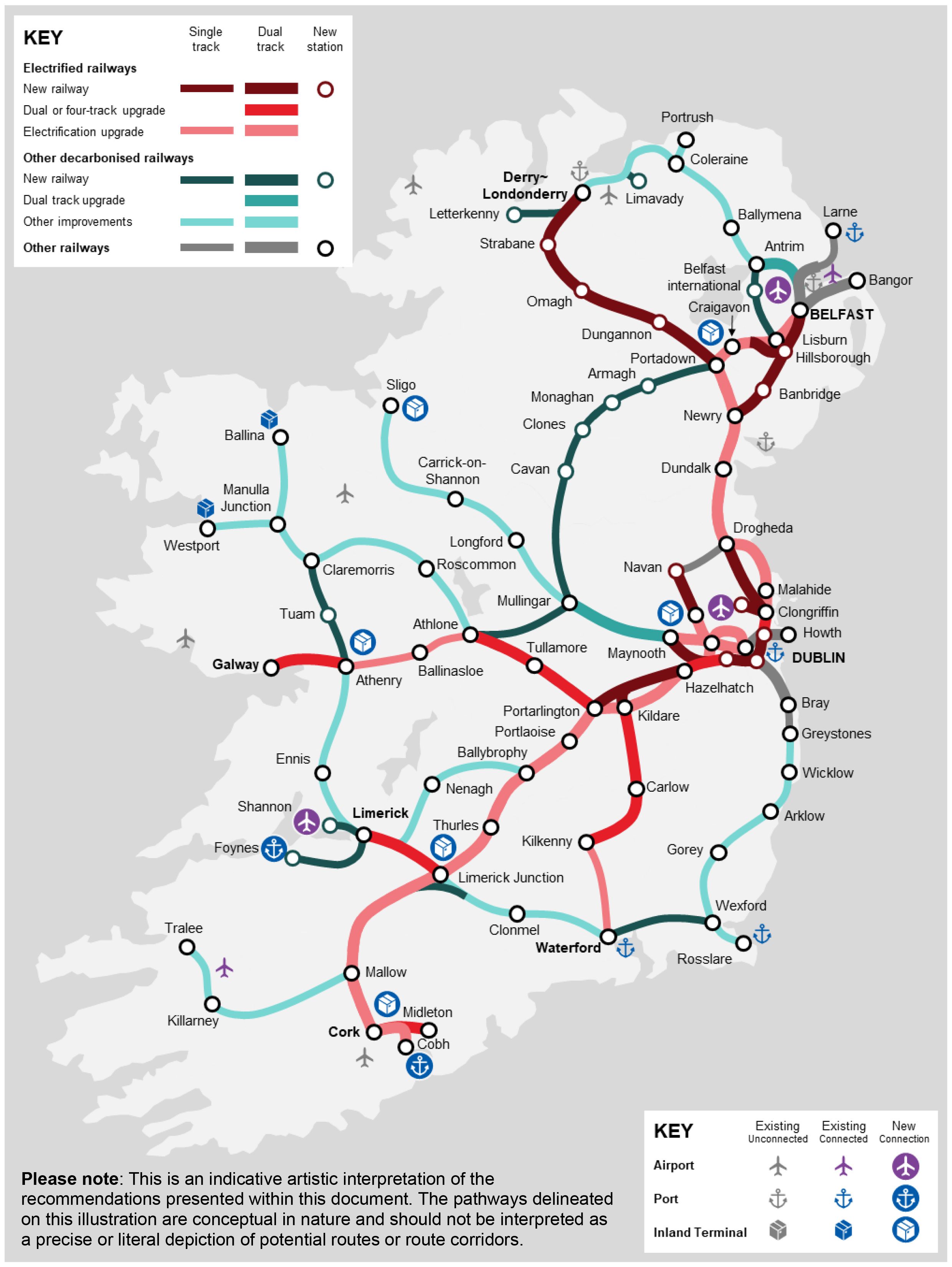
Yes:
2507_Arup_A-future-all-island-railway-map.jpg

This is my suspicion alright!

Why could the switch not be done on the move? It's hardly ground breaking technology. I doubt it would be a good look in this day and age to install DC capability and then run on diesel!

With the details currently released, I'm not sure anyone can answer that one definitively yet.

Exactly. Which is why I reckon a misunderstanding is more likely. But I'm sure time will tell.
 

AdamWW

Established Member
Joined
6 Nov 2012
Messages
5,962
I think Greater Anglia’s FLIRT U.K.s can change over on the move now, so surely it’d be the same for these ones, too?

The TfW ones definitely change between overhead power and battery on the fly. I'm on a train now that is just about to put its pantograph up on the move.
 

craigybagel

Established Member
Joined
25 Oct 2012
Messages
5,829
It is lighter than an diesel engine it is replacing and weight balance shouldn't be too much of an issue.
Good to know. I'm fairly clueless when it comes to the technology behind electric trains, we've not been blessed with any at my depot.
I'm aware of this - I was more wondering beyond this nice plan the majority of which won't happen in our lifetime, has a proposed date been given for the extension of the electrified network? Or even a voltage for that network?
 

zwk500

Veteran Member
Joined
20 Jan 2020
Messages
18,581
Location
Northampton
I'm aware of this - I was more wondering beyond this nice plan the majority of which won't happen in our lifetime, has a proposed date been given for the extension of the electrified network? Or even a voltage for that network?
While I can't find anything published on NI Railways specifically on an electrification strategy (the strong implication of what is published is 'they're working on it'), Irish Rail have published more information, including stating 25kV AC for the Dublin-Limerick and Dublin-Cork lines: https://www.irishrail.ie/en-ie/about-us/iarnrod-eireann-projects-and-investments/connect-project

The DART+ Railway orders include electrification designs, and the new stock is 1.5kV DC only so Hazelhatch (slow lines only), Maynooth and Drogheda will be DC OLE. The detailed drawings are available at the Railway Order applications for each element, see: https://www.dartplus.ie/en-ie/home

Quoting from the Irish Rail 2027 Strategy paper: https://www.irishrail.ie/Admin/IrishRail/media/Content/About Us/IE-Strategy-2027_Final_One-Page_20210114.pdf
The existing electrified network consists of the DART, running from Malahide/ Howth – Connolly – Greystones electrified at 1500 V DC. The NDP’s DART+ will see this network extended, allowing for a smooth and cost-efficient delivery of electrified services to Drogheda, Maynooth, M3 Parkway, Hazelhatch along with Greystones as currently. InterCity electrification could follow with a different technology, such as 25 kV AC, which requires fewer substations and is more energy-efficient over longer distances.
(available at https://www.irishrail.ie/en-ie/about-us/company-information/iarnrod-eireann-strategy if the link breaks)

Given the acknowledgement of the benefits for longer-distance electrification at high voltage, the references to 25KV, and 25KV's position as Europe's de facto high-speed standard, it is a fair assumption that any long-distance electrification will be to this standard.
 

craigybagel

Established Member
Joined
25 Oct 2012
Messages
5,829
While I can't find anything published on NI Railways specifically on an electrification strategy (the strong implication of what is published is 'they're working on it'), Irish Rail have published more information, including stating 25kV AC for the Dublin-Limerick and Dublin-Cork lines: https://www.irishrail.ie/en-ie/about-us/iarnrod-eireann-projects-and-investments/connect-project

The DART+ Railway orders include electrification designs, and the new stock is 1.5kV DC only so Hazelhatch (slow lines only), Maynooth and Drogheda will be DC OLE. The detailed drawings are available at the Railway Order applications for each element, see: https://www.dartplus.ie/en-ie/home

Quoting from the Irish Rail 2027 Strategy paper: https://www.irishrail.ie/Admin/IrishRail/media/Content/About Us/IE-Strategy-2027_Final_One-Page_20210114.pdf

(available at https://www.irishrail.ie/en-ie/about-us/company-information/iarnrod-eireann-strategy if the link breaks)

Given the acknowledgement of the benefits for longer-distance electrification at high voltage, the references to 25KV, and 25KV's position as Europe's de facto high-speed standard, it is a fair assumption that any long-distance electrification will be to this standard.
Thanks. I looked into this subject a few months ago, and I found a study on the Dart Plus website weighing up the pros and cons of AC Vs DC for the extended network. It didn't give a definitive answer as to which would be picked.

It also suggested that although the new DARTs are being delivered as DC only, they could be converted to bi mode AC/DC. The units with batteries fitted would require the batteries removing to allow for this however.

That study if anyone is interested is here. I suspect it may well be outdated now however
https://www.dartplus.ie/getattachme...Expansion-Rail-Electrification-Assessment.pdf
 

csd

Member
Joined
18 Jan 2012
Messages
22
A September 2024 presentation given by IE's Director of Capital Projects included a map of the proposed electrification by 2050 - see below. Note that this is already out of date as 25kV is now planned for Cork - Cobh/Midleton. Notable for this thread is the fact that 25 kV AC is proposed for north of Drogheda.

My (pessimistic) guesses for likely completion are:

1. Connolly - Maynooth/M3 Parkway (1500V DC): 2029
2. Heuston - Hazelhatch (slow lines) (1500V DC): 2031
3. Malahide - Drogheda (1500V DC): 2031
4. Mallow - Cork - Cobh/Midleton (25 kV AC): 2032
5. Heuston - Cork & Limerick: (25 kV AC): 2035
6. Heuston - Galway (25 kV AC): 2040
7. Cherryville - Waterford (25 kV AC): 2045 (inc double tracking to Kilkenny)

Drogheda - NI border to be done if EU/cross-border funding materialises.

1765318908639.png
 

stadler

Established Member
Joined
5 Jun 2023
Messages
3,304
Location
Horsley
A September 2024 presentation given by IE's Director of Capital Projects included a map of the proposed electrification by 2050 - see below. Note that this is already out of date as 25kV is now planned for Cork - Cobh/Midleton. Notable for this thread is the fact that 25 kV AC is proposed for north of Drogheda.

My (pessimistic) guesses for likely completion are:

1. Connolly - Maynooth/M3 Parkway (1500V DC): 2029
2. Heuston - Hazelhatch (slow lines) (1500V DC): 2031
3. Malahide - Drogheda (1500V DC): 2031
4. Mallow - Cork - Cobh/Midleton (25 kV AC): 2032
5. Heuston - Cork & Limerick: (25 kV AC): 2035
6. Heuston - Galway (25 kV AC): 2040
7. Cherryville - Waterford (25 kV AC): 2045 (inc double tracking to Kilkenny)

Drogheda - NI border to be done if EU/cross-border funding materialises.

View attachment 193612
That would be an extremely slow timeframe to take twenty years to electrify some lines. Also i am surprised that Irish Rail have no plans to convert the DART network to 25KV AC power. You would think that would be a better option for such a small network rather than having two different power systems.
 

craigybagel

Established Member
Joined
25 Oct 2012
Messages
5,829
A September 2024 presentation given by IE's Director of Capital Projects included a map of the proposed electrification by 2050 - see below. Note that this is already out of date as 25kV is now planned for Cork - Cobh/Midleton. Notable for this thread is the fact that 25 kV AC is proposed for north of Drogheda.

My (pessimistic) guesses for likely completion are:

1. Connolly - Maynooth/M3 Parkway (1500V DC): 2029
2. Heuston - Hazelhatch (slow lines) (1500V DC): 2031
3. Malahide - Drogheda (1500V DC): 2031
4. Mallow - Cork - Cobh/Midleton (25 kV AC): 2032
5. Heuston - Cork & Limerick: (25 kV AC): 2035
6. Heuston - Galway (25 kV AC): 2040
7. Cherryville - Waterford (25 kV AC): 2045 (inc double tracking to Kilkenny)

Drogheda - NI border to be done if EU/cross-border funding materialises.

View attachment 193612
Thank you, it's good to see a more up to date set of plans confirming things
Also i am surprised that Irish Rail have no plans to convert the DART network to 25KV AC power. You would think that would be a better option for such a small network rather than having two different power systems.
That would involve replacing the entire current DART fleet. Granted, half of them are life expired but the other half isn't. It's also hard to see how you do it without shutting the whole network down for several months, and given how integral it is to the public transport network of the city, that might not be acceptable. With the ready availability of dual voltage or battery powered trains, it's easy to see why it's not worth the effort.
 

berneyarms

Established Member
Joined
26 Nov 2013
Messages
3,113
Location
Dublin
That would be an extremely slow timeframe to take twenty years to electrify some lines. Also i am surprised that Irish Rail have no plans to convert the DART network to 25KV AC power. You would think that would be a better option for such a small network rather than having two different power systems.
It is absolutely realistic and probably a bit optimistic given how Irish politics work, and the fact that the new five year funding programme from the National Development Programme has put several shovel ready projects back until after 2030 for funding.

DART+ Southwest and DART+ Coastal North are not included in the current five year funding programme and that means that work won’t start on them until after 2030.
 

zwk500

Veteran Member
Joined
20 Jan 2020
Messages
18,581
Location
Northampton
That would be an extremely slow timeframe to take twenty years to electrify some lines.
Not 'extremely' slow when you consider what other infrastructure changes will take place alongside the electrification. A lot of this money is coming from the EU via one arm or another (like the Enterprise fleet replacement), so there are limits how quickly they can access that, and then you have to consider the availability of people and materials (and a million other things like co-ordination with Eirgrid).
Also i am surprised that Irish Rail have no plans to convert the DART network to 25KV AC power. You would think that would be a better option for such a small network rather than having two different power systems.
Why would they spend a lot of money converting their existing electrification when they have so much non-electrified track?

The time to do it would have been when bringing in the X'Trapolis fleet, if they were going to do it. But that would have meant spending even more money on the Dublin Area giving them better electrification while the rest of the country had to wait for any electrification at all, which is very poor political optics.
 

csd

Member
Joined
18 Jan 2012
Messages
22
As well as the electrification programme, there are a lot of other works planned for the next 20 years as well. Even if it has the cash, Ireland doesn't have the workforce, planning system, housing, or other infrastructure needed to deliver it all at once. Part of it is a legacy of the global financial crisis, but there has not been a single km of main line electrified in Ireland since 2000, and not a single km of opened/re-opened main line since 2010 (and one of these openings was at the expense of the South Wexford line, which closed the same year).

In the current capital programme we have:

1a. DART+ West: ~30 route-km of electrification, level crossing closures, new 4-platform terminal station at Spencer Dock, Connolly station remodelling (track and new public areas), resignalling with ETCS Level 1
1b. DART+ Fleet: New EMU/BEMU fleet (185 of up to 750 vehicles on order)
1c. DART+ Depot: New depot to maintain the expanded DART fleet
1d. DART+ BEMU enablement: Charging system and platform works to bring BEMU service to Drogheda ahead of the main DART+ Coastal North electrification and track/station remodelling.
2. Cork Area Commuter Rail Programme: Doubling of Glounthaune - Midleton, new stations, resignalling, Mallow station remodelling (it will have 5 platforms!), (post 2030) electrification at 25 kV AC & new fleet
3. Foynes Line reopening: 42 km of single track with a passing loop in Adare. For freight, but IE have applied for planning to open a temporary station at Adare for the Ryder cup in 2027.
4. Limerick Junction - Killonan (re)-doubling (27 km).
5. New station at Moyross, Limerick
6. Ceannt Station Upgrade (Galway): Expanding from two to five platforms and re-opening the original train shed for passenger use.
7. New station for Waterford.
8. Enterprise: fleet replacement and track upgrades
9. National ETCS L1 rollout: Greystones to Dundalk is completed and one ICR is equipped, but the rest of the fleet (159 vehicles, excludes 8100 DARTs and 071s) and the rest of the network need to be re signalled (3,000 balises across all lines except the mechanically signalled ones and lines being re signalled as part of DART+/CACR)

On top of that, we have NDP-committed projects to build (or start building) in the period to 2030:
1. Design of Navan line reopening: c 40 km of double-track, mostly along an alignment that closed in 1963. This will likely be electrified at 1500V DC as it's an extension of DART, but they might do BEMU instead.
2a. DART+ Wicklow: Hourly BEMU operation between Greystones and Wicklow.
2b. DART+ Coastal North: 37 route-km of electrification (Malahide - Drogheda), new platform at Clongriffen
3. Western Rail Corridor Phase 2: Athenry - Claremorris, build to start 2028
4. EIB co-funded works: a new platform at Limerick Junction to assist train journeys between Galway/Ennis and Waterford, new track passing loops covering the Limerick to Waterford line, Sligo line, Westport/Ballina line and Dublin-Belfast Northern line, and additional platforms for stations on the Galway and Sligo routes
5. Cork line level crossing removals

I'm sure I've forgotten something. Then on top of that, there's the light rail/metro projects delivered by TII:

1. Luas extension to Finglas
2. Luas Red Line fleet replacement
3. Metrolink (including a 4-platform station for IE at Glasnevin)

Then there's what we know of post-2030:
1. DART+ South West: Glasnevin - Islandbridge Jn and Heuston - Hazelhatch electrification (slow lines and platforms 6 - 8 at HN only, 1500 V DC), 4th track between Islandbridge Jn and Ballyfermot, new stations at Ballyfermot and Cabra, ETCS L1 resignalling
2. Cork Area electrification
3. Clonsilla - Navan reopening
4. Mainline electrification

The total committed public transport funding for 2026-2030 comes to €12.1 billion, which is a step change in ambition and spend for Ireland. Mainline electrification has to fit in around all of this other activity.

 
Last edited:

JonasB

Member
Joined
27 Dec 2016
Messages
1,123
Location
Sweden
Nothing yet but this is where the official press release would be published:


I am guessing that an official press release will get issued some time this week.
I did look there without results, which is a bit surprising since Stadler usually are pretty quick with press releases. I haven't seen anything from IÉ or NIR either. So I'm a bit curious about where Railway Gazette got the images from.

== Doublepost prevention - post automatically merged: ==

A SMILE would be overkill for what is required - Ireland doesn’t require a 250km/h train. The presence of the power car is also not SMILE related - they are electric only and have articulated driving cars.
And the new Norwegian long distance Flirts have a similar power car in bimode version.
 
Last edited:

dubscottie

Member
Joined
4 Apr 2010
Messages
1,013
I did look there without results, which is a bit surprising since Stadler usually are pretty quick with press releases. I haven't seen anything from IÉ or NIR either. So I'm a bit curious about where Railway Gazette got the images from.

== Doublepost prevention - post automatically merged: ==


And the new Norwegian long distance Flirts have a similar power car in bimode version.
I have seen the images on internal platforms (Irishrail).

== Doublepost prevention - post automatically merged: ==

Many of the Enterprise trains booked for 22000 are definitely DOO South of Dundalk. I have observed this and had this confirmed by an IE guard i spoke to not long ago. Trains operated with a 22000/29000 do not require a guard South of Dundalk. Some 22000 trains run with a guard only to/from Dundalk. Some 22000 trains run with a guard to/from Drogheda. Only the DD stock is required to have a guard to/from Dublin Connolly. If a 22000/29000 is substituting a DD diagram then it will normally still have a guard on the full route to Dublin Connolly but does not have to.

Also that is not entirely correct about the door procedure. Both the DD and 22000 use an equivalent to our UK ten bell despatch. Both the DD and 22000 use the same exact method as each other and neither stock allows the guard to close the doors. I was on a couple Enterprise trains the month before last and also spoke with a very friendly IE guard and observed the procedure.

The platform staff do indeed despatch trains but the guard is still involved and still gives the close door bells and right away bells to the driver.

The method used on both the DD and 22000 stock on the Enterprise services is as follows:

Guard: check the signal and that the train can leave
Guard: gives 2 on the bells
Driver: presses close doors
Guard: waits for all passenger doors to close
Guard: check signal again to check the train can leave
Guard: closes local door
Guard: gives 2 on the bells
Driver: train departs

Same exact method on both. The only difference is that on the DD the guard does the bells from the saloon but on the 22000 the guard does the bells from the rear cab. Also the DD has an old fashioned bell sound and the 22000 has a modern beep sound.

In the UK we have a similar method known as ten bell currently used on XC/220/221 and CH/165/168/172 and SN/377 trains (and also on GWR/165/166 and C2C/357 previously) as follows:

Guard: check the signal and that the train can leave
Guard: gives 1-2 on the bells
Driver: repeats 1-2 on the bells
Driver: presses close doors
Guard: waits for all passenger doors to close
Guard: check signal again to check the train can leave
Guard: closes local door
Guard: gives 2 on the bells
Driver: repeats 2 on the bells
Driver: train departs

So the only difference between the DD/22000 method and our UK method is that on the DD/22000 they use the same exact code for "close doors" and "right away" and the driver does not repeat any bells codes.

I doubt it has been decided yet on how the Stadler Flirt will operate but it is certainly a possibility that the method could change when they are introduced especially as the article mentions cameras.
Even if its done on a DOO basis, there is still a guard. Know many of them. On Irishrail, trains are now dispatched by platform staff at large or rural stations. New CEO.
I work on the 22 sets.(and 29s).
 

Attachments

  • 20251204_091726.jpg
    20251204_091726.jpg
    4 MB · Views: 63
Last edited:

Snow1964

Established Member
Joined
7 Oct 2019
Messages
11,156
Location
West Wiltshire
News stories have appeared this morning, that the Ireland's Taoiseach is travelling to Belfast to publicly announce the new Enterprise fleet today.

Sounds like more will be known later today

== Doublepost prevention - post automatically merged: ==

Updated today as contract now signed

Taoiseach Micheál Martin and Tánaiste Simon Harris, together with First Minister Michelle O’Neill, deputy First Minister Emma Little-Pengelly and a senior representative from the UK Government, were in Belfast’s Grand Central Station to witness Northern Ireland’s Infrastructure Minister, Liz Kimmins, and Ireland’s Minister for Transport, Darragh O’Brien, formally signing a landmark contract with leading Swiss manufacturer Stadler for a new fleet of eight state-of-the-art Intercity trains for the Belfast-Dublin Enterprise service. They were joined by SEUPB Chief Executive Gina McIntyre and representatives from Iarnród Éireann and Translink.

This major €698m / £548m cross border investment for new fleet and associated infrastructure, is jointly funded by the Northern Ireland Executive, Department for Infrastructure and the Government of Ireland, Department of Transport, and supported with €165m through PEACEPLUS, a programme managed by the Special EU Programmes Body (SEUPB). PEACEPLUS is co-funded by the Government of the United Kingdom of Great Britain and Northern Ireland, the European Union, the Government of Ireland, and the Northern Ireland Executive.

The signing ceremony at Belfast Grand Central Station marks the beginning of a significant partnership to deliver a modern, high quality Intercity rail service - transforming the Enterprise experience for passengers and strengthening one of the island’s most important transport links.
Due for delivery late 2028, the new Intercity trains – based on Stadler’s proven FLIRT platform - have been purpose designed for the Enterprise route and will deliver a major step change in comfort and customer experience. With around 400 seats, the fleet features include:
  • Accessibility has been prioritised through step free interiors and 100% unaided boarding at every exterior door, making this among the most accessible Intercity fleets in Europe;
  • Enhanced customer facilities including modern digital information systems, power sockets and USB charging points, improved luggage and bike storage;
  • A premium Enterprise Plus section, and a spacious dining and bar area.
The new Enterprise fleet will also be Ireland’s first tri mode trains, capable of operating on electric, diesel, and battery power. This will reduce emissions, enable quieter journeys, and ensure seamless operation as the Belfast–Dublin line transitions toward full electrification.

With improved acceleration and performance of the fleet and associated infrastructure development, this project will support a target express journey time of under two hours.

The trains will also support expansion to up to 16 services per direction daily, strengthening long-term cross-border economic, cultural and social connectivity.

 
Last edited:

Top