• Our new ticketing site is now live! Using either this or the original site (both powered by TrainSplit) helps support the running of the forum with every ticket purchase! Find out more and ask any questions/give us feedback in this thread!

Car driver assist tech, safety and where such things might go

Status
Not open for further replies.

Bletchleyite

Veteran Member
Joined
20 Oct 2014
Messages
113,832
Location
"Marston Vale mafia"
I'm sadly old enough to remember "Only a fool breaks the two second rule" adverts, but that must have been set in the 1970s when cars were still on cross-ply tyres and had no ABS.

Is there an argument that manufacturers know the limitations of their vehicles and brakes and have set the systems accordingly?

The thing is we don't accept 1970s safety standards in 2025, so the two second rule should still apply, but with the improved safety the improved systems bring. Nothing is gained by the cars being closer together (bar a very small amount of road capacity, but it's negligible until you get to congestion of the sort that will have everyone going at 20mph anyway) so why do so?

I must admit I set my adaptive cruise control to the furthest setting, but it does mean that drivers often pull in front of me to leave the motorway at the last minute. (My car does react quickly to this situation, but I think it monitors the relative risk of two cars going at high speed for a couple of seconds in close proximity rather than the actual risk that any car in front will suddenly pull in front and stop dead.)

Personally I would always lift off in such a situation, because if someone is already driving erratically by doing such a thing they set off a red flashing light and loud alarm - one erratic manoeuvre means that car poses a serious threat to me and needs to be watched very carefully and given maximum space. By contrast if it indicated left and waited in a suitable position for me to drop back and let it in (something adaptive cruise won't do of course) then I will give it much more trust not to do something silly - everyone makes mistakes, but the impression of the quality of the driving is based on how they are dealt with.
 
Sponsor Post - registered members do not see these adverts; click here to register, or click here to log in
R

RailUK Forums

Mawkie

Established Member
Joined
17 Feb 2016
Messages
1,288
The thing is we don't accept 1970s safety standards in 2025, so the two second rule should still apply, but with the improved safety the improved systems bring. Nothing is gained by the cars being closer together (bar a very small amount of road capacity, but it's negligible until you get to congestion of the sort that will have everyone going at 20mph anyway) so why do so?


Personally I would always lift off in such a situation, because if someone is already driving erratically by doing such a thing they set off a red flashing light and loud alarm - one erratic manoeuvre means that car poses a serious threat to me and needs to be watched very carefully and given maximum space. By contrast if it indicated left and waited in a suitable position for me to drop back and let it in (something adaptive cruise won't do of course) then I will give it much more trust not to do something silly - everyone makes mistakes, but the impression of the quality of the driving is based on how they are dealt with.
Can't argue with any of that really.

I guess the argument must be that these systems are getting more and more 'clever' with each iteration - and human drivers seem to be getting less and less clever with each iteration - when is the point at which the computers do a better job than the humans? All these ADAS systems are reporting back to the Mothership, and every accident or incident provides data to tweak the model, which is then sent to the cars as an OTA update.

Certainly the adaptive cruise and lane keep assist is a doing an excellent job for me in crawling traffic, when I don't have to steer or brake or accelerate.
 

Sun Chariot

Established Member
Joined
16 Mar 2009
Messages
6,743
Location
2 miles and 50 years away from the Longmoor Milita
The opening post, with this sentence from @Topological:
We are not actually far off technology that could make people go into Lane 1.
...prompts a genuine question from me:
How does autonomous driving tech safely deal with the following scenario?

Scenario:
Smart motorways with "temporary lane" where hard shoulder can be an additional lane (e.g.on M42) - and Motorways with refuges but no hard shoulder (e.g. on M27).
A vehicle breaks down on a Live lane - most often Lane 1 but - several times on M27 - in Lane 4 next to central reservation.
Blocked lane has nothing between the stranded vehicle and oncoming traffic (e.g. Highways Agency and/or Police yet to arrive). A visual warning might be on the overhead gantries.
 

Bletchleyite

Veteran Member
Joined
20 Oct 2014
Messages
113,832
Location
"Marston Vale mafia"
How does autonomous driving tech safely deal with the following scenario?

Scenario:
Smart motorways with "temporary lane" where hard shoulder can be an additional lane (e.g.on M42) - and Motorways with refuges but no hard shoulder (e.g. on M27).
A vehicle breaks down on a Live lane - most often Lane 1 but - several times on M27 - in Lane 4 next to central reservation.
Blocked lane has nothing between the stranded vehicle and oncoming traffic (e.g. Highways Agency and/or Police yet to arrive). A visual warning might be on the overhead gantries.

One would assume that autonomous driving would stick to the Highway Code rule of "you must always drive such that you can stop safely in the distance you can see to be clear", thus if it couldn't pull out to overtake the stationary vehicle it would safely pull up behind it. This would of course be quite annoying as you'd then be stuck there until it moved.
 

Mawkie

Established Member
Joined
17 Feb 2016
Messages
1,288
The opening post, with this sentence from @Topological:
We are not actually far off technology that could make people go into Lane 1.
...prompts a genuine question from me:
How does autonomous driving tech safely deal with the following scenario?

Scenario:
Smart motorways with "temporary lane" where hard shoulder can be an additional lane (e.g.on M42) - and Motorways with refuges but no hard shoulder (e.g. on M27).
A vehicle breaks down on a Live lane - most often Lane 1 but - several times on M27 - in Lane 4 next to central reservation.
Blocked lane has nothing between the stranded vehicle and oncoming traffic (e.g. Highways Agency and/or Police yet to arrive). A visual warning might be on the overhead gantries.
There is an interesting YouTube video of 2 guys trying to make a Tesla crash into another car. Of course it's in a controlled environment of some sorts, but it makes interesting viewing. At one point the car has had enough and starts to drive off in completely the opposite direction, seemingly in a effort to get away from the other idiot driver.


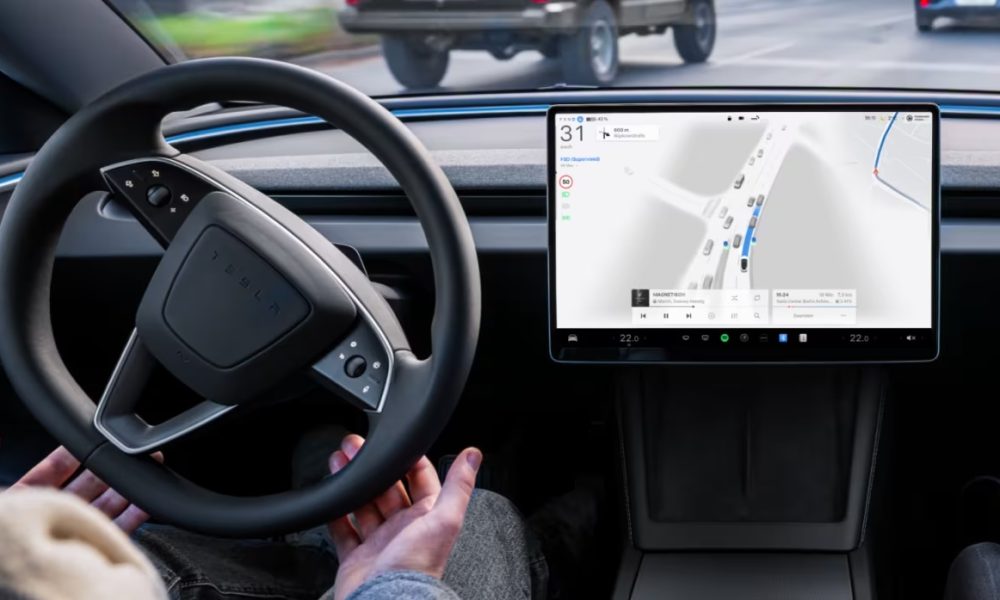
I also note that Tesla are having a big push to get European authorities to accept Full Self Driving (FSD) on European roads. Tesla are claiming that their FSD goes above and beyond what the current European safety regulations require but their tech doesn't fit into the narrow definition of the regulations in the EU.

Tesla are offering 30 day trials of FSD for all new and existing drivers of Tesla cars - this seems more a sales push than anything else, but as always with Tesla, the data harvesting from an additional 1.5m cars doing beta testing for them will be useful.

(Edit to add screen shot as the link seems a bit wonky)
Screenshot_2025-11-29-10-40-21-63_41453ac94f418184dfd859d8c1bcdad8.jpg

Tesla are also offering the chance to experience FSD in some European countries as a passenger - I guess as a way to add pressure on European safety regulators.


Certainly interesting times ahead.
 
Last edited:
Status
Not open for further replies.

Top