• Our new ticketing site is now live! Using either this or the original site (both powered by TrainSplit) helps support the running of the forum with every ticket purchase! Find out more and ask any questions/give us feedback in this thread!

AWC Derailment at Shap Summit 03/11/25

Status
Not open for further replies.

sprinterguy

Veteran Member
Joined
4 Mar 2010
Messages
11,578
Location
Macclesfield
I must have missed the bit where the air leak was said to be associated with the coupling mechanism? And if this was the case, how come it was OK to drag the pendo behind it all the way to Polmadie?
I thought it was a pair of West Coast locos that took the unit forward from Carlisle to Polmadie - 47746 and 57314?
 
Sponsor Post - registered members do not see these adverts; click here to register, or click here to log in
R

RailUK Forums

Viper

Member
Joined
11 Apr 2020
Messages
73
Location
York
in that case they should be charged a penalty by the minute for the time everybody involved spends waiting for the assisting loco to turn up. I do hope this sort of business behaviour carries a price.
I would suspect not as a Thunderbird is typically a Network Rail train, albeit provided as a service from the respective operator, and is therefore likely to not have any delay costs attributed to the operator themselves.
 

172007

Member
Joined
2 Jan 2021
Messages
1,171
Location
West Mids
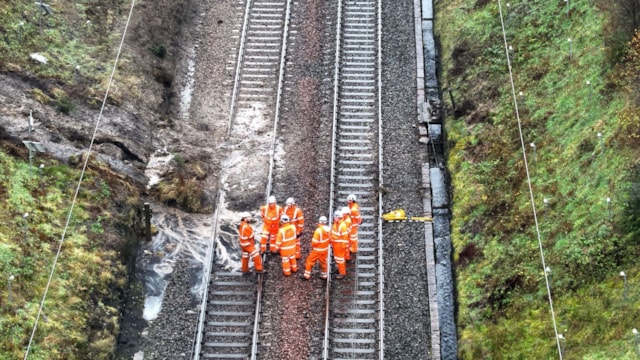
It doesnt appear to have been posted on the thread unless i missed it but Network Rails Nedia centre has an aerial photo of the mudslip here:

This picture was published quite quickly.

As with other pictures there appears to be a laxk of whitness marks in the 6ft suggesting the derailment occured or certanly the front vehicle ceasing to continue straight for some distance after the landslip
 

Annetts key

Established Member
Joined
13 Feb 2021
Messages
3,832
Location
West is best
I have seen some photos of a landslide that appears to be the one related to this incident. As far as I am aware, they are not in the public domain so I can't link to them here and I don't wish to copy them here. These photos do have four to eight people in bright clean orange clothing looking at the landslide.

In the photos that I have seen, there is soil in the four foot with the cess rail being covered in places. Plus there is what appears to be dislodged vegetation close to the line on what should be the ballast shoulder. But the height of the soil is higher than the top of the rail here. The photo is an aerial shot, so I'm unable to say for certain, but there may be some small rocks amongst the mud and soil.

It looks like a train has been through it, but that after the train went through, soil and mud continued to flow down onto the cess rail.

I know from having been to a landslide elsewhere in the country, that wet soil can continue moving slowly for some time after the initial slide event has taken place.
So now that Network Rail has published a photograph of the landslip, I will post up the photos that I was referring to in the post that I quote above.

Photo 1.jpgPhoto 2.jpgPhoto 3.jpgPhoto 4.jpgPhoto 5.jpgPhoto 6.jpgPhoto 7.jpg
 

ainsworth74

Forum Staff
Staff Member
Global Moderator
Joined
16 Nov 2009
Messages
31,128
Location
Redcar
So now that Network Rail has published a photograph of the landslip, I will post up the photos that I was referring to in the post that I quote above.

View attachment 192035View attachment 192036View attachment 192037View attachment 192038View attachment 192039View attachment 192040View attachment 192041
We really did get lucky with that accident didn't we? Pendolino behaved excellently staying upright, in line with only the leading vehicle being deflected from true (and perhaps being kept from going further by the opposite rail?), over plain line with nothing coming the other way.
 

Mcr Warrior

Veteran Member
Joined
8 Jan 2009
Messages
17,306
Pendolino behaved excellently staying upright, in line with only the leading vehicle being deflected from true (and perhaps being kept from going further by the opposite rail?), over plain line with nothing coming the other way.
So, just how far did the Pendolino likely continue after hitting the pile of debris? Must be some way if it had been doing 80+ m.p.h.
 
Joined
3 Mar 2020
Messages
676
Location
Furness
So, just how far did the Pendolino likely continue after hitting the pile of debris? Must be some way if it had been doing 80+ m.p.h.
You can probably work it out by the spacing of the catenary droppers and registration arms if you look at the photo on a laptop really zoomed in. Can't do it on a crappy android phone myself.
 

zwk500

Veteran Member
Joined
20 Jan 2020
Messages
18,647
Location
Northampton

Mcr Warrior

Veteran Member
Joined
8 Jan 2009
Messages
17,306
You can probably work it out by the spacing of the catenary droppers and registration arms if you look at the photo
My apologies. That's possibly intermediate/advanced level sleuthing. Would you be so kind as to enlighten us with a best guess? Many thanks if you are able to do so. What I asked in post #369, was, I reckon, meant to be a fairly straightforward question!
 

Bald Rick

Veteran Member
Joined
28 Sep 2010
Messages
35,965
Stopping distance from 80mph on level track with emergency braking is around 500m. The effective braking rate may well have been higher this time as the front vehicle was off.
 

AlexRail575

Member
Joined
8 Nov 2025
Messages
24
Location
Canada
Stopping distance from 80mph on level track with emergency braking is around 500m. The effective braking rate may well have been higher this time as the front vehicle was off.
Since the train stayed upright and travelled at least 300-350 meters, with 9 (correction:) 10 out of 11 carriages still on the rails, any additional decceleration due to the train dragging along the landslip material and then continued interaction with the ballast was probably pretty mild. A very lucky outcome, had the landslip been worse the train might have been deflected further to the side, jack-knifed and/or rolled over.
 
Last edited:

AlexRail575

Member
Joined
8 Nov 2025
Messages
24
Location
Canada
My goodness, it really was a close call wasn't it?
Well, the railway being straight, no crossovers or other points in the immediate vicinity of the derailment, and no immediately incoming train in the opposite direction probably all conspired to make this pretty mild.
 

Humftamuft

Member
Joined
4 Feb 2021
Messages
8
Location
Tameside
Since the train stayed upright and travelled at least 300-350 meters, with 9 out of 11 carriages still on the rails, any additional decceleration due to the train dragging along the landslip material and then continued interaction with the ballast was probably pretty mild. A very lucky outcome, had the landslip been worse the train might have been deflected further to the side, jack-knifed and/or rolled over.
Only one bogie derailed, leading bogie of leading car. Obstacle deflector deserves an A* (or today’s equivalent)!
 

LNW-GW Joint

Veteran Member
Joined
22 Feb 2011
Messages
21,946
Location
Mold, Clwyd
Stopping distance from 80mph on level track with emergency braking is around 500m. The effective braking rate may well have been higher this time as the front vehicle was off.
Wouldn't the 390 have been on the steep 1 in 75 downgrade from the summit?
 

ainsworth74

Forum Staff
Staff Member
Global Moderator
Joined
16 Nov 2009
Messages
31,128
Location
Redcar
A brief update from the RAIB today with the usual quick outline of what happened the general thrust of their investigation:

At around 06:10 on 3 November 2025, a passenger train travelling from Glasgow Central to London Euston derailed after striking a landslip around 3 miles (5 km) south of Shap, Cumbria. The train was travelling at around 83 mph (134 km/h) when it struck debris that had been washed onto the track. This lifted the first bogie off the rails and to the right, where it ran derailed for around 560 metres. There were 9 staff and 86 passengers on board the train at the time of the collision.

Four people were treated for minor injuries as a result of the accident, and damage was caused to the train and to railway infrastructure.

The landslip occurred during a period of heavy and sustained rainfall. RAIB’s preliminary examination found that a drainage channel, which runs across the slope above the washed-out material, was unable to accommodate the volume of water which was present. This led to the slope material below becoming saturated, initiating the landslip.

Our investigation will determine the sequence of events which led to the derailment and will include consideration of:

  • the design, maintenance and management of earthworks and drainage in this area
  • the effectiveness of on-site monitoring equipment
  • the operational response to adverse weather warnings
  • the performance of the train during the derailment
  • any underlying factors which might have contributed to the derailment.

 

Mcr Warrior

Veteran Member
Joined
8 Jan 2009
Messages
17,306
Stopping distance from 80mph on level track with emergency braking is around 500m. The effective braking rate may well have been higher this time as the front vehicle was off.
Good shout. 560 metres travelled and the train had been going at some 83 m.p.h. according to today's preliminary RAIB report.
 

ainsworth74

Forum Staff
Staff Member
Global Moderator
Joined
16 Nov 2009
Messages
31,128
Location
Redcar
according to today's preliminary RAIB report
Just for the sake of clarity todays update is not a preliminary report it is simply a statement that they are investigating, a few brief known facts and outlines their current main lines of inquiry. If they do issue a preliminary report they will clearly title it, I believe, as an interim report (as was done with both Carmont and Talerddig).
 

edwin_m

Veteran Member
Joined
21 Apr 2013
Messages
28,756
Location
Nottingham
Carmont was also caused by a drainage channel being inadequate for the flow of water. Obviously the underlying causes are unknown in this case but it's a worrying similarity.
 

Aaron_TTL

Member
Joined
9 Jun 2022
Messages
249
Location
Scotland
Id be very interested to read about the land movement sensors seen in the overhead shots of the landslide, did they malfunction, not report the movement in time etc?
 

Master Cutler

Member
Joined
23 Jan 2021
Messages
191
Location
Mansfield
Am I correct in assuming that with the full emergency brakes applied the carriages behind the derailed front unit will help to prevent it from jack knifing by keeping the whole train under tension?
 

AndrewE

Established Member
Joined
9 Nov 2015
Messages
7,365
Am I correct in assuming that with the full emergency brakes applied the carriages behind the derailed front unit will help to prevent it from jack knifing by keeping the whole train under tension?
I suspect that the bar-couplings have helped more. Rigid bolted connections with minimal springing* alluded to above (see comments about the consequent difficulties of re-forming sets) are probably more important than any braking behaviour. I would think that an emergency brake application would take effect almost instantly through the train anyway. If the braking propogated progressively back along the train it would put the train in compression.

*My guess about minimal springing is based on the fact that if these vehicles are never going to be shunted and are powered from 2, 3 or 4 points within the train then there is hardly any need to separate the coaches dynamically or protect them from impacts...

I looked up the German ICE disaster as I thought part of the cause of the jackknifing was that they stuck with screw-couplings between coaches, but it's not mentioned.
 

Bletchleyite

Veteran Member
Joined
20 Oct 2014
Messages
113,816
Location
"Marston Vale mafia"
I looked up the German ICE disaster as I thought part of the cause of the jackknifing was that they stuck with screw-couplings between coaches, but it's not mentioned.

I don't know about the couplers (though I do know Germany still uses screw couplers quite a lot), but the main cause of jack-knifing in this case was that the derailed train hit a bridge, and I would expect the same to happen to a Pendolino in an accident of a similar nature. Bar couplers may be strong, but they aren't going to be able to resist hitting something big, hard and stationary at linespeed.
 

norbitonflyer

Established Member
Joined
24 Mar 2020
Messages
5,835
Location
SW London
I don't know about the couplers (though I do know Germany still uses screw couplers quite a lot), but the main cause of jack-knifing in this case was that the derailed train hit a bridge, and I would expect the same to happen to a Pendolino in an accident of a similar nature. Bar couplers may be strong, but they aren't going to be able to resist hitting something big, hard and stationary at linespeed.
The Pendolinio at Grayrigg ended up pointing the wrong way
 

edwin_m

Veteran Member
Joined
21 Apr 2013
Messages
28,756
Location
Nottingham
Am I correct in assuming that with the full emergency brakes applied the carriages behind the derailed front unit will help to prevent it from jack knifing by keeping the whole train under tension?
Unlikely. The front car is ploughing through the ballast so is most likely going to have more decelerating force on it than any one of the following cars. So there will be some compressive force in the coupler between the first and second car - without this the front car would come to a stop sooner.

Clearly in this case the compressive force wasn't enough to cause jack-knifeing.
 

35B

Established Member
Joined
19 Dec 2011
Messages
5,571
I suspect that the bar-couplings have helped more. Rigid bolted connections with minimal springing* alluded to above (see comments about the consequent difficulties of re-forming sets) are probably more important than any braking behaviour. I would think that an emergency brake application would take effect almost instantly through the train anyway. If the braking propogated progressively back along the train it would put the train in compression.

*My guess about minimal springing is based on the fact that if these vehicles are never going to be shunted and are powered from 2, 3 or 4 points within the train then there is hardly any need to separate the coaches dynamically or protect them from impacts...

I looked up the German ICE disaster as I thought part of the cause of the jackknifing was that they stuck with screw-couplings between coaches, but it's not mentioned.
It was the springing in compression that caused the jackknifing in the Azuma derailment because of how it was designed to act at lower forces.
 

AndrewE

Established Member
Joined
9 Nov 2015
Messages
7,365
It was the springing in compression that caused the jackknifing in the Azuma derailment because of how it was designed to act at lower forces.
er, what Azuma derailment? Is that another name for the ICE?
You will have to explain the comment further as I can't make any sense of it.
 

800001

Established Member
Joined
24 Oct 2015
Messages
7,400
er, what Azuma derailment? Is that another name for the ICE?
You will have to explain the comment further as I can't make any sense of it.
When the Azuma collided with a Hst at Neville Hill, the Azuma then derailed.

It makes absolutely perfect sense.

An Azuma is the LNER hitachi train.
 
Status
Not open for further replies.

Top