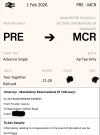
Although starting/finishing short with an Advance ticket is not strictly in accordance with the rules for Advance tickets, the policy of the Rail industry is that no additional fare should be charged (unless there is clear evidence of intent to try and avoid a higher fare).
This seems quite difficult to define though.
If the £2.65 Lancaster to Oxford Road was available and a £2.65 Lancaster to Deansgate was also available, clearly no intent to avoid a higher fare.
What if the former was available on booking, but the latter had sold out and the Deansgate ticket was now £3.65? £10.65? What if no advances were left and the £26.70 Any Permitted was all that was available?
How can anyone know on the day and time of travel how the two fares would have compared when booked? Especially not some hired goons from Carlisle Security, that's for sure!
...Real example...
Tomorrow I will use the full length* of a Birmingham Stations to Letchworth advance single (Chiltern and connections) for a rather spectacularly good £12.50. I will change onto the 17:39 KGX-LET. It did occur to me that that leg alone would be a £21.70 Anytime Day Single.
So if I bought the £12.50 ticket and started short and only used the Kings Cross to Letchworth leg, very difficult to detect of course, but is that now clear intent to avoid a higher fare?
I would say certainly yes, but where is the threshold? Does it depend on the amount of money saved or perhaps the frequency of the act, or both? Maybe the internal guidelines are more descriptive on this, it would be interesting to know!
*honestly guv, I am in Birmingham at the moment and going home tomorrow!