• Our new ticketing site is now live! Using either this or the original site (both powered by TrainSplit) helps support the running of the forum with every ticket purchase! Find out more and ask any questions/give us feedback in this thread!

Lisbons funicular suffers catastrophic runaway (03/09)

Status
Not open for further replies.
Joined
1 Jul 2024
Messages
187
Location
Derbyshire Dales
The separate brakes are for stopping when they 'let go' the cable (official term). There are just a couple of blocks, not the steepest, with no cable by the power house where they run by gravity.
Since electrification, traction is provided by traction motors on the carriages. To drive, the motors of both cars are connected in series. For this reason, they have two-pole overhead lines, with the negative line of the first car connected directly to the positive line of the second.
Don't quite understand this. The cars are counterbalanced by each others' weight. When one stops, the counterbalance ceases to exist, so the only braking is provided by the mechanical brakes and the motors. The motors are connected in series via trolleys on the overhead lines, so the motors of the descending car are regenerating while the those of the other are driving and provide a speed limiter. So far so good, and losing contact with the cable is not only normal but assessed as safe. But if one trolley loses contact or one car derails, the both cars then have only the mechanical brake, and if this fails, nothing at all. So three factors in this accident - loss of cable, loss of regeneration, and inadequate last- resort mechanical braking. So it would seem to come down to the adequacy of design and maintained condition of the mechanical brakes. What sort are they, how often tested, what are the failure modes and how are failures detected? Apart from the way we have just seen sadly.

Recent BBC posts add a little:
Tour guide Marianna Figueiredo ... heard a loud crash.
“In five seconds I was there,” she tells me. “People started to jump from the windows inside the funicular at the bottom of the hill.
"Then I saw another one [further up] that was already crushed...."
I'm assuming that only one ascending and one descending car can use the route at the same time, and from the location of the crash the descending car must have lost control some way up the hill as there was a car already at the bottom, with people abandoning it in panic, when Ms Figueiredo reached it. My impression is that the ascending car must have run backwards down the hill with the descending one coming towards it out of control.
 
Last edited:
Sponsor Post - registered members do not see these adverts; click here to register, or click here to log in
R

RailUK Forums

DelW

Established Member
Joined
15 Jan 2015
Messages
6,036
I'm assuming that only one ascending and one descending car can use the route at the same time, and from the location of the crash the descending car must have lost control some way up the hill as there was a car already at the bottom, with people abandoning it in panic, when Ms Figueiredo reached it. My impression is that the ascending car must have run backwards down the hill with the descending one coming towards it out of control.
My understanding is that it works like a normal funicular, except that the cable pulley at the top is unpowered. There are two cars, each of which runs on its own track, separate on the upper section but interlaced (gauntletted) below the midpoint. The only stops are at the top and bottom ends.

The cars are equipped with motors, not powerful enough to drive a single car, but sufficient to overcome the out-of-balance force resulting from a different load in each car.

The ascending car is driven up the hill under power from its motor, so allowing the other car to descend under gravity, restrained by the cable and possibly its motor in regen mode.

The failure occurred with one car at or close to each end. The bottom car ran back a short distance, then hit the stops. The top car ran away down the mainly straight upper section, but derailed at the only bend, a little way from the bottom end. It must have reached quite a speed, having travelled around 200m. It then struck a building close to the track, hence the extreme damage it and its unfortunate passengers suffered.
 

Gag Halfrunt

Member
Joined
23 Jul 2019
Messages
1,005
So far so good, and losing contact with the cable is not only normal but assessed as safe.

That's not correct. The cars are permanently aattached to the cable. Wikipedia says:

The line conforms to the core principle defining a true funicular, with two cars permanently attached to opposite ends of a haulage cable, which is looped over a pulley at the upper end of the track.


61653 HTAFC

Veteran Member
Joined
18 Dec 2012
Messages
19,372
Location
Yorkshire
There's quite a few posts above referring to the cable "snapping". Based on what we can see this does seem to be a likely cause, but has it actually been confirmed yet?

There also seems to be a bit of confusion caused by comparison to the San Francisco cable car system, which does not operate in the same manner as this system.
 

Whisky Papa

Member
Joined
8 Aug 2019
Messages
744
@ThirteenArches re #31.

Your top quote (from #16) is about the San Francisco cable cars, not the Gloria funicular, which may be causing your confusion?

I do wish we could nest quotes on here, it would be much more straightforward to follow.
 
Joined
1 Jul 2024
Messages
187
Location
Derbyshire Dales
That makes more sense - it's not like a cable tramway, say the one formerly in Douglas IOM, where a gripper attaches the car to the cable when traction is required. So the only question that remains is, after the failure of the cable attachment, why didn't the combined regeneration and mechanical braking stop it before it derailed, at which point it lost all braking? Or was the derailment the cause of loss of the cable?
 

DelW

Established Member
Joined
15 Jan 2015
Messages
6,036
That makes more sense - it's not like a cable tramway, say the one formerly in Douglas IOM, where a gripper attaches the car to the cable when traction is required. So the only question that remains is, after the failure of the cable attachment, why didn't the combined regeneration and mechanical braking stop it before it derailed, at which point it lost all braking? Or was the derailment the cause of loss of the cable?
The car apparently travelled under gravity from the top of the line to about 3/4 of the way down, where it derailed at the only curve. The cable failure must have occurred while it was still at or near the top, so cable failure first, then descent, then derailment. As to why the braking system failed to operate effectively (possibly on both cars, though the consequences were less for the bottom one), that will doubtless be the primary focus of the investigation.
 

Giugiaro

Established Member
Joined
4 Nov 2011
Messages
1,314
Location
Valongo - Portugal
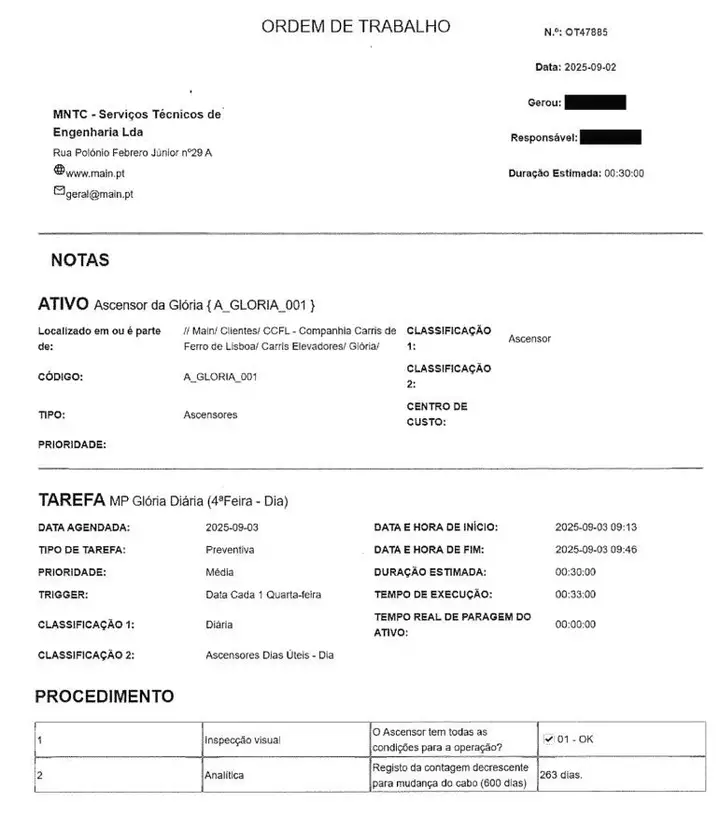
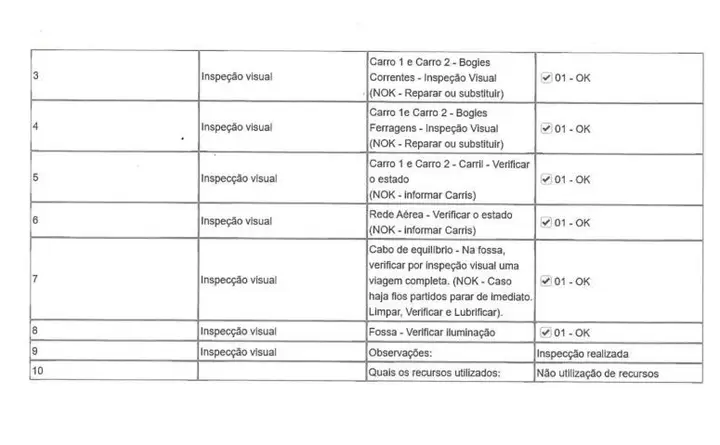
An inspection was carried out by a technician from MAIN between 09:13 and 09:46 on the day of the accident. One of the targets was the cable that connected the two vehicles and, after a full return journey was completed, the cable was deemed to be "good". The next cable replacement was due in 263 days.

More details here (in Portuguese):

== Doublepost prevention - post automatically merged: ==

Here's the report from the inspection done yesterday:

mw-720


mw-720


From this source: https://sicnoticias.pt/pais/2025-09...inspecao-na-manha-do-dia-da-tragedia-7ac09d7f
 

P Binnersley

Member
Joined
30 Dec 2018
Messages
533
There's quite a few posts above referring to the cable "snapping". Based on what we can see this does seem to be a likely cause, but has it actually been confirmed yet?

There also seems to be a bit of confusion caused by comparison to the San Francisco cable car system, which does not operate in the same manner as this system.
Nothing confirmed.

The cable detaching from the car and a failure of the beam that passes through the slot between the cable and the car would have the same effect.
 

61653 HTAFC

Veteran Member
Joined
18 Dec 2012
Messages
19,372
Location
Yorkshire
Nothing confirmed.

The cable detaching from the car and a failure of the beam that passes through the slot between the cable and the car would have the same effect.
I suspected as much, but there have been several posts referring to the cable snapping or failing. The links posted in #38 seem to confirm that the cable itself did not "fail" (i.e. snap), which in turn makes a failure at the point the cable is attached to (one of) the cars more likely. Though a failure of the cable attachment could (as a shorthand) be described as a cable failure by the press or by commentators on a forum, I'd obviously expect an investigation to make a distinction between those two potential failure modes.
 

Gostav

Member
Joined
14 May 2016
Messages
541
An inspection was carried out by a technician from MAIN between 09:13 and 09:46 on the day of the accident. One of the targets was the cable that connected the two vehicles and, after a full return journey was completed, the cable was deemed to be "good". The next cable replacement was due in 263 days.
I guess the more important question is when was the last time the braking system was tested for operation?
 

edwin_m

Veteran Member
Joined
21 Apr 2013
Messages
28,749
Location
Nottingham
I suspected as much, but there have been several posts referring to the cable snapping or failing. The links posted in #38 seem to confirm that the cable itself did not "fail" (i.e. snap), which in turn makes a failure at the point the cable is attached to (one of) the cars more likely. Though a failure of the cable attachment could (as a shorthand) be described as a cable failure by the press or by commentators on a forum, I'd obviously expect an investigation to make a distinction between those two potential failure modes.
Neither my Portuguese nor my knowledge of the system are good enough to tell exactly what components were inspected, but it's plausible that everything that was critical to the integrity of the cable and its fixings to the vehicles was part of that inspection, and that some problem was either not visible or missed. It's pretty much certain that something failed that meant the vehicles were no longer mechanically connected, otherwise the upper vehicle could not have set off downhill while the other remained almost in the same place.

But as @Gostav has just posted, it's pretty much inconceivable that the cable was 100% relied on - there must surely have been a brake suitable to stop a runaway and probably applied automatically by loss of tension in the cable. This sort of arrangement probably needs the cable to be attached to some part of the brake mechanism, and I'm wondering if something caused both to separate from the vehicle, rendering the brake useless. This would probably be a structural failure somewhere on the underframe, not easily visible on a visual inspection and perhaps not seen as risky.
 

Ken X

Member
Joined
29 Nov 2021
Messages
347
Location
Horsham
As somebody who spent over 20 years inspecting passenger lifts I am interested to see how this investigation pans out. My sympathies go to the passengers and families of those involved.

There are many types of devices avaliable to prevent uncovanented descent of a car and there would seem to have been a failure of one or more of these devices resulting in this cars descent.

It is notable that the lower car descended at the same time but was saved by only having a short distance to travel and/or by it's safety devices operating.

This indicates the primary means of suspension, presumably a steel wire rope, was the initial point of failure, either due to material parting or the failure of one of the terminations.

This, in itself should not have resulted in the upper car descending. I would expect the car to have a service brake for normal use and an independent overspeed governor system to stop the car if the maximum speed was exceeded. There are further devices such as slack rope detection etc which would again apply an independent brake when activated.

These devices have been around for many years so the age of the system should not have been a factor. The oldest lift in my patch was a 1905 Otis which was still in daily use. It had a slack rope sensor and an overspeed governor as well as a service brake and all these devices were original fitments. We operated each device every six months and they still functioned correctly.

It's very sad to see a failure of this magnitude and I hope the cause is be quickly determined.
 

bahnause

Member
Joined
30 Dec 2016
Messages
1,044
Location
bülach (switzerland)
Neither my Portuguese nor my knowledge of the system are good enough to tell exactly what components were inspected, but it's plausible that everything that was critical to the integrity of the cable and its fixings to the vehicles was part of that inspection, and that some problem was either not visible or missed. It's pretty much certain that something failed that meant the vehicles were no longer mechanically connected, otherwise the upper vehicle could not have set off downhill while the other remained almost in the same place.
Unless the inspector was Superman with X-ray vision, I would not assume that defects in the rope or attachments could be detected during a daily routine inspection.

These things are checked by metallurgical examinations during longer breaks in operation.
But as @Gostav has just posted, it's pretty much inconceivable that the cable was 100% relied on - there must surely have been a brake suitable to stop a runaway and probably applied automatically by loss of tension in the cable. This sort of arrangement probably needs the cable to be attached to some part of the brake mechanism, and I'm wondering if something caused both to separate from the vehicle, rendering the brake useless. This would probably be a structural failure somewhere on the underframe, not easily visible on a visual inspection and perhaps not seen as risky.
As described in another post, modern standards require a second braking system to be in place if the cable is not continuous (does not form a loop).

However, it is not unheard of for the secondary braking system to fail. In aerial cableways, for example, it can happen that the gondola has already lifted off the suspension cables when the brake closes. Modern systems with continuous cables do not have a safety braking system. It is assumed that cables will not break.
 
Last edited:

Gostav

Member
Joined
14 May 2016
Messages
541
It should also be taken into account that the existing cable railways often have a variety of designs, and almost every historical line has a unique cable system and safety system (which is particularly evident on several cliff railways in the UK), which poses a great challenge to the supervisory authorities.

For those cable railways, are the safety mechanisms designed in the 19th century and still in use today is actually able to work properly in emergency?
 

Gag Halfrunt

Member
Joined
23 Jul 2019
Messages
1,005

There is a palpable sense of shock on the faces of people looking at the wreckage of a funicular crash in the Portuguese capital where 16 people died - but a three-year-old German boy was among the lucky survivors.

He was pulled from the carriage where his father reportedly died and his mother was among more than 20 other people who were injured.

Nationals of Portugal, South Korea, Switzerland, Canada, Germany and Ukraine are believed to be among the dead, police say.

It is still unclear what caused the crash. The capital's public transport operator, Carris, said all funiculars would be inspected and that it had launched an independent investigation.

Portugal's political elite turned up at the Church of St Dominic on Thursday night for a service held in honour of those killed.

Outside the church, people called for a thorough investigation into what happened. "We need people to know they're safe here," one woman said as others nodded.

One local resident told the BBC she was "still processing" what had happened as she walked past the site of the crash, where the wreckage of the funicular that had derailed and crashed into a building lay on the ground.

"It's very, very sad," she said.

Others gathered and took photos of the wreckage, or stood silently watching. Two tourists from Singapore said they had been scheduled to ride the funicular on Wednesday but had changed their plans at the last minute.

"It's scary… Who knows, we might have been on this one," one said. "It changes your perspective on life. You just don't expect something like this to happen."

Tour guide Mariana Figueiredo was among those at the scene of the crash on Wednesday evening. She said she had been traumatised by what she had witnessed.

Ms Figueiredo said she heard a large crash and rushed to the scene, close to where her TukTuk was parked.

"In five seconds I was there," she said. "People started to jump from the windows inside the funicular at the bottom of the hill. Then I saw another one [further up] that was already crushed.

"I started to climb the hill to help the people but when I got there the only thing I could hear was silence."

Ms Figueiredo said that when she and others started to pull the roof off of the funicular, they saw dead bodies inside.

She said she witnessed children being rescued, and tried to help people with broken bones and to calm those in distress.

"A lot of people were crying around me. They were very frightened. I was trying to calm them down."

A man, who was on another funicular at the bottom of the hill at the time of the crash, told reporters that he thought he was going to die.

"No matter how many more years I live, I'll never take the funicular again," he said.

Police have not officially named any of the dead or injured, but said at a news conference on Thursday that they believed two Canadians, one German and one Ukrainian national were thought to be among the dead.

This followed from an earlier update in which police said they believed five Portuguese, two South Korean and one Swiss national had been identified.

The Portuguese transport union said funicular brake guard André Jorge Gonçalves Marques was among those killed.

Charity Santa Casa da Misericórdia, whose employees used the funicular for their work commute, confirmed that four of their workers were killed in the accident.

One employee, Valdemar Bastos, told the BBC that staff at the charity, located on top of a steep hill, often used the funicular along with tourists and elderly people.

"I have always felt safe," he said. "I never thought this could happen."

On Thursday, the head of Lisbon's public transport operator, Carris, said that all funiculars in the city would be closed until technical inspections had been carried out.

Pedro Gonçalo de Brito Aleixo Bogas told reporters that the Gloria line would reopen in the future with a new carriage.

He said the company had increased its spending on maintaining funiculars - which had operated correctly since 2007 - but added that the cost of maintaining them had more than doubled over the past 10 years.

The findings from the investigation would be released soon, Dr De Brito Bogas said, but declined to say when this would happen.

Footage shared on social media showed the crumpled yellow funicular overturned on the cobblestone street and people running from the area as smoke filled the air.

Several passengers trapped in the wreckage had to be freed by emergency responders, local authorities said.

Officials in Lisbon had initially put the death toll at 17, however that number was later revised down to 16 after they discovered a person who died in hospital overnight had been counted twice.

A funicular is a type of railway system that allows travel up and down steep slopes, and in Lisbon they are a crucial means of navigating the city's steep, cobbled streets.

The city's funicular railways - Glória, Lavra, Bica and Graça - are a popular tourist attraction, as the bright yellow tram-like vehicles snake through the often-narrow, hilly streets.

Glória was opened in 1885 and electrified three decades later.

It travels some 275m (900ft) from Restauradores, a central city square, up to the picturesque streets of Bairro Alto. The journey takes just three minutes.

The two carriages on the Glória route are attached to opposite ends of a haulage cable, which is pulled by electric motors.

As one carriage travels downhill, its weight lifts the other, allowing them to ascend and descend simultaneously, reducing the energy needed to transport them.

The second, intact carriage could be seen just metres from the wreckage at the bottom of the hill.

 
Joined
10 Feb 2016
Messages
134
An inspection was carried out by a technician from MAIN between 09:13 and 09:46 on the day of the accident. One of the targets was the cable that connected the two vehicles and, after a full return journey was completed, the cable was deemed to be "good". The next cable replacement was due in 263 days.

More details here (in Portuguese):

== Doublepost prevention - post automatically merged: ==

Here's the report from the inspection done yesterday:

mw-720


mw-720


From this source: https://sicnoticias.pt/pais/2025-09...inspecao-na-manha-do-dia-da-tragedia-7ac09d7f
I've spent most of my life in engineering and one thing I have learned is that true coincidences are extremely rare.
The face that the cable system was inspected on the morning of the accident rings alarm bells for me, unless of course it's inspected every day or weekly. I'm wondering if the inspection involves giving everything a good shake or a tap with a hammer. Whatever the cause, the inspection didn't find it beforehand.
RIP to all those involved.
 

Giugiaro

Established Member
Joined
4 Nov 2011
Messages
1,314
Location
Valongo - Portugal
The 3-year-old German boy has been discharged from hospital, and both parents also survived. The father, who was wrongly identified as one of the mortal victims, was found injured in Saint Joseph's Hospital in Lisbon.
 

edwin_m

Veteran Member
Joined
21 Apr 2013
Messages
28,749
Location
Nottingham
I've spent most of my life in engineering and one thing I have learned is that true coincidences are extremely rare.
The face that the cable system was inspected on the morning of the accident rings alarm bells for me, unless of course it's inspected every day or weekly. I'm wondering if the inspection involves giving everything a good shake or a tap with a hammer. Whatever the cause, the inspection didn't find it beforehand.
RIP to all those involved.
Also, it would be very unlikely for two failures (the cable or its attachment, and the emergency brake) to happen independently but simultaneously. Either the same event caused both, or possibly the emergency brake became defective some time ago but that wasn't picked up on inspections until the brake was actually needed when the cable failed.
 

westcoaster

Established Member
Joined
4 Dec 2006
Messages
4,513
Location
DTOS A or B
Neither my Portuguese nor my knowledge of the system are good enough to tell exactly what components were inspected, but it's plausible that everything that was critical to the integrity of the cable and its fixings to the vehicles was part of that inspection, and that some problem was either not visible or missed. It's pretty much certain that something failed that meant the vehicles were no longer mechanically connected, otherwise the upper vehicle could not have set off downhill while the other remained almost in the same place.

But as @Gostav has just posted, it's pretty much inconceivable that the cable was 100% relied on - there must surely have been a brake suitable to stop a runaway and probably applied automatically by loss of tension in the cable. This sort of arrangement probably needs the cable to be attached to some part of the brake mechanism, and I'm wondering if something caused both to separate from the vehicle, rendering the brake useless. This would probably be a structural failure somewhere on the underframe, not easily visible on a visual inspection and perhaps not seen as risky.
If you have google lens on your mobile phone, hold it over the attachment and it will translate the check list for you.

I saw a picture today from above, it looked to me like a telephone pole has sliced the vehicle in half whilst sliding on its side.
 

Beebman

Member
Joined
17 Feb 2011
Messages
966
Location
Twyford
National broadcaster RTP is this morning reporting that since 2020 the National Railway Safety Authority in Portugal no longer has the power to supervise 'cable transport systems' built before 1986 and classified as heritage (article in Portuguese, I've used Google Translate):

https://www.rtp.pt/noticias/pais/el...-autoridade-de-seguranca-ferroviaria_n1681730

That includes the Glória and Lavra funiculars but the Institute for Mobility and Transport (IMT) continued to inspect the Bica and Santa Justa ones although only as 'a gesture of goodwill and good cooperation' with Carris.

I saw a picture today from above, it looked to me like a telephone pole has sliced the vehicle in half whilst sliding on its side.

The RTP link above includes a 2.5-minute embedded video (scroll down the page) which has a brief shot at 0:32-0:34 that suggests to me that the car hit a traction pole after derailing which might be the principal reason for the vehicle's destruction. Later on the video there's some shots of the cable being removed from its slot for examination (e.g. at 1:34). (Most of the video is of various officials discussing the incident.)
 

P Binnersley

Member
Joined
30 Dec 2018
Messages
533
The GPIAA (Portuguese equivalent of RAIB) an initial report (in Portuguese).
This includes some diagrams and pictures.

The main points (courtesy of Google translate) are:
The elevator is subject to a maintenance plan to be followed by the respective service provider, which provides for varying levels of intervention with different frequency depending on the scope and extent of the interventions. These range from major overhauls every four years to routine daily visual inspections of visible safety elements, with various other inspections and interventions
The published inspection sheet was from the daily visual inspection.
Moments after the movement begins, and when they have travelled no more than about six meters, the cabins suddenly lose the balancing force provided by the connecting cable connecting them. Cabin No. 2 suddenly moves back, its movement halted about 10 meters later by its partial exit beyond the end of the railway and the burial of the underside of the trampoline at the end of the cable trench.
Cabin No. 1, at the top of Calçada da Glória, continued its downward movement, increasing its speed. The vehicle's brakeman immediately applied the air brake and the hand brake to try to halt the movement. These actions had no effect in sustaining or reducing the vehicle's speed, and the cabin continued accelerating down the slope.

It is estimated, with a non-negligible margin of uncertainty due to the lack of knowledge of some parameters, that the first impact occurred at a speed of around 60 km/h, with all these events having occurred in a time of less than 50 seconds.
60km/h is ~40mph.
From the on-site study of the wreckage, it was immediately clear that the cable connecting the two cabins had given way at its attachment point inside the upper trampoline of cabin #1 (the one that began its journey at the top of Calçada da Glória). The rest of the cable, the reverse flywheel, and the pulleys through which it runs were lubricated and without apparent anomalies. The cable on the upper trampoline of cabin #2 was also without apparent anomalies.
The "Trampoline" is the cable gripping mechanism. There are two per car (upper and lower).

The evidence confirms that the emergency system in the reversing wheel located at the top of Calçada da Glória, which, in the event of a loss of power in the cable, cuts off power to the cabins, worked as expected, which would have the effect of immediately and automatically applying the pneumatic brake in each of them.

However, and regardless of this, evidence indicates that the air brake and also the hand brake were quickly applied by the brakeman of cab #1, but that in the existing configuration, the brakes do not have sufficient capacity to stop the moving cabs without their empty masses being mutually balanced by the connecting cable. Therefore, it does not constitute a redundant system in the event of this connection failure.
The brakes were not strong enough to stop the (unbalanced) cars in the event of the cable breaking.

To date, the investigation has found that the elevator is not under the supervision of the Institute of Mobility and Transport, I.P., and the investigation currently does not have reliable and confirmed information regarding the legal framework of the Glória elevator or which public entity is responsible for supervising the operation and safety of this public transportation system, beyond the intervention of an accredited entity that, at the initiative of the operating company, inspects the equipment during major repairs every four years. 4.
The funicular seems to have fallen into a legal "black hole".
 
Last edited:

Egg Centric

Established Member
Joined
6 Oct 2018
Messages
2,909
Location
Land of the Prince Bishops
The brakes were not strong enough to stop the (unbalanced) cars in the event of the cable breaking.

There is an official translation as well although tbh it reads as though it was also made with Google Translate. In any case it appears that this absolutely insane (to my mind - surely this isn't common in funiculars?) reason is the main cause. Obviously whatever caused the cable to brake is important, but the fact that once it did the accident was guaranteed to happen even once both brakes were applied is inexplicable.
 

endecotp

Member
Joined
23 Apr 2014
Messages
352
The BBC coverage of this report includes this phrase:

Although the brakeman activated the pneumatic brakes and a manual brake when the cable came loose, it is not clear whether another, automatic brake came on as it was supposed to, the report states.


AndyPJG

Member
Joined
29 Jun 2012
Messages
543
The BBC coverage of this report includes this phrase:


Portuguese officials investigating Wednesday's deadly funicular crash in Lisbon say a cable along the railway's route snapped, but the rest of the mechanism was functioning properly.

"After examining the wreckage at the site, it was immediately determined that the cable connecting the two carriages had given way," a statement by the national transport safety office said.

The brakeman tried to apply emergency brakes but failed to prevent the derailment, the investigators add.
(my bolding)
Edit: also
The seven-page statement also says the cable was only 337 days into its expected 600-day operational life.
 
Last edited:

Egg Centric

Established Member
Joined
6 Oct 2018
Messages
2,909
Location
Land of the Prince Bishops
The BBC coverage of this report includes this phrase:

Although the brakeman activated the pneumatic brakes and a manual brake when the cable came loose, it is not clear whether another, automatic brake came on as it was supposed to, the report states.

The BBC aren't understanding the report (shock!). Unless the translation is totally wrong, the automatic brake is the pneumatic brake (we'd call it air brake imo) which was also applied manually by the brakeman, so whether or not it came on automatically isn't especially important to the end result (although obv would be a concern if it didn't).

From the report:
At this time, it has not yet been possible to conduct verification checks to confirm whether the system for automatically applying the pneumatic brake to the cabins following a loss of cable tension in the trambolho worked. However, regardless of this, the evidence indicates that the air brake and the manual brake were quickly applied by the brakeman of cab #1, but that in the current configuration, the brakes do not have sufficient capacity to stop the cabins in motion without their empty masses being mutually balanced by the connecting cable. Therefore, the existing brakes does not constitute a redundant system in case of a failure in the connecting cable.

If the above is correct then the thing is just very poorly designed, full stop. Regardless of what else was going on, I think even cable cars usually have an extra cable for redundancy no? Even if not (on googling it this doesn't seem to be a universal rule) then there is no reason this couldn't have had proper brakes.
 
Last edited:

Taunton

Veteran Member
Joined
1 Aug 2013
Messages
12,323
There also seems to be a bit of confusion caused by comparison to the San Francisco cable car system, which does not operate in the same manner as this system.
I think the posts about San Francisco quite understand the mechanical principles, including how running downhill gripping the cable ensures they don't exceed cable speed of 9 mph, but that they also have a rarely used emergency brake lever, for use if a cable failure, which jams its mechanism in the cable slot and stops the car dead, a feature which I understand is legally required, but in Lisbon was either not present or not activated.
 

61653 HTAFC

Veteran Member
Joined
18 Dec 2012
Messages
19,372
Location
Yorkshire
I think the posts about San Francisco quite understand the mechanical principles, including how running downhill gripping the cable ensures they don't exceed cable speed of 9 mph, but that they also have a rarely used emergency brake lever, for use if a cable failure, which jams its mechanism in the cable slot and stops the car dead, a feature which I understand is legally required, but in Lisbon was either not present or not activated.
I just meant that the limitations of the site software (the difficulty in quoting more than one post in a conversation) were causing confusion.
 

neonison

Member
Joined
25 Feb 2007
Messages
259
Location
Standedge, One hill, four tunnels
On the San Francisco system the gripman takes the cable as required to provide haulage or braking effect which is essentially any time the car is in motion and lets go of the cable at every stop en route. The continuous cables, there are a number from a single winding house (car barn), run all day, non stop.
In the case that the gripman loses the cable and the car runs away the last resort is a metal wedge which jams into the slot and will either friction weld itself to stop the car or rip up the slotted rail, either eventually will stop the car.
There is a risk of the cars rear ending one another as everything is line of sight and signalling are just traffic lights at the intersections.
 

Bovverboy

Established Member
Joined
1 Dec 2013
Messages
2,098
If the above is correct then the thing is just very poorly designed
That's on a par with saying that a helicopter is poorly designed if it doesn't have a backup rotor to use if the primary one falls off.

== Doublepost prevention - post automatically merged: ==

Portuguese officials investigating Wednesday's deadly funicular crash in Lisbon say a cable along the railway's route snapped

Wasn't it implied earlier that the cable hadn't snapped, as such, but had become detached from one of the cars?
 
Last edited:
Status
Not open for further replies.

Top