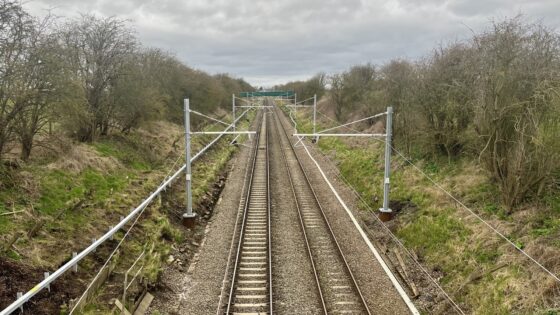
Electrification is a strategic benefit to the railway measurable at a large (time and geography) scale. As in, the benefits of real electrification are measured in the decades after completion. Using batteries to remove tailpipe emissions, while achieving direct emissions goals, does nothing for actual sustainability over diesel engines: trains are just as expensive/complex in procurement/maintenance, requires intensive extraction of finite resources for the production of batteries, and the major one: energy efficiency is still the same.
Of the dominant components in the likely modern battery technology (lithium iron phosphate), only lithium is in meaningfully constrained supply.
And the lithium in a battery pack is largely recyclable.
Its not as if overhead electrification doesn't require similar mining, where do you think the worn copper and silver from overhead contact wires goes?
At least the battery remains in one unit that can be shipped to disposal and recycling rather than being scattered to the literal wind.
The energy efficiency and complexity of a battery train are much closer to an electric train than to a diesel one.
A battery train needs one additional moving part, a cooling pump, compared to an electric one.
Electrification also has the benefit of being a known and well understand technology in terms of operational procedures and methods. Any of the battery solutions suggested here would need a risky, expensive and time consuming development phase to actually be put into practice.
Well Electrification is a well understood technology that is well understood to be extremely expensive. Even the proposed rates for Wigston-East Midlands are way too high to be sustainable over much of the railway.
They'd have to fall by half to two thirds before large scale continuous electrification beyond that which exists could be justified.
There is some risk in the deployment of battery trains to be sure, but it is a pretty minor risk given there is lots of experience in electric trains and lithium batteries. Indeed extensive experience of battery trains in other parts of the world does exist.
It is
highly unlikely to fail.
This is especially true for a mixed traffic railway like MML that handles high volumes of freight and variation between intercity and local services. Freight and Intercity interact with many other areas so the boundaries of "decarbonising" MML with battery/discontinuous undergoes a lot of scope creep.
The majority of intercity traffic on the MML is simply Sheffield/Nottingham to London and back. It's not really "integrated".
And XC will likely be on diesel for a significant period yet.
As for freight, freight is highly unlikely to use electric traction whatever happens, so it doesn't really affect much.
They will just use the Class 66 or Class 70 like they always have.
attery solutions also make rolling stock highly specific to an area of infrastructure (and vice versa) crippling the concept of fleet cascades.
Does it?
A battery train can do anything an EMU can do, and a battery train can do anything a battery train with less range can do.
And the discontinuous electrification aspect make them generally less reliable as the infrastructure must have even higher availability in a way that isn't required with diesels. This means what little electrification is deemed necessary for a discontinuous system is itself more expensive and bespoke and among one project, the costs are not as well spread out.
On the other hand, electrification that does not exist cannot fail.
A discontinuous electrification scheme also fails more gracefully than a conventional one, because even if it fails to the point that service cannot continue it is unlikely to strand trains in the middle of nowhere.
For MML RS3 there is more detail on this. Referring to STK cost, 20% is OLE and distribution assets, 25% is structure rebuilds, 55% is contract handling including paying TOCs for long possessions. (These are noel dolphin numbers) Hopefully that latter detail does not exist in GBR. But "contract handling" in general should be something that is actually possible to cut down on. Obviously different projects will have different spreads if there are particularly difficult clearances involved that go wrong in construction. But I imagine the proportions don't majorly change from this.
Whether in GBR or not, the costs of long possessions have to be paid by
someone.
Trains will be cancelled, buses will cost money and ticket revenue will be lost.
You can't just make it vanish into thin air to make the electrification figures look better.

 www.newcivilengineer.com

 www.bbc.co.uk


