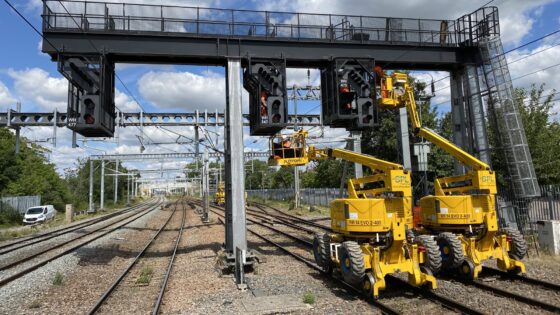
We keep hearing about the Scottish ‘rolling programme’ but I struggle to see it these days. Between 2014 and 2019 there was widespread electrification in the Central Belt - fair enough. But since then there seems to have only been a few relatively small and local schemes. Barrhead (without the Larkfield Chord) and currently East Kilbride. I’ll be generous and add the Carstairs re-modelling. Some mast bases on the new Leven line and a start on steelwork towards Dalmeny. Great, but is it really keeping the teams from the teenies working at full pace?
There was certainly a good plan under Salmond with a lot of the legwork done for projects that were only fully delivered after he'd stood down
Recently though... nah... Hence the nonsense of continuing to run the electrified East Kilbride branch with DMUs. The flagship Falkirk High service reduced in frequency but money found for under 22s (and pensioners) to have free travel on long distance coach services
Scotland gets lauded for things that England is criticised for
Electrification to Dalmeney is praised because it'll allow bi-modes to use electricity at the city end without the hassle/ expense/ closures needed to wire the full route... they might wire other sections at a later date when money allows... but isn't that rather similar to the plans for the MML?
As I've said before, if we've got to the point where full electrification has become significantly more expensive than the decreasing costs of batteries then we need to take that info consideration. When the facts change, I change my mind.
Electrification is one means to an end. Electrification can be
a great tool, but it's not the only tool and it's certainly not a goal in it's own right. People buy hammers to do a specific job, the objective isn't too collect hammers.
For me the main problem with partial MML wiring (other than the stock problems when longest 222s get pinched for a speculative OAO) is that the logical priorities to wire would be big urban areas like Leicester/ Nottingham/ Derby/ Sheffield (improved air quality where it's needed most, trains can charge whilst sat at stations, better acceleration from a standing start) but wiring these 'as is' locks those cities into a generation(s) of strained capacity... But waiting for such big stations to be expensively remodelled to wire them means one bigger costlier project at the time, making it easier for politicians to refuse to fund
Wiring in the countryside is less of a priority, where trains are already travelling at line speed and the air quality is better, but those bits don't constrain future capacity in the same way