
-
Our new ticketing site is now live! Using either this or the original site (both powered by TrainSplit) helps support the running of the forum with every ticket purchase! Find out more and ask any questions/give us feedback in this thread!
You are using an out of date browser. It may not display this or other websites correctly.
You should upgrade or use an alternative browser.
You should upgrade or use an alternative browser.
Wigan-Bolton electrification. Construction updates only please
- Thread starter GRALISTAIR
- Start date
- Status
- Not open for further replies.

Sponsor Post - registered members do not see these adverts; click here to register, or click here to log in
R
RailUK Forums

pokemonsuper9
Established Member
Although there was a 2nd schedule that wasn't used, which might just mean they were confident enough in it or that there was an issue that needed to be fixed before they could go again.The very first electric test train from Wigan North Western to Bolton and back, ran earlier this morning. Seems it was very successful as it ran early throughout.
zwk500
Veteran Member
Well timed as a 15x and with that amount of pathing, you'd hope it ran early!The very first electric test train from Wigan North Western to Bolton and back, ran earlier this morning. Seems it was very successful as it ran early throughout.

td97
Established Member
- Joined
- 26 Jul 2017
- Messages
- 1,556
Entry into service was achieved over the weekend following Office of Rail & Road authorisation earlier in the month.
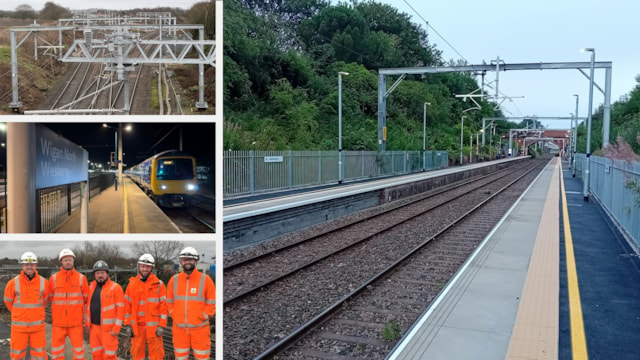
 www.networkrailmediacentre.co.uk
A £100m electrification of the railway between Wigan and Bolton is officially complete after overhead power lines were entered into service this weekend.
Overnight on Saturday (26 July), Network Rail teams unveiled new train driver signage and removed barriers at stations which have seen platforms extended in the final stage of the major multi-year investment.
It follows successful test train running and regulatory sign-off in recent weeks to commission the newly installed infrastructure along the 6.5-mile route between the two towns.
Wigan to Bolton railway cleaner and greener after £100m electrification
A £100m electrification of the railway between Wigan and Bolton is officially complete after overhead power lines were entered into service this weekend.
www.networkrailmediacentre.co.uk

darylyates17
Member
When will electric services run on it will it be from December?Entry into service was achieved over the weekend following Office of Rail & Road authorisation earlier in the month.
Wigan to Bolton railway cleaner and greener after £100m electrification
A £100m electrification of the railway between Wigan and Bolton is officially complete after overhead power lines were entered into service this weekend.

59CosG95
Established Member
The cost likely includes the numerous bridge rebuilds that dogged the scheme in the earlier stages.£5m per single track km doesn’t sound like exceptionally good value for what should on the face of it be a simple scheme, being a short extension of an existing network and relatively low speed too.
pokemonsuper9
Established Member
769s started running on electric from Ince yesterday, as well as one journey into Wigan North Western, which didn't use diesel at all.When will electric services run on it will it be from December?

“Short” does not necessarily imply cheap - as fixed costs will get spread over fewer km. Any ex-industrial / mining area is always going to be anything but “simple”. Going to stick my neck out and say if you want low £/stkm try Grantham - Skegness (and put any resignalling required in a separate budget!). Of course there’s plenty of economic reasons why you wouldn’t…£5m per single track km doesn’t sound like exceptionally good value for what should on the face of it be a simple scheme, being a short extension of an existing network and relatively low speed too.
zwk500
Veteran Member
It being short means less economies of scale, although £5m/stkm isn't brilliant. Peak GWML cost was apparently £4m/stkm although that was a while ago.£5m per single track km doesn’t sound like exceptionally good value for what should on the face of it be a simple scheme, being a short extension of an existing network and relatively low speed too.

Nottingham59
Established Member
The important comparator is what was the expected cost at the time that the decision to electrify was made?£5m per single track km doesn’t sound like exceptionally good value for what should on the face of it be a simple scheme, being a short extension of an existing network and relatively low speed too.
I can’t link to it currently but as recently as last summer Northern was quoting £78m.The important comparator is what was the expected cost at the time that the decision to electrify was made?
The cost likely includes the numerous bridge rebuilds that dogged the scheme in the earlier stages.
The red iron bridge that had to be raised, have extra ramps installed and all the associated engineering works Vs just taking it down springs to mind!
pokemonsuper9
Established Member
They still haven't installed those ramps yet! There have usually been some people around it when I've been passing it so hopefully we see access restored soon.The red iron bridge that had to be raised, have extra ramps installed and all the associated engineering works Vs just taking it down springs to mind!
Nottingham59
Established Member
According to Modern Railways in 2021, the cost at approval was £78m.I can’t link to it currently but as recently as last summer Northern was quoting £78m.
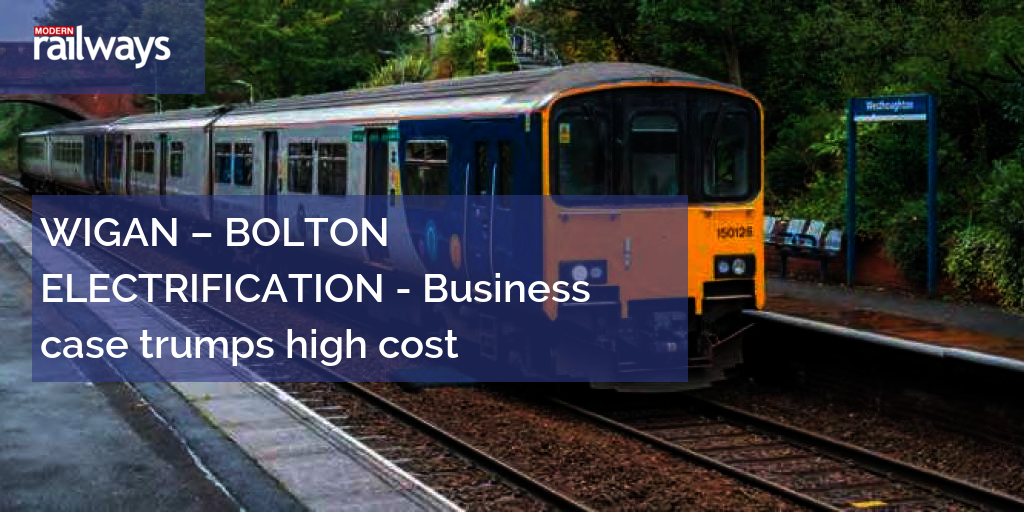
WIGAN – BOLTON ELECTRIFICATION - Business case trumps high
■ Six route miles tops GWEP unit costs ■ 17 bridges highlights civils cost challenge ■ National Electrification Efficiency Panel in challenge mode
 www.modernrailways.com
There were sucked teeth in the industry when Government approval for the electrification of the six miles of double track railway between Wigan East and Lostock Junction was announced at the beginning of September. The cost of £78 million equated to £3.9 million per single track kilometre (stkm).
They are aiming for it to be ready by October! Plenty of activity now after months of inaction.The red iron bridge that had to be raised, have extra ramps installed and all the associated engineering works Vs just taking it down springs to mind!
Formby EMU Fan
Member
I travelled this line on Saturday 2nd August on the 2O79 1503 Service from Southport to Manchester Oxford Road on a Class 769. I wondered whether it would switch to Electric power from Wigan Wallgate (or possibly Ince as I am not sure the platform at Wallgate was electrified) but when I got off the train at Westhoughton it still had the pantograph lowered, and it definitely departed using Diesel power. Later that same day on my return journey, I observed a later Service 2O74 2049 Class 769 service Southport to Manchester and that definitely had the pantograph raised at Westhoughton, and departed using Electric. At what point are they supposed to switch to Electric Traction or is it at Drivers discretion?
There is no wiring at Wigan Wallgate: a 769 via Wallgate should change mode when stopped in the platform at Ince, both ways, and that has happened on the 6 or so services I have caught since the first day (last Monday).I travelled this line on Saturday 2nd August on the 2O79 1503 Service from Southport to Manchester Oxford Road on a Class 769. I wondered whether it would switch to Electric power from Wigan Wallgate (or possibly Ince as I am not sure the platform at Wallgate was electrified) but when I got off the train at Westhoughton it still had the pantograph lowered, and it definitely departed using Diesel power. Later that same day on my return journey, I observed a later Service 2O74 2049 Class 769 service Southport to Manchester and that definitely had the pantograph raised at Westhoughton, and departed using Electric. At what point are they supposed to switch to Electric Traction or is it at Drivers discretion?
I note from RTT https://www.realtimetrains.co.uk/service/gb-nr:W49688/2025-08-02/detailed that your 2O79 was 769450, and according to RTT it completed its diagram that day including running into Wigan North Western then ECS to Allerton depot. It is possible that it had developed a fault that was stopping it from running in electric mode, but I doubt that it would have completed its diagram pretty much on time all day if that was the case. I suggest that either the driver forgot, and changed at Bolton instead, or maybe there was some element of training the driver hadn't received.
450 ran on diesel throughout it’s entire diagram on the 2nd I believe, if it wasn’t 450 there definitely was one 769 that was stuck in diesel all day.I travelled this line on Saturday 2nd August on the 2O79 1503 Service from Southport to Manchester Oxford Road on a Class 769. I wondered whether it would switch to Electric power from Wigan Wallgate (or possibly Ince as I am not sure the platform at Wallgate was electrified) but when I got off the train at Westhoughton it still had the pantograph lowered, and it definitely departed using Diesel power. Later that same day on my return journey, I observed a later Service 2O74 2049 Class 769 service Southport to Manchester and that definitely had the pantograph raised at Westhoughton, and departed using Electric. At what point are they supposed to switch to Electric Traction or is it at Drivers discretion?
Formby EMU Fan
Member
Thanks for the response. I am not a regular user of that line, the one day do have an excuse to use it I get a Class 769 stuck in Diesel traction, and my return trip was on a Class 156, so I have yet to ride it under Electric Traction450 ran on diesel throughout it’s entire diagram on the 2nd I believe, if it wasn’t 450 there definitely was one 769 that was stuck in diesel all day.

Last edited:
Yes, 450 had a fault last week and there was an instruction not to run in electric mode.450 ran on diesel throughout it’s entire diagram on the 2nd I believe,
Thank you. So even £78m raised eyebrows in the industry as to how much it was costing, and yet on completion it appears to have cost £100m. Even allowing for inflation, that’s a sizeable overrun.According to Modern Railways in 2021, the cost at approval was £78m.
WIGAN – BOLTON ELECTRIFICATION - Business case trumps high
■ Six route miles tops GWEP unit costs ■ 17 bridges highlights civils cost challenge ■ National Electrification Efficiency Panel in challenge mode

Dr Hoo
Established Member
So how much per single track kilometre (stk) does that work out at? An ‘under budget’ figure from a team already experienced will be a useful benchmark for what is the best that we can expect nowadays?
zwk500
Veteran Member
Modern Railways in the article linked above claims that the original £78m worked out at £3.9m/stkm. 78/3.9=20, (which is slightly more than 6 route miles of plain double track, so presumably includes some crossovers/overruns).So how much per single track kilometre (stk) does that work out at? An ‘under budget’ figure from a team already experienced will be a useful benchmark for what is the best that we can expect nowadays?
£100m over 20stkm would be £5m/stkm. Bear in mind that for a short scheme like this the project overheads are only being spread over a few stkm, not hundreds as major projects are able to do. Also the reported figures might be rounded off.
Adjusting for inflation is always tricky over a multi-year project, but the various calculators seem to suggest that £5m is right in the ballpark for an at-inflation increase on £3.9m. This scheme will be more expensive per stkm than most due to it's short length (possibly mitigated by being close enough to Manchester-Bolton electrification to benefit from that?) Oh, for a rolling programme with strategic vision!
Would be interesting to see a breakdown of the costs broken down into fixed across the project and variable by stkm.
Dr Hoo
Established Member
Were there any ‘feeders’, substations and whatnot on a short scheme like this that meets existing catenary at both ends? Wouldn’t that tend to make it ‘cheap’?
Trainbike46
Established Member
I may be wrong, but I thought this project had an unusually high number of structures that needed work, which would drive up the price per stkm.Modern Railways in the article linked above claims that the original £78m worked out at £3.9m/stkm. 78/3.9=20, (which is slightly more than 6 route miles of plain double track, so presumably includes some crossovers/overruns).
£100m over 20stkm would be £5m/stkm. Bear in mind that for a short scheme like this the project overheads are only being spread over a few stkm, not hundreds as major projects are able to do. Also the reported figures might be rounded off.
Adjusting for inflation is always tricky over a multi-year project, but the various calculators seem to suggest that £5m is right in the ballpark for an at-inflation increase on £3.9m. This scheme will be more expensive per stkm than most due to it's short length (possibly mitigated by being close enough to Manchester-Bolton electrification to benefit from that?) Oh, for a rolling programme with strategic vision!
Would be interesting to see a breakdown of the costs broken down into fixed across the project and variable by stkm.
zwk500
Veteran Member
According to the NR Press release there were no Feeders or substations, but there were:Were there any ‘feeders’, substations and whatnot on a short scheme like this that meets existing catenary at both ends? Wouldn’t that tend to make it ‘cheap’?
Since 2022 the project has seen:
- 21 kilometres of power lines installed
- 414 new overhead line equipment stanchions erected
- Six road bridges and one footbridge completely reconstructed
- Modifications to 17 bridges and two-level crossings
- Signalling and track upgrades completed
- Platform extensions at Hindley, Westhoughton and Ince stations
6 bridge reconstructions, 17 bridge modifications for a total of 1.1 bridges/stkm won't help keep costs down. 2 LC's is also a big lump that can't get spread out in the averaged figure.
Dr Hoo
Established Member
I thought that ‘bridge modification’ usually meant higher parapets with steeple copes and other anti-trespass measures. These can’t be avoided by track lowering and insulating paint.
I get that no two routes or schemes are identical but isn’t it just a case of ‘win some, lose some’?
I reckon that £5,000,000/stk is a good rule of thumb at modern prices when envisaging or proposing new schemes.
I get that no two routes or schemes are identical but isn’t it just a case of ‘win some, lose some’?
I reckon that £5,000,000/stk is a good rule of thumb at modern prices when envisaging or proposing new schemes.
Trainbike46
Established Member
It depends - it looks like both MMLe and the recent Scottish schemes are cheaper than that.I thought that ‘bridge modification’ usually meant higher parapets with steeple copes and other anti-trespass measures. These can’t be avoided by track lowering and insulating paint.
I get that no two routes or schemes are identical but isn’t it just a case of ‘win some, lose some’?
I reckon that £5,000,000/stk is a good rule of thumb at modern prices when envisaging or proposing new schemes.
Bridge modifications can mean quite a range of things. Averaging a bridge reconstruction, which is much more significant, per mile will have added to costs too.
Why are platform extension counted as part of an electrification scheme?According to the NR Press release there were no Feeders or substations, but there were:
6 bridge reconstructions, 17 bridge modifications for a total of 1.1 bridges/stkm won't help keep costs down. 2 LC's is also a big lump that can't get spread out in the averaged figure.
- Status
- Not open for further replies.