• Our new ticketing site is now live! Using either this or the original site (both powered by TrainSplit) helps support the running of the forum with every ticket purchase! Find out more and ask any questions/give us feedback in this thread!

Sites for Labour's New Towns that already have rail connections

bspahh

Established Member
Joined
5 Jan 2017
Messages
2,449
The figure of 350,000 seems to have come from this report from UK Day One

UK Day One is related to the Centre for British Progress, which is a think tank. That page says:

Politico has this description of them:
The report from UK Day One also says:

The Government can and should deliver the Tempsford New Town quickly. The first building work should begin within two years, the first residents should move in before the end of this Parliament, and the first trains should be soaring over the new viaduct at Welwyn around the time of the next General Election. To deliver on this timeline, it needs to take the following steps:
<snip>
  • Immediately begin work on passing a hybrid bill to enable the Welwyn Bottleneck to be fixed. The fastest way to do this may be through instructing one of the specialist firms that government has on retainer. To pass the bill in less than eighteen months, it may be necessary to amend Standing Orders. An EIA (Environmental Impact Assessment) will have to be prepared.

From their LinkedIn profiles, the authors of the report look to be ~ 24 and 31 years old. I'm not sure how much experience they have of fixing rail bottlenecks.
 
Last edited:
Sponsor Post - registered members do not see these adverts; click here to register, or click here to log in
R

RailUK Forums

geoffk

On Moderation
Joined
4 Aug 2010
Messages
3,933
Location
Exeter
It's not just density, nor is it even mostly density - density simply affects the economics of the transport system. Any primarily bus-based city (which Manchester largely is) is always going to fare badly because buses are so slow. You need high capacity, high frequency (min 4tph, ideally 6 - and most routes in Hamburg go to 12 in the morning and evening peaks) rapid transit rail, with bus used to bring people to that on very short shuttle runs if they don't live close to a station. (And to refer back to my 4 leaf clover structure, that involves no buses and thus will be the fastest possible!)

But talking of density I'd be interested in a comparison of figures for the whole of the main built up area of Hamburg vs Manchester. I think they'd actually be remarkably similar (though Hamburg a little more dense), because Manchester is full of terraced housing (which is quite dense) and very little parkland, whereas while most housing (but not all) in Hamburg is 3-5 storey tenement or courtyard style flats there is a lot of greenery there too separating the blocks.
I read that the European countries with the lowest levels of home ownership are Germany, Austria and Switzerland. Factors contributing to this include strong tenant protection laws and high property prices, as well as a renting "culture". A significant proportion of residents in each country live in flats or apartments and the resulting higher density makes public transport more viable. Is there any point in trying to learn lessons from the German-speaking countries (OK that's only part of Switzerland) or is a no-go area for our politicians? Do these countries have higher building standards, particularly insulation and sound-proofing, and generally less anti-social behaviour?
 

Magdalia

Established Member
Joined
1 Jan 2022
Messages
7,443
Location
The Fens
The figure of 350,000 seems to have come from this report from UK Day One
Thanks for this. If the date on it is right then the UK Day One Tempsford report is a year old. Kane Emerson, one of the authors, is also in the Yimby Alliance:


We’re YIMBYs: we believe that everyone deserves a high quality, safe and affordable place to live. That means we want to see better places and more homes built with the support of local communities. YIMBY stands for “Yes in my back yard”: we support more high-quality homes near us.

Comment on this report will have to wait until tomorrow!
 

brad465

Veteran Member
Joined
11 Aug 2010
Messages
11,609
Location
Taunton or Kent
According to the ONS a couple of years ago, the average number of residents per household is 2.35. If this Tempsford proposal did lead to 350,000 people living there, that would mean nearly 150,000 homes, which is 10% of the government's ambitious target.
 
Last edited:

GusB

Established Member
Joined
9 Jul 2016
Messages
8,200
Location
Elginshire
I read that the European countries with the lowest levels of home ownership are Germany, Austria and Switzerland. Factors contributing to this include strong tenant protection laws and high property prices, as well as a renting "culture". A significant proportion of residents in each country live in flats or apartments and the resulting higher density makes public transport more viable. Is there any point in trying to learn lessons from the German-speaking countries (OK that's only part of Switzerland) or is a no-go area for our politicians? Do these countries have higher building standards, particularly insulation and sound-proofing, and generally less anti-social behaviour?
I think that we need to address the issue that renting is seen as a sub-optimal situation. For many people on the continent, renting is just the way it is. You've already mentioned strong tenant protection laws and I think this, or lack thereof, is what prevents people in the UK adopting a "renting culture". Quite simply, people are averse to renting because there's little long-term security. People don't make long-term plans when there's a risk that you'll have to up-sticks and move somewhere else in six month's time.

I don't see why we shouldn't learn from our continental neighbours.
 

The Ham

Veteran Member
Joined
6 Jul 2012
Messages
12,069
According to the ONS a couple of years ago, the average number of residents per household is 2.35. If this Tempsford proposal did lead to 350,000 people living there, that would mean nearly 150,000 homes, which is 10% of the government's ambitious target.

Compare that to 1980 when it was 2.72 and to have the same population size you'd have meant nearly 129,000 homes.

As I've said before this is actually a bigger factor in the need for more homes than population growth, with it being 3 homes needed due to shrinking home occupation rates compared to 2 due to growing population.

Part of this is down to the being proportionally far fewer children than there was and proportionally far more people over 65 than there was.

Arguably, part of this is down to how much harder it is for people to be able to afford to have just one parent working.
 

The Ham

Veteran Member
Joined
6 Jul 2012
Messages
12,069
Surely a major reason for buying rather than renting is that, once you have (finally) paid off the mortgage you own your home, whereas after decades of paying rent you do not!

Although if rents were lower then this would be less of an issue.
 

The exile

Established Member
Joined
31 Mar 2010
Messages
9,503
Location
Somerset
Do these countries have higher building standards, particularly insulation and sound-proofing, and generally less anti-social behaviour?
Don’t know about building standards, but German culture is still much more collective than ours. Tenant protection is strong but you should see the list of rules in contracts (mine governed things like when you could have a bath, how often you had to clean the windows etc and when you could or could not do it) Plenty of ways in which you could be found in breach of contract….
 

Magdalia

Established Member
Joined
1 Jan 2022
Messages
7,443
Location
The Fens
I see they're talking about 350,000 homes at Tempsford.

There is a mini-industry of consultants writing reports about Tempsford.

The figure of 350,000 seems to have come from this report from UK Day One
The report is here, on the Centre for British Progress website:


Nothing is more important for the success of new towns than their location. New towns need excellent rail links into existing cities that have suppressed demand. The Government could create such a new town at the intersection of the East Coast Main Line and the future East-West Rail, standing on the best greenfield site in England within a short rail journey of Oxford, Cambridge and London.
July 15, 2024
Kane Emerson Dr Samuel Hughes

Note the publication date is 15 July 2024 (not 2025).

As already stated, Kane Emerson is from the YIMBY Alliance. Dr Samuel Hughes was also a co-author in a Britain Remade consultant report on New Towns see here:


For the first time in 50 years, there is a national commitment to building a new generation of new towns. With the severity of Britain’s housing crisis, this is exciting news. But as history shows us, the location and design of new towns is critical to them growing into prosperous and liveable communities. They can fail.

This paper lays out principles for selecting the location and design of new towns, along with policy changes that will make it easier to build new towns quickly, well and with the maximum boost to British economic growth and productivity. We then use these principles to produce a shortlist of twelve new towns from a long list of 50 options 
that were identified through a combination of internal workshops, spatial analysis, and desk-based research.

Table 1: proposed new towns​

TownCountyPotential HomesExisting (in bold) or planned infrastructure
Greater CambridgeCambridgeshire150,000 - 200,000East West Rail, New tramway, A14, M1
TempsfordBedfordshire150,000 - 200,000East West Rail, East Coast Main Line, A428, A1(M

My recollection is that this report came out not long after the General Election. The section about Cambridge is basically a rehash of Gove's Case for Cambridge in the March 2024 Budget, and appears to have been written by the same people.

Recently a link to another consultant report was on the EWR consultation discussion see here:


Tempsford New Market Town
Envisioning a new town at the heart of the OxCam Arc with homes embedded around new transport infrastructure

This is also undated but also looks like it was written before the November 2024 EWR non-statutory consultation.

The Centre for British Progress and Britain Remade both make the fundamental mistake of over-estimating the amount of land at Tempsford available for development. This is because they look at Google Maps and see lots of green, without knowing the local geography. The existing village is near the confluence of the rivers Great Ouse and Ivel: much of the land that they think is available for building is flood plain, and they need to look at maps of St Neots, Huntingdon and St Ives to see how the Great Ouse flood plain has to remain green.

In practice, there is very little land available for development on the west side of the ECML, because of flood plain and the existing and proposed infrastructure, which includes, road, rail and high voltage power lines. To give them credit, the Jas Bhalla report recognises this, and only has a small area of development on the west side of the ECML, south of Tempsford village going towards Sandy, and a long way from the proposed new Tempsford station. The Jas Bhalla report is also interesting as it confines development to the Bedfordshire side of the county border, whereas Centre for British Progress and Britain Remade would need to use land on the Cambridgeshire side of the border too.

My assessment is that the Tempsford New Town will be entirely, or almost entirely, on the east side of the ECML, and that there is enough green field land to build for 50-100k population. This includes the disused RAF airfield, but a lot more besides.

Where the Centre for British Progress are different, and spectacularly entertaining for readers of this forum, is how they link the case for Tempsford to the case for improvements to the ECML. For example they say this:

This ‘Welwyn Bottleneck’ compromises the capacity of the entire ECML. Fixing it would markedly improve capacity along the whole line, and especially so for everything south of the other, less severe bottleneck near Peterborough. With some straightforward signalling upgrades, the capacity of the ECML could probably be doubled on the southern stretch. Fixing the Peterborough Bottleneck would allow this improvement to be extended to the entire line as far as Edinburgh. But even with no further improvements elsewhere, fixing the Welwyn Bottleneck would generate a substantial improvement in service for every existing city on the line while still leaving abundant capacity for a new city to be added.

Their research clearly did not include reading RailUKForum!

Another entertaining aspect is their touching faith in the hybrid bill process, and the ability of the party whips to get government business through parliament:

The new Government has a unique opportunity to cut through this. It enjoys an exceptionally strong mandate to build the vital infrastructure that Britain needs. It could simply ask Parliament to pass a hybrid bill granting the powers necessary to fix the Bottleneck. A hybrid bill would completely bypass the convoluted DCO process and is essentially immune to judicial review.

I wonder if they did any research on the hybrid bill process for HS2, and whether they still think this after the government's recent experiences with winter Fuel Allowances and Personal Independence Payments.

The new towns taskforce is due to report in September.

There is a very strong case for a New Town at Tempsford, and I expect that it will be near the top of the list when the New Towns Taskforce reports. I do wonder whether the Grauniad had expected the New Towns Taskforce report to be published before the summer recess, and had to hang a pre-prepared Tempsford article on an old hat consultant report instead.

 

brad465

Veteran Member
Joined
11 Aug 2010
Messages
11,609
Location
Taunton or Kent
There is a very strong case for a New Town at Tempsford, and I expect that it will be near the top of the list when the New Towns Taskforce reports. I do wonder whether the Grauniad had expected the New Towns Taskforce report to be published before the summer recess, and had to hang a pre-prepared Tempsford article on an old hat consultant report instead.
While this report doesn't read like one, it's also possible that at least some of the details were deliberately leaked to gauge opinion and prepare people for the upcoming news. This is a very common political tactic across all policy areas.
 

Magdalia

Established Member
Joined
1 Jan 2022
Messages
7,443
Location
The Fens
While this report doesn't read like one, it's also possible that at least some of the details were deliberately leaked to gauge opinion and prepare people for the upcoming news. This is a very common political tactic across all policy areas.
Generally speaking you are right, but the timing is wrong here. Now that parliament is in recess, the upcoming news on New Towns is still over the horizon and won't be coming until September. I expect those sorts of leaks to be coming in late August/early September, not now.
 

Snow1964

Established Member
Joined
7 Oct 2019
Messages
11,299
Location
West Wiltshire
I read that the European countries with the lowest levels of home ownership are Germany, Austria and Switzerland. Factors contributing to this include strong tenant protection laws and high property prices, as well as a renting "culture". A significant proportion of residents in each country live in flats or apartments and the resulting higher density makes public transport more viable. Is there any point in trying to learn lessons from the German-speaking countries (OK that's only part of Switzerland) or is a no-go area for our politicians? Do these countries have higher building standards, particularly insulation and sound-proofing, and generally less anti-social behaviour?
Yes some of their building standards are higher, but the main difference is in enforcement of standards and availability. There local authorities would never dream of renting and subsidising a private poorly maintained damp house/flat.

I believe there are also local laws that set maximum rents relative to median income.

Of course whilst we have stupid right to buy, no one is going to invest in extra properties if they have to give them away at a discount before they have collected enough rent to cover their build cost. It's a policy that is effectively cutting public housing for rent.

I recently saw a graphic that compared UK housing to mid 1970s (50 years ago), in real terms money spent was similar, but 50 years ago was around 7% rent subsidy and 93% building and improving public (council) housing, now we spend £18bn or nearer 92% on rent subsidy (some of which is to private landlords who supply mouldy homes) and only about 8% on new builds.

Can't find link at moment, but clearly whilst there is shortage of cheap quality rental homes, we are paying to subsidise the problem rather than attempting to fix it. Of course if there are enough good ones then no one is going to be able to rent out a bad home.

There was another significant point (which politicians don't seem to get), if you have lack of affordable rental homes for 20-30 then you have poor labour mobility, parts of the economy stagnate as people can't find anywhere to live near the growth centres, so companies doing well can't find skilled new staff. Even the NHS is struggling to get staff in some parts of the country because newly trained people can't find affordable accommodation.
 

Nottingham59

Established Member
Joined
10 Dec 2019
Messages
3,357
Location
Nottingham
This is the EA's flood risk map for the area around the two sites proposed for Tempsford station on EWR, marked in red. There is lot of land not at risk, and most of the areas at risk are expected to flood to less than 30cm above ground level.


1753611446170.png

EDIT:
The map above was the surface water flooding risk. This is the river water flood risk for 2036 to 2069 for the same area1753616477111.png
 
Last edited:

Brubulus

Member
Joined
13 Oct 2022
Messages
974
Location
Cambridge
Always thought that EWR should link with the ECML to provide a direct Cambridge-Huntingdon service. Given that journey times would be incredibly short, around 30 minutes there's a massive journey time justification for such a service, and it would create substantial modal shift. Secondly there should be an Alconbury station, just north of Huntingdon, where this new service can terminate, alongside making the semi-fast GN services all-day, and running to Alconbury Weald instead of Peterborough.

Regarding Tempsford, it should be a high-density linear development that merges Sandy and St Neots into a single conurbation. The town centre should be in the north, with an overall density of 60dph across a development with 1000ha of residential development. That enables 60,000 homes, where around 125,000 people will live, so the total conurbation will have a population of around 170,000, more than enough for a light rail service along the ECML corridor between St Neots and Sandy, given the highly linear nature of this development. Surface water flooding can be mitigated.The Ouse floodplain eats into developable land around Little Barford and Tempsford village, but this is surprisingly limited.
 

Attachments

  • Screenshot_20250727-131329_Maps.png
    Screenshot_20250727-131329_Maps.png
    3 MB · Views: 16
  • Screenshot_20250727-135050_Chrome.png
    Screenshot_20250727-135050_Chrome.png
    1.3 MB · Views: 16

Magdalia

Established Member
Joined
1 Jan 2022
Messages
7,443
Location
The Fens
This is the river water flood risk for 2036 to 2069 for the same area

Thanks for the maps.

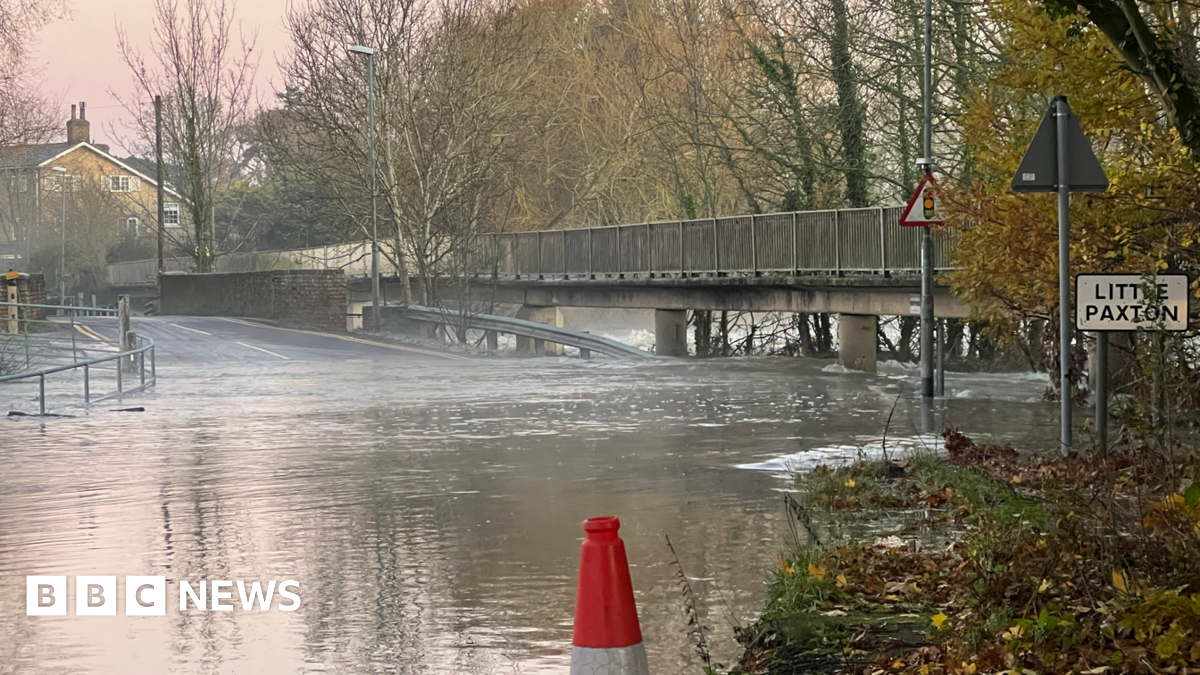
It is the river water flood risk that is critical. The Great Ouse floods at least once most winters, see for example this report for the aftermath of Storm Bert last November:


A road which has been damaged twice this year due to flooding has been closed again after the nearby River Great Ouse burst its banks.

Little Paxton Bridge in St Neots, Cambridgeshire, was repaired and reopened in October after previous flooding exposed the old cobbles underneath the road.

Cambridgeshire County Council said its latest repair had been more substantial and would increase flood resilience.

Following Storm Bert, flood warnings remain in place for areas close to the River Great Ouse at Wyboston, Eaton Socon, Eynesbury, Eaton Ford and St Neots.

The top of your map shows where the Great Ouse floods in Riverside Park between St Neots and Eaton Socon, and at Wyboston. It also shows how the land between the river and the A1 at Tempsford is almost entirely in the river water flood area, as is much of the land between the A1 and the ECML. None of the land that is blue on your river water flood map is suitable for building.

Nearly all of the land that is suitable for building is east of the ECML. It is basically a triangle bounded on the south east by the Sandy ridge (Everton and Woodbury are on the north west face of this) and in the North East by Hen Brook (in the top right corner of your map), with the eastern apex at Abbotsley.

Always thought that EWR should link with the ECML to provide a direct Cambridge-Huntingdon service.
Totally unnecessary. Huntingdon-Cambridge has recently had a huge investment on the A14 and is only a short distance from the end of the guided busway in St Ives. The Cambridge-Huntingdon bus service is 3bph on route B plus 1bph on route T1, and the B would be higher frequency if Stagecoach could recruit more drivers.

Secondly there should be an Alconbury station, just north of Huntingdon, where this new service can terminate, alongside making the semi-fast GN services all-day, and running to Alconbury Weald instead of Peterborough.
I like the idea of a station at Alconbury Weald. But there are significant issues, mainly to do with Peterborough. Huntingdon-Peterborough is a big flow, 117k one way journeys. For each they are number 2 station for the other. Huntingdon-Peterborough is bigger than all the local flows into Cambridge, apart from Ely and Royston. Then there is the 2 track section at Holme Fen and the traincrew and carriage sidings being at Peterborough. A lot of conflicting objectives that are difficult to balance.

Regarding Tempsford, it should be a high-density linear development that merges Sandy and St Neots into a single conurbation.
This won't work because Sandy and St Neots are almost entirely west of the ECML, whereas Tempsford New Town will be almost entirely east of the ECML. It is also important to consider that the St Neots town centre, Eaton Ford and Eaton Socon are all a long way from the railway. There are also issues of identity to consider: St Neots in particular has a fierce independent streak with a big budget town council and a long standing tradition of electing independent councillors. St Neots isn't going to be swallowed by Tempsford New Town.
 

duffield

Established Member
Joined
31 Jul 2013
Messages
3,305
Location
East Midlands
I think that we need to address the issue that renting is seen as a sub-optimal situation. For many people on the continent, renting is just the way it is. You've already mentioned strong tenant protection laws and I think this, or lack thereof, is what prevents people in the UK adopting a "renting culture". Quite simply, people are averse to renting because there's little long-term security. People don't make long-term plans when there's a risk that you'll have to up-sticks and move somewhere else in six month's time.

I don't see why we shouldn't learn from our continental neighbours.
Surely a major reason for buying rather than renting is that, once you have (finally) paid off the mortgage you own your home, whereas after decades of paying rent you do not!
Despite having a fairly decent pension and a modest lifestyle I'd now be burning through my savings rapidly if I was paying rent rather than having paid off my mortgage.
 

158756

Established Member
Joined
12 Aug 2014
Messages
1,629
Totally unnecessary. Huntingdon-Cambridge has recently had a huge investment on the A14 and is only a short distance from the end of the guided busway in St Ives. The Cambridge-Huntingdon bus service is 3bph on route B plus 1bph on route T1, and the B would be higher frequency if Stagecoach could recruit more drivers.


I like the idea of a station at Alconbury Weald. But there are significant issues, mainly to do with Peterborough. Huntingdon-Peterborough is a big flow, 117k one way journeys. For each they are number 2 station for the other. Huntingdon-Peterborough is bigger than all the local flows into Cambridge, apart from Ely and Royston. Then there is the 2 track section at Holme Fen and the traincrew and carriage sidings being at Peterborough. A lot of conflicting objectives that are difficult to balance.

Investment in the A14 is all well and good but Cambridge has major traffic problems. Public transport links between Huntingdon and Cambridge are pretty awful despite all the money spent on the busway. The "B" takes 1.5 hours, far too slow to achieve any significant modal share. The T1 is much quicker but has only recently been introduced, and only runs hourly with no Sunday service.

There is a lot of potential for rail from St Neots and Huntingdon to Cambridge, I know the ECML is not flush with capacity but it seems a shame there is not more interest in this market for EWR. Obviously there would be the option to change trains at Tempsford, but that will only ever be a limited market. Tempsford could also be used as a parkway for some journeys, but the larger the new town gets the more hassle it'll be to get there.
 

Magdalia

Established Member
Joined
1 Jan 2022
Messages
7,443
Location
The Fens
Investment in the A14 is all well and good but Cambridge has major traffic problems. Public transport links between Huntingdon and Cambridge are pretty awful despite all the money spent on the busway. The "B" takes 1.5 hours, far too slow to achieve any significant modal share. The T1 is much quicker but has only recently been introduced, and only runs hourly with no Sunday service.

There is a lot of potential for rail from St Neots and Huntingdon to Cambridge, I know the ECML is not flush with capacity but it seems a shame there is not more interest in this market for EWR. Obviously there would be the option to change trains at Tempsford, but that will only ever be a limited market. Tempsford could also be used as a parkway for some journeys, but the larger the new town gets the more hassle it'll be to get there.
The guided busway isn't ideal but it is what we have on the Huntingdon-Cambridge axis. Drivers in the Huntingdon area can use Park and Ride at either end St Ives or Trumpington. Between Bedford and Cambridge the EWR intermediate stations at Tempsford and Cambourne are primarily about serving new development not existing settlements, but both can also be railheads for St Neots and Huntingdon, as they will have good access off the A421.
 

md2016

Member
Joined
3 Feb 2023
Messages
48
Location
Haddenham
You'd think Taplow would be an obvious place for a new town. On the Elizabeth line, near the M4, a genuinely nice place to live and with lots of poorly used land
 

Magdalia

Established Member
Joined
1 Jan 2022
Messages
7,443
Location
The Fens
You'd think Taplow would be an obvious place for a new town. On the Elizabeth line, near the M4, a genuinely nice place to live and with lots of poorly used land
The Centre for British Progress have looked at Taplow too see here:


New Towns for a New Generation​

For new towns to drive economic growth and benefit workers, they must be built to give access to high wage jobs, not as disconnected settlements. Along with urban extensions to high wage cities including York and Cambridge, and transport-driven regeneration in Manchester and Birmingham, there are promising locations near Elizabeth Line stations – particularly the underused land with low biodiversity around Taplow.
January 19, 2025
Kane Emerson Pedro Serôdio
 

Non Multi

Member
Joined
11 Dec 2017
Messages
1,192
You'd think Taplow would be an obvious place for a new town. On the Elizabeth line, near the M4, a genuinely nice place to live and with lots of poorly used land
It would be an enlarged village mainly to the south of the existing village and nothing more, mostly on land IIRC that was previously used for gravel extraction. It's currently used by wild deer and cattle to graze, or for public recreation. Any expansion eastwards would not be within short walking distance from the railway station.

The green area outlined on the website includes the current residential area, allotments, plus sites used for commercial/industrial estates, civil aircraft navigation, water treatment and farmland used for dairy cattle.

The retail park pictured in the Labour Think Tank's post is extremely well used since it's redevelopment a decade ago. Closure would be devastating for those employed there and the families that rely on them.

Due to the gravel extraction, some of the land is on a steep gradient so bike commuters would get a daily work out, an e-bike would be an option but remember most ebikes are banned from TfL trains.

New builds are priced at an absolute premium for the South East due to the location (plus proximity of good secondary schools, jobs and Heathrow), so generally unaffordable for first time buyers. IIRC the recent new build estate at Taplow Riverside/Skindles prices were between £500k - £1million+ depending on the property. It may be however a great opportunity for the banks and BlackRock.

Furthermore, government would need to give Taplow back their GP Surgery as well, the Burnham surgery (which is the one used by Taplow residents) can barely cope as it is. There is one small primary school in the village.

Public transport to Taplow village itself (not the station or the A4) is poor compared to neighbouring areas, a Bucks council tendered Tuesday & Friday 2 return trip bus service between Maidenhead and Slough via Taplow, Dorney and Eton. Car ownership would be as usual, an absolute necessity and would significantly increase traffic on the local A roads and pressure on local parking.

Sorry to be largely negative, but the Think Tank's post paints an overly positive picture on residential construction there when the reality would be somewhat different.
 
Last edited:

renegademaster

Established Member
Joined
22 Jun 2023
Messages
2,227
Location
Croydon
GPs are always a chicken and egg kind of situation. Nimbys get developments blocked for not including a doctor's facility, but no GP will set up shop until enough move in. GP can use anywhere for their practices, mine is in an old 2 up 2 down, i don't know how difficult getting planning permission to convert a residential property to a clinic is however.
 

The exile

Established Member
Joined
31 Mar 2010
Messages
9,503
Location
Somerset
GPs are always a chicken and egg kind of situation. Nimbys get developments blocked for not including a doctor's facility, but no GP will set up shop until enough move in. GP can use anywhere for their practices, mine is in an old 2 up 2 down, i don't know how difficult getting planning permission to convert a residential property to a clinic is however.
Surely a solution here would be to require developers of large scale developments in areas currently lacking in certain facilities like gp and dentists surgeries (but also post offices and the like) to be required to build suitable accommodation to be provided rent-free up until the point at which a predetermined population increase has been reached (I’d add + 1 year to avoid the “cliff edge”. There’d need to safeguards to avoid an existing facility moving from elsewhere to get the free rent, of course.
 

Merle Haggard

Established Member
Joined
20 Oct 2019
Messages
3,991
Location
Northampton
Surely a solution here would be to require developers of large scale developments in areas currently lacking in certain facilities like gp and dentists surgeries (but also post offices and the like) to be required to build suitable accommodation to be provided rent-free up until the point at which a predetermined population increase has been reached (I’d add + 1 year to avoid the “cliff edge”. There’d need to safeguards to avoid an existing facility moving from elsewhere to get the free rent, of course.

Providing premises is the easier bit.

Forty plus years ago, where the area I live was developed, a GP surgery building was provided. It now has 6,619 registered patients and has two GPs, who each work half a week. You might be able to guess what level of service is provided if you're ill, but there is a very nice building.
 

The exile

Established Member
Joined
31 Mar 2010
Messages
9,503
Location
Somerset
Providing premises is the easier bit.

Forty plus years ago, where the area I live was developed, a GP surgery building was provided. It now has 6,619 registered patients and has two GPs, who each work half a week. You might be able to guess what level of service is provided if you're ill, but there is a very nice building.
True - but that’s the only bit that the developers can influence. Since I doubt there are any seriously undersubscribed GP surgeries anywhere in the UK (if there are, it begs the question “what’s wrong with them?”) using lack of facilities as a reason for turning down development is effectively saying there should be no development anywhere.
 

AlastairFraser

Established Member
Joined
12 Aug 2018
Messages
4,205
It would be an enlarged village mainly to the south of the existing village and nothing more, mostly on land IIRC that was previously used for gravel extraction. It's currently used by wild deer and cattle to graze, or for public recreation. Any expansion eastwards would not be within short walking distance from the railway station.

The green area outlined on the website includes the current residential area, allotments, plus sites used for commercial/industrial estates, civil aircraft navigation, water treatment and farmland used for dairy cattle.

The retail park pictured in the Labour Think Tank's post is extremely well used since it's redevelopment a decade ago. Closure would be devastating for those employed there and the families that rely on them.

Due to the gravel extraction, some of the land is on a steep gradient so bike commuters would get a daily work out, an e-bike would be an option but remember most ebikes are banned from TfL trains.

New builds are priced at an absolute premium for the South East due to the location (plus proximity of good secondary schools, jobs and Heathrow), so generally unaffordable for first time buyers. IIRC the recent new build estate at Taplow Riverside/Skindles prices were between £500k - £1million+ depending on the property. It may be however a great opportunity for the banks and BlackRock.

Furthermore, government would need to give Taplow back their GP Surgery as well, the Burnham surgery (which is the one used by Taplow residents) can barely cope as it is. There is one small primary school in the village.

Public transport to Taplow village itself (not the station or the A4) is poor compared to neighbouring areas, a Bucks council tendered Tuesday & Friday 2 return trip bus service between Maidenhead and Slough via Taplow, Dorney and Eton. Car ownership would be as usual, an absolute necessity and would significantly increase traffic on the local A roads and pressure on local parking.

Sorry to be largely negative, but the Think Tank's post paints an overly positive picture on residential construction there when the reality would be somewhat different.
And a lot of the land is low-lying and potentially susceptible to flooding from the nearby Thames.
 

renegademaster

Established Member
Joined
22 Jun 2023
Messages
2,227
Location
Croydon
and dentists surgeries (but also post offices and the like) to be required to build suitable accommodation to be provided rent-free u
I doubt developers make enough margins to cover this, therefore it would just kill off private development and housebuilding to near 0
 

HSTEd

Veteran Member
Joined
14 Jul 2011
Messages
20,396
If you are going to impose such restrictions on developers in an attempt to get more support for development (which personally I think is futile, but there we go), I would suggest we'd have to do a ground up estimate on actual future needs for such facilities.

Estates near where I grew up were provided with shops and the like that promptly closed due to lack of demand.

eCommerce and motorised transport (be it car or even e-bike) has rendered ultra local facilities like shops far less economic than they once were. Especially with steadily escalating labour costs, a trend which is likely to accelerate in future due to demographic issues.
 

Top