
Bletchleyite
Veteran Member
Network Rail Wessex route have announced that Crewkerne station will close from Monday 28th July until further notice to improve punctuality as a result of a four mile long 40mph TSR in place west of Salisbury due to dry track beds.
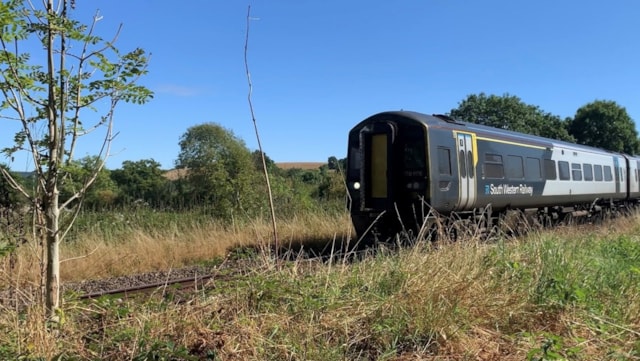
Plan ahead – buses to serve Crewkerne station from Monday 28 July due to dried out railway embankments
South Western Railway services between London Waterloo and Exeter St Davids will not call at Crewkerne from Monday 28 July, until further notice Rail replacement bus services will operate between Yeovil Junction and Axminster in both directions, calling at Crewkerne Dried out railway embankments...www.networkrailmediacentre.co.uk
As the station is on the edge of town, a stop nearer town would to some extent offset the inconvenience of the change. It might mean them needing to register it as a local bus service, though?
Anyone driving to the station will probably just drive to a different one during the period of closure.
I honestly think they'd be better running a 2 hourly service west of Yeovil with plenty of padding, the problem with the West of England line (well, one of the many problems) is that there really isn't any margin for error with the passing loops, an example, in the past twelve months I don't think I've departed from Pinhoe on the up without being delayed by a down train, admittedly it's mostly 1-4 minutes, but its just an example of how tightly timed everything is along there.
Skipping Crewkerne isn't going to go down well, we're talking of a relatively busy station with a fair catchment area that could potentially be train-less for months if the weather stays dry.
Indeed - the idea of extending the double track to run... exactly the same service as today is never going to find it easy to demonstrate value for money... Yes, performance is obviously a meaningful benefit, as is being able to flex the timetable structure slightly to accommodate constraints elsewhere. But it's still hard to show that many tens of millions of pounds are well spent on that.
A slight increase to permissible speeds might be easier to demonstrate value from, as you may be able to get all the same benefits only with saving three lots of half a minute in various places along the single line. However to be realistic this would need several sections of at least a few kilometres where there are no level crossings or risky earthworks / structures. I suspect such stretches just don't exist along the parts where the time needs to be saved. You may also only see this benefit once modern rolling stock is introduced to the line, which is still years and years off.
The current 158/9s are about to commence a C6 which will give 8 years more service, and they’ll then be 40 years old when next due a C6.
The proposed doubling on the WofE route in NR studies is to provide an all-day half-hourly service west of Axminster / Honiton, and east of Yeovil, plus resilience for GWR diversions, which is where improvements between Yeovil and Axminster are required. That’s not the same service, though there would, of course, be performance benefits.
They all justify 6 cars, but the performance will still fall apart with skipping Crewkerne, so now there will be late trains and no trains for Crewkerne, there's also no college kids for 6 weeks.
A train every 2 hours isn't going to cut it, but one every 90 minutes would be better, it's just a question of would that be good enough to impact the whole line.
As I said by cutting from 1tph with 6 coaches to 1 train every 90 minutes you might be able to run the trains as 9 coaches long.
(Train of 6 coaches with a 4.5 hour round trip between Exeter and Salisbury at an hourly frequency requires 9 sets, change that to 90 minutes and you could run all the services as 9 coaches - assuming that the 2tph frequency is retained Waterloo to Salisbury).
You could potentially see if there's scope for extra services at the Exeter end, although that would either require some of the through trains to be shorter and/or to use trains which otherwise would be sat idle during the off peak and/or GWR to run (say extend some of the Okehampton services).
If you could get a 60 minute frequency at the western end, then you could look to run some extra buses between Honiton and Yeovil to improve local connections (anyone heading to London would likely wait for the next service or make sure they're on the earlier service).
Much as I've shouted in favour of "Takt" before, I think on lines like this (see also the Borderlands line) it is more important to offer a decent service than to run clockface particularly in these days of journey planners. Thus I think this idea of running through every 90 minutes with a longer train could be a good one.
Any other thoughts?


