stevieinselby
Established Member
GOOD!However it does basically preclude a 3+2 layout

GOOD!However it does basically preclude a 3+2 layout
Agreed, stepping up to the train is by far the cheapest solution. It makes much more sense to solve the problem intermittently than to sub optimise all our rail vehicles.An example of a step-free alternative is having one vehicle with level boarding (and having all the accessibility related stuff in that vehicle) rather than the whole train if that leads to an overall more practical train design. Or maybe two on long trains like Thameslink.
Requiring every door to be step free is equivalent to banning stairs at stations. There are advantages of stairs - they move able bodied people more quickly than lifts. So you have both stairs and lifts.
There are advantages of high floor trains/trams - ease of putting stuff underneath and a flat floor throughout. So you can have both low floor and high floor coaches. I still think the original Sheffield design is the best accessible tram design overall that there has ever been.
Nobody is seeking to ban double decker buses. You just put the accommodation for those who can't climb stairs downstairs.
Regarding stopping points the humps on Thamslink look to be at least 10m long so they are not a tiny target to aim for even if manually driven.We are, quite rightly, moving towards having step-free access to the platform at every station, albeit slowly. That doesn't mean removing staircases and escalators, it doesn't even mean building new stations without them, but it does mean providing step-free alternatives. "Most people can manage" isn't good enough if you're one of the people who can't. And yes, I understand that with legacy infrastructure we can't fix everything overnight, but the least we can do is to ensure that all new builds – whether that's stations or trains – are compatible with step-free access through the current standards.
Stopping points, train formations and gauge clearance.
Thameslink trains are controlled by computer through the core section, which means they will always stop in exactly the same place. That's essential if you want to have humps on the platform lining up with the doors. Outside the core section, where trains are controlled by drivers, they can't guarantee the stopping point and so those humps aren't used.
Humps only work when every train has the same formation, so that the designated accessible area(s) will always align with the hump(s) on the platform. If a station will be served by different train formations and configurations (whether that's a different number of carriages, end doors vs 1/3-2/3, 20m carriages and 23m carriages) then humps that line up for one train won't line up for the next.
You need to have some gap between the platform edge and the train body. Where all trains are passenger trains stopping at the station – as is the case on the Thameslink and Elizabeth Line cores and on the Underground – you can get away with a small gap, because trains will only be moving slowly and so they will have a tight kinematic envelope. As soon as you have freight or fast trains coming past the platform, you need a bigger gap, because at speed the train will wobble and bounce more and there would be a high risk of it clipping the platform if it was set up to be level with and adjacent to the train doorway. While that risk is less with a hump than a full length platform, it would still be a problem. And the gap you need to leave at 1100mm (typical train door height) is wider than the gap you need to leave at 915mm (standard platform height) because of the shape of the train profile, creating bigger problems any time you are using a train without a gap-filler.
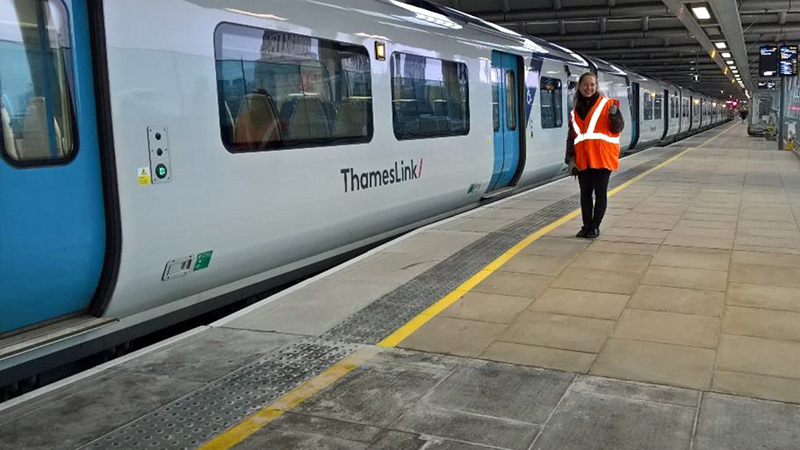
At last, somebody has corrected the wrong assumption developing in this thread, that raised areas of platforms (known as 'Harrison Humps') can only work where all stopping trains are identical. The stations through the TL core are used by 8-car class 700/0s and 12-car class 700/1s. They provide level access to the two inner pairs of doors spanning the centre two cars, (4&5 for the /0s and 6&7 for the/1s).Agreed, stepping up to the train is by far the cheapest solution. It makes much more sense to solve the problem intermittently than to sub optimise all our rail vehicles.
== Doublepost prevention - post automatically merged: ==
Regarding stopping points the humps on Thamslink look to be at least 10m long so they are not a tiny target to aim for even if manually driven.
We only really need 1 set of accessible doors per train, I would have thought that it is not particularly difficult to get multiple train formations to be able to stop so that a single set of doors is adjacent to the raised section of platform.
The gauge clearance issue is more difficult, but I would have thought that fitting a set of mechanical gap fillers to one/two sets of doors per train would be cheaper than procuring low floor trains and less annoying than sloped and stepped floors on the inside.
The 700 solution is better than that, - the two pairs of doors are in separate 20m cars with a wide level-floored gangway between the two.I think I'd ideally say two sets of doors because door failures can and do occur. Fortunately it's viable, at least on 24m vehicles, to have two sets of doors in a low floor between-bogies drop section and still have an accessible toilet, a couple of wheelchair spaces and two or three seating bays in that length.
The 700 solution is better than that, - the two pairs of doors are in separate 20m cars with a wide level-floored gangway between the two.
It requires the trains to be designed specifically for that platform layout. Yes, Thameslink manage it because they have two types of fixed-formation trains and so they could design the trains and the stop boards in such a way that the accessible doors would line up with the humps for both 8- and 12-car sets.At last, somebody has corrected the wrong assumption developing in this thread, that raised areas of platforms (known as 'Harrison Humps') can only work where all stopping trains are identical. The stations through the TL core are used by 8-car class 700/0s and 12-car class 700/1s. They provide level access to the two inner pairs of doors spanning the centre two cars, (4&5 for the /0s and 6&7 for the/1s).
My post was specifically referring to the inferences that TL trains need to identical, pointing out that about half of the class 700s are 80m longer than the rest yet level access is achieved with both sub-classes.It requires the trains to be designed specifically for that platform layout. Yes, Thameslink manage it because they have two types of fixed-formation trains and so they could design the trains and the stop boards in such a way that the accessible doors would line up with the humps for both 8- and 12-car sets.
Now try Doncaster, where the same platform can be used by 2-car class 150s; 2- and 3-car class 158s; 3-car class 170s; 3-car class 185s; 4-, 5-, 4+4- and 4+5-car class 22xs; 5-, 9- and 5+5-car class 80xs; IC225 sets; and in the future 10-car class 897s and who knows what else! Where are you putting the humps, and the accessible portion of the train?
Level boarding is a platform issue, as long as we have multiple heights on some routes. No single train height can fix that.
Maybe it might be possible to achieve a 914mm floor height with a level floor throughout in the future, but until then, the relatively low costs of humps and improved signage might be the most practical way forward.Aside from the Lizzie core and HS2 the standard is 915mm above rail level. If we order all new stock to suit that then the platforms can be brought in line over time.
I can think of a solution to door failure that that's 2-3 minutes away on Thameslink!I think I'd ideally say two sets of doors because door failures can and do occur. Fortunately it's viable, at least on 24m vehicles, to have two sets of doors in a low floor between-bogies drop section and still have an accessible toilet, a couple of wheelchair spaces and two or three seating bays in that length.
The hump is placed in one position, the stop position is generated by an Android app on a tablet using augmented reality or an off the shelf HUD. I used to have a HUD on my 2014 BMW so this is not a particularly novel or expensive solution.It requires the trains to be designed specifically for that platform layout. Yes, Thameslink manage it because they have two types of fixed-formation trains and so they could design the trains and the stop boards in such a way that the accessible doors would line up with the humps for both 8- and 12-car sets.
Now try Doncaster, where the same platform can be used by 2-car class 150s; 2- and 3-car class 158s; 3-car class 170s; 3-car class 185s; 4-, 5-, 4+4- and 4+5-car class 22xs; 5-, 9- and 5+5-car class 80xs; IC225 sets; and in the future 10-car class 897s and who knows what else! Where are you putting the humps, and the accessible portion of the train?

For a Regional train, I think the 755 is an enormous upgrade on anything before, I think it is efficient, modern, very pleasant inside and delivers on anything I’d expect for the routes they work.
For a supposedly “Intercity” train (according to Greater Anglia’s branding anyway, and yes I know it’s only a 100 minute journey to Norwich but the point is people keep claiming they’d be better alternatives to the 80x which I think is ludicrous), the 745 is underwhelming at best.
The 745s are far better trains than the 80x. Yes I know some people suffer from Vestibule Disease. The ride is much better, the build quality is far far better than an 80x, and in general the travel experience is better on a 745 than an 80x.I think people lump the 745s and 755s together too much and heap praise on both where, in my view, only the 755 deserves it.
For a Regional train, I think the 755 is an enormous upgrade on anything before, I think it is efficient, modern, very pleasant inside and delivers on anything I’d expect for the routes they work.
For a supposedly “Intercity” train (according to Greater Anglia’s branding anyway, and yes I know it’s only a 100 minute journey to Norwich but the point is people keep claiming they’d be better alternatives to the 80x which I think is ludicrous), the 745 is underwhelming at best.
The 745s are far better trains than the 80x. Yes I know some people suffer from Vestibule Disease. The ride is much better, the build quality is far far better than an 80x, and in general the travel experience is better on a 745 than an 80x.
Secondly 745s have buffets and vaguely comfortable seats and if they were bi-mode units, they would be perfect since there are no underfloor dissel engines.
Level boarding and large doors are still useful for intercity passengers, especially given more intercity passengers have heavy luggage or pushchairs, and a 745 is far easier for them than any other intercity train.
Precisely. Brilliant short haul & multi stop train that shows 730/19x etc how it should be, but not suited to ECML/WCML. As for whether Norwich should be IC at all, it’s broadly comparable to London-Bristol.This seems fair - as a regional train the 755 is pretty amazing
Bristol benefits from services to the Welsh capital and beyond. London to Brum benefits from services north of the city yet something like an improved 730 or a 444 style ac EMU, (maybe a 397 with it's major faults removed!), as @Bletchleyite implies.Precisely. Brilliant short haul & multi stop train that shows 730/19x etc how it should be, but not suited to ECML/WCML. As for whether Norwich should be IC at all, it’s broadly comparable to London-Bristol.
Wonder what they would have been called instead of ‘Clactons’? And as part time summer SO Norwich units, a fine predecessor for 755s. (Back on topic!Had the original modernisation plan beef better followed, the southern ECML would have had the 309s
 )
)As they were primarily offered for express services to York, I imagine just 'Yorkies', not sure one of our mods would name themselves after a boring EMU.Wonder what they would have been called instead of ‘Clactons’? And as part time summer SO Norwich units, a fine predecessor for 755s. (Back on topic!

As they were primarily offered for express services to York, I imagine just 'Yorkies', not sure one of our mods would name themselves after a boring EMU.
Mk1s with cabs and power bogies. Simple. But always the most popular trains amongst Colchester line commuters. The 4BINs were a foul replacement and the Norwichs got the Colchester contingent instead.Boring maybe, but probably the best-designed long distance passenger interior of the Mk1 and Mk2 era.
The 4BINs were a foul replacement
Hence my RUK login, the GEML doesn't have the smoothest track, (in those days much of it jointed), but the Commonwealth bogies certainly made 100mph a comfy ride.Boring maybe, but probably the best-designed long distance passenger interior of the Mk1 and Mk2 era.


... in your opinion.The Greater Anglia Stadlers are by a long way the best current generation trains on the network. I'd far rather do Scotland - England in a Flirt (even a regional one!) than an 8xx.

The 745 is 125mph capable. However since only 100mph is needed for the GEML, it's a 100mph train.The whole thread is confused. Independent dimensions are all being mashed together.
Different service types - inter-city, regional, urban stopping - drive different passenger accommodation and door layout requirements. Different speed profiles drive different mechanical requirements which do in turn affect what is and isn't possible for the passenger accommodation. Then there are things like First Class, catering, seat comfort etc that are entirely down to operator specification and have nothing to do with 'the train' itself.
The Flirts in the UK are a good train for a relatively niche type of services. 100mph max, and in the case of the 755s, relatively low usage, non-intensive lines where you can afford to give train length over to power packs.
With the Class 745, the traction equipment takes up saloon space in a way an Aventra (100-110mph) does not. So level boarding comes at a cost of passenger capacity. For equivalent medium density 2+2 layout, the tapered bottom of the 745 makes it more cramped than say a Class 730. The rollercoaster floor and the traction equipment in coaches 6 and 7 of the 745 does make walking through the train more difficult. Over bogies, if you only want a ramp and have seats on a platform, you are OK in Standard Class, but in First Class, you are forced to have wasteful 1+1, or you have to have additional steps to create a flat floor to accommodate the normal 2+1.
We don't have a 125mph capable low floor Stadler in the UK so we can't make comparisons with any Class 80x types. Theoretically a UK version of the Smile could be ordered. Alternatively an Alstom Coradia Stream (like the NS ICNG) offers a similar product. Again, the same ramp / step compromises apply. I was on an ICNG doing Amsterdam - Antwerp - the First Class section over bogies was raised in its entirely in order to fit in 2+1 seating, whereas the equivalent Second Class section only had ramps and platforms. When you have rollercoaster floors like that people don't walk down the train, especially those with suitcases.
When you are in an urban environment like London's where you expect to carry crush loads, then every square metre of floor space becomes sacred and ramps are a no-no. Even if it's across a jacobs bogie, the seating platform is wider than the double seats leaving a very narrow ramped passageway. London's operating environment needs standing passengers' feet to be *under* the seat bases.
Then comes the age old platform / train interface. NS has retractable steps on their modern Sprinter fleet as standard, whereas SNCB seems to only bother with a fixed lower 'catch' step with their Desiro Mainlines. This suggests the financials and maintenance of those retractable steps aren't a trivial consideration. Having leapt across a number of large gaps on only moderately curvy Belgium platforms (Mechelen 11/12, Brussels-Luxemberg), I'm afraid I agree with RSSB's preference towards a vertical step and a smaller horizontal gap, especially in our 915mm platform height context.