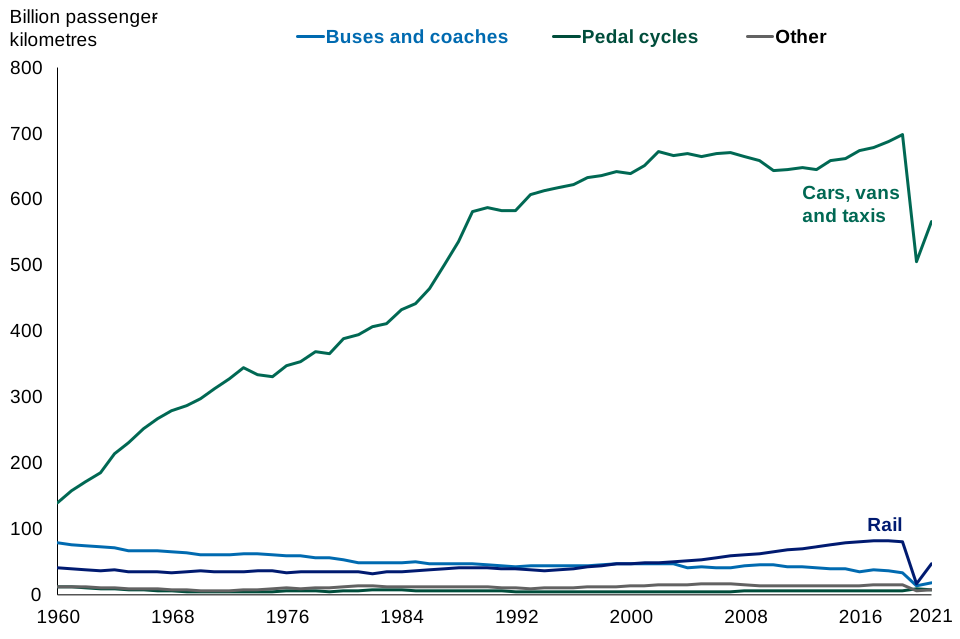
If a source mentions road wear they are clutching at straws trying to come up with a reason against EVS, it's an imperfect relationship but road wear approximates to the fourth power of axle loading. Ergo cars don't really matter, it's heavier vehicles doing the vast majority of road wear, lorries on motorways, buses in towns tractors in the country.
The Conversation and the Guardian represent world views where what they want is people to make sacrifices to achieve their policy goals. What they hate is when a technological fix comes along and allows people to keep doing something without impact or even do more of it. They also fully embrace the "stasis fallacy" and "everythingism" which demands that all solutions must solve all problems immediately and we can never assume that some of the solutions will get better over time.
EVs solve local emissions, EVs powered by nuclear (and windmills if you must) solve climate change, self driving cars, planning reforms and road pricing solve local traffic noise issues and road capacity. LFP batteries solve cobalt mining issues, rare earths aren't a problem, sodium ion solves any issues with lithium being scarce, which it isn't anyway. Hydrogen reduction or direct electrolysis solve the direct production of CO2 from steel as would switching many of its applications to something less carbon intensive, like glass fibres or wood.
No one organisation can do all of that but demanding any one of those organisation curtails their business due to another bit of it not being ready only delays the point in time where all of the above is ready. People taking the Guardian or Conversation viewpoint are also the ones who delay the above happening or cede the lead in all the above to basically the totalitarian regime of China.
If you think EVs are a niche solution what's your solution to transport?
This is the reality of transport in the UK and for read across this is typical of all developed nations. There is no rich nation where cars don't have a share of passenger km over 50%.
There was no halcyon time when everybody cycled or used the train, there was just a time when people didn't travel nearly as much, didn't see or do as many things or had as many opportunities.
Cars only don't count on the impact of roads when it comes to the structural lifespan of the roads, they do count when it comes to the surfacing lifespan and other maintenance (reading of white lines). Yes each lorry still has an impact, but unless you've got a fairly high percentage of HGV's then large numbers of cars are still going require the roads to be maintained.
However, a fair amount of the focus on this thread had been about altering the impact from HGV movements and could there have been something done to improve rail freight.
Also one of the big issues with cars is congestion, swapping one car for another (especially if it's larger) isn't going to alter that. Even though there's some potential for efficiencies through self driving cars, mostly only when 100% of cars are self driving (although there would be some from needing to drive kids places - given the numbers driven to secondary school is fairly low the peak for impact isn't going to be that great). The way that other options (walking, cycling and public transport) fix this is by being far more efficient with the amount of space required to transport a given number of people.
For example a road needs to be running at 100% efficiency to transport 2,000 people by car on one lane of traffic, HS2 could do that with just 4tph (both allowing for typical vehicle loadings), in fact HS2 could carry the same number of people as a 4 lane motorway and still have spare capacity (for example increasing average rail loading from 50% to up to 70%), however few roads can actually carry 1,600 cars an hour per lane (motorways and other limited access roads being those which are able to manage it, although the very busy sections of roads, especially the M25, typically manage their very high daily numbers by being busy for longer than just the typical peak hours).
A single person in a car takes up about 2.5m of road width (allowing for travelling at lower speeds, a little more as speed increases) a cycle requires about 1.5m. Yes when a family of five travel in a car they shift the balance towards car travel, however average car occupancy is less than 1.5 people, so the numbers of people travelling with more than 3 people in a car is very low (for every car with 3 people in there's 4 cars with one person in, for every car with 5 people there's 8 cars with one person in).
If there's more rail capacity (although generally more rail frequency is more attractive) for all those single person trips then it would likely increase the efficiency of the roads. For example a road with 1,000 cars (750 with one person in, 200 with 3 in and 50 with 5 in) with an average car occupancy of 1.6 (which is higher than typical) could shift to a higher occupancy rate if 10% of the single occupancy cars moved to rail as that would give an occupancy rate if 1.65 if traffic volumes otherwise didn't change.
However, if that traffic to grow back to 1,000 vehicles and that was a mix of 3 (50 vehicles) and 5 people (25 vehicles) that would increase the occupancy rate to 1.8 people per car. Overall road travel would still be your highest percentage, yet rail would have seen increases, but there would be far more people travelling because the efficiency of the travel has been increased.
Likewise, no one has said that rail would be replacing road travel, just would it be better if there was more opportunity for rail travel to relieve the capacity constraints which the roads have rather than building more roads which would likely just alter where those constraints are (for example what impact does the LTC have on the need to implement Operation Stack and how does that compare to if we were to deliver a rail based option?).
Of course all of the above is fairly insignificant compared to the amount of space needed to store cars. Cycle parking can fit quite a lot more cycles into the space of 1 car, however when you then start accounting for the manoeuvring space as well then the amount is staggering.
A small car park for 12 cars could accommodate 180 cycles (more if you double stacked the cycles, but the upper levels of such attackers aren't as well used as the ground level parking). Even if every one of those cars was a 7 seater and every seat was used that's still only 84 people being moved by car, or less than half the number of people the cycles could carry. The reality would be typically 18 people across those 12 spaces, so 1/10th of the number being carried by the bikes.