• Our new ticketing site is now live! Using either this or the original site (both powered by TrainSplit) helps support the running of the forum with every ticket purchase! Find out more and ask any questions/give us feedback in this thread!

Is the 9bn Lower Thames Road crossing approval bad news for rail?

Status
Not open for further replies.

SynthD

Established Member
Joined
4 Apr 2020
Messages
2,034
Location
UK
While the train gauges permitted by a route are in the public sectional appendices, is there a third party websites that shows it in a better way? Openrailway.org does, among others, speed and track gauge.

But that still means heading across south London to the bridge north of Clapham Junction. Ripple Lane yard in Barking is another choice. Freight can congregate here, and stay with just OHLE. I think that Barking to the midlands is already suitable for containers, as it is the route to London Gateway port.
 
Sponsor Post - registered members do not see these adverts; click here to register, or click here to log in
R

RailUK Forums

HSTEd

Veteran Member
Joined
14 Jul 2011
Messages
20,320
Would you need to axe passenger trains? A 75mph freight would keep up with most of the passenger trains down there. I guess the West London line.could get cosy
A 75mph freight, which given the economics of the freight industry would almost certainly end up diesel hauled, is not going to fit well onto a railway operated by modern-ish EMUs with modern-ish EMU acceleration performance.
A Class 66 only has 2500hp real at-rail horsepower after all.

Traction electricity is now apparently more expensive than diesel for rail use after all.
 

Trainman40083

Established Member
Joined
29 Jan 2024
Messages
4,601
Location
Derby
While the train gauges permitted by a route are in the public sectional appendices, is there a third party websites that shows it in a better way? Openrailway.org does, among others, speed and track gauge.

But that still means heading across south London to the bridge north of Clapham Junction. Ripple Lane yard in Barking is another choice. Freight can congregate here, and stay with just OHLE. I think that Barking to the midlands is already suitable for containers, as it is the route to London Gateway port.
I guess the subject title might convey the crossing would make it easier for road to access Cover. Not sure there is a lot of space in Dover. But that port suggests freight to Europe. Isn't London Gateway more a deep sea port for shipping from around the World?
 

SynthD

Established Member
Joined
4 Apr 2020
Messages
2,034
Location
UK
I guess the subject title might convey the crossing would make it easier for road to access Cover. Not sure there is a lot of space in Dover. But that port suggests freight to Europe. Isn't London Gateway more a deep sea port for shipping from around the World?
The route to London Gateway is suitable for containers. As Ripple Lane is on this route, we know that it can be reached by containers. As the aim is to carry more freight by rail, I wonder what HS1 can do, as well as trying to put more through the non high speed lines to Folkestone.

How much of the freight that we would like to see move from road to rail is already in containers? Is it suitable for them, including the start and end of their journey?
 

The Ham

Veteran Member
Joined
6 Jul 2012
Messages
12,036
Was about to post the same thing. 1/3 of the cost of the LTC planning application...

But even if this was a success I don't think it would make the ferries much quieter. 16,000 lorries per day equates to around 320 trains per day. You would need several freight trains per hour to make a significant dent in the lorry numbers, and the existing mixed traffic routes to the tunnel wouldn't have that kind of spare capacity even if they widened them to W12 gauge.

Assuming running services for 16 hours a day (7am to 11pm) and 16,000 lorries is the total for both directions to reduce lorry movements by 10% you'd only need 1tph in each direction (each extra 10% wide be a further 1 train).

Yes it'll be impossible to get to 100% shifted by rail unless there was capacity to be able to cope with 10tph in each direction (and a significant change in shipping habits).

Each train would (based on the 50 lorries assumed above) roughly make one freight ferry 1/3 as busy (apparently they carry between 100 and 180 lorries)
 

Trainman40083

Established Member
Joined
29 Jan 2024
Messages
4,601
Location
Derby
Assuming running services for 16 hours a day (7am to 11pm) and 16,000 lorries is the total for both directions to reduce lorry movements by 10% you'd only need 1tph in each direction (each extra 10% wide be a further 1 train).

Yes it'll be impossible to get to 100% shifted by rail unless there was capacity to be able to cope with 10tph in each direction (and a significant change in shipping habits).

Each train would (based on the 50 lorries assumed above) roughly make one freight ferry 1/3 as busy (apparently they carry between 100 and 180 lorries)
I seem to recall when I read the report on gauge enhancement, they spoke of potential for 29,000 containers a year, from Europe.. Trains of containers would be best on more distant flows. Certainly nothing in Southern, maybe not Eastern England. Midlands, Yorkshire, North West or Scotland . Trying to recall the two main rail routes they would use in Kent. One was Maidstone. Doubtful container trains could operate morning/evening Peaks, but possibly could overnight.
 

MPW

Member
Joined
2 Dec 2021
Messages
268
Location
Orpington
Sir Peter Hendy absolutely loves buses. I am hopeful that means a new crossing would be used to greatly improve cross river transport connections, even if not in the format of rail which most of us on this forum would love to see.

The tunnel plans i have seen dont go into much detail on bus provision (maybe a more detailed paper does?). It's not obvious where a rail to bus interchange would best be placed for the new tunnel. Maybe it would actually be better to use the existing dartford crossing given the proximity of existing rail stations to the motorway on north (Purfleet, chafford hundred, even upminster) and south approaches (dartford, stone crossing, ebbsfleet). To include direct connections to main destinations either side (blue water, lakeside, town centres). Relieved capacity could be partly used towards bus priority lanes (if still needed).
 

DynamicSpirit

Established Member
Joined
12 Apr 2012
Messages
9,213
Location
SE London
Well looking at the detailed access of the route, there seems to be almost no access from any local roads to the new tunnel: It's basically a link from the A2 South-East of Gravesend to the M25, with one intermediate junction with the A13 NorthEast of Grays, but that junction is very much designed for traffic heading East towards Southend, not for traffic to/from Grays. Which explains the comments earlier in the threat that the new link is designed for long distance traffic. So it seems that, even if you have a car, the tunnel is not going to make it easy to drive from - say - Gravesend to Tilbury. That also means the new link is going to be useless for local buses, so any new bus routes are almost certainly going to be on the existing Dartford crossing. That probably does depend on putting in a dedicated bus lane on the Dartford Crossing - which would be a good way to ameliorate the impact of the new tunnel, but would be politically a very hard sell because it would mean removing a 'public' lane from the M25 right at one of its busiest points.
 

Peter Sarf

Established Member
Joined
12 Oct 2010
Messages
9,630
Location
Croydon
As I've said before, the issues isn't necessary the cost of the LTC but rather the impact of building it on other roads which will then get overloaded and need further spending to fix.


The issue isn't necessary the need for a growing economy, but rather having an economy of a size which can support the spending requirements of the population.

If we need a larger NHS budget as the population is getting less healthy than ours been in the past, we need a larger economy or to pay more taxes.

If we have an increasing number of people getting handouts from the government and not planning on working again, we need a larger economy or to pay more taxes.

(By the way, both of those are directly linked to an aging population, in that with a greater percentage of people over 65 than the past three population is getting generally less healthy, likewise you'd notice that anyone who gets the state pension fits within the category of "getting handouts from the government and not planning on working again" - and no paying NI isn't the government saving that amount for a pension payout, as general taxes paid for the things when they are paid)


The entire UK population could sit down for a picnic on a strip of land the width of a trio of 2 lane motorways which runs from north to south of this island, so I don't think we're at risk of that happening.

We're more likely to be at risk of running out of land by building yet more space for our inefficient little metal transport boxes. As to park the current number of cars owned in the UK you'd need 7 times the amount of space at 21 motorways with two lanes (assuming a standard car park layout within each carriageway and whilst that would leave enough space for two way traffic, the picnic also allows enough land allowance for people to come and go).

That's even though there's about half the number of cars as there are people (34 million cars vs 68 million people when rounded to the nearest million).
Thank you, a very interesting perspective on the space we humans use.
Sir Peter Hendy absolutely loves buses. I am hopeful that means a new crossing would be used to greatly improve cross river transport connections, even if not in the format of rail which most of us on this forum would love to see.

The tunnel plans i have seen dont go into much detail on bus provision (maybe a more detailed paper does?). It's not obvious where a rail to bus interchange would best be placed for the new tunnel. Maybe it would actually be better to use the existing dartford crossing given the proximity of existing rail stations to the motorway on north (Purfleet, chafford hundred, even upminster) and south approaches (dartford, stone crossing, ebbsfleet). To include direct connections to main destinations either side (blue water, lakeside, town centres). Relieved capacity could be partly used towards bus priority lanes (if still needed).
+
Well looking at the detailed access of the route, there seems to be almost no access from any local roads to the new tunnel: It's basically a link from the A2 South-East of Gravesend to the M25, with one intermediate junction with the A13 NorthEast of Grays, but that junction is very much designed for traffic heading East towards Southend, not for traffic to/from Grays. Which explains the comments earlier in the threat that the new link is designed for long distance traffic. So it seems that, even if you have a car, the tunnel is not going to make it easy to drive from - say - Gravesend to Tilbury. That also means the new link is going to be useless for local buses, so any new bus routes are almost certainly going to be on the existing Dartford crossing. That probably does depend on putting in a dedicated bus lane on the Dartford Crossing - which would be a good way to ameliorate the impact of the new tunnel, but would be politically a very hard sell because it would mean removing a 'public' lane from the M25 right at one of its busiest points.
It does make sense that buses utilising the Dartford Crossing is more useful than if they used the proposed Lower Thames Crossing. After all there is a lot more population and business close by either side of the Thames at the Dartford crossing. The Lower Thames Crossing is more or less in the middle of nowhere !. I used to live in Strood right where ther LTN would start and there was not much reason to go out NW along its route (save Hoo Junction !).
 

MatthewHutton

Member
Joined
17 Aug 2024
Messages
1,084
Location
Oxford
A 75mph freight, which given the economics of the freight industry would almost certainly end up diesel hauled, is not going to fit well onto a railway operated by modern-ish EMUs with modern-ish EMU acceleration performance.
A Class 66 only has 2500hp real at-rail horsepower after all.

Traction electricity is now apparently more expensive than diesel for rail use after all.
Only the fastest express services average meaningfully more than 70mph or whatever with stops.
 

DynamicSpirit

Established Member
Joined
12 Apr 2012
Messages
9,213
Location
SE London
Only the fastest express services average meaningfully more than 70mph or whatever with stops.

Also, unlike passenger services, there's no customer-convenience requirement for freight to be evenly spaced around the hour. If there's a gap between passenger services, it's probably not an issue for freight if you send, say, 4 freight trains in succession a few minutes after each other in the gap, all going at the same speed, and then nothing more for the next hour. I'm guessing that could make it easier to find paths?
 

MatthewHutton

Member
Joined
17 Aug 2024
Messages
1,084
Location
Oxford
Also, unlike passenger services, there's no customer-convenience requirement for freight to be evenly spaced around the hour. If there's a gap between passenger services, it's probably not an issue for freight if you send, say, 4 freight trains in succession a few minutes after each other in the gap, all going at the same speed, and then nothing more for the next hour. I'm guessing that could make it easier to find paths?
I think one of the challenges is that rail freight is never prioritised for investment. If you spent £100m on rail freight schemes there is probably a lot of low hanging fruit. One example would be https://ciltuk.org.uk/Portals/0/RailElectrification_Spreads.pdf?ver=2023-03-01-101049-347
 

HSTEd

Veteran Member
Joined
14 Jul 2011
Messages
20,320
Only the fastest express services average meaningfully more than 70mph or whatever with stops.
Average speed is only half the story though.

It doesn't matter if the freight train can match the average speed of the train when its desperately trying to crawl away from a signal and there is an EMU bearing down on it. Trains with different acceleration performance will "oscillate" inside their paths, and the size of those oscillations themselves reduce capacity.

For example:
On open track, the EMU accelerates away from the freight train, which means the freight train has another EMU bearing down from behind that it must stay ahead of.
At some point the EMU in front brakes to a stand at a station, sits there for several minutes, and then accelerates away. All the while the freight train bears down.

On average the trains might be going the same speed, but average spacing being greater than the achievable headway is not good enough. Spacing must be greater than the real headway, plus margin, at every single instant.
 

Trainman40083

Established Member
Joined
29 Jan 2024
Messages
4,601
Location
Derby
I think one of the challenges is that rail freight is never prioritised for investment. If you spent £100m on rail freight schemes there is probably a lot of low hanging fruit. One example would be https://ciltuk.org.uk/Portals/0/RailElectrification_Spreads.pdf?ver=2023-03-01-101049-347
You are right, rail freight isn't prioritised. If it were, the Haughley Junction, Felixstowe branch and Ely enhancements would have been done years ago. So, we don't expect much to change in Kent. Okay some freight might have used HS1, but there seems to be plans to increase passenger numbers. And HS1 only had one pair of loops, I think.
 

HSTEd

Veteran Member
Joined
14 Jul 2011
Messages
20,320

The Planner

Veteran Member
Joined
15 Apr 2008
Messages
19,687
Average speed is only half the story though.

It doesn't matter if the freight train can match the average speed of the train when its desperately trying to crawl away from a signal and there is an EMU bearing down on it. Trains with different acceleration performance will "oscillate" inside their paths, and the size of those oscillations themselves reduce capacity.

For example:
On open track, the EMU accelerates away from the freight train, which means the freight train has another EMU bearing down from behind that it must stay ahead of.
At some point the EMU in front brakes to a stand at a station, sits there for several minutes, and then accelerates away. All the while the freight train bears down.

On average the trains might be going the same speed, but average spacing being greater than the achievable headway is not good enough. Spacing must be greater than the real headway, plus margin, at every single instant.
Its much more nuanced than that and depends on a number of factors such as how far stations are apart, linespeed and the headway. If the second passenger train is following the freight, how does it catch it if the stopping pattern is the same? Vast majority of dwells are ½ or 1 minute, and a professional driver won't be chasing reds anyway.
 

MatthewHutton

Member
Joined
17 Aug 2024
Messages
1,084
Location
Oxford
Average speed is only half the story though.

It doesn't matter if the freight train can match the average speed of the train when its desperately trying to crawl away from a signal and there is an EMU bearing down on it. Trains with different acceleration performance will "oscillate" inside their paths, and the size of those oscillations themselves reduce capacity.

For example:
On open track, the EMU accelerates away from the freight train, which means the freight train has another EMU bearing down from behind that it must stay ahead of.
At some point the EMU in front brakes to a stand at a station, sits there for several minutes, and then accelerates away. All the while the freight train bears down.

On average the trains might be going the same speed, but average spacing being greater than the achievable headway is not good enough. Spacing must be greater than the real headway, plus margin, at every single instant.

On the Chiltern Mainline which has (old) DMUs and a top speed of 100mph a stop typically causes a 3 minute delay against a non stop train - that is 2 minutes to accelerate and decelerate and 1 minute dwell.

I believe when you have an intercity train they typically have a 2 minute dwell* so assuming somewhat better performance I would expect a stop at 125mph with an intercity train to have a 4 minute stop penalty against a non stop train.

On most of the network there aren’t enough services for that sort of delay to be an issue.

* And at the smaller stops I suspect by adopting at least some Asian practices like platform carriage markings and possibly platform edge doors that this time could be reduced somewhat.

== Doublepost prevention - post automatically merged: ==

That report makes rather optimistic assumptions on costs of electrification to justify its conclusions.
I suspect that if there was an effort to move towards continental European and Asian best practice that hitting “rather optimistic” costs could be achieved.

Also to be fair a lot of the low hanging fruit are freight only railways so there is probably more scope for longer closures etc to keep costs low.
 

Zomboid

Established Member
Joined
2 Apr 2025
Messages
2,292
Location
Oxford
I suspect that if there was an effort to move towards continental European and Asian best practice that hitting “rather optimistic” costs could be achieved.

Also to be fair a lot of the low hanging fruit are freight only railways so there is probably more scope for longer closures etc to keep costs low.
The biggest costs come from getting the necessary clearances, which means bridge rebuilds etc. Given that the big idea would be to run W12 gauge trains then some of them are probably fairly tight as they are. You can do some good with surge arresters etc, but there's not a silver bullet, and some bridges are going to need rebuilding.
 

The Ham

Veteran Member
Joined
6 Jul 2012
Messages
12,036
Like what was proposed here.
Multipurpose for freight and passengers.

Even if the cost was under estimated by a factor of 4 it would cost no more than LTC.

Likewise even at the lower end of their freight estimate (550,000 lorry movements moving to rail) that's almost (at 1,510 per day) 10% of the current lorry movements through the Kent departure points (quoted up thread as 16,000 per day).

That would reduce the need for the implementation of Operation Brock and Operation Stack (which the LTC would increase the need for), which are effectively symptoms that there's not suitable road traffic capacity (that may not be driving capacity, for example it could be the lack of suitable parking/queuing capacity).

They also cost money to implement as well as impacting the economy (some estimates put it at £250 million a day). The latter could, even if the government could only capture 10% of that value to fund the rail link, make the rail link a much better value to the government.

If you build a rail link at a cost of £10bn and each day that Operation Stack isn't in place the government captures £25 million you'd need 400 days of it not in use to cover the rail link costs. Clearly that's not going to happen in one year or even 5 years, but over (say) a 40 year period you'd have to be very brave to bet against that from happening.

That's without considering any other benefits the rail link produces.

Yes, 10% fewer lorries isn't going to stop it from ever being used, but at times when it's likely to be implemented (such as during the school holidays) the shift to rail might be a bit higher to avoid the impact on lorry travel from the implementation of Operation Stack.
 

MatthewHutton

Member
Joined
17 Aug 2024
Messages
1,084
Location
Oxford
Even if the cost was under estimated by a factor of 4 it would cost no more than LTC.

Likewise even at the lower end of their freight estimate (550,000 lorry movements moving to rail) that's almost (at 1,510 per day) 10% of the current lorry movements through the Kent departure points (quoted up thread as 16,000 per day).

That would reduce the need for the implementation of Operation Brock and Operation Stack (which the LTC would increase the need for), which are effectively symptoms that there's not suitable road traffic capacity (that may not be driving capacity, for example it could be the lack of suitable parking/queuing capacity).

They also cost money to implement as well as impacting the economy (some estimates put it at £250 million a day). The latter could, even if the government could only capture 10% of that value to fund the rail link, make the rail link a much better value to the government.

If you build a rail link at a cost of £10bn and each day that Operation Stack isn't in place the government captures £25 million you'd need 400 days of it not in use to cover the rail link costs. Clearly that's not going to happen in one year or even 5 years, but over (say) a 40 year period you'd have to be very brave to bet against that from happening.

That's without considering any other benefits the rail link produces.

Yes, 10% fewer lorries isn't going to stop it from ever being used, but at times when it's likely to be implemented (such as during the school holidays) the shift to rail might be a bit higher to avoid the impact on lorry travel from the implementation of Operation Stack.
There’s levelling up benefits to Kent and Essex too. Worth spending £10bn of public money to deliver 80 days worth of economic benefits over a period to those places.
 

Technologist

Member
Joined
29 May 2018
Messages
467
I don’t dispute that, yes I do with regards to the sources.
https://www.theguardian.com/business/2023/dec/01/do-electric-cars-have-problem-mining-for-minerals
(Whilst largely supportive, see bottom of article for bits surrounding human rights abuses)

https://theconversation.com/why-sur...ehicles-raises-environmental-red-flags-214808
That goes into their material and energy requirements, not just from manufacture.

https://theconversation.com/eco-fri...why-its-vital-to-cut-energy-demand-now-183567

Whilst the orders of magnitude of benefit can be massive, in theory, the size of the EVs are getting larger and eroding the road surface moreso. This will require more tarmac and bitumen for the surfaces (or something quasi-sustainable) to cope with our wants, not needs.

Human rights abuses - Chile salt lakes most prominent, water and wildlife.

I am not against EVs (rural areas could do with them), I am against their use as a blanket ‘solution’ to all our problems regarding transport.

If a source mentions road wear they are clutching at straws trying to come up with a reason against EVS, it's an imperfect relationship but road wear approximates to the fourth power of axle loading. Ergo cars don't really matter, it's heavier vehicles doing the vast majority of road wear, lorries on motorways, buses in towns tractors in the country.

The Conversation and the Guardian represent world views where what they want is people to make sacrifices to achieve their policy goals. What they hate is when a technological fix comes along and allows people to keep doing something without impact or even do more of it. They also fully embrace the "stasis fallacy" and "everythingism" which demands that all solutions must solve all problems immediately and we can never assume that some of the solutions will get better over time.

EVs solve local emissions, EVs powered by nuclear (and windmills if you must) solve climate change, self driving cars, planning reforms and road pricing solve local traffic noise issues and road capacity. LFP batteries solve cobalt mining issues, rare earths aren't a problem, sodium ion solves any issues with lithium being scarce, which it isn't anyway. Hydrogen reduction or direct electrolysis solve the direct production of CO2 from steel as would switching many of its applications to something less carbon intensive, like glass fibres or wood.

No one organisation can do all of that but demanding any one of those organisation curtails their business due to another bit of it not being ready only delays the point in time where all of the above is ready. People taking the Guardian or Conversation viewpoint are also the ones who delay the above happening or cede the lead in all the above to basically the totalitarian regime of China.

If you think EVs are a niche solution what's your solution to transport?

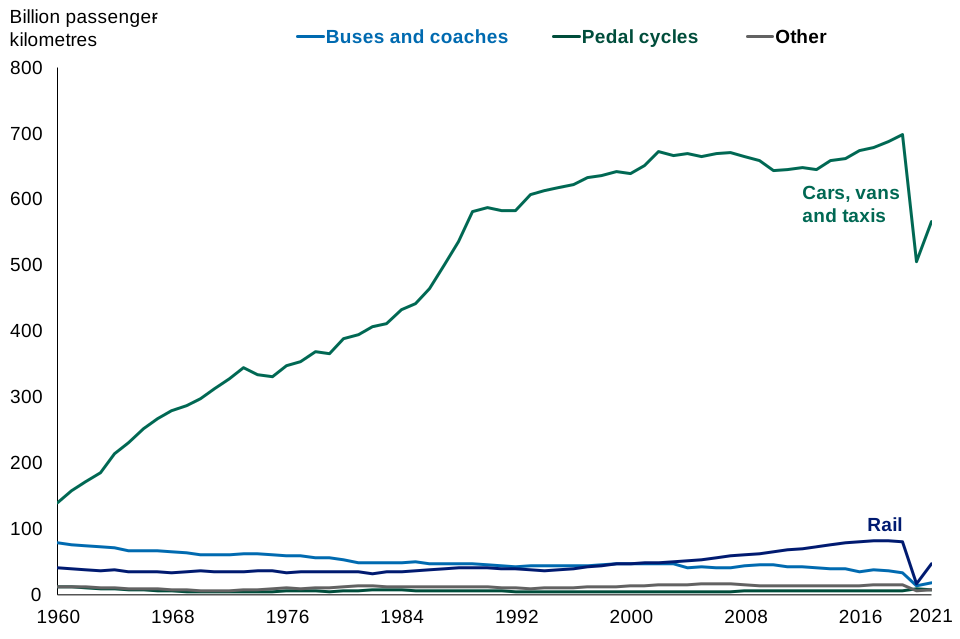
This is the reality of transport in the UK and for read across this is typical of all developed nations. There is no rich nation where cars don't have a share of passenger km over 50%.

02-image-2.svg


There was no halcyon time when everybody cycled or used the train, there was just a time when people didn't travel nearly as much, didn't see or do as many things or had as many opportunities.
 
Joined
2 Feb 2019
Messages
1,039
I find it hugely ironic that no public funding could be found to sustain the ferry but funds can be found for this incredibly expensive project.
The Government decision on 25 March was to give planning consent for the Lower Thames Crossing. There is no funding at present to build it and no guarantee there will be any funding to build it. Clearly the expectation is that the construction will be funded privately and tolls will be charged. If the private sector declines to provide funding there is no money to build it.
 

eldomtom2

On Moderation
Joined
6 Oct 2018
Messages
2,385
road pricing solve local traffic noise issues and road capacity
Road pricing solves those problems by reducing the number of people on the road, but elsewhere you're against the idea of taking measures to reduce the number of people driving.

Those are also some fairly strong accusations you're levelling at academics and journalists there...
 

HSTEd

Veteran Member
Joined
14 Jul 2011
Messages
20,320
A rail solution will almost inevitably come with substantial operational subsidies for the rest of time. Especially one that comes with substantial terminal handling costs (like forcing container shipment between Calais and North London instead of piggyback).


That will blow out its net life cycle cost to vastly in excess of the road crossing, which should at least cover operational costs with tolls.
 

DynamicSpirit

Established Member
Joined
12 Apr 2012
Messages
9,213
Location
SE London
A rail solution will almost inevitably come with substantial operational subsidies for the rest of time. Especially one that comes with substantial terminal handling costs (like forcing container shipment between Calais and North London instead of piggyback).

Would it? Remember we're talking - if I've understood previous posts correctly - in the tens of thousands of HGVs/day most of them travelling roughly the same route between Dover and the M25. A rail solution that absorbs even a fraction of that traffic would become a much more intensively used freight line than exists anywhere else in the UK, probably running numerous trains an hour. I'd be astonished if you couldn't run such a line at a reasonable profit. (But with the proviso that it would be a huge investment, and would require a big shift in the way we do freight, to containerise it and allow freight to be easily swapped from rail to lorry en route)
 

HSTEd

Veteran Member
Joined
14 Jul 2011
Messages
20,320
Would it? Remember we're talking - if I've understood previous posts correctly - in the tens of thousands of HGVs/day most of them travelling roughly the same route between Dover and the M25. A rail solution that absorbs even a fraction of that traffic would become a much more intensively used freight line than exists anywhere else in the UK, probably running numerous trains an hour. I'd be astonished if you couldn't run such a line at a reasonable profit. (But with the proviso that it would be a huge investment, and would require a big shift in the way we do freight, to containerise it and allow freight to be easily swapped from rail to lorry en route)
The problem is that you will get hit really hard by terminal costs. You will have to pay to lift the container (onto the train) in Calais, then lift it (off the train);again at the north end.

Even if you ignore your linehaul costs, the lifting costs are likely to make you uncompetitive with the road haulage.

This is a major reason that the Chunnel shuttle is a rolling highway rather than just a container route.
If you want to compete, I think you'd need a new railway that could take piggyback trains.
 

The Ham

Veteran Member
Joined
6 Jul 2012
Messages
12,036
If a source mentions road wear they are clutching at straws trying to come up with a reason against EVS, it's an imperfect relationship but road wear approximates to the fourth power of axle loading. Ergo cars don't really matter, it's heavier vehicles doing the vast majority of road wear, lorries on motorways, buses in towns tractors in the country.

The Conversation and the Guardian represent world views where what they want is people to make sacrifices to achieve their policy goals. What they hate is when a technological fix comes along and allows people to keep doing something without impact or even do more of it. They also fully embrace the "stasis fallacy" and "everythingism" which demands that all solutions must solve all problems immediately and we can never assume that some of the solutions will get better over time.

EVs solve local emissions, EVs powered by nuclear (and windmills if you must) solve climate change, self driving cars, planning reforms and road pricing solve local traffic noise issues and road capacity. LFP batteries solve cobalt mining issues, rare earths aren't a problem, sodium ion solves any issues with lithium being scarce, which it isn't anyway. Hydrogen reduction or direct electrolysis solve the direct production of CO2 from steel as would switching many of its applications to something less carbon intensive, like glass fibres or wood.

No one organisation can do all of that but demanding any one of those organisation curtails their business due to another bit of it not being ready only delays the point in time where all of the above is ready. People taking the Guardian or Conversation viewpoint are also the ones who delay the above happening or cede the lead in all the above to basically the totalitarian regime of China.

If you think EVs are a niche solution what's your solution to transport?

This is the reality of transport in the UK and for read across this is typical of all developed nations. There is no rich nation where cars don't have a share of passenger km over 50%.

02-image-2.svg


There was no halcyon time when everybody cycled or used the train, there was just a time when people didn't travel nearly as much, didn't see or do as many things or had as many opportunities.

Cars only don't count on the impact of roads when it comes to the structural lifespan of the roads, they do count when it comes to the surfacing lifespan and other maintenance (reading of white lines). Yes each lorry still has an impact, but unless you've got a fairly high percentage of HGV's then large numbers of cars are still going require the roads to be maintained.

However, a fair amount of the focus on this thread had been about altering the impact from HGV movements and could there have been something done to improve rail freight.

Also one of the big issues with cars is congestion, swapping one car for another (especially if it's larger) isn't going to alter that. Even though there's some potential for efficiencies through self driving cars, mostly only when 100% of cars are self driving (although there would be some from needing to drive kids places - given the numbers driven to secondary school is fairly low the peak for impact isn't going to be that great). The way that other options (walking, cycling and public transport) fix this is by being far more efficient with the amount of space required to transport a given number of people.

For example a road needs to be running at 100% efficiency to transport 2,000 people by car on one lane of traffic, HS2 could do that with just 4tph (both allowing for typical vehicle loadings), in fact HS2 could carry the same number of people as a 4 lane motorway and still have spare capacity (for example increasing average rail loading from 50% to up to 70%), however few roads can actually carry 1,600 cars an hour per lane (motorways and other limited access roads being those which are able to manage it, although the very busy sections of roads, especially the M25, typically manage their very high daily numbers by being busy for longer than just the typical peak hours).

A single person in a car takes up about 2.5m of road width (allowing for travelling at lower speeds, a little more as speed increases) a cycle requires about 1.5m. Yes when a family of five travel in a car they shift the balance towards car travel, however average car occupancy is less than 1.5 people, so the numbers of people travelling with more than 3 people in a car is very low (for every car with 3 people in there's 4 cars with one person in, for every car with 5 people there's 8 cars with one person in).

If there's more rail capacity (although generally more rail frequency is more attractive) for all those single person trips then it would likely increase the efficiency of the roads. For example a road with 1,000 cars (750 with one person in, 200 with 3 in and 50 with 5 in) with an average car occupancy of 1.6 (which is higher than typical) could shift to a higher occupancy rate if 10% of the single occupancy cars moved to rail as that would give an occupancy rate if 1.65 if traffic volumes otherwise didn't change.

However, if that traffic to grow back to 1,000 vehicles and that was a mix of 3 (50 vehicles) and 5 people (25 vehicles) that would increase the occupancy rate to 1.8 people per car. Overall road travel would still be your highest percentage, yet rail would have seen increases, but there would be far more people travelling because the efficiency of the travel has been increased.

Likewise, no one has said that rail would be replacing road travel, just would it be better if there was more opportunity for rail travel to relieve the capacity constraints which the roads have rather than building more roads which would likely just alter where those constraints are (for example what impact does the LTC have on the need to implement Operation Stack and how does that compare to if we were to deliver a rail based option?).

Of course all of the above is fairly insignificant compared to the amount of space needed to store cars. Cycle parking can fit quite a lot more cycles into the space of 1 car, however when you then start accounting for the manoeuvring space as well then the amount is staggering.

A small car park for 12 cars could accommodate 180 cycles (more if you double stacked the cycles, but the upper levels of such attackers aren't as well used as the ground level parking). Even if every one of those cars was a 7 seater and every seat was used that's still only 84 people being moved by car, or less than half the number of people the cycles could carry. The reality would be typically 18 people across those 12 spaces, so 1/10th of the number being carried by the bikes.

 

renegademaster

Established Member
Joined
22 Jun 2023
Messages
2,215
Location
Croydon
On the Chiltern Mainline which has (old) DMUs and a top speed of 100mph a stop typically causes a 3 minute delay against a non stop train - that is 2 minutes to accelerate and decelerate and 1 minute dwell.

I believe when you have an intercity train they typically have a 2 minute dwell* so assuming somewhat better performance I would expect a stop at 125mph with an intercity train to have a 4 minute stop penalty against a non stop train.

On most of the network there aren’t enough services for that sort of delay to be an issue.

* And at the smaller stops I suspect by adopting at least some Asian practices like platform carriage markings and possibly platform edge doors that this time could be reduced somewhat.

== Doublepost prevention - post automatically merged: ==


I suspect that if there was an effort to move towards continental European and Asian best practice that hitting “rather optimistic” costs could be achieved.

Also to be fair a lot of the low hanging fruit are freight only railways so there is probably more scope for longer closures etc to keep costs low.
Even if you can find a path that fits in the timetable without slowing down anything else, you remove any flexibility when SHTF, and then you got a bunch of express trains and EMUs stuck behind sheds doing 60mph, because something arrived at a junction 15 minutes late
 

Mikey C

Established Member
Joined
11 Feb 2013
Messages
8,262
The problem is that you will get hit really hard by terminal costs. You will have to pay to lift the container (onto the train) in Calais, then lift it (off the train);again at the north end.

Even if you ignore your linehaul costs, the lifting costs are likely to make you uncompetitive with the road haulage.

This is a major reason that the Chunnel shuttle is a rolling highway rather than just a container route.
If you want to compete, I think you'd need a new railway that could take piggyback trains.
My supplier 5 miles outside of Dusseldorf is supplying me with a load of widgets for my factory 3 miles outside of Nottingham say.

Option 1, a lorry drives the entire journey via the Chunnel or a ferry
Option 2, a lorry drives part of the way to a rail head, which takes the container to a UK rail head, which then loads it onto a UK lorry

Option 2 is doable, but would require MASSIVE investment in enormous rail terminal capacity across Europe, and indeed rail capacity, a complete rewrite of the European supply chain. This would have to be coordinated across Europe, as it makes no sense to drive from Spain or Italy to Calais, only to then put the container on a train.
 
Status
Not open for further replies.

Top