• Our new ticketing site is now live! Using either this or the original site (both powered by TrainSplit) helps support the running of the forum with every ticket purchase! Find out more and ask any questions/give us feedback in this thread!

Should the HS2-HS1 tunnel under London be uncancelled?

Status
Not open for further replies.

John Jefkins

Member
Joined
14 Mar 2025
Messages
39
Location
Croydon
What interchange takes 65 minutes at Euston but not at St Pancras?

Where exactly are you proposing HS2 trains call next after Old Oak Common?
I thought I'd answered this, but I cannot see that answer now.

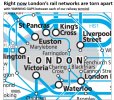
I said it's an "interchange penalty" where the "perceived journey time" gets increased by 65 minutes for a person travelling from Thameslink network places such as Cambridge or North London or South East London (eg via London bridge) or Sevenoaks or Brighton to say Birmingham, Manchester or Glasgow on HS2.

Using Euston instead of St Pancras means you allow much more time to be sure of being able to change trains. Thameslink is frequent from London Bridge too and hasn't got the steps you get on the underground. These travellers will have cases or buggies.
 

Attachments

  • London-Station-steps.jpg
    London-Station-steps.jpg
    157.8 KB · Views: 33
  • London-Stations.jpg
    London-Stations.jpg
    142.3 KB · Views: 35
  • London-Stations-Failure.jpg
    London-Stations-Failure.jpg
    58 KB · Views: 33
  • BoostingMarkets.jpg
    BoostingMarkets.jpg
    199.1 KB · Views: 33
  • MarketUplift.jpg
    MarketUplift.jpg
    183.2 KB · Views: 30
  • Connecting-Rail-Networks.jpg
    Connecting-Rail-Networks.jpg
    230 KB · Views: 32
Sponsor Post - registered members do not see these adverts; click here to register, or click here to log in
R

RailUK Forums

JonathanH

Veteran Member
Joined
29 May 2011
Messages
23,406
If you're coming from say Cambridge or Brighton or Sevenoaks or London bridge on a Thameslink you'd need more time to reach Euston and you'd also thus allow more time to make certain of getting onto your booked train time.
Yes, but the explicit additional interchange time for a St Pancras - St Pancras interchange to a St Pancras - Euston interchange is closer to fifteen minutes, maybe half an hour, not an hour.
 

The Planner

Veteran Member
Joined
15 Apr 2008
Messages
19,748
I thought I'd answered this, but I cannot see that answer now.

I said it's an "interchange penalty" where the "perceived journey time" gets increased by 65 minutes for a person travelling from Thameslink network places such as Cambridge or North London or South East London (eg via London bridge) or Sevenoaks or Brighton to say Birmingham, Manchester or Glasgow on HS2.

Using Euston instead of St Pancras means you allow much more time to be sure of being able to change trains. Thameslink is frequent from London Bridge too and hasn't got the steps you get on the underground. These travellers will have cases or buggies.
Yes, but where has 65 minutes come from for a St Pancras to Euston interchange?

Interested to know which presentations/publications the slides are from too.
 

MarkyT

Established Member
Joined
20 May 2012
Messages
7,625
Location
Torbay
Yes, but where has 65 minutes come from for a St Pancras to Euston interchange?
I think it's a perceived time. I'd guess it's the time people might allow for an uncertain or complex connection. I'd argue that Euston-St Pancras on foot at around 500m is not complex at all and can be accomplished easily in under 10 minutes. Improvements to the link as part of the Euston development with a new east side entrance leading to Phoenix way could make this even more convenient for all Euston users to access Thameslink, Kent HS1 etc. If you allowed over an hour on first making such a journey, you'd likely revise that estimate on any future trips.
 

MotCO

Established Member
Joined
25 Aug 2014
Messages
6,146
Does the 65 minutes including checking in time for international departures?
 

mike57

Established Member
Joined
13 Mar 2015
Messages
2,405
Location
East coast of Yorkshire
They recommend arrival 75 minutes before departure at the moment.
Slightly off topic, but the earlier they recommend arriving the more pressure you put on the overcrowded facilities at St Pancras. Given that the current level of security and checks is going to continue for the forseeable future surely its time to try and improve them. Did the original designers consider that at some point in the future we would be part of Schengen, and the security would be reduced to bag checks?

Really the whole HS2, HS1, Euston, Kings Cross St Pancras issues form one big spread out interchange, and you cannot look at one bit in isolation.
 

John Jefkins

Member
Joined
14 Mar 2025
Messages
39
Location
Croydon
Note there's no physical route between the SE platforms at St. Pancras and the NLL line. Along with connecting lines from MML and ECML, the Camden chord is only connected to the international platforms. It might be possible to add extra points (crossings with slips probably) to create such a track connection, but it would require reversing trains to cross the entire throat on the flat for each movement. The existing terminal layout is very clever with a grade separation squeezed into the throat to minimise conflict, in concept rather like that planned for HS2 at Euston. From https://railway-news.com/wp-content/uploads/2016/12/signalling-at-the-st-pancrasctrl-terminal.pdf
View attachment 176407

This too would create 3 roads towards Javelin platforms - (a) by widening the existing NNL route to 2 tracks and (b) by adding an overbridge directly to the Javelin tracks.
With only 2 Eurostar trains/hr using their 6 platforms, there are only 4 movements an hour to them. Even doubling the Eurostars won't use those routes much of each hour when the overbridge could be exclusively used (ie one route) and a HS1 direction movement in the opposite direction to the Eurostar could be exploited at the same time.
The rest of the hour, the 200m long Javelins or HS2 trains would have 3 routes in and out to their 3 platforms. Its a movement to or from the Javelin platforms every 2.5 minutes where more than one independent route could be used at the same time towards either HS2 or HS1.

== Doublepost prevention - post automatically merged: ==

You haven’t answered my earlier questions (fair enough, you don’t have to), but you have repeated many things that are not true.

It is worth reading, in full, the assessment of the potential rail options (and other options). Link here, obviously too long to quote.

The report is 10 years old, and the costs contained within it must be treated with the same caution as the costs of HS2 itself from 10 years ago.

Right, down to brass tacks.

1) Can you explain why you think St Pancras has only 6tph from 9 platforms. Between 0800-0900 tomorrow there are 18 train movements in or out of St Pancras P5-P13. At the peak times there are 7 Southeastern High Speed services each way, and that is likely to be 8 before too long. Are you proposing that all of these continue onto HS2?

2) The existing track layout at St Pancras is not conducive to frequent reversals from Stratford and towards Camden. It can only be done in the international platforms, not the domestic. To enable the domestic platforms to be used as such would require wholesale remodelling of the throat, and almost certainly reduced speeds. The reduced speed would extend junction clearance margins and the platform reoccupation would need to increase from the current 4 minutes, probably to 6.

3) The international platforms at St P are international gauge (and height), the domestic platforms are domestic gauge (and height), and also only 295m. Which are to be used in your proposal by the Southeastern High Speed services (240m), and the HS2 services (400m), all of which will be formed of domestic gauge stock?

4) Put simply, it would not be possible to turn round the quantity of services at St Pancras you propose to, using any of the platforms, simply because of the large number of conflicting movements - up to 40 an hour at peaktimes - it would cause on any track layout at grade.

5) Turning 400m HS2 trains in 3.5 minutes might be possible, but only if there are not large numbers of people alighting and boarding, which there would be. Nowhere in the world does this.

5) The existing (unused) link between St Pancras and the North London Line is single track. As was the (non-existing) proposed link from there to Old Oak Common. Your proposal implies this would all be double track. Clearly this costs money, as there would be several new structures to build. As the above linked report also explains, it also requires lots of demolition in central Camden, including of listed buildings. It also means closing the NLL for some time to enable the rebuild, and I suspect would permanently reduce the capacity of the NLL too (unless much further demolition was preferred). This would take 7-8 years minimum from where we are now, plus several billion pounds.

6) There is no link from the HS2 OOC box towards Heathrow. Therefore having Southeastern High Speed services go to Heathrow is a non starter. (Unless you want to rebuild the OOC box and / or build new subterrean junctions west of OOC, and grade seperated junctions on to the GWML; as with the Camden end this would take about 7-8 years minimum from where we are now plus several billion pounds).

7) To use the international platforms at Stratford for trains terminating from the west requires either a shunt move on the running line east of Ripple Lane, or wrong line running between St Pancras and Stratford. Neither are easily timetabled.

8) Your assumptions about traffic generation from the direct link are baffling to me and seem to be very optimistic. I have never seen any modelled data to suggest that through trains from Kent to OOC would drive anything like the increases you suggest, similarly for through trains from HS2 towards Kent. How have you calculated them? Could you give some examples of journeys that are made much easier, and what the current flows are?

9) Kings Cross St Pancras tube does not have lots of spare capacity, as anyone using it on a weekday morning will attest.

10) Alternatives to Euston were studied extensively during the early stage of development for HS2. Using St Pancras was considered, but not taken forward. Am I right to assume that you feel the teams of professional engineers, rail operations experts, station capacity experts, town planners, construction planners, environmental managers and analysts who did this work reached the wrong conclusion, but your proposal is the right one?


In summary, doing what you propose would actually be likely to cost more than going to Euston, and take somewhat longer (as we’d be starting from scratch for planning and consents), if it was even possible, which appears not to be the case for much of it.


and finally... when you emphasise certain words in CAPITALS it makes your posts look quite shouty and implies that you think you know far more about this than others and that we are all a bit stupid. Of course that might be true. But, when others have done this in the past, both on this website and in other places, it is usually done by people who have a pet proposal and will not listen to any reasons put forward why that proposal may be challenging. Perhaps you will prove me wrong here by considering and answering some of the points above, without just repeating what you have already written.

I've tried answering this but my answer doesn't save.
 

Attachments

  • StPancras-Junctionwork.jpg
    StPancras-Junctionwork.jpg
    282.7 KB · Views: 43

The Ham

Veteran Member
Joined
6 Jul 2012
Messages
12,058
I said it's an "interchange penalty" where the "perceived journey time" gets increased by 65 minutes for a person travelling from Thameslink network places such as Cambridge or North London or South East London (eg via London bridge) or Sevenoaks or Brighton to say Birmingham, Manchester or Glasgow on HS2.

I think there's an element of double counting.

Based on what you've said people will turn up early to ensure they make their booked train, correct?

That's going to be the case regardless of if it's a cross platform change or you've got to walk for 20 minutes.

The reason for it is to ensure that if there's a small delay on your first leg you make your connection.

Whilst you may allow more time for a bite complex trip, placing to arrive 30 minutes before your booked train will stay the same.
 

yoyothehobo

Member
Joined
21 Aug 2015
Messages
860
This too would create 3 roads towards Javelin platforms - (a) by widening the existing NNL route to 2 tracks and (b) by adding an overbridge directly to the Javelin tracks.
With only 2 Eurostar trains/hr using their 6 platforms, there are only 4 movements an hour to them. Even doubling the Eurostars won't use those routes much of each hour when the overbridge could be exclusively used (ie one route) and a HS1 direction movement in the opposite direction to the Eurostar could be exploited at the same time.
The rest of the hour, the 200m long Javelins or HS2 trains would have 3 routes in and out to their 3 platforms. Its a movement to or from the Javelin platforms every 2.5 minutes where more than one independent route could be used at the same time towards either HS2 or HS1.

== Doublepost prevention - post automatically merged: ==


I've tried answering this but my answer doesn't save.
IS that viaduct even physically possible without trains requiring a 1:10 gradient?
 

Bald Rick

Veteran Member
Joined
28 Sep 2010
Messages
35,967
Javelins weren’t ever over 4 per hour. And these HS2 trains to Ashford would add capacity.

I see.

What appears to have happened is that you aren‘t considering any of the challenges to your proposal, and just repeating back your proposal to us all as the answer to those challenges. Please, please consider the possibility that what you are proposing might not be practical, or even possible, in the timescales you expect or the costs you quote (or, actually, not quote).

To pick up the point I quoted above, I can assure you that there are 7 trains per hour each way at peak times on the Southeastern HighSpeed services (check tonight’s departures), and that is likely to return to the 8tph each way that existed before Covid by next year.

A few other things:

1) The tunnels from OOC to Euston are under construction, and the portal at the Euston end has been under construction for some time. They will be finished (from a civils perspective) by the end of 2027. Much of the Euston work has already been committed - not the station itself but all the supporting Civils including the tunnels, their portals, the vent shafts, the construction compounds, everything. That is money spent that can‘t be unspent.

2) It is not as simple as asking Dave the TBM driver to turn left a bit at Swiss Cottage. Where your proposed twin track portal is cuts right through the former Up Empty Carriage Line, and the Northern line is also uncomfortably close. It is also right in the middle of a rather wealthy residential area, the residents of whom will have something to say about it. To gain consent to build something new there you are looking at 4-5 years minimum before you can even mobilise a contractor and start thinking about shovels. That compares with 2.5 years before the Civils into Euston is finished.

3) There is no prospect of ‘building a ramp’ out of either the west end of OOC box or the east end of Stratford box. Each would involve widespread local disruption, as the boxes would have to be expanded considerably. Startford box effectively floats on the water table, so that would be quite the challenge. If it is even possible - and I very much doubt it is - it will involve extensive land take and demoliton including peoples’ homes. They would also require grade seperated junctions on to the GWML and GEML respectively. I can’t see either being possible for any less than a billion each - more for Stratford.

3a) South Eastern HighSpeed services couldn’t use Heathrow anyway, as there is not capacity for them unless the Heathrow express is removed. If HEx was removed, then the trains would have to be limited to a single unit to fit in the Heathrow platforms (to the dtriment of southeastern’s existing passengers), or all three Heathrow stations would need to be lengthened (very expensively).

4) Reconfiguring tracks, platforms etc at St Pancras is not a trivial exercise. Again it is not as simple as turning up with a crane and playing with a train set. It needs new bridges (lots of them), a complete recofiguration of the tracks, signalling and overhead line and then reconfiguring the station itself. Again, there is no planning consent for this - at a Grade 1 listed building - so you can expect it to take at least 4-5 years to get permission to do this. It will also need widespread closures to enable, and Eurostar / Southeastern will be asking for something in the region of £6m+ per day compensation. Total cost of the reconfiguration would again be north of a billion.

5) Terminating trains from the west at Stratford is not possible, as has been said before. It is also not possible to reconfigure the tracks to enable it happen, at least not without rebuilding the box (see above for the challenges with that).

6) HS2 will be operating 400m trains from day 1 on the Birminghams, and almost certainly other services too.

6a) You propose diverting freight away from Primrose Hill and via Gospel Oak to Willesden. You have forgotten that additional freight joins the NLL at Gospel Oak, taking the paths of those services that have left at Camden Rd Jn. It is also quicker via Primrose Hill, and the line provides a useful regulating facility as it links two of the most intensively used lines in the country. The connection for conventional services must be maintained through Primrose Hill, including for diversions during engineering works and for timetabled empty coaching stock.

7) There is already an easy connection from Thameslink to Euston. It takes 8 minutes and is called walking. Lots of people do it every day - I do it a couple of times a week. Yes it might be easier if it was direct at St Pancras, but only about 7 minutes easier. When changing trains between St Pancras and Euston I allow 15 minutes from timetabled arrival to departure; when changing trains within St Pancras I allow 8 minutes. There is no way that a 7 minute improvement is going to drive a significant boost to passenegr numbers. Similarly, people from the Great Eastern who want to connect with HS2 will simply change to the Elizabeth line at Stratford for a service to OOC - taking 22 minutes. That will be easier, and quicker, than heading through the shopping centre (5-10 minutes) and then getting a service that spends a minimum of 25-30 minutes travelling to OOC via a trundle around Camden and a turn back in St Pancras.

8) Euston is also well connected by the underground and other local transport. Please can you give some specific examples of specific journeys that will be significantly quicker through a St Pancras HS2 connection than via Euston. Travelling from Thameslink is not one of them. The 65 minutes saving you quote simply does not hold for anything I can think of.

9) Back to St Pancras and the turnbacks - you need to allow for at least 8tph each way South Eastern High Speeds (unless your proposal terminates some at St Pancras?), 4 international services to/from Europe an hour terminating (as per HS1 plans), and what you say will be 8, but will actually be 10-12 HS2 services turning round each way (again unless some are terminating?). That will be around 80 movements in or out of the throat each hour - essentially on 2 lines from the west and 2 lines from the east, with almost all services having to cross west - east or vice versa. (For clarity, the 80 consist of 8tph SE from Stratford to OOC x 2 movements each (16), plus the same for the opposite direction (16); 4 international services inbound, 4 outbound, and 10 HS2 services from OOC to Stratford x 2 movements each (20) plus the same for the opposite direction (20)). That is a movement every 45 seconds, most of which will in someway conflict with each other, especially considering that a 400 metre train takes over two minutes from from passing the home signals to being in clear at the platform. It would be interesting to see a track layout that delivers this level of movement, and a rough cost and timescale for constructing it.


To summarise

  • the £5-£6bn saving you suggest for avoiding having to rebuild Euston is an overestimate, as some of that money is already spent or committed
  • to deliver what you propose means a completely new consents process, and completely new designs, starting from scratch, which could not take less than 5 years if you started tomorrow (by which time Euston Enabling civils will be comllete and the main station construction will be well underway), and then only if there was minimal local opposition (but there will be lots)
  • the costs of your proposals will run well into the billions, and almost certainly cost substantially more than any saving made by delaying or avoiding work at Euston.
  • Some elements of the proposal appear not to be physically possible, even at a basic level of scrutiny
  • the train service proposition of turning upwards of 36-40 trains per hour, all of 200m plus, at St Pancras from 2 x 2 track approaches that conflict seems ambitious to put it very mildly. My train planning colleagues may have other adjectives that are more applicable
  • the benefits you claim seem to be wildly over-estimated, and based on a flawed understanding of interchange penalties, current passenger flows, and how PDFH works when there are multiple alternative routing options.

Interested to know which presentations/publications the slides are from too.

Self published, mate.
 
Last edited:

camflyer

Member
Joined
13 Feb 2018
Messages
1,171
Of all of the HS2 cuts, the link to HS1 is the one I can live with the most. Far more important to "uncancell" the routes north of Birmingham.

I'm not convinced that Birmingham to Paris/Brussels would be a significant route in terms of passenger numbers and for anyone wanting to do it then there would be an easy transfer in London - certainly easier than getting from the Gare du Nord to Gare de Lyon in Paris.
 

Bald Rick

Veteran Member
Joined
28 Sep 2010
Messages
35,967
I'm not convinced that Birmingham to Paris/Brussels would be a significant route in terms of passenger numbers and for anyone wanting to do it then there would be an easy transfer in London

Eurostar currently has approx 70% of the London-Paris air/rail market share for a shorter journey (2h20) with an hourly frequency. If Birmingham + Manchester to Paris (and let’s throw in Liverpool as well) captured the same proportion with direct trains that would take about 3h for Birmingham, 4h for Manchester, it would fill less than a eurostar each way per day between them. But with a one train per day frequency, and those journey times, it would not capture 70% of the market - more like 20%, or about a third of a eurostar… per day.

The only way to make such trains remotely viable would be to have them call in London, and to have them carry domestic passengers between London and the north, and that means a “St Pancras Shuffle”. And at that point, it is just as easy to shuffle between Euston and St Pancras and avoid a few billion of expenditure.

Unless we join Schengen of course, then it all becomes part of a joined up service spec, no birder control, with the Channel Tunnel being just a longer version of the Severn Tunnel.
 
Last edited:

The Ham

Veteran Member
Joined
6 Jul 2012
Messages
12,058
I see.

What appears to have happened is that you aren‘t considering any of the challenges to your proposal, and just repeating back your proposal to us all as the answer to those challenges. Please, please consider the possibility that what you are proposing might not be practical, or even possible, in the timescales you expect or the costs you quote (or, actually, not quote).

To pick up the point I quoted above, I can assure you that there are 7 trains per hour each way at peak times on the Southeastern HighSpeed services (check tonight’s departures), and that is likely to return to the 8tph each way that existed before Covid by next year.

A few other things:

1) The tunnels from OOC to Euston are under construction, and the portal at the Euston end has been under construction for some time. They will be finished (from a civils perspective) by the end of 2027. Much of the Euston work has already been committed - not the station itself but all the supporting Civils including the tunnels, their portals, the vent shafts, the construction compounds, everything. That is money spent that can‘t be unspent.

2) It is not as simple as asking Dave the TBM driver to turn left a bit at Swiss Cottage. Where your proposed twin track portal is cuts right through the former Up Empty Carriage Line, and the Northern line is also uncomfortably close. It is also right in the middle of a rather wealthy residential area, the residents of whom will have something to say about it. To gain consent to build something new there you are looking at 4-5 years minimum before you can even mobilise a contractor and start thinking about shovels. That compares with 2.5 years before the Civils into Euston is finished.

3) There is no prospect of ‘building a ramp’ out of either the west end of OOC box or the east end of Stratford box. Each would involve widespread local disruption, as the boxes would have to be expanded considerably. Startford box effectively floats on the water table, so that would be quite the challenge. If it is even possible - and I very much doubt it is - it will involve extensive land take and demoliton including peoples’ homes. They would also require grade seperated junctions on to the GWML and GEML respectively. I can’t see either being possible for any less than a billion each - more for Stratford.

3a) South Eastern HighSpeed services couldn’t use Heathrow anyway, as there is not capacity for them unless the Heathrow express is removed. If HEx was removed, then the trains would have to be limited to a single unit to fit in the Heathrow platforms (to the dtriment of southeastern’s existing passengers), or all three Heathrow stations would need to be lengthened (very expensively).

4) Reconfiguring tracks, platforms etc at St Pancras is not a trivial exercise. Again it is not as simple as turning up with a crane and playing with a train set. It needs new bridges (lots of them), a complete recofiguration of the tracks, signalling and overhead line and then reconfiguring the station itself. Again, there is no planning consent for this - at a Grade 1 listed building - so you can expect it to take at least 4-5 years to get permission to do this. It will also need widespread closures to enable, and Eurostar / Southeastern will be asking for something in the region of £6m+ per day compensation. Total cost of the reconfiguration would again be north of a billion.

5) Terminating trains from the west at Stratford is not possible, as has been said before. It is also not possible to reconfigure the tracks to enable it happen, at least not without rebuilding the box (see above for the challenges with that).

6) HS2 will be operating 400m trains from day 1 on the Birminghams, and almost certainly other services too.

6a) You propose diverting freight away from Primrose Hill and via Gospel Oak to Willesden. You have forgotten that additional freight joins the NLL at Gospel Oak, taking the paths of those services that have left at Camden Rd Jn. It is also quicker via Primrose Hill, and the line provides a useful regulating facility as it links two of the most intensively used lines in the country. The connection for conventional services must be maintained through Primrose Hill, including for diversions during engineering works and for timetabled empty coaching stock.

7) There is already an easy connection from Thameslink to Euston. It takes 8 minutes and is called walking. Lots of people do it every day - I do it a couple of times a week. Yes it might be easier if it was direct at St Pancras, but only about 7 minutes easier. When changing trains between St Pancras and Euston I allow 15 minutes from timetabled arrival to departure; when changing trains within St Pancras I allow 8 minutes. There is no way that a 7 minute improvement is going to drive a significant boost to passenegr numbers. Similarly, people from the Great Eastern who want to connect with HS2 will simply change to the Elizabeth line at Stratford for a service to OOC - taking 22 minutes. That will be easier, and quicker, than heading through the shopping centre (5-10 minutes) and then getting a service that spends a minimum of 25-30 minutes travelling to OOC via a trundle around Camden and a turn back in St Pancras.

8) Euston is also well connected by the underground and other local transport. Please can you give some specific examples of specific journeys that will be significantly quicker through a St Pancras HS2 connection than via Euston. Travelling from Thameslink is not one of them. The 65 minutes saving you quote simply does not hold for anything I can think of.

9) Back to St Pancras and the turnbacks - you need to allow for at least 8tph each way South Eastern High Speeds (unless your proposal terminates some at St Pancras?), 4 international services to/from Europe an hour terminating (as per HS1 plans), and what you say will be 8, but will actually be 10-12 HS2 services turning round each way (again unless some are terminating?). That will be around 80 movements in or out of the throat each hour - essentially on 2 lines from the west and 2 lines from the east, with almost all services having to cross west - east or vice versa. (For clarity, the 80 consist of 8tph SE from Stratford to OOC x 2 movements each (16), plus the same for the opposite direction (16); 4 international services inbound, 4 outbound, and 10 HS2 services from OOC to Stratford x 2 movements each (20) plus the same for the opposite direction (20)). That is a movement every 45 seconds, most of which will in someway conflict with each other, especially considering that a 400 metre train takes over two minutes from from passing the home signals to being in clear at the platform. It would be interesting to see a track layout that delivers this level of movement, and a rough cost and timescale for constructing it.


To summarise

  • the £5-£6bn saving you suggest for avoiding having to rebuild Euston is an overestimate, as some of that money is already spent or committed
  • to deliver what you propose means a completely new consents process, and completely new designs, starting from scratch, which could not take less than 5 years if you started tomorrow (by which time Euston Enabling civils will be comllete and the main station construction will be well underway), and then only if there was minimal local opposition (but there will be lots)
  • the costs of your proposals will run well into the billions, and almost certainly cost substantially more than any saving made by delaying or avoiding work at Euston.
  • Some elements of the proposal appear not to be physically possible, even at a basic level of scrutiny
  • the train service proposition of turning upwards of 36-40 trains per hour, all of 200m plus, at St Pancras from 2 x 2 track approaches that conflict seems ambitious to put it very mildly. My train planning colleagues may have other adjectives that are more applicable
  • the benefits you claim seem to be wildly over-estimated, and based on a flawed understanding of interchange penalties, current passenger flows, and how PDFH works when there are multiple alternative routing options.

All valid points, especially the point about the 65 minutes of journey time saving.

The other point is the 70% of HS2 users who would benefit from the link. Unless their counting users to/from London (some will be inconvenienced and some will be no better off) then Kent is a massive powerhouse which I just hadn't realised.

If it is, then there's a certain content creator call Phil on TikTok who needs to eat some humble pie about Surrey being better than Kent.

If we're going to create a HS1/HS2 link, it would be better if it was part of a wider HS network in the UK.

Whilst this would have the same issues as you've listed, as there's more time to plan it and you're not squeezing it into a very congested central London, you could deliver many of the same benefits but without a lot of the complications:

Having a HS East (a line from London to the North East possibly via Cambridge) with an outer London hub before going to a central London station.

Then HS Wales and West, which connects at Old Oak Common before looping around London and connecting with the HS East Hub and HS1's Hub (Stratford)

Depending on scope you could even have an interchange station with Thameslink.

That would get you a LOT of interchanges, and around London connections without having to go via zone 1.

Yes the train around would likely be fairly slow (probably to the point where changing at Old Oak Common for the Elizabeth Line might be quicker), but as long as it was no more than about 10 minutes slower the benefit of the direct would probably still win out for the majority of people. Even for people changing at Old Oak Common from HS2 would probably still do it for a train where they can more easily sit would still make it viable.

There's probably lots of holes in this suggestion too, but as I've said there'll be time to plan it properly.

Eurostar currently has approx 70% of the London-Paris air/rail market share for a shorter journey (2h20) with an hourly frequency. If Birmingham + Manchester to Paris (and let’s throw in Liverpool as well) captured the same proportion with direct trains that would take about 3h for Birmingham, 4h for Manchester, it would fill less than a eurostar each way per day between them. But with a one train per day frequency, and those journey times, it would not capture 70% of the market - more like 20%, or about a third of a eurostar… per day.

The only way to make such trains remotely viable would be to have them call in London, and to have them carry domestic passengers between London and the north, and that means a “St Pancras Shuffle”. And at that point, it is just as easy to shuffle between Euston and St Pancras and avoid a few billion of expenditure.

Unless we join Schengen of course, then it all becomes part of a joined up service spec, no birder control, with the Channel Tunnel being just a longer version of the Severn Tunnel.

Indeed, it's why, if you're looking to reduce the number of flights by improving rail capacity you're better off improving journey times between HS2 and Scotland.

The other thing to note, is whilst you may get 20% market share from a direct HS1-HS2 link you will likely get some market share without it (from those who are willing to go by train over flying but aren't currently as there's lack of capacity, the extra length of the journey, etc.). Yes that may only be fairly small amount, however it does reduce the benefit of the link.
 

mike57

Established Member
Joined
13 Mar 2015
Messages
2,405
Location
East coast of Yorkshire
The sad thing about all this thread is that I think a lot of people argue that things could have been done better. I know we all have our own ideas, but the common theme to me is that there are a lot of missed opportunities. The problem is that now that construction is well under way making even simple changes is next to impossible so we are stuck with what we have, and whilst maybe not quite a 'white elephant' the cutbacks at the northern end have certainly turned HS2 a very pale shade of grey on the white elephant scale :lol:

Couple this with a failure to join up HS1 and HS2 and the shoehorning of HS2 terminal into Euston, with all the added cost and complications and it just starts to look like a very expensive WCML bypass, and thats when it does actually reach Euston.

Given a blank sheet of paper:

I would have tunneled from OOC to King Cross St Pancras, creating underground platforms at King X and carrying on to Stratford using existing HS1 tunnels where you then have a proper HS2 terminal, hopefully with space to expand reserved as well and not shoehorned in.

Services from the North (WCML) would then terminate at Stratford, calling at OOC and Kings X along the way. I would then extend internal HS1 'Javelin' services west, again calling at Kings X and OOC with 1tph of the 2tph Didcot Parkway and Newbury terminating services being the obvious candidate to be joined up and remaining HS1 services terminating at OOC.

I deliberately havn't mentioned international services as these have the complication of security, but if you need more capacity at St Pancras removing the 'local' HS1 services frees up space as until the security bottleneck can be relieved expansion of international services is pie in the sky.

So instead of rebuilding Euston you tunnel on for maybe 2-3 miles, and build your underground station with new tunnels to join up with HS1 just east of Kings X.

As well as delivering HS2 this delivers a fast cross London service, which links into Heathrow services at OOC, and improves links into Kent.

This would have added improved cross London connections now, and in the future the abilty to run international services from a regional hub and frees up space at St Pancras International which could be used to increase people processing capacity (Border checks and security).

And yes I realise this is what could have been, and we are stuck with what we have, but the sad thing is given the cost overuns on the whole HS2 project I dont think the extra scope, maybe 3 miles more tunnel would have added a huge amount to the total project cost. Station wise an HS2 terminal at Stratford would have been an easier build, so you are replacing Euston rebuild with a Stratford terminal where space is less of an issue and an underground maybe 4 platform station at Kings X.
 

Bald Rick

Veteran Member
Joined
28 Sep 2010
Messages
35,967
The sad thing about all this thread is that I think a lot of people argue that things could have been done better.

I think the sad thing is that people assume that the people who developed HS2 (or indeed any other major rail project) didn’t look at literally hundreds of potential options before selecting the one to be built after a painstaking option development and selection process.

I also think some assume that the option development process is a couple of people sitting round a map who say “let’s do this then”. It really isn’t, it is years of study by all the professionals I mentioned up thread, and not just engineers.

Even sadder is that a small minority think that even after a project has gained consent, done design and started construction, that it is a simple thing just to change the project massively. Whilst those who post on these pages are largely harmless (with one or two exceptions), there are unfortunately cases where politicians sit in this category.


Re a tunnelled route and underground station at Kings Cross and terminus at Stratford, a few things spring to mind:

1) where at Kings Cross could take it - that avoids all the existing underground lines and Crossrail2. (The ‘Euston Cross‘ proposers found that out the hard way)
2) a deep level 6 (or more) platform station might be possible, it might not. It would be very expensive
3) onward connections for such a station - how do they work given the current issues at KXSP underground
4) How would the tunnels on to Stratford take all the existing traffic and (say) 10-12 HS2 trains an hour, or the proposed 17 tph.
5) where at Stratford is there a site that could accommodate such a terminus, and what are the onward travel connections.
6) leaving practicalities aside, how much extra would all this cost.
 

John Jefkins

Member
Joined
14 Mar 2025
Messages
39
Location
Croydon
What interchange takes 65 minutes at Euston but not at St Pancras?

Where exactly are you proposing HS2 trains call next after Old Oak Common?

What interchange takes 65 minutes at Euston but not at St Pancras?

Where exactly are you proposing HS2 trains call next after Old Oak Common?
I thought I’d already replied to you on this. I’ll try again here.

The “interchange penalty” is used by the Passenger Demand Forecast Handbook to estimate how passengers are deterred by a bad interchange such as switching from the Thameslink or Eurostar or Javelin or Kings X or Great Eastern networks to reach Euston.

They allow about an hour to walk the route and make it in time for their second train.

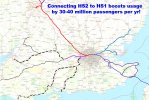
Switching terminals from Euston to a combination of St Pancras or Stratford or other HS1 stations adds 47% more passengers for about 70% of London and the south east of passengers trying to travel HS2 or most GWR routes. That’s 20 to 30 million extra passengers per year paying £60 fares in the 2040s. Billions extra.

After OOC trains would call at St Pancras, reversing just as high speed ICE trains do at Frankfurt within 4 or 5 minutes to use HS1 to terminate at either Stratford or Ebbsfleet or Ashford’s pairs of unused platforms. Birmingham shuttles don’t need cleaning at each end of their HS2 45 minute journeys so they could use a double slot to terminate at St Pancras. Others would need 20 to 40 minutes to add resilience in their terminations on HS1 platforms.
 
Last edited:

JamesT

Established Member
Joined
25 Feb 2015
Messages
4,916
I think the sad thing is that people assume that the people who developed HS2 (or indeed any other major rail project) didn’t look at literally hundreds of potential options before selecting the one to be built after a painstaking option development and selection process.

I also think some assume that the option development process is a couple of people sitting round a map who say “let’s do this then”. It really isn’t, it is years of study by all the professionals I mentioned up thread, and not just engineers.
It probably would help if the options report was published more obviously. I’m sure it must be somewhere as the scheme went through an extensive parliamentary process, but I’m struggling to find it.
Page 9 of https://assets.publishing.service.g...velopment_of_the_HS2_Proposed_Scheme_v1.6.pdf has a brief overview of why Euston was considered the best option for a terminus. (Can’t seem to cut and paste from it to quote)
 

John Jefkins

Member
Joined
14 Mar 2025
Messages
39
Location
Croydon
Interesting, I've always thought that if there was a link, Stratford International could finally have a purpose as "the" London stop on a through service from HS1 to HS2, rather than having to go into and reverse out of St Pancras again.
The NNL already exists as a “link”.
The steel work on its road bridges just need replacing to allow for GC gauge. Not even as much money as the omitted tunnel from Primrose Hill to Euston.

So, by just cutting short the tunnel they’re about to build to Euston at Primrose Hill and building a ramp up to the NNL - using railway land just north of Juniper Crescent and NNL land, we can use the NNL to reach St Pancras’s 9 poorly used platforms and the 6 unused platforms down HS1 and scatter HS2 terminations along them.

By overlapping the 4 Javelin trains/hr reversed at St P to terminate at OOC we can reverse 8 HS2 trains per hour on 24 slots at their 3 St Pancras platforms. Later we could also explore using the 6 Eurostar platforms more efficiently to share a couple of them with HS2 trains too.
 

John Jefkins

Member
Joined
14 Mar 2025
Messages
39
Location
Croydon
Only if we join Schengen. Much as I would like to, it seems a majority of my countrymen do not.

I would suggest looking for the previous threads on this subject. International services on the rest of the UK network have many issues that make them infeasible and it would degrade the services that HS2 should be providing.
But Domestic services would get 15 million extra passengers a year if HS2 trains could reverse at St Pancras to terminate at those unused HS1 platforms at Stratford, Ebbsfleet and Ashford.

The NNL link already exists. Part just needs 4 tracks restored.
For GC gauge we’d just need new steelwork over 6 road bridges.

We could overlap Javelins sent west to OOC with almost all HS2 trains sent east to St Pancras and Stratford.

Most of that cleared land at Euston could be reused for housing with a much smaller Euston rebuild delayed until HS2 reaches Manchester or Leeds and until all of Euston gets rebuilt as one new integrated station with a slightly wider surface throat and where HS2 trains are allocated a few platforms.

Take the OOC tunnel to the NNL instead of Euston and just add a stub of a junction there to link up to the existing routes into Euston.
 

hwl

Established Member
Joined
5 Feb 2012
Messages
8,293
I think the sad thing is that people assume that the people who developed HS2 (or indeed any other major rail project) didn’t look at literally hundreds of potential options before selecting the one to be built after a painstaking option development and selection process.

I also think some assume that the option development process is a couple of people sitting round a map who say “let’s do this then”. It really isn’t, it is years of study by all the professionals I mentioned up thread, and not just engineers.

Even sadder is that a small minority think that even after a project has gained consent, done design and started construction, that it is a simple thing just to change the project massively. Whilst those who post on these pages are largely harmless (with one or two exceptions), there are unfortunately cases where politicians sit in this category.
Amen - some of the the proposals on this thread are absolutely delusional fantasy that got ruled out very early in any option development as being impractical engineering wise and not severing much demand either based on cold hard facts and analysis.
 

mr_jrt

Established Member
Joined
30 May 2011
Messages
1,578
Location
Brighton
Long story short, I think that not having any kind of Euro-gauge connection to the European rail network is madness. The ship has truly been spoiled for a ha'porth of tar. That said, as literally everybody here has been saying, repeatedly, said ship sailed a loooooooooong time ago.

In an idealised arrangement, I think what would have worked well is a double track tunnel between OOC and Stratford International, with HS2 services turning back at various points along HS1.
The missing part of the equation is the onward travel capacity from OOC and Stratford, with Crossrail obviously taking the brunt of that. EustonKXStP obviously has more tube lines to disperse onward travel, though.

At Stratford, you could use the centre platforms as terminal through platforms (a-la Paddington Crossrail), sending trains up the ramp towards Temple Mills to reverse and prep, though I'd be concerned about capacity over that single track. At Ebbsfleet there's ample room to reconfigure things to turn the majority of services, I'd be tempted to have nothing terminate at Ashford, and to turn the remainder at Folkestone.

Alternatively, just turn everything HS2 back at Ebbsfleet, so you can optimise the interchange for passengers wanting to interchange for services into Europe. Land at Ebbsfleet is considerably cheaper than land at Euston, after all.
 

JamesT

Established Member
Joined
25 Feb 2015
Messages
4,916
But Domestic services would get 15 million extra passengers a year if HS2 trains could reverse at St Pancras to terminate at those unused HS1 platforms at Stratford, Ebbsfleet and Ashford.

The NNL link already exists. Part just needs 4 tracks restored.
For GC gauge we’d just need new steelwork over 6 road bridges.

We could overlap Javelins sent west to OOC with almost all HS2 trains sent east to St Pancras and Stratford.

Most of that cleared land at Euston could be reused for housing with a much smaller Euston rebuild delayed until HS2 reaches Manchester or Leeds and until all of Euston gets rebuilt as one new integrated station with a slightly wider surface throat and where HS2 trains are allocated a few platforms.

Take the OOC tunnel to the NNL instead of Euston and just add a stub of a junction there to link up to the existing routes into Euston.
You're really going to have to show your working on where these extra passengers are coming from. And repeated references to a document you have to pay money to read aren't going to convince any of us that can't read it.

How are you turning round trains at Stratford? There's no way to get from the 'unused' International platforms on the outside of the station to the opposite direction to terminate them. It's also assuming a pretty heroic turnaround time, even if you could access both platforms for terminating trains, you're going to handle up to 18tph in 2 platforms?

PS: You're quoting my original post to this thread, rather than any of the following ones. If you're responding to my responses you should quote them.
 

mike57

Established Member
Joined
13 Mar 2015
Messages
2,405
Location
East coast of Yorkshire
what are the onward travel connections
If the OOC - Kings X - Stratford route had been possible/made possible then Stratford gives connections to East London, Essex and Kent, Kings X serves Central & South London, Surrey, Sussex and North London via Thameslink, and also European services. OOC gives connections to West London, Heathrow, and points west. It also gets away from the 'dump everyone at the edge of the central area' with the pressure this puts on underground services in the central area. Combining this up with an extended HS1 domestic service must take pressure off the London terminals and the central area public transport. Once the connections exist people will use them, and journey opportunities which were previously 'too much trouble' become possible, so either new journeys, or mode switch from car.
it is years of study
Unfortunately any study is only as good as the starting brief, which tends to come from politicians.

I will be honest, I think historians in two or three generations time will look unfavourably on the HS2 project. Escalating costs, reduction in scope, missed oportunities will be the key words.

== Doublepost prevention - post automatically merged: ==

Alternatively, just turn everything HS2 back at Ebbsfleet, so you can optimise the interchange for passengers wanting to interchange for services into Europe. Land at Ebbsfleet is considerably cheaper than land at Euston, after all
That actually overcomes the space problem at Stratford, trains just call there. Although passenger numbers at Ebbsfleet may be low there is room for proper terminal platforms and service facilities, and the infrastructure to get there exists.
 

dosxuk

Established Member
Joined
2 Jan 2011
Messages
2,443
At Stratford, you could use the centre platforms as terminal through platforms (a-la Paddington Crossrail), sending trains up the ramp towards Temple Mills to reverse and prep, though I'd be concerned about capacity over that single track.
No you couldn't. The centre platforms are after the junction for the ramp. The only option for a train from the west calling at the centre eastbound platform is to continue to the east. The only way to reverse at Stratford from the west is to run wrong-rail from St Pancras - which would decimate the available frequency.
 

camflyer

Member
Joined
13 Feb 2018
Messages
1,171
Having a HS East (a line from London to the North East possibly via Cambridge) with an outer London hub before going to a central London station.

Sounds fantastic (as someone who drives Cambridge to the NE regularly) but good luck to any politician or planner who tries to build a HS line through Cambridge. It would make the arguments over EastWest Rail look like storm in a teacup.
 

Mgameing123

Member
Joined
29 Apr 2023
Messages
1,060
Location
Denmark
Was cancelling the HS2-HS1 tunnel between Old oak Common and St Pancras a mistake , if anything i think this is one of the most short-sighted cancellations of HS2 as it prevents linking the larger European rail network to the Uk's that would potentially provide an international rail link from the north to Europe
Yes it is a mistake. Nobody can convince me that having a disconnected high speed rail network is a good idea.
 
Status
Not open for further replies.

Top