• Our new ticketing site is now live! Using either this or the original site (both powered by TrainSplit) helps support the running of the forum with every ticket purchase! Find out more and ask any questions/give us feedback in this thread!

Should the HS2-HS1 tunnel under London be uncancelled?

Status
Not open for further replies.

JonathanH

Veteran Member
Joined
29 May 2011
Messages
23,405
Using EXISTING north London line links and EXISTING poorly used platforms at St Pancras ( for reversals ) and 6 completely unused HS1 platforms ( at Stratford , Ebbsfleet and Ashford ) for terminations SAVES £6 billion at Euston.
There aren't existing north London links to HS2 though. Where is the tunnel portal going to be? How much does it cost to build?

Overlap Javelins with HS2 trains to bypass London for millions.
How much demand is there from the HS1 corridor to the north, as opposed to demand from other places in central London? Stratford to Stratford International isn't a panacea as a connection, and is not really any better than St Pancras to Euston which you seem to be suggesting is a challenge.

There doesn't appear to be clarity here as to just how many trains need to run on the 'overlap' section. Is it trains from HS1 as well as trains starting in London? Is this at the speeds typically associated with the existing North London Line?

Overlapping Javelins sent west to OOC with HS2 trains sent east via St Pancras reversals to Stratford or Kent adds at least 12 trains per hour ACROSS London to connect up networks.
What sort of grade separation does this require at St Pancras? Where do the 'Javelins' terminate? How many more of them need to be built?

If this saves £6bn of cost at Euston, how much of that needs to be spent instead for this plan?
 
Last edited:
Sponsor Post - registered members do not see these adverts; click here to register, or click here to log in
R

RailUK Forums

Bald Rick

Veteran Member
Joined
28 Sep 2010
Messages
35,965
St Pancras platforms aren’t at capacity with only 6 tph using 9 platforms.

Right now we could save £6 BILLION by bypassing Euston ( linking to the North London Line at a shortened tunnel to Juniper Crescent ( Primrose Hill) instead of Euston.

£5b on postponing anything at Euston until HS2 reaches Leeds again ( when only 2 or 3 platforms could take a few HS2 trains)

New road bridges to take GC gauge and 4 tracking work using existing railway land from Camden Town eastwards to the St P junction would cost about half what’s saved on tunnelling from Primrose Hill to the huge Euston throat also saved.

By overlapping 4 Javelins sent west to terminate at OOC or Heathrow with 8 to 11 HS2 trains sent via St Pancras 4 minute reversals to terminate at Stratford or Ebbsfleet or Ashford we create relief for the overcrowded Elizabeth line

and a 50% boosted market for 70% of HS2 passengers

It’s the DOMESTIC market uplift of using the St Pancras and Stratford links to Thameslink, Kings X , Javelins, Great Eastern networks plus an already upgraded tube station with extra tube lines plus having through trains to Stratford and Kent instead of a Euston dead end.

Using EXISTING north London line links and EXISTING poorly used platforms at St Pancras ( for reversals ) and 6 completely unused HS1 platforms ( at Stratford , Ebbsfleet and Ashford ) for terminations SAVES £6 billion at Euston.

You haven’t answered my earlier questions (fair enough, you don’t have to), but you have repeated many things that are not true.

It is worth reading, in full, the assessment of the potential rail options (and other options). Link here, obviously too long to quote.

The report is 10 years old, and the costs contained within it must be treated with the same caution as the costs of HS2 itself from 10 years ago.

Right, down to brass tacks.

1) Can you explain why you think St Pancras has only 6tph from 9 platforms. Between 0800-0900 tomorrow there are 18 train movements in or out of St Pancras P5-P13. At the peak times there are 7 Southeastern High Speed services each way, and that is likely to be 8 before too long. Are you proposing that all of these continue onto HS2?

2) The existing track layout at St Pancras is not conducive to frequent reversals from Stratford and towards Camden. It can only be done in the international platforms, not the domestic. To enable the domestic platforms to be used as such would require wholesale remodelling of the throat, and almost certainly reduced speeds. The reduced speed would extend junction clearance margins and the platform reoccupation would need to increase from the current 4 minutes, probably to 6.

3) The international platforms at St P are international gauge (and height), the domestic platforms are domestic gauge (and height), and also only 295m. Which are to be used in your proposal by the Southeastern High Speed services (240m), and the HS2 services (400m), all of which will be formed of domestic gauge stock?

4) Put simply, it would not be possible to turn round the quantity of services at St Pancras you propose to, using any of the platforms, simply because of the large number of conflicting movements - up to 40 an hour at peaktimes - it would cause on any track layout at grade.

5) Turning 400m HS2 trains in 3.5 minutes might be possible, but only if there are not large numbers of people alighting and boarding, which there would be. Nowhere in the world does this.

5) The existing (unused) link between St Pancras and the North London Line is single track. As was the (non-existing) proposed link from there to Old Oak Common. Your proposal implies this would all be double track. Clearly this costs money, as there would be several new structures to build. As the above linked report also explains, it also requires lots of demolition in central Camden, including of listed buildings. It also means closing the NLL for some time to enable the rebuild, and I suspect would permanently reduce the capacity of the NLL too (unless much further demolition was preferred). This would take 7-8 years minimum from where we are now, plus several billion pounds.

6) There is no link from the HS2 OOC box towards Heathrow. Therefore having Southeastern High Speed services go to Heathrow is a non starter. (Unless you want to rebuild the OOC box and / or build new subterrean junctions west of OOC, and grade seperated junctions on to the GWML; as with the Camden end this would take about 7-8 years minimum from where we are now plus several billion pounds).

7) To use the international platforms at Stratford for trains terminating from the west requires either a shunt move on the running line east of Ripple Lane, or wrong line running between St Pancras and Stratford. Neither are easily timetabled.

8) Your assumptions about traffic generation from the direct link are baffling to me and seem to be very optimistic. I have never seen any modelled data to suggest that through trains from Kent to OOC would drive anything like the increases you suggest, similarly for through trains from HS2 towards Kent. How have you calculated them? Could you give some examples of journeys that are made much easier, and what the current flows are?

9) Kings Cross St Pancras tube does not have lots of spare capacity, as anyone using it on a weekday morning will attest.

10) Alternatives to Euston were studied extensively during the early stage of development for HS2. Using St Pancras was considered, but not taken forward. Am I right to assume that you feel the teams of professional engineers, rail operations experts, station capacity experts, town planners, construction planners, environmental managers and analysts who did this work reached the wrong conclusion, but your proposal is the right one?


In summary, doing what you propose would actually be likely to cost more than going to Euston, and take somewhat longer (as we’d be starting from scratch for planning and consents), if it was even possible, which appears not to be the case for much of it.


and finally... when you emphasise certain words in CAPITALS it makes your posts look quite shouty and implies that you think you know far more about this than others and that we are all a bit stupid. Of course that might be true. But, when others have done this in the past, both on this website and in other places, it is usually done by people who have a pet proposal and will not listen to any reasons put forward why that proposal may be challenging. Perhaps you will prove me wrong here by considering and answering some of the points above, without just repeating what you have already written.

 
Last edited:

Hadders

Veteran Member
Associate Staff
Senior Fares Advisor
Joined
27 Apr 2011
Messages
18,160
Ideally being in Schengen would make this feasible however as others have previously stated it's not a popular idea at the moment. With Schengen a proper HS2-HS1 link (maybe akin to the original BR plans with an underground through station either in the St Pancras/King's Cross area or Euston) could allow some HS2 trains to continue to Europe rather than terminating at Euston? Slightly off topic but someone on a previous thread suggested doing on-train passport checks while stationary at Cheriton and Coquelles. Surely something similar could be done at Ashford International and Lille Europe but without passengers having to de-train? There could be a train from Birmingham and Manchester to Paris which would run as separate 200m sets as far as Birmingham Interchange then couple up, stop at Old Oak, Stratford then Ashford for passport checks.
Regardless of infrastructure challenges, in 30-odd years of Eurostar operation we've not managed to get anything beyoned Paris or Brussells (save the odd Euro Disney etc) because the challenge of passport checks and security is too comples.

Ideally we would have through trains but that will only work if there's a softer approach to security and passport checks. Sadly, the British people will not accept that, underlined most recently by the Broxit vote in 2016. Any proposal for checks when stationary is a non-starter, how much time would that add to the journey, especially when an irregularity was found?

The low cost airlines have taken much of the market that longer through Eurostar services would have envisaged having. Someone travelling from Glasgow, Manchester or Birmingham to Paris, Brussells, Amsterdam, etc etc is more likely to fly. Rather than modal shift (which in reality isn't going to happen), I'd like to see more focus on making these flights less polluting and more environmentally friendly.
 

Sad Sprinter

Established Member
Joined
5 Jun 2017
Messages
3,186
Location
Way on down South London town
It does seem like a mistake. I get it regarding practicalities but to seal off a connection to HS1 for all time seems a bit weird.

As someone said upthread (I think) building a link from hs1 to hs2 for javelin services that the odd regional Eurostar could use might have been better. We never did think of say, extending javelin trains to Heathrow or somewhere like that.
 

JonathanH

Veteran Member
Joined
29 May 2011
Messages
23,405
We never did think of say, extending javelin trains to Heathrow or somewhere like that.
What is special, or needed, about running Javelin trains to Heathrow?

HS1 stops at Ashford, which offers connections to East Kent, but that isn't a huge population, Ebbsfleet, which is a car park in a fairly sparsely populated part of North Kent and linked by a slow line to Medway, and Stratford International, where there is already a nearby station with trains to Heathrow. St Pancras offers nearby services to many places north of London, including on HS2 if it ever reaches Euston.

There are much more populous areas without easy rail links to Heathrow, indeed there aren't yet commitments for local (NLL and WLL) links to Old Oak Common. Getting this right should be more of a focus than HS1 to HS2 connectivity.

the odd regional Eurostar could use
We are struggling to justify HS2 into Euston for up to 17tph. The infrastructure in the Midlands and the North that would allow HS2 to run to its full potential has been cancelled. How does a line for an 'odd regional Eurostar' jump the queue for funding?
 
Last edited:

Bald Rick

Veteran Member
Joined
28 Sep 2010
Messages
35,965
We never did think of say, extending javelin trains to Heathrow or somewhere like that.

Who is “we” in this context? Be assurred that all sorts of options were considered. Option generation and assessment is not a public facing activity!

Besides, as has been explained upthread, it is simply not practical to get a direct link from HS2 to Heathrow.
 

43096

On Moderation
Joined
23 Nov 2015
Messages
18,891
Regardless of infrastructure challenges, in 30-odd years of Eurostar operation we've not managed to get anything beyoned Paris or Brussells (save the odd Euro Disney etc) because the challenge of passport checks and security is too comples.
Amsterdam?

Ski trains to the Alps?
 

swt_passenger

Veteran Member
Joined
7 Apr 2010
Messages
34,314
Yes it's a mistake, and not building the junction tunnels (even if don't build the link at this stage) isolates HS2
There weren’t going to be ‘junction tunnels’ (plural), the link was only a dedicated single track route between the middle of OOC‘s eastern headwall and somewhere in the vicinity of Primrose Hill, as was discussed in a previous thread somewhere.

Here you are, you posted in this thread about ‘step plate junctions’, in amongst a few replies I linked to an older drawing that explained there were no underground junctions after all:

But in the context of this thread it’s clear it was never going to be a high capacity link allowing high frequencies of domestic services.
 
Last edited:

Sad Sprinter

Established Member
Joined
5 Jun 2017
Messages
3,186
Location
Way on down South London town
What is special, or needed, about running Javelin trains to Heathrow?

HS1 stops at Ashford, which offers connections to East Kent, but that isn't a huge population, Ebbsfleet, which is a car park in a fairly sparsely populated part of North Kent and linked by a slow line to Medway, and Stratford International, where there is already a nearby station with trains to Heathrow. St Pancras offers nearby services to many places north of London, including on HS2 if it ever reaches Euston.

There are much more populous areas without easy rail links to Heathrow, indeed there aren't yet commitments for local (NLL and WLL) links to Old Oak Common. Getting this right should be more of a focus than HS1 to HS2 connectivity.


We are struggling to justify HS2 into Euston for up to 17tph. The infrastructure in the Midlands and the North that would allow HS2 to run to its full potential has been cancelled. How does a line for an 'odd regional Eurostar' jump the queue for funding?

I didn’t say if should. My point was that the link was always assumed to be for Eurostars to reach the north. But theoretically, if the link was for domestics to terminate at Heathrow which would obviously see more use than the occasional Eurostar, you’d be able to have regional Eurostars then by stealth. Without having expensive infrastructure dedicated to those single services alone.

As for your other comment about why should they terminate at Heathrow, well…Ideally I’d send them through Heathrow to connect onto the SWML.

== Doublepost prevention - post automatically merged: ==

Who is “we” in this context? Be assurred that all sorts of options were considered. Option generation and assessment is not a public facing activity!

Besides, as has been explained upthread, it is simply not practical to get a direct link from HS2 to Heathrow.

What plans were considered to run Javellins through to Heathrow?
 

John Jefkins

Member
Joined
14 Mar 2025
Messages
39
Location
Croydon
Sorry for multi quoting. I haven’t got time to respond to all the points now, but I will tomorrow. Before I do that, can I check a summary of your proposal:

1) A new tunnel (doible track?) is built from OOC to somewhere near Primrose Hill

2) All Southeastern High Speed services (up to 8tph) reverse at St Pancras platforms 11-13 before heading west over new build track to that new tunnel, to terminate at OOC, and vice versa

3) 8tph HS2 services (of the 10-12 that will run when Phase 1 is complete) head via this new tunnel to St Pancras platforms 11-13 (max length 295 metres), either terminating there or continuing east to Stratford (2 tph each way), Ebbsfleet (2 tph each way) or Ashford (2tph each way).

Assuming I’m correct, and putting to one side for now the 10 year delay to the project this would entail, can you just check your working on platform usage at St Pancras with 24tph turning each hour, using the hesdways and junction margins at St Pancras and minimum turnback times and minimum platform reoccupations?
1) The proposed tunnel from OOC is cut short in railway land north of Juniper crescent ( currently occupied by HS2 temporary offices / portacabins ) ascending by the roundhouse to the NNL. Stub ramp(s) ascending in existing sidings west of Euston tracks to join a widened surface route to any future Euston platforms ( eg 2 or 3 for HS2 built if it reaches Manchester.

I’m not suggesting a 2nd tunnel. I’m saying cut the tunnel about to be built at a Primrose Hill junction where both HS2 tracks connect to the NNL and a 3rd track ascends to join a slightly wider existing Euston throat and a couple of possible future platforms at Euston.
The main line would head for St Pancras.
That Euston ramp could built later.

2) There are only 4 Javelins per hour. They would all reverse in around 4 minutes to extend west to OOC ( ideally Heathrow replacing Heathrow express if a single track ramp similar to the one at Stratford linked HS2 tracks to the GWR at OOC).
3) 8 initial 200m classic compatible HS2 trains reverse at St Pancras Javelin platforms using 24 7.5 min slots. Birmingham trains don’t need to be cleaned at both ends so could terminate in a double slot. Others could extend to Stratford or Ebbsfleet or Ashford.

Doing this would take LESS time than waiting for Euston to be built because it’s far simpler to replace 6 road bridge superstructures ( Whaley bridge took 6 weeks ). St Pancras would need a new single track overbridge and the existing NNL chord widened to two tracks.
New escalators & lifts to the Javelin platforms ( on the side wall) and maybe that drafty atrium filled in to provide more 1st floor space. All at HS1 expense as they’d benefit. All possible by 2030.

Turnback times work now as Javelins actually can terminate and turn around in 10 minutes. It only takes a driver 2 minutes to walk to the end of a 200m train so reversals within 4 or 5 minutes within 24 7.5 minute slots works. 30 6 minute slots adds resilience.

I would suggest setting up the javelin side of platform 10 as a possible emergency platform for rush hours or resilience reasons. It’s got platforms either side and Eurostar doesn’t need it all day long.

The key points are that as these platforms already exist this is FASTER to open than getting Euston built. The TBMs at OOC dig east to Primrose Hill instead of Euston. Faster.

We boost HS2 passengers by connecting to Thameslink, Javelins , Kent and Stratford. We boost revenue by £1 billion a year, get it open to central London years SOONER and save £6 billion at Euston by reducing what’s needed there and postponing it until HS2 reaches Manchester.

HS2 phase 1 will only have about 8 trains / hr.
When it gets more then we can send some of those to the Eurostar platforms if some of them also run to OOC instead of St Pancras.
Why do only 2 Eurostars / hr occupy 6 platforms? They don’t in Paris. HS1 staff admit they under use those platforms. 1st floor space at St Pancras is also under used. And there is room to add a balcony over the Javelin platforms. Room for expansion.
 
Last edited:

The Ham

Veteran Member
Joined
6 Jul 2012
Messages
12,056
1) The proposed tunnel from OOC is cut short in railway land north of Juniper crescent ( currently occupied by HS2 temporary offices / portacabins ) ascending by the roundhouse to the NNL. Stub ramp(s) ascending in existing sidings west of Euston tracks to join a widened surface route to any future Euston platforms ( eg 2 or 3 for HS2 built if it reaches Manchester.

I’m not suggesting a 2nd tunnel. I’m saying cut the tunnel about to be built at a Primrose Hill junction where both HS2 tracks connect to the NNL and a 3rd track ascends to join a slightly wider existing Euston throat and a couple of possible future platforms at Euston.
The main line would head for St Pancras.
That Euston ramp could built later.

2) There are only 4 Javelins per hour. They would all reverse in around 4 minutes to extend west to OOC ( ideally Heathrow replacing Heathrow express if a single track ramp similar to the one at Stratford linked HS2 tracks to the GWR at OOC).
3) 8 initial 200m classic compatible HS2 trains reverse at St Pancras Javelin platforms using 24 7.5 min slots. Birmingham trains don’t need to be cleaned at both ends so could terminate in a double slot. Others could extend to Stratford or Ebbsfleet or Ashford.

Doing this would take LESS time than waiting for Euston to be built because it’s far simpler to replace 6 road bridge superstructures ( Whaley bridge took 6 weeks ). St Pancras would need a new single track overbridge and the existing NNL chord widened to two tracks.
New escalators & lifts to the Javelin platforms ( on the side wall) and maybe that drafty atrium filled in to provide more 1st floor space. All at HS1 expense as they’d benefit. All possible by 2030.

Turnback times work now as Javelins actually can terminate and turn around in 10 minutes. It only takes a driver 2 minutes to walk to the end of a 200m train so reversals within 4 or 5 minutes within 24 7.5 minute slots works. 30 6 minute slots adds resilience.

I would suggest setting up the javelin side of platform 10 as a possible emergency platform for rush hours or resilience reasons. It’s got platforms either side and Eurostar doesn’t need it all day long.

The key points are that as these platforms already exist this is FASTER to open than getting Euston built. The TBMs at OOC dig east to Primrose Hill instead of Euston. Faster.

We boost HS2 passengers by connecting to Thameslink, Javelins , Kent and Stratford. We boost revenue by £1 billion a year, get it open to central London years SOONER and save £6 billion at Euston by reducing what’s needed there and postponing it until HS2 reaches Manchester.

HS2 phase 1 will only have about 8 trains / hr.
When it gets more then we can send some of those to the Eurostar platforms if some of them also run to OOC instead of St Pancras.
Why do only 2 Eurostars / hr occupy 6 platforms? They don’t in Paris. HS1 staff admit they under use those platforms. 1st floor space at St Pancras is also under used. And there is room to add a balcony over the Javelin platforms. Room for expansion.

The whole point of Heathrow Express is that or gets you to London (Paddington) quickly.

There's been talk of doubling the number of international services from St Pancras in the medium term, could you proposal also cater for that?

Likewise, I believe that there's still some domestic services on HS1 which were running pre COVID but still aren't, could your proposal cope with that?

In addition, if linking to Heathrow is a popular as you think, could it also cope with more domestic services?

Likewise there's a desire from some people for the Southern Approach to Heathrow to exist. Some when that's suggested talk about having services from Basingstoke/Guildford to Paddington by pairing up with the Heathrow Express services (giving direct access to Old Oak Common for HS2). If you were to do that, then there's three mainline which under your proposal which could inherit delays from each other.

You've also not dealt with the fact that rail growth could outpace development of the system. Even on a growth rate (1.5% per year) much lower than originally anticipated by HS2 (2.5% per year) and that's without the extra capacity and lower per seat operating costs of HS2 trains which could facilitate cheaper ticket prices.
 

John Jefkins

Member
Joined
14 Mar 2025
Messages
39
Location
Croydon
I think history will look back at the decision to abandon linking HS1 and HS2 (or at least terminating them at the same location) as a major lost opportunity but given where we are now it isn't going to happen in the foreseeable future.

The reality is we are struggling to get past Old Oak Common, and given the current economic situation and the massive overspend on the bit of HS2 that is being built i think it's safe to say that any further high speed rail is decades away at best.

I actually think the economic situation is getting worse and will end up being worse than at any point in the last 60 years or so and this will impact the railways as it will everything else.

St Pancras International is pretty much at capacity, so would an hourly Birmingham (either Ebbsfleet or Ashford may be alternate hours) Lille Paris service help, probably. Will it happen, no.
By making the main route past Old Oak into the link to HS1 we save £6 billion at Euston, get the line open EARLIER ( as HS1 platforms at Stratford , Ebbsfleet and Ashford already exist ) and boost demand and revenue by over £1 billion a year.

Switching from a Euston dead end to reversals at St Pancras towards Stratford and Kent removes a 65 minute interchange penalty ( ie it cuts an hour off perceived journey times for 70% of the HS2 London & South East market - according to the Passenger Demand Forecast Handbook). That boosts demand by 47%.

It’s those domestic markets that boost revenue.
It’s better using the 9 poorly used platforms at St Pancras and the 6 totally used platforms down HS1 that saves costs.
 

Hadders

Veteran Member
Associate Staff
Senior Fares Advisor
Joined
27 Apr 2011
Messages
18,160
Amsterdam?

Ski trains to the Alps?
Necessitating getting off the train in Brussels/Lille to go through passport control and security.

Hardly a seamless journey.
 

The Planner

Veteran Member
Joined
15 Apr 2008
Messages
19,748
By making the main route past Old Oak into the link to HS1 we save £6 billion at Euston, get the line open EARLIER ( as HS1 platforms at Stratford , Ebbsfleet and Ashford already exist ) and boost demand and revenue by over £1 billion a year.

Switching from a Euston dead end to reversals at St Pancras towards Stratford and Kent removes a 65 minute interchange penalty ( ie it cuts an hour off perceived journey times for 70% of the HS2 London & South East market - according to the Passenger Demand Forecast Handbook). That boosts demand by 47%.

It’s those domestic markets that boost revenue.
It’s better using the 9 poorly used platforms at St Pancras and the 6 totally used platforms down HS1 that saves costs.
How do you get it open earlier when nothing is designed funded or has consents? I don't see any difference in timescales to Euston where its the station that is the issue, not the route which already has the design and powers in place.
 

mike57

Established Member
Joined
13 Mar 2015
Messages
2,404
Location
East coast of Yorkshire
St Pancras platforms aren’t at capacity with only 6 tph using 9 platforms.
I think the problem at St Pancras is more that the HS1 iinternational trains security terminal is at capacity. That in turn limits other cross channel services which *might* be viable.

As this is speculative discussion -

I know that it was always intended that Stratford would be served by international services. The question is, could space have be found at Stratford for HS2 termination platforms, Euston/St Pancras just then becomes a stop on Old Oak Common - Euston/St Pancras - Stratford terminating. A second international terminal is then provided at Stratford and some (half or more if growth is there) international trains start there. That means that the cramped international facilities at St Pancras are relieved and available paths in the tunnel could be used. Passengers from 'HS2' land then change at Stratford for the continent as do passengers from large parts of the SE that have links to Stratford. It also provides a fast cross London service. Domestic HS1 services then carry on west to OOC or further afield to supplement the cross London service.

Pie in the sky, yes given where we are now with the whole project. But going back to day one a missed opportunity. Euston redevelopment wouldn't have been on the same scale, so money saved. Additional benefits from a fast cross London service. Additional capacity for international services.

Passengers currently arriving at Kings Cross/St Pancras (Pretty much everthing arriving on MML, Thameslink, ECML) can the either start their international journey at St Pancras or a 10 minute connection to Stratford.

The St Pancras issues for international services really are limiting the cross channel market. Given demand there should be at least two operators, and services to several more major continental hubs even with current security requirements. HS2 works could also have been an opportunity to sort this. Once the link exists then if at some point in the future a direct Birmingham - Lille - Paris/Brussles service is viable the infrastructure exists.

To be honest the whole HS2 project just feels like bad decisions and a failure to think beyond 'WCML relief line'. Given the costs we should have tried to get more out of it.
 

John Jefkins

Member
Joined
14 Mar 2025
Messages
39
Location
Croydon
The whole point of Heathrow Express is that or gets you to London (Paddington) quickly.

There's been talk of doubling the number of international services from St Pancras in the medium term, could you proposal also cater for that?

Likewise, I believe that there's still some domestic services on HS1 which were running pre COVID but still aren't, could your proposal cope with that?

In addition, if linking to Heathrow is a popular as you think, could it also cope with more domestic services?

Likewise there's a desire from some people for the Southern Approach to Heathrow to exist. Some when that's suggested talk about having services from Basingstoke/Guildford to Paddington by pairing up with the Heathrow Express services (giving direct access to Old Oak Common for HS2). If you were to do that, then there's three mainline which under your proposal which could inherit delays from each other.

You've also not dealt with the fact that rail growth could outpace development of the system. Even on a growth rate (1.5% per year) much lower than originally anticipated by HS2 (2.5% per year) and that's without the extra capacity and lower per seat operating costs of HS2 trains which could facilitate cheaper ticket prices.
Yes Eurostar can double- as we’re proposing to reverse in the Javelin platforms ( but long term I’d argue that “Eurostar” only really doubles its market by sending some trains to reach West London & Heathrow at Old Oak ).

Javelins weren’t ever over 4 per hour. And these HS2 trains to Ashford would add capacity.

There are 2 options. One to take Javelins to OOC. ( no extra trains needed for a 7 minute extension west ). Two to build a ramp at OOC to the GWR and take existing Heathrow express paths by making Javelins the new Heathrow express ( with just one stop at OOC). Option 2 allows Eurostars to reach OOC and frees up Paddington platforms of Heathrow express trains so more GWR trains can be added.

If the southern approach is added, Javelins could actually extend to Woking.

By making this line an ACROSS rail across London we cope with extra demand. It’s a low speed line able to take perhaps 24 trains per hour - like Thameslink. HS2 trains slow down to 40 mph anyway to reach stations. The empty first floor of St Pancras would get used as a station instead of a champagne bar and restaurant site. Stratford’s empty platforms would get used.

A smaller Euston could be still added later - as an integrated rebuild of the whole station and with flexible sharing of HS2 and other platforms built together and accessed by shared extra tracks from the junction with a two track HS2 tunnel from OOC to Primrose Hill.

== Doublepost prevention - post automatically merged: ==

I think the problem at St Pancras is more that the HS1 iinternational trains security terminal is at capacity. That in turn limits other cross channel services which *might* be viable.

As this is speculative discussion -

I know that it was always intended that Stratford would be served by international services. The question is, could space have be found at Stratford for HS2 termination platforms, Euston/St Pancras just then becomes a stop on Old Oak Common - Euston/St Pancras - Stratford terminating. A second international terminal is then provided at Stratford and some (half or more if growth is there) international trains start there. That means that the cramped international facilities at St Pancras are relieved and available paths in the tunnel could be used. Passengers from 'HS2' land then change at Stratford for the continent as do passengers from large parts of the SE that have links to Stratford. It also provides a fast cross London service. Domestic HS1 services then carry on west to OOC or further afield to supplement the cross London service.

Pie in the sky, yes given where we are now with the whole project. But going back to day one a missed opportunity. Euston redevelopment wouldn't have been on the same scale, so money saved. Additional benefits from a fast cross London service. Additional capacity for international services.

Passengers currently arriving at Kings Cross/St Pancras (Pretty much everthing arriving on MML, Thameslink, ECML) can the either start their international journey at St Pancras or a 10 minute connection to Stratford.

The St Pancras issues for international services really are limiting the cross channel market. Given demand there should be at least two operators, and services to several more major continental hubs even with current security requirements. HS2 works could also have been an opportunity to sort this. Once the link exists then if at some point in the future a direct Birmingham - Lille - Paris/Brussles service is viable the infrastructure exists.

To be honest the whole HS2 project just feels like bad decisions and a failure to think beyond 'WCML relief line'. Given the costs we should have tried to get more out of it.
Of course space exists at Stratford , Ebbsfleet and Ashford to terminate HS2 services. The platforms are empty.

Actually at Stratford, it’s safer to use the empty outer platforms for through trains and the inner ones to terminate trains as that stops reversing trains from crossing tge through line in the wrong direction. That’s a detail. It doesn’t detract from the capacity that exists there.

Yes , I’d suggest actually using “Eurostar” trains too as the future Manchester service with seats sold in over half the train For domestic passengers. But that’s just an option for the future.

Right now we could get that tunnel from Old Oak Common built cheaper and HS2 to St Pancras built sooner if we bypassed Euston and sent most HS2 trains onto already existing HS1 platforms instead of waiting to build platforms at Euston.

We’d also boost HS2 demand by 35% ( 15 million extra passengers a year ) by reversing trains at St Pancras and terminating along HS1 instead of taking trains to Euston.

4 Javelins / hr can extend west to OOC.
8 HS2 trains / hr can extend east to HS1 platforms instead of Euston.

== Doublepost prevention - post automatically merged: ==

I would suggest looking for the previous threads on this subject. International services on the rest of the UK network have many issues that make them infeasible and it would degrade the services that HS2 should be providing.
Connecting the main tunnel from OOC to HS1 instead of Euston ( and adding something smaller at Euston later ) is mainly about DOMESTIC trains rather than international ones though.

HS2 services should connect better to Thameslink , Kings X , Great Eastern and Javelin networks.

Switching most of them ( at least 8 trains / hr ) to reverse at St Pancras and terminate on todays empty and unused HS1 platforms instead of spending £6b at Euston can be opened sooner and can boost passenger numbers by saving 70% of the HS2 market 65 minutes perceived journey time by offering them an easier interchange or a longer through journey to Kent or Essex.

4 Javelins per hour sent west to terminate at OOC.
8 HS2 trains per hour sent east to terminate along HS1 platforms.
 
Last edited:

John Jefkins

Member
Joined
14 Mar 2025
Messages
39
Location
Croydon
The whole point of Heathrow Express is that or gets you to London (Paddington) quickly.

There's been talk of doubling the number of international services from St Pancras in the medium term, could you proposal also cater for that?

Likewise, I believe that there's still some domestic services on HS1 which were running pre COVID but still aren't, could your proposal cope with that?

In addition, if linking to Heathrow is a popular as you think, could it also cope with more domestic services?

Likewise there's a desire from some people for the Southern Approach to Heathrow to exist. Some when that's suggested talk about having services from Basingstoke/Guildford to Paddington by pairing up with the Heathrow Express services (giving direct access to Old Oak Common for HS2). If you were to do that, then there's three mainline which under your proposal which could inherit delays from each other.

You've also not dealt with the fact that rail growth could outpace development of the system. Even on a growth rate (1.5% per year) much lower than originally anticipated by HS2 (2.5% per year) and that's without the extra capacity and lower per seat operating costs of HS2 trains which could facilitate cheaper ticket

So rather than sending HS2 traffic to a purpose-built terminal at Euston, you’d try to cram them into an already overloaded St Pancras?
Eurostar gave up on split domestic/international trains several years ago.
You would also have to build border controls and staff them at every additional station you’re calling at.
Would these 3 tph to Manchester be instead of HS2’s planned 3 tph? So you’re halving the domestic capacity at a start.
This is tail wagging the dog stuff. Restructuring the first major uplift in domestic rail capacity in decades in order to service a comparatively small number of people who would use an international through train is madness.
Let’s focus on domestic services first.
Yes some Eurostar stuff is also possible but the domestic benefits of connecting to St Pancras and Stratford instead of Euston are the main benefits.

The 1st floor of St Pancras has loads of unused passenger space.
Reversals there would mean lots of passengers remain on board through trains instead of using two sets of platforms and two trains.

I’m taking about providing better domestic services to 70% of the HS2 market by cutting their journey times by an hour ( according to the PDFH) as a better interchange cuts out a 65 minute interchange penalty.

Simply by switching most HS2 trains to terminate on HS1 platforms.
 

JamesT

Established Member
Joined
25 Feb 2015
Messages
4,915
Let’s focus on domestic services first.
Yes some Eurostar stuff is also possible but the domestic benefits of connecting to St Pancras and Stratford instead of Euston are the main benefits.

The 1st floor of St Pancras has loads of unused passenger space.
Reversals there would mean lots of passengers remain on board through trains instead of using two sets of platforms and two trains.

I’m taking about providing better domestic services to 70% of the HS2 market by cutting their journey times by an hour ( according to the PDFH) as a better interchange cuts out a 65 minute interchange penalty.

Simply by switching most HS2 trains to terminate on HS1 platforms.
Euston HS2 station is planned to be between 6 and 11 platforms. How are the 3 Southeastern platforms supposed to handle the HS2 traffic on top of what they have at the moment?
Not to mention that they're not long enough to handle 400m HS2 trains.
Even if you could turn them round in those platforms, where are you terminating them? None of the stations along HS1 have vast numbers of platforms where you can sit a train and prep it for its next journey.
 

JonathanH

Veteran Member
Joined
29 May 2011
Messages
23,405
I’m taking about providing better domestic services to 70% of the HS2 market by cutting their journey times by an hour ( according to the PDFH) as a better interchange cuts out a 65 minute interchange penalty.
Can you describe what routes the 65 minute interchange penalty apply to? That is not the time it takes to get from St Pancras to Euston on foot.
 

Technologist

Member
Joined
29 May 2018
Messages
471
Totally agree. But simplest link is to terminate the tunnel from Old Oak at Primrose Hill with two ramps ( ie both tracks ) linking to the North London line route to St Pancras. Restore 4 tracking and both old platforms at Camden Town to take TfL and freight. Reversing Javelins at St Pancras to terminate them at OOC creates 24 slots of 7.5m each on the Javelin platforms to take 8 Classic compatible HS2 trains to St Pancras instead of Euston with them terminating at those 6 unused platforms at Stratford (2) , Ebbsfleet (2) or Ashford (2). That would create 12 tph across London from OOC to St Pancras and Stratford. It boosts HS2 demand 47% for 70% of London and the South East as well as GWR demand by connecting the Thameslink, Javelin , Kings Cross , MML and Great Eastern networks to HS2 and the GWR ( plus Heathrow).

Forget that Euston dead end. Just use St Pancras and unused HS1 platforms to terminate all HS2 trains until HS2 reaches Manchester again - by which time we’d only need 3 or 4 platforms at Euston and the whole of Euston could be rebuilt as a single level integrated station with just a single track from HS2 for just 4 trains / hr.

St Pancras and existing unused HS1 platforms at Stratford, Ebbsfleet and Ashford could handle 11 HS2 trains per hour.

Can you draw this?

Won't you end up with a massive bottleneck where there is only 2 tracks going over Kentish Town Road?

Unless that is the 4 tracking is extended eastward which would require buildings to be knocked down.

Popping the tunnel out at Primrose Hill looks no trival given the amount of multi-level tracks in that area.
 

John Jefkins

Member
Joined
14 Mar 2025
Messages
39
Location
Croydon
Was cancelling the HS2-HS1 tunnel between Old oak Common and St Pancras a mistake , if anything i think this is one of the most short-sighted cancellations of HS2 as it prevents linking the larger European rail network to the Uk's that would potentially provide an international rail link from the north to Europe

Note there's no physical route between the SE platforms at St. Pancras and the NLL line. Along with connecting lines from MML and ECML, the Camden chord is only connected to the international platforms. It might be possible to add extra points (crossings with slips probably) to create such a track connection, but it would require reversing trains to cross the entire throat on the flat for each movement. The existing terminal layout is very clever with a grade separation squeezed into the throat to minimise conflict, in concept rather like that planned for HS2 at Euston. From https://railway-news.com/wp-content/uploads/2016/12/signalling-at-the-st-pancrasctrl-terminal.pdf
View attachment 176407
I agree it’s already cleverly organised to reduce conflicts.
But there are only 2 Eurostar trains / hr. Even if that doubles it still leaves scope to cross over from a widened and thus dual tracked NNL chord and there is room to add two links across.

Another single track reversible bridge curving through today’s cement mixer tower could link across the Eurostar tracks to the Javelin platforms too - but with Eurostar movements so rare that might not actually be necessary.

Long term I’m actually more interested in using the side platforms of those Eurostar ones for more of the HS2 trains.

My option 2 of Javelins becoming a new Heathrow express leaves the two central platforms at OOC free to take half of the “Eurostar” style trains leaving more of the 400m platforms at St Pancras free.

There are lots of options possible here. Flexibility!

== Doublepost prevention - post automatically merged: ==

Sorry for multi quoting. I haven’t got time to respond to all the points now, but I will tomorrow. Before I do that, can I check a summary of your proposal:

1) A new tunnel (doible track?) is built from OOC to somewhere near Primrose Hill

2) All Southeastern High Speed services (up to 8tph) reverse at St Pancras platforms 11-13 before heading west over new build track to that new tunnel, to terminate at OOC, and vice versa

3) 8tph HS2 services (of the 10-12 that will run when Phase 1 is complete) head via this new tunnel to St Pancras platforms 11-13 (max length 295 metres), either terminating there or continuing east to Stratford (2 tph each way), Ebbsfleet (2 tph each way) or Ashford (2tph each way).

Assuming I’m correct, and putting to one side for now the 10 year delay to the project this would entail, can you just check your working on platform usage at St Pancras with 24tph turning each hour, using the hesdways and junction margins at St Pancras and minimum turnback times and minimum platform reoccupations?

== Doublepost prevention - post automatically merged: ==

Can you draw this?

Won't you end up with a massive bottleneck where there is only 2 tracks going over Kentish Town Road?

Unless that is the 4 tracking is extended eastward which would require buildings to be knocked down.

Popping the tunnel out at Primrose Hill looks no trival given the amount of multi-level tracks in that area.

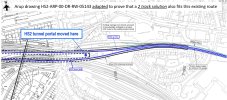
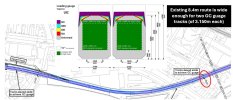
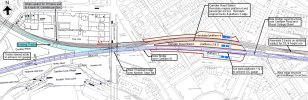
Here are some drawings. No bottleneck as there'd be 4 tracking (just restoring the original 4 tracks onto existing railway land (see last of the images below).
TfL and freight would use the restored tracks (with freight continuing in 8 slots between Overground trains to run from Stratford to Willesden - as they do now to Camden).
Right now only one freight each way an hour uses the route to Primrose Hill. Just take those to Willesden and the Camden Town station to Primrose Hill route is totally free for HS2 trains and Javelins - which could be signalled to cope with 24 tph at 40mph (which is a good enough speed for trains slowing down to reach St Pancras platforms).

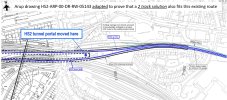
These drawings adapt the original Arup drawings that proved this route works. But by using it for TWO tracks and at least 12 tph instead of just a couple of Eurostars it's viable.

Popping the tunnel out on railway land just north of Juniper Crescent (where HS2 now have their temporary offices) is easy with the ramp curving around onto the NNL and reaching ground level before the road bridge - as HS2 gradients. I've checked on Autocad and measured the viaduct width to check that a pair of GC guage trains fit.
Only the top floor of a dentists practice would be demolished (at Kentish Town Rd where the viaduct needs widening for 4 tracks). Only one building 1st floor. That building could be rebuilt into the back garden - to restore the same space as a single floor structure under the new viaduct.

I'm a retired Architect who worked on the Channel Tunnel UK terminal. I've also put these ideas to HS1 Ltd directors, Ministers and Campaign for better Transport.
 

Attachments

  • PrimroseHill-Junction.jpg
    PrimroseHill-Junction.jpg
    243.5 KB · Views: 37
  • AlternativeSolution.jpg
    AlternativeSolution.jpg
    207 KB · Views: 37
  • PrimroseHill.jpg
    PrimroseHill.jpg
    317.8 KB · Views: 39
  • CamdenMarket-NNL.jpg
    CamdenMarket-NNL.jpg
    102.9 KB · Views: 37
  • CamdenRoadStation.jpg
    CamdenRoadStation.jpg
    201.3 KB · Views: 37
  • StPancras-Junctionwork.jpg
    StPancras-Junctionwork.jpg
    282.7 KB · Views: 37
  • NNL-4tracking-on-existing-railway-land.jpg
    NNL-4tracking-on-existing-railway-land.jpg
    260.6 KB · Views: 37
Last edited:

MotCO

Established Member
Joined
25 Aug 2014
Messages
6,146
Is there any capacity at St Pancras International once Virgin or other competitors to Eurostar commence operations?
 

John Jefkins

Member
Joined
14 Mar 2025
Messages
39
Location
Croydon
There aren't existing north London links to HS2 though. Where is the tunnel portal going to be? How much does it cost to build?


How much demand is there from the HS1 corridor to the north, as opposed to demand from other places in central London? Stratford to Stratford International isn't a panacea as a connection, and is not really any better than St Pancras to Euston which you seem to be suggesting is a challenge.

There doesn't appear to be clarity here as to just how many trains need to run on the 'overlap' section. Is it trains from HS1 as well as trains starting in London? Is this at the speeds typically associated with the existing North London Line?


What sort of grade separation does this require at St Pancras? Where do the 'Javelins' terminate? How many more of them need to be built?

If this saves £6bn of cost at Euston, how much of that needs to be spent instead for this plan?
There are multiple options here (for a growing market).

Option 1 is for 4 Javelins / hr sent west to terminate at OOC's central platforms and 8 HS2 tph using the 24 slots (of 7.5min) or 30 slots (of 6 minutes) freed up on Javelin platforms. (I'd prefer to use the poorly used Eurostar platforms but HS1 directors don't want to contemplate better using them until they've got their deal to expand Eurostar worked out - in the next 2 years). To really expand Eurostar though, it needs to reach O.O.C.

So Option 2 is for those same 4 Javelins to replace the Heathrow express (with a ramp to the GWR at OOC just like the ramp at Stratford).
By the way, yet another single track ramp at the other end of Stratford could link to the GE tracks just east of Maryland station to take yet more Javelins from Colchester - one day.

So the overlap is of at least 12 trains/hr (4 Javelins plus at least 8 HS2 200m trains). But with Eurostars reaching OOC it could be 14. As that would free up Eurostar platforms at St Pancras, there could be 11 HS2 trains plus 4 Javelins plus 2 Eurostars using the overlap - so let's signal it for at least 20 tph. Its only a slow speed line after all.

Thameslink is signalled for 24 tph. Let's use this link in the same way.
 

Attachments

  • Option1.jpg
    Option1.jpg
    133.9 KB · Views: 24
  • Option2.jpg
    Option2.jpg
    273.7 KB · Views: 23
  • Option3.jpg
    Option3.jpg
    212.9 KB · Views: 22
  • MarketUplift.jpg
    MarketUplift.jpg
    183.2 KB · Views: 24
  • BoostingMarkets.jpg
    BoostingMarkets.jpg
    199.1 KB · Views: 26

JonathanH

Veteran Member
Joined
29 May 2011
Messages
23,405
Reversing into St Pancras and back out again seems a folly, when the trains coming from HS1 could just go 'straight on' from the portal to a new station off York Way where the Camden Council depot and Freight Way are. Presumably the Piccadilly Line is broadly underneath for underground connections.

However, Stratford to Heathrow still looks as if it would be quicker on the Elizabeth Line, once the effort of getting to Stratford International is considered.
 

John Jefkins

Member
Joined
14 Mar 2025
Messages
39
Location
Croydon
You haven’t answered my earlier questions (fair enough, you don’t have to), but you have repeated many things that are not true.

It is worth reading, in full, the assessment of the potential rail options (and other options). Link here, obviously too long to quote.

The report is 10 years old, and the costs contained within it must be treated with the same caution as the costs of HS2 itself from 10 years ago.

Right, down to brass tacks.

1) Can you explain why you think St Pancras has only 6tph from 9 platforms. Between 0800-0900 tomorrow there are 18 train movements in or out of St Pancras P5-P13. At the peak times there are 7 Southeastern High Speed services each way, and that is likely to be 8 before too long. Are you proposing that all of these continue onto HS2?

2) The existing track layout at St Pancras is not conducive to frequent reversals from Stratford and towards Camden. It can only be done in the international platforms, not the domestic. To enable the domestic platforms to be used as such would require wholesale remodelling of the throat, and almost certainly reduced speeds. The reduced speed would extend junction clearance margins and the platform reoccupation would need to increase from the current 4 minutes, probably to 6.

3) The international platforms at St P are international gauge (and height), the domestic platforms are domestic gauge (and height), and also only 295m. Which are to be used in your proposal by the Southeastern High Speed services (240m), and the HS2 services (400m), all of which will be formed of domestic gauge stock?

4) Put simply, it would not be possible to turn round the quantity of services at St Pancras you propose to, using any of the platforms, simply because of the large number of conflicting movements - up to 40 an hour at peaktimes - it would cause on any track layout at grade.

5) Turning 400m HS2 trains in 3.5 minutes might be possible, but only if there are not large numbers of people alighting and boarding, which there would be. Nowhere in the world does this.

5) The existing (unused) link between St Pancras and the North London Line is single track. As was the (non-existing) proposed link from there to Old Oak Common. Your proposal implies this would all be double track. Clearly this costs money, as there would be several new structures to build. As the above linked report also explains, it also requires lots of demolition in central Camden, including of listed buildings. It also means closing the NLL for some time to enable the rebuild, and I suspect would permanently reduce the capacity of the NLL too (unless much further demolition was preferred). This would take 7-8 years minimum from where we are now, plus several billion pounds.

6) There is no link from the HS2 OOC box towards Heathrow. Therefore having Southeastern High Speed services go to Heathrow is a non starter. (Unless you want to rebuild the OOC box and / or build new subterrean junctions west of OOC, and grade seperated junctions on to the GWML; as with the Camden end this would take about 7-8 years minimum from where we are now plus several billion pounds).

7) To use the international platforms at Stratford for trains terminating from the west requires either a shunt move on the running line east of Ripple Lane, or wrong line running between St Pancras and Stratford. Neither are easily timetabled.

8) Your assumptions about traffic generation from the direct link are baffling to me and seem to be very optimistic. I have never seen any modelled data to suggest that through trains from Kent to OOC would drive anything like the increases you suggest, similarly for through trains from HS2 towards Kent. How have you calculated them? Could you give some examples of journeys that are made much easier, and what the current flows are?

9) Kings Cross St Pancras tube does not have lots of spare capacity, as anyone using it on a weekday morning will attest.

10) Alternatives to Euston were studied extensively during the early stage of development for HS2. Using St Pancras was considered, but not taken forward. Am I right to assume that you feel the teams of professional engineers, rail operations experts, station capacity experts, town planners, construction planners, environmental managers and analysts who did this work reached the wrong conclusion, but your proposal is the right one?


In summary, doing what you propose would actually be likely to cost more than going to Euston, and take somewhat longer (as we’d be starting from scratch for planning and consents), if it was even possible, which appears not to be the case for much of it.


and finally... when you emphasise certain words in CAPITALS it makes your posts look quite shouty and implies that you think you know far more about this than others and that we are all a bit stupid. Of course that might be true. But, when others have done this in the past, both on this website and in other places, it is usually done by people who have a pet proposal and will not listen to any reasons put forward why that proposal may be challenging. Perhaps you will prove me wrong here by considering and answering some of the points above, without just repeating what you have already written.
Thanks. Sorry for the caps by the way. Silly habit of mine.
1) You've doubled tph for movements. There normally are 6 tph (12 movements). I've allowed for 8 slots for Javelins and 16 for HS2 trains - which are indeed being built to cope with either height of platform. Yes, all 4 (or 5) Javelins would continue to OOC.
2) I too would prefer using the Eurostar platforms, and HS1 agree they are "underused" right now. They want to pause discussion of that until they've worked out deals with Virgin, but even with a doubling of Eurostar style services, those platforms would remain underused and resilience stock could be parked in the ECML and MML chords.
I agree that an overbridge is needed (and I've drawn one curving across Eurostar tracks to the Javelin approach). The chord to the NNL needs 2 tracks. But the tracks towards Eurostar platforms could be crossed for most of each hour as there really are only 4 train movements (perhaps 8 in the future) each hour to and from those 6 platforms.
As you say, the St Pancras throat is already well designed and capable of taking extra train movements with these changes (all far cheaper than building a 10 platform Euston).
3) As just said, HS2 trains are now designed to cope with either platform height.
4) I would agree that using a couple of the Eurostar platforms is better. But why don't we explore this more - as the cost savings and market boosting makes it worthwhile. I'm an Architect rather than rail person, so I agree that a solution needs to be found here. Let's work on that though rather than giving up.

5) They would all be 2 track as explained. 4 tracking the NNL actually leaves room for a 3 track approach you will see.
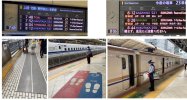
You say "nowhere else reverses trains this fast", but Frankfurt HbH reverses ICE trains in 4 to 5 minutes. All day long with ICE (high speed trains).
Tokyo even cleans trains and terminates them in only 10-12 minutes. (Evidence in the photos I took there below - where the indicator shows 15 minute slots).

6) Initially HS2 will only be running 200m classic compatible trains. Hence Options 1 and 2 only deal with up to 8 of those trains/hr. Longer term, 400m trains would need to use a couple of those 6 Eurostar platforms or be sent to a by then built Euston. But most HS2 trains will remain as those 200m long "classic compatibles". And we could explore that idea of shared Eurostar style trains bidding for the franchises for Manchester trains with 1/3rd international and 2/3rds domestic swopping on platforms 5 & 10.
7) A minor track adjustment to the route up to the Temple Mills ramp would enable terminating trains to reach either of the central platforms there.
Through trains would be switched to the disused outer platforms as that wouldn't cause the fast lines to be crossed. Again these are 200m classic compatible HS2 trains.

8) I'm not talking about Kent trains being the main traffic boost. Its the connections to the vast Thameslink network (plus easier links via London Bridge than to Euston) that causes the main boost. 70% of London benefits there. Javelins, Piccadilly line, Stratford's link to Great Eastern, Kings X links from Cambridge, MML etc all add bits too. Kent is a smaller part. The PDFH says that for Thameslink passengers, using St Pancras instead of Euston cuts out a 65 minute interchange penalty and boosts markets by 47%.
That also works for Kings X traffic (eg from Cambridge) and to a lesser extent GE connections and Kent connections too.

9) Again, Thameslink has far more capacity than tube links from Euston. Kings X tube has vast capacity and more tube lines.
For through trains, people stay on board (to Stratford or Kent). St Pancras and Stratford are far better connected already than Euston.
The 1st floor of St Pancras is also underused with vast capacity if the champagne bar and restaurants were moved.

10) I cannot comment on why this got missed. But it did. Arup did draw this up, but the NNL was only proposed as a Eurostar link. Eurostar never wanted to stop trains at Stratford and would only rarely use the Kent platforms - making sharing possible. Ashford has sidings just beyond it too. Could it be that vested interests saw HS2 as an opportunity to fleece government out of loads of cash for a rebuilt Euston when HS1 already had the poorly used platforms and the capacity?

Thinking about this more, since 2014, Thameslink got more reliable, Elizabeth line proved the case for cross-london traffic, Land adjacent to the NNL got developed leaving clear passageways either side to cantilever stuff over it's edge and it's been shown that HS2 planning was over-specified and a lot of bad mistakes were made. We've moved on.

What I'm proposing costs far less than Euston. It can be opened sooner - to start payback sooner. And it gives time for a reduced scale Euston re-built for both types of trains with platforms flexibly shared. That Euston could wait until HS2 reaches Manchester. Possibly until it reaches Leeds...
Far fewer HS2 platforms would be ever needed at Euston though. Perhaps only 2 - for just the Birmingham shuttle (with 45 minute journeys getting cleaned at only Brum)
That would mean 2 tracks towards St Pancras and only a single track (stub built now) from Primrose Hill towards a future smaller Euston.
 

Attachments

  • Fast-Termination-at-Tokyo.jpg
    Fast-Termination-at-Tokyo.jpg
    119.2 KB · Views: 19
Last edited:

The Ham

Veteran Member
Joined
6 Jul 2012
Messages
12,056
Let’s focus on domestic services first.
Yes some Eurostar stuff is also possible but the domestic benefits of connecting to St Pancras and Stratford instead of Euston are the main benefits.

The 1st floor of St Pancras has loads of unused passenger space.
Reversals there would mean lots of passengers remain on board through trains instead of using two sets of platforms and two trains.

I’m taking about providing better domestic services to 70% of the HS2 market by cutting their journey times by an hour ( according to the PDFH) as a better interchange cuts out a 65 minute interchange penalty.

Simply by switching most HS2 trains to terminate on HS1 platforms.

70% of HS2 market at the southern end is not heading to/from southeastern (TOC or NR) area, so how does heading to HS1 help those other areas?

I can see how getting to St. Pancras would help with the interchange to Thameslink, but that's unlikely to be an hour quicker.

I can more easily understand that 70% of HS2 market at the southern end is going to/from southeast (region of the UK), however a chunk of that will be changing at Old Oak Common and (if it's built) changing to Crossrail 2 at Euston.

As the southeast region of the UK includes Bucks (0.55 million), Oxfordshire (0.75 million), Berkshire (0.95million), Hampshire (1.4 million), Surrey (1.2 million), East/West Sussex (1.4 million) and Kent (1.6 million*). However, that still doesn't cater for places like Essex who may also use HS2 services and are in the Eastern region of the UK.

* Whilst Kent is the largest county by population, not by much when compared to Hampshire (which doesn't include Portsmouth, Southampton or the Isle of Wight) and it's not even 20% of the total population of the Southeast. Even if you include Kent, Medway, East Sussex and West Sussex you only get to just over 1/3 of the Southeast's population, so are you really saying that they are such a power house that the similar sized population from Hampshire, Surrey, Portsmouth, Southampton and the Isle of Wight don't have a similar impact on desire for direction of travel?

The only way I can understand that the 70% works is if there's like 50% within London and you are counting that but implying that they will all also benefit from being at St Pancras by an hour off their journey time even if they were going to somewhere like Tottenham Court Road (where the journey would be worse) or Paddington (where it would make no difference as they'd be changing at Old Oak Common anyway).
 

JonathanH

Veteran Member
Joined
29 May 2011
Messages
23,405
However, that still doesn't cater for places like Essex who may also use HS2 services and are in the Eastern region of the UK.
I think that Stratford International is doing some heavy lifting in the other poster's proposals, meaning that passengers for Essex change there.
 

John Jefkins

Member
Joined
14 Mar 2025
Messages
39
Location
Croydon
What interchange takes 65 minutes at Euston but not at St Pancras?

Where exactly are you proposing HS2 trains call next after Old Oak Common?
Its the "interchange penalty" where the perceived total journey time is increased by 65 minutes due to the uncertainty of how long it takes to make the connection.
If you're coming from say Cambridge or Brighton or Sevenoaks or London bridge on a Thameslink you'd need more time to reach Euston and you'd also thus allow more time to make certain of getting onto your booked train time.

At St Pancras the connection is so much quicker and Thameslinks so more frequent that you'd need less time to connect to an HS2 train there.

== Doublepost prevention - post automatically merged: ==

You haven’t answered my earlier questions (fair enough, you don’t have to), but you have repeated many things that are not true.

It is worth reading, in full, the assessment of the potential rail options (and other options). Link here, obviously too long to quote.

The report is 10 years old, and the costs contained within it must be treated with the same caution as the costs of HS2 itself from 10 years ago.

Right, down to brass tacks.

1) Can you explain why you think St Pancras has only 6tph from 9 platforms. Between 0800-0900 tomorrow there are 18 train movements in or out of St Pancras P5-P13. At the peak times there are 7 Southeastern High Speed services each way, and that is likely to be 8 before too long. Are you proposing that all of these continue onto HS2?

2) The existing track layout at St Pancras is not conducive to frequent reversals from Stratford and towards Camden. It can only be done in the international platforms, not the domestic. To enable the domestic platforms to be used as such would require wholesale remodelling of the throat, and almost certainly reduced speeds. The reduced speed would extend junction clearance margins and the platform reoccupation would need to increase from the current 4 minutes, probably to 6.

3) The international platforms at St P are international gauge (and height), the domestic platforms are domestic gauge (and height), and also only 295m. Which are to be used in your proposal by the Southeastern High Speed services (240m), and the HS2 services (400m), all of which will be formed of domestic gauge stock?

4) Put simply, it would not be possible to turn round the quantity of services at St Pancras you propose to, using any of the platforms, simply because of the large number of conflicting movements - up to 40 an hour at peaktimes - it would cause on any track layout at grade.

5) Turning 400m HS2 trains in 3.5 minutes might be possible, but only if there are not large numbers of people alighting and boarding, which there would be. Nowhere in the world does this.

5) The existing (unused) link between St Pancras and the North London Line is single track. As was the (non-existing) proposed link from there to Old Oak Common. Your proposal implies this would all be double track. Clearly this costs money, as there would be several new structures to build. As the above linked report also explains, it also requires lots of demolition in central Camden, including of listed buildings. It also means closing the NLL for some time to enable the rebuild, and I suspect would permanently reduce the capacity of the NLL too (unless much further demolition was preferred). This would take 7-8 years minimum from where we are now, plus several billion pounds.

6) There is no link from the HS2 OOC box towards Heathrow. Therefore having Southeastern High Speed services go to Heathrow is a non starter. (Unless you want to rebuild the OOC box and / or build new subterrean junctions west of OOC, and grade seperated junctions on to the GWML; as with the Camden end this would take about 7-8 years minimum from where we are now plus several billion pounds).

7) To use the international platforms at Stratford for trains terminating from the west requires either a shunt move on the running line east of Ripple Lane, or wrong line running between St Pancras and Stratford. Neither are easily timetabled.

8) Your assumptions about traffic generation from the direct link are baffling to me and seem to be very optimistic. I have never seen any modelled data to suggest that through trains from Kent to OOC would drive anything like the increases you suggest, similarly for through trains from HS2 towards Kent. How have you calculated them? Could you give some examples of journeys that are made much easier, and what the current flows are?

9) Kings Cross St Pancras tube does not have lots of spare capacity, as anyone using it on a weekday morning will attest.

10) Alternatives to Euston were studied extensively during the early stage of development for HS2. Using St Pancras was considered, but not taken forward. Am I right to assume that you feel the teams of professional engineers, rail operations experts, station capacity experts, town planners, construction planners, environmental managers and analysts who did this work reached the wrong conclusion, but your proposal is the right one?


In summary, doing what you propose would actually be likely to cost more than going to Euston, and take somewhat longer (as we’d be starting from scratch for planning and consents), if it was even possible, which appears not to be the case for much of it.


and finally... when you emphasise certain words in CAPITALS it makes your posts look quite shouty and implies that you think you know far more about this than others and that we are all a bit stupid. Of course that might be true. But, when others have done this in the past, both on this website and in other places, it is usually done by people who have a pet proposal and will not listen to any reasons put forward why that proposal may be challenging. Perhaps you will prove me wrong here by considering and answering some of the points above, without just repeating what you have already written.
I took half an hour to answer this - but cannot see my reply. Moderator, please can you sort this out. Thanks.

== Doublepost prevention - post automatically merged: ==

I cannot claim any technical knowledge, but it seems to me that it would be worth linking HS1 and HS2, not for international services north of London- I quite agree that they are not feasible- but to better integrate points east and southeast of London into the network.

Could there not be a service running, at the very least, Dover-Ashford-Ebbsfleet-Stratford-[St. Pancras or Euston]-Old Oak- Heathrow, or further afield,

Totally agree. And replacing steelwork over 6 road bridges, restoring 4 tracking onto existing railway land and restoring the 2 old Camden Town platforms is a lot cheaper than building Euston.

HS1 Ltd would need to add an extra overbridge to access Javelin platforms and add a couple more lifts onto the outside of the newer bit of St Pancras. But little else.
The top floor of St Pancras has loads of spare space. HS1 has 6 totally unused platforms to terminate trains. And high speed trains reverse at Frankfurt in only 5 minutes.
 

Attachments

  • Option1.jpg
    Option1.jpg
    133.9 KB · Views: 10
  • Option2.jpg
    Option2.jpg
    273.7 KB · Views: 8
  • PrimroseHill-Junction.jpg
    PrimroseHill-Junction.jpg
    243.5 KB · Views: 7
  • PrimroseHill.jpg
    PrimroseHill.jpg
    317.8 KB · Views: 7
  • NNL-4tracking-on-existing-railway-land.jpg
    NNL-4tracking-on-existing-railway-land.jpg
    260.6 KB · Views: 9
  • StPancras-Junctionwork.jpg
    StPancras-Junctionwork.jpg
    282.7 KB · Views: 10
Last edited:

John Jefkins

Member
Joined
14 Mar 2025
Messages
39
Location
Croydon
I think that Stratford International is doing some heavy lifting in the other poster's proposals, meaning that passengers for Essex change there.
That's the main connection to Essex. But if it's successful, why not add a single track tunnel connection from the eastern end of Stratford to join Great Eastern tracks east of Maryland station. That would enable say 3 Javelins per hour from Colchester to St Pancras, Old Oak and Heathrow (or even Woking via a Heathrow southern link).

Lets CONNECT our London rail links together by actually using this HS2-HS1 link !

== Doublepost prevention - post automatically merged: ==

You haven’t answered my earlier questions (fair enough, you don’t have to), but you have repeated many things that are not true.

It is worth reading, in full, the assessment of the potential rail options (and other options). Link here, obviously too long to quote.

The report is 10 years old, and the costs contained within it must be treated with the same caution as the costs of HS2 itself from 10 years ago.

Right, down to brass tacks.

1) Can you explain why you think St Pancras has only 6tph from 9 platforms. Between 0800-0900 tomorrow there are 18 train movements in or out of St Pancras P5-P13. At the peak times there are 7 Southeastern High Speed services each way, and that is likely to be 8 before too long. Are you proposing that all of these continue onto HS2?

2) The existing track layout at St Pancras is not conducive to frequent reversals from Stratford and towards Camden. It can only be done in the international platforms, not the domestic. To enable the domestic platforms to be used as such would require wholesale remodelling of the throat, and almost certainly reduced speeds. The reduced speed would extend junction clearance margins and the platform reoccupation would need to increase from the current 4 minutes, probably to 6.

3) The international platforms at St P are international gauge (and height), the domestic platforms are domestic gauge (and height), and also only 295m. Which are to be used in your proposal by the Southeastern High Speed services (240m), and the HS2 services (400m), all of which will be formed of domestic gauge stock?

4) Put simply, it would not be possible to turn round the quantity of services at St Pancras you propose to, using any of the platforms, simply because of the large number of conflicting movements - up to 40 an hour at peaktimes - it would cause on any track layout at grade.

5) Turning 400m HS2 trains in 3.5 minutes might be possible, but only if there are not large numbers of people alighting and boarding, which there would be. Nowhere in the world does this.

5) The existing (unused) link between St Pancras and the North London Line is single track. As was the (non-existing) proposed link from there to Old Oak Common. Your proposal implies this would all be double track. Clearly this costs money, as there would be several new structures to build. As the above linked report also explains, it also requires lots of demolition in central Camden, including of listed buildings. It also means closing the NLL for some time to enable the rebuild, and I suspect would permanently reduce the capacity of the NLL too (unless much further demolition was preferred). This would take 7-8 years minimum from where we are now, plus several billion pounds.

6) There is no link from the HS2 OOC box towards Heathrow. Therefore having Southeastern High Speed services go to Heathrow is a non starter. (Unless you want to rebuild the OOC box and / or build new subterrean junctions west of OOC, and grade seperated junctions on to the GWML; as with the Camden end this would take about 7-8 years minimum from where we are now plus several billion pounds).

7) To use the international platforms at Stratford for trains terminating from the west requires either a shunt move on the running line east of Ripple Lane, or wrong line running between St Pancras and Stratford. Neither are easily timetabled.

8) Your assumptions about traffic generation from the direct link are baffling to me and seem to be very optimistic. I have never seen any modelled data to suggest that through trains from Kent to OOC would drive anything like the increases you suggest, similarly for through trains from HS2 towards Kent. How have you calculated them? Could you give some examples of journeys that are made much easier, and what the current flows are?

9) Kings Cross St Pancras tube does not have lots of spare capacity, as anyone using it on a weekday morning will attest.

10) Alternatives to Euston were studied extensively during the early stage of development for HS2. Using St Pancras was considered, but not taken forward. Am I right to assume that you feel the teams of professional engineers, rail operations experts, station capacity experts, town planners, construction planners, environmental managers and analysts who did this work reached the wrong conclusion, but your proposal is the right one?


In summary, doing what you propose would actually be likely to cost more than going to Euston, and take somewhat longer (as we’d be starting from scratch for planning and consents), if it was even possible, which appears not to be the case for much of it.


and finally... when you emphasise certain words in CAPITALS it makes your posts look quite shouty and implies that you think you know far more about this than others and that we are all a bit stupid. Of course that might be true. But, when others have done this in the past, both on this website and in other places, it is usually done by people who have a pet proposal and will not listen to any reasons put forward why that proposal may be challenging. Perhaps you will prove me wrong here by considering and answering some of the points above, without just repeating what you have already written.
 

Attachments

  • Connecting-Rail-Networks.jpg
    Connecting-Rail-Networks.jpg
    230 KB · Views: 12
  • London-Stations.jpg
    London-Stations.jpg
    142.3 KB · Views: 11
  • BoostingMarkets.jpg
    BoostingMarkets.jpg
    199.1 KB · Views: 11
  • MarketUplift.jpg
    MarketUplift.jpg
    183.2 KB · Views: 9
  • CurrentCosts.jpg
    CurrentCosts.jpg
    193.7 KB · Views: 8
  • AlternativeSolution.jpg
    AlternativeSolution.jpg
    207 KB · Views: 9
Last edited by a moderator:

The Planner

Veteran Member
Joined
15 Apr 2008
Messages
19,748
There are multiple options here (for a growing market).

Option 1 is for 4 Javelins / hr sent west to terminate at OOC's central platforms and 8 HS2 tph using the 24 slots (of 7.5min) or 30 slots (of 6 minutes) freed up on Javelin platforms. (I'd prefer to use the poorly used Eurostar platforms but HS1 directors don't want to contemplate better using them until they've got their deal to expand Eurostar worked out - in the next 2 years). To really expand Eurostar though, it needs to reach O.O.C.
I am unsure about what you are stating here, are you saying that a HS2 train turns around in either 6 or 7½ minutes?
 
Status
Not open for further replies.

Top