• Our new ticketing site is now live! Using either this or the original site (both powered by TrainSplit) helps support the running of the forum with every ticket purchase! Find out more and ask any questions/give us feedback in this thread!

Glasgow-Edinburgh 47/7 and pp set diagrams - 1980

Status
Not open for further replies.

Big Jumby 74

Established Member
Joined
12 Feb 2022
Messages
2,254
Location
UK
Hi all. I am aware there are several threads worth of discussion about this route in general, but can't find the answer to that which I refer now, so would welcome comments from those with a better memory than I;

Given the shortish length of route and the 47/7's having had a second fuel tank added for these diagrams, would I be correct in thinking that the diagrams involved a short (11-13 ish mins) turn round at both Edinburgh and Glasgow. This would be natural thinking from BR at the time, given the economic climate back then, but for a more resilient timetable it could have been the case that a longer overlapping turn round (41-43 ish mins) could have been in place at one end, with the the obvious increase in locos and sets.
I know ScR had 12 x 47/7 in those early days, but my understanding is that reliability wasn't that good given the intensity of the diagrams, so does suggest short turn rounds at both ends was the norm.

Any confirmation or otherwise very welcome. TIA.
 
Sponsor Post - registered members do not see these adverts; click here to register, or click here to log in
R

RailUK Forums

The exile

Established Member
Joined
31 Mar 2010
Messages
9,475
Location
Somerset
From memory, Queen Street trains “always” left from platform 14 - meaning there was only ever one set in Waverley at a time.
 

Cheshire Scot

Established Member
Joined
24 Jul 2020
Messages
1,677
Location
North East Cheshire
Hi all. I am aware there are several threads worth of discussion about this route in general, but can't find the answer to that which I refer now, so would welcome comments from those with a better memory than I;

Given the shortish length of route and the 47/7's having had a second fuel tank added for these diagrams, would I be correct in thinking that the diagrams involved a short (11-13 ish mins) turn round at both Edinburgh and Glasgow.
Yes, 11-13 min turnrounds were the norm at both ends.

In the previous cl 27 on each end pp operation there was a fifth set which was nominally required for one peak extra morning and evening although the practice was for each of the five sets to be taken out in turn for servicing between the peaks. This continued in the early 47/7 days but it was soon realised a 47/7 & MkIII set could be more benifcially used on a Glasgow Aberdeen diagram (2 round trips) with the peak extras being covered by less prestigeous stock with the E&G running all day with short turnrounds.
 

Big Jumby 74

Established Member
Joined
12 Feb 2022
Messages
2,254
Location
UK
From memory, Queen Street trains “always” left from platform 14 - meaning there was only ever one set in Waverley at a time
Yes, 11-13 min turnrounds were the norm at both ends.
Thank you both. That answers my question, and makes good sense, four diagrams for the core standard pattern service.
In the previous cl 27 on each end pp operation there was a fifth set which was nominally required for one peak extra morning and evening although the practice was for each of the five sets to be taken out in turn for servicing between the peaks. This continued in the early 47/7 days
This again makes good diagramming sense, even in to 47/7 days to give a little wiggle room, even if not actually required for servicing. Obviously the thinking behind such things can and often did change, viz the Aberdeen diagrams.
In the book 'Class 47 - The 50 year history' there is mention of 9 x 47/7 diagrams (from 12 locos), a secondary observation on my part, but partly why I asked the question, as 4/5 diagrams (Glasgow-Edinburgh) seemed to be the likely core number required. Quite possible of course that diagram swaps towards the end of the (day's) diagram's might on paper increase that number of diagrams, but 9 does still seem excessive.

Just out of curiosity, how many MkIII pp sets were there in the end?
 

hexagon789

Veteran Member
Joined
2 Sep 2016
Messages
18,337
Location
Glasgow
Just out of curiosity, how many MkIII pp sets were there in the end?
Enough stock for 7 (at least the Scottish Region/ScotRail had seven Mk3 FO, converted to CO in 1986), and there were also 3 Mk2 sets from May 1985 (from May 1986 a 4th was added when Edinburgh to Aberdeen went push-pull).

There was also the 'spare' set in the early 80s, pre Aberdeen going fully push-pull, using the one retained set of ex-E&G modified Mk2Zs; in 1982 it was used on the Glasgow-Perth/Dundee semi-fast alternating with a load 5 Mk1 VB set, in 1983 that swapped to an Edinburgh-Perth semi-fast.

The Spare set was used variously for a peak-hour E&G diagram, a hot spare and even the 'low cost' summer only "Jacobite" between either Glasgow or Edinburgh and Inverness, depending on the year.
 

The exile

Established Member
Joined
31 Mar 2010
Messages
9,475
Location
Somerset
Enough stock for 7 (at least the Scottish Region/ScotRail had seven Mk3 FO, converted to CO in 1986), and there were also 3 Mk2 sets from May 1985 (from May 1986 a 4th was added when Edinburgh to Aberdeen went push-pull).

There was also the 'spare' set in the early 80s, pre Aberdeen going fully push-pull, using the one retained set of ex-E&G modified Mk2Zs; in 1982 it was used on the Glasgow-Perth/Dundee semi-fast alternating with a load 5 Mk1 VB set, in 1983 that swapped to an Edinburgh-Perth semi-fast.

The Spare set was used variously for a peak-hour E&G diagram, a hot spare and even the 'low cost' summer only "Jacobite" between either Glasgow or Edinburgh and Inverness, depending on the year.
On summer Sundays in the mid 80s one of the sets got a day out to Oban from Edinburgh.
 

Magdalia

Established Member
Joined
1 Jan 2022
Messages
7,437
Location
The Fens
Tread very carefully with regard to the Edinburgh-Glasgow service in 1980, it is a minefield where what most people think they remember isn't what actually happened.

That is because Falkirk tunnel was closed for emergency engineering work on 10 March 1980 and only reopened on 8 December 1980.

During this period, which included the introduction of the class 47/7+MarkIII+DBSO sets, a revised service via Falkirk Grahamston was in operation.

Glasgow departures were at xx05 and xx35, Edinburgh departures were at xx15 and xx45.

5*class 47/7+MarkIII+DBSO sets were required to operate the revised service.

Anyne got a ”1H80“or ”Loco-hauled Travel” book handy? That would show the diagrams and times
1H80 only lists the trains that were in the published timetable, it does not give the revised service.

There is no Loco Hauled Travel book for 1980, these started in 1982.
 

Helvellyn

Established Member
Joined
28 Aug 2009
Messages
2,592
Enough stock for 7 (at least the Scottish Region/ScotRail had seven Mk3 FO, converted to CO in 1986), and there were also 3 Mk2 sets from May 1985 (from May 1986 a 4th was added when Edinburgh to Aberdeen went push-pull).

There was also the 'spare' set in the early 80s, pre Aberdeen going fully push-pull, using the one retained set of ex-E&G modified Mk2Zs; in 1982 it was used on the Glasgow-Perth/Dundee semi-fast alternating with a load 5 Mk1 VB set, in 1983 that swapped to an Edinburgh-Perth semi-fast.

The Spare set was used variously for a peak-hour E&G diagram, a hot spare and even the 'low cost' summer only "Jacobite" between either Glasgow or Edinburgh and Inverness, depending on the year.
Just to expand on this:

Ten locomotives (47701-710) and ten DBSOs (9701-9710) were originally converted along with 7 Mk 3A FOs (11004-11010) and 28 Mk 3A TSOs (12004-12031) being transferred from the London Midland Region. That nominally gave seven sets (DBSO-FO-TSO-TSO-TSO-TSO-47/7) with three spare locos and three spare DBSOs.

As mentioned a Mk 2 set was formed up from some ex-push-pull vehicles, including FK 13424 that gained ScotRail livery but was quickly scrapped due to being insulated with asbestos. With the extra set, and I think due to loco availability two extra 47/7s were converted (47711/12) that gained Large Logo livery.

For the Aberdeen services going over to Push-Pull operation and extra three DBSOs (9711-9713) were converted plus four more 47/7s (47713-716), all of which i believe went straight into ScotRail colours. A handful of Mark 1 BGs gained ScotRail colours as well for use with the Mark 2D TSOs/TSOTs and Mk 2E FOs in these sets until the DBSOs and 47/7s were all ready.

I think Mk 2F FO 3284 gained ScotRail livery as the nominal replacement for Mk 2 FK 13424. FO 11022 and TSO 12051 also gained ScotRail after moving north as replacements for vehicles written off at Polmont (FO 11004 and TSO 12006) along with DBSO 9714 being converted to replace the DBSO (9706) written off there. There was one TSO (12018) written off with fire damage, whilst 12009/10 headed back to the London Midland region several years early (I think when ScotRail removed a TSO from each set and converted the FO to a CO).

Caveat to all the above being that it's all from memory!
 

Big Jumby 74

Established Member
Joined
12 Feb 2022
Messages
2,254
Location
UK
Tread very carefully with regard to the Edinburgh-Glasgow service in 1980, it is a minefield where what most people think they remember isn't what actually happened.

That is because Falkirk tunnel was closed for emergency engineering work on 10 March 1980 and only reopened on 8 December 1980.

During this period, which included the introduction of the class 47/7+MarkIII+DBSO sets, a revised service via Falkirk Grahamston was in operation.

Glasgow departures were at xx05 and xx35, Edinburgh departures were at xx15 and xx45.

5*class 47/7+MarkIII+DBSO sets were required to operate the revised service.
Thank you, that does spin a slightly different light on things. Would I be correct in thinking the xx05 Glasgow departures made a stop at Falkirk G instead of the xx00's stop at High station?
 

hexagon789

Veteran Member
Joined
2 Sep 2016
Messages
18,337
Location
Glasgow
And for several years after that.
I thought they stopped after about 1983, maybe 1984?

== Doublepost prevention - post automatically merged: ==

Just to expand on this:

Ten locomotives (47701-710) and ten DBSOs (9701-9710) were originally converted along with 7 Mk 3A FOs (11004-11010) and 28 Mk 3A TSOs (12004-12031) being transferred from the London Midland Region. That nominally gave seven sets (DBSO-FO-TSO-TSO-TSO-TSO-47/7) with three spare locos and three spare DBSOs.

As mentioned a Mk 2 set was formed up from some ex-push-pull vehicles, including FK 13424 that gained ScotRail livery but was quickly scrapped due to being insulated with asbestos. With the extra set, and I think due to loco availability two extra 47/7s were converted (47711/12) that gained Large Logo livery.

For the Aberdeen services going over to Push-Pull operation and extra three DBSOs (9711-9713) were converted plus four more 47/7s (47713-716), all of which i believe went straight into ScotRail colours. A handful of Mark 1 BGs gained ScotRail colours as well for use with the Mark 2D TSOs/TSOTs and Mk 2E FOs in these sets until the DBSOs and 47/7s were all ready.

I think Mk 2F FO 3284 gained ScotRail livery as the nominal replacement for Mk 2 FK 13424. FO 11022 and TSO 12051 also gained ScotRail after moving north as replacements for vehicles written off at Polmont (FO 11004 and TSO 12006) along with DBSO 9714 being converted to replace the DBSO (9706) written off there. There was one TSO (12018) written off with fire damage, whilst 12009/10 headed back to the London Midland region several years early (I think when ScotRail removed a TSO from each set and converted the FO to a CO).

Caveat to all the above being that it's all from memory!
Looks good to me! :)

I understood the shortening of the Mk3 sets to 3 TSO plus CO in 1986 was to free up about 3 TSOs to form an additional push-pull set for Edinburgh to Aberdeen to go push-pull. Very soon it seems it was decided to use the Mk2Z TSO instead*, so by 1987 they'd generally gone back to 4 TSO, but obviously still with the converted COs.

This gave two five and two six-car Mk2 push-pull sets for 1986, each nominally having:

DBSO
FO - mostly 2E but one 2F vehicle
TSOT - 2D
2 TSO - 2D
*TSO - 2Z (six-car sets only)

Further changes occurred in 1987.
 
Last edited:

Magdalia

Established Member
Joined
1 Jan 2022
Messages
7,437
Location
The Fens
Thank you, that does spin a slightly different light on things. Would I be correct in thinking the xx05 Glasgow departures made a stop at Falkirk G instead of the xx00's stop at High station?
Yes. According to Railway Observer May 1980 most also called at Linlithgow and Polmont.

There could be further complications for weekend engineering work including sometimes going via Cumbernauld with a reversal at Eastfield.
 

hexagon789

Veteran Member
Joined
2 Sep 2016
Messages
18,337
Location
Glasgow
Yes. According to Railway Observer May 1980 most also called at Linlithgow and Polmont.
Interesting, given they weren't usual calls in the Edinburgh/Glasgow express services even in the peak hours until added in an alternating fashion to all normal services from the May 1986 timetable.
 

matchmaker

Established Member
Joined
8 Mar 2009
Messages
1,890
Location
Central Scotland
From memory, Queen Street trains “always” left from platform 14 - meaning there was only ever one set in Waverley at a time.
Queen Street has never had a platform 14 - highest number was 11 which was in the low level station. High level was 1-7.
 

Cheshire Scot

Established Member
Joined
24 Jul 2020
Messages
1,677
Location
North East Cheshire
Queen Street has never had a platform 14 - highest number was 11 which was in the low level station. High level was 1-7.
A different era but prior to 1960s remodelling High Level had nine platforms plus the four Low Level prior to that being reduced to two with electrification so 13 in total prior to 1960.
 

hexagon789

Veteran Member
Joined
2 Sep 2016
Messages
18,337
Location
Glasgow
Did the push-pull sets work to Inverness at all? If they did how frequently?
There was a brief Sundays only Glasgow to Inverness via Aberdeen and return which used one but conventionally hauled Aberdeen/Inverness.

There was also the seasonal/Fridays 'Jacobite' of the 1983, 1984 and 1985 timetables; otherwise only very rarely and conventionally hauled stock.

Inverness didn't sign DBSOs, so any use of push-pull sets on the Highland Main Line was generally worked conventionally and not as push-pull.
 

The exile

Established Member
Joined
31 Mar 2010
Messages
9,475
Location
Somerset
Queen Street has never had a platform 14 - highest number was 11 which was in the low level station. High level was 1-7.
If the train is at Queen Street then it’s an Edinburgh train! Platform 14 at Waverley for Queen St trains.

== Doublepost prevention - post automatically merged: ==

I thought they stopped after about 1983, maybe 1984?
Certainly ran in 1985.
 

Big Jumby 74

Established Member
Joined
12 Feb 2022
Messages
2,254
Location
UK
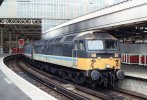
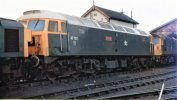
A couple of my pics of 47/7's back in the day. 707 on IS shed in August '79, and 706 looking the worst for ware on my own patch as was, about to depart Waterloo with the 16.55 to Exeter, one day in Oct 1991.
 

Attachments

  • BJ-47706 at Waterloo with 1655 to Exeter. Oct 1991..jpg
    BJ-47706 at Waterloo with 1655 to Exeter. Oct 1991..jpg
    480.3 KB · Views: 51
  • BJ-47707 on IS depot, August 1979..jpg
    BJ-47707 on IS depot, August 1979..jpg
    362.2 KB · Views: 51

Taunton

Veteran Member
Joined
1 Aug 2013
Messages
12,334
In the previous cl 27 on each end pp operation there was a fifth set which was nominally required for one peak extra morning and evening although the practice was for each of the five sets to be taken out in turn for servicing between the peaks. This continued in the early 47/7 days but it was soon realised a 47/7 & MkIII set could be more beneficially used on a Glasgow Aberdeen diagram (2 round trips) with the peak extras being covered by less prestigious stock with the E&G running all day with short turnrounds.
Although somewhat before the era of the original question here, the 1970s 2x27 service, which I have written about on here before, did have this fifth set which acted as a spare at the Glasgow end, generally standing at Eastfield. It did get used as a changeover during the day because the continuous running all day from 0600 to 2300 was occasionally beyond the fuel/water capacity of the locos, so they were serviced, without being detached from the stock, in turn during the day. The ETH installation, after a couple of years, did bring its own problems but allowed the water tank space to be converted to a larger fuel tank.
 

Cheshire Scot

Established Member
Joined
24 Jul 2020
Messages
1,677
Location
North East Cheshire
Although somewhat before the era of the original question here, the 1970s 2x27 service, which I have written about on here before, did have this fifth set which acted as a spare at the Glasgow end, generally standing at Eastfield. It did get used as a changeover during the day because the continuous running all day from 0600 to 2300 was occasionally beyond the fuel/water capacity of the locos, so they were serviced, without being detached from the stock, in turn during the day. The ETH installation, after a couple of years, did bring its own problems but allowed the water tank space to be converted to a larger fuel tank.
The class 27/1s also had larger fuel tanks although perhaps not as large as on 27/2s (?), I think something like 600 or 650 gallons rather than the as built 400 or 450 (can't remember), with smaller water tanks which often proved barely adequate when they were frequently used on non E&G services.
 

Big Jumby 74

Established Member
Joined
12 Feb 2022
Messages
2,254
Location
UK
The class 27/1s also had larger fuel tanks although perhaps not as large as on 27/2s (?), I think something like 600 or 650 gallons rather than the as built 400 or 450 (can't remember), with smaller water tanks which often proved barely adequate when they were frequently used on non E&G services
The critical point in understanding diagram content of course, being not so much the capacity (per gallon) but the range. Was involved in the SR 3H and 159 fleets, the former were permitted (planned) a max of 500 miles IIRC whilst the latter was 1600 miles, although in more recent times (I am reliably informed) this latter has varied at odd times between a high of 1700 and a low of 1500. Never directly involved with the Crompton's so can't give a figure for them off hand.
 

Taunton

Veteran Member
Joined
1 Aug 2013
Messages
12,334
In 27x2 days, and likely into 47/7 times, the 0620 start from Queen Street did 17 single trips before ending up at 2320 at Edinburgh, that is 810 miles. A bit for to/fro the overnight sidings, and sensibly a 10% contingency by the end, means a range required of 900 miles, and that assumes tanks properly filled to the top every night. Given that it was hard full throttle driving I would expect the consumption to be greater than average.
 

Strathclyder

Established Member
Joined
12 Jun 2013
Messages
3,848
Location
Clydebank
Further to the tangent of a Deltic heading a Mk3 push-pull set up to Oban - Edinburgh excursion in August 1981. 55021 Argyll & Sutherland Highlander was used twice, on the 2nd and 23rd of that month (linked photo copyright of Flickr's Arnie Furniss); headcode was 1Z19 for all 4 workings.

 
Status
Not open for further replies.

Top