No, it is currently sat doing nothing outside at Hitachi’s Merchant Park facility.Is 802207 in full use now? It’s my last 802 with TPE I’ve yet to ride on.

-
Our new ticketing site is now live! Using either this or the original site (both powered by TrainSplit) helps support the running of the forum with every ticket purchase! Find out more and ask any questions/give us feedback in this thread!
You are using an out of date browser. It may not display this or other websites correctly.
You should upgrade or use an alternative browser.
You should upgrade or use an alternative browser.
802207 Hitachi testing battery power for Transpennine
- Thread starter MR-507508
- Start date
- Status
- Not open for further replies.
Sponsor Post - registered members do not see these adverts; click here to register, or click here to log in
R
RailUK Forums
Does anyone know if this was achieved running on just the battery, or the battery+remaining gensets?
Just battery.
As others have said, this is great news, and is obviously going to be the future direction of rolling stock.
InTheEastMids
Established Member
- Joined
- 31 Jan 2016
- Messages
- 1,397
Thanks and absolutely agree on both points. It should give the industry confidence to say be clearer about where it will not electrifyJust battery.
As others have said, this is great news, and is obviously going to be the future direction of rolling stock.
The really interesting point is about the way change in technologies like batteries has been exponential.
People are very bad at imagining this, including energy models that have tended to presume linear progression and therefore failed to properly foresee the way solar and now battery deployment is growing.
For new trains it may mean the marginal cost of adding even quite significant amounts of batteries is going to be quite low, especially in a lifetime cost where you have to think about all the other stuff that has to happen anyway - build the rest of the train, acceptance testing, parking them at Long Marston for 3 years, industrial dispute resolution, training and so on.
But it also could mean the retrofit costs do not fall as much as one might think from just looking at battery prices - because whilst the batteries themselves may be extremely cheap, all the other re-engineering costs stay relatively static or increase more in line with inflation.
Diesels would switch off, that’s the whole idea of this project, save on emissions.If an 8** is using just its battery in an urban area does it actually switch off any diesels, or do they have to idle…to keep warm or whatever?
Approaching a station diesel would turn off, battery would be used approaching, while at, and departing a station, then diesel
Would kick back in again.
If an 8** is using just its battery in an urban area does it actually switch off any diesels, or do they have to idle…to keep warm or whatever?
AIUI in the testing they were switched off. Also I have an inkling that the MTU gensets have a pre-warming function that doesnt require the engine to be idling.
Pre warming is normally min 20 minutes before an engine turns on.AIUI in the testing they were switched off. Also I have an inkling that the MTU gensets have a pre-warming function that doesnt require the engine to be idling.
Thanks. Presumably this could be configured to a ‘keep warm’ function if the engine was to be switched off for, say, 10 minutes.Pre warming is normally min 20 minutes before an engine turns on.
Think it’s all programmed by gps by head code so that shouldn’t be an issueThanks. Presumably this could be configured to a ‘keep warm’ function if the engine was to be switched off for, say, 10 minutes.
If you look at Turntide's press release (cited in post #83) it says:
2570 V
822 kW
577 kWh.
The weight per single module is given on the summary page as 100 kg, but that's to good to be credible. In the data sheet it's stated to be 300 kg, which would make 4800 kg (plus structure) for the whole battery.
Those look quite plausible figures to me.
There is also data on their site about these battery modules (lithium-ion Nickel Manganese Cobalt). The biggest of these, called Gen 1, holds 36 kWh. In the data sheet for these they show a configuration of four in series, giving 1285V. So if a custom design had four of those, combined in series and parallel, you would get:Delivering sustainable mobility solutions means having high energy density. The solution should also be a flexible and scalable modular design for rapid deployment. The Series system voltage is a 48-volt (V) to 630-V capacity and more than 750 kilowatts.
The partnership produced a high-performance rail application battery pack of 16 batteries with a nominal system voltage of more than 2,500 V, designed to last four years on arduous routes or up to 15 years on lighter routes. This modular solution is ideal for retrofitting existing trains and avoiding extensive reengineering or rebuilding of the entire train.
2570 V
822 kW
577 kWh.
The weight per single module is given on the summary page as 100 kg, but that's to good to be credible. In the data sheet it's stated to be 300 kg, which would make 4800 kg (plus structure) for the whole battery.
Those look quite plausible figures to me.
https://www.modernrailways.com/article/uk-first-inter-city-battery-trial-opens-options-new-power
For those that subscribe this is an interesting article reporting on a successful trial. Assuming I don't miss something then it would be good to see this rolled out fairly soon on new build (open access operators) and some refits. Could well be a relatively easy quick win to 'electrify' some some routes and / or avoid use of diesel traction in station environments
With quickly advancing battery technology this probably has the capability to completely rethink OLE priorities.
For those that subscribe this is an interesting article reporting on a successful trial. Assuming I don't miss something then it would be good to see this rolled out fairly soon on new build (open access operators) and some refits. Could well be a relatively easy quick win to 'electrify' some some routes and / or avoid use of diesel traction in station environments
The successful trial to fit a Class 802/2 bi-mode unit with a lithium ion battery in place of a generator unit (GU) exceeded expectations and has enabled Hitachi to show exactly what might be possible if adopted for a full train fleet. The £17 million project was funded largely by Hitachi, with a £2 million contribution from the rolling stock leasing company Angel Trains.
The trial is also important as the industry looks towards the use of battery power more widely and underlines the value of requirements in train procurement exercises for any diesel engines that may be required in the short term to be replaced easily with batteries as the technology evolves
With quickly advancing battery technology this probably has the capability to completely rethink OLE priorities.
Nicholas Lewis
Established Member
No brainer full retrofit of all bimodes should give a competitive pricehttps://www.modernrailways.com/article/uk-first-inter-city-battery-trial-opens-options-new-power
For those that subscribe this is an interesting article reporting on a successful trial. Assuming I don't miss something then it would be good to see this rolled out fairly soon on new build (open access operators) and some refits. Could well be a relatively easy quick win to 'electrify' some some routes and / or avoid use of diesel traction in station environments
Mustn't use that as an excuse not do something now as battery technology especially lithium hasn't had a significant improvement in either power density or recharging rates from some years. If it does improve just swap out the batteries and gain some extra range.With quickly advancing battery technology this probably has the capability to completely rethink OLE priorities.
Mustn't use that as an excuse not do something now as battery technology especially lithium hasn't had a significant improvement in either power density or recharging rates from some years.
Lithium battery energy density has been at least steadily rising over recent years just as it always has.

The image is of a graph showing Lithium battery energy density over time. Taken from the following website:
The Rise of Batteries in Six Charts and Not Too Many Numbers
The unstoppable rise of batteries is leading to a domino effect that puts half of global fossil fuel demand at risk.
 rmi.org
The Rise of Batteries in Six Charts and Not Too Many Numbers
The unstoppable rise of batteries is leading to a domino effect that puts half of global fossil fuel demand at risk.
January 25, 2024
By Daan Walter, Sam Butler-Sloss, and Kingsmill Bond
Battery demand is growing exponentially, driven by a domino effect of adoption that cascades from country to country and from sector to sector. This battery domino effect is set to enable the rapid phaseout of half of global fossil fuel demand and be instrumental in abating transport and power emissions. This is the conclusion of RMI’s recently published report X-Change: Batteries. In this article, we highlight six of the key messages from the report.

eastwestdivide
Established Member
Does that chart really suggest battery cost is nearly $0/kWh?

pokemonsuper9
Established Member
Another graph on the same page shows it as $100/kWh as of 2023, it has likely dropped further by now.Nearer $200/kWh I would guessDoes that chart really suggest battery cost is nearly $0/kWh?
You still have to recharge the batteries, which will lead to some huge power requirements in places. Plenty of OHLE will still be needed.With quickly advancing battery technology this probably has the capability to completely rethink OLE priorities.
The reality is that lots of people are holding off to see what the impact of solids state batteries is on how much better charging rates and battery life (in terms of cycles) is.
Snow1964
Established Member
It is even possible to twist the accounting so the cost of some of them is free.For those that subscribe this is an interesting article reporting on a successful trial. Assuming I don't miss something then it would be good to see this rolled out fairly soon on new build (open access operators) and some refits. Could well be a relatively easy quick win to 'electrify' some some routes and / or avoid use of diesel traction in station environments
Currently there are some 80x trains on GWR (and possibly other operators too) where not all diesel generator sets are operational. Loosely speaking there aren't enough spares to be able to repair them quickly, and swap in replacements.
So there is a notional cost of buying extra diesel generators to allow sufficient to always have spares, so if can buy a battery pack to release some, the battery pack is funded as alternative solution. The complication is that some sets were uprated as a contract variation with the extra cost of maintaining the higher rating falling on DfT so untangling the benefits vs cost savings would be messy.
InTheEastMids
Established Member
- Joined
- 31 Jan 2016
- Messages
- 1,397
Does that chart really suggest battery cost is nearly $0/kWh?
Nearer $200/kWh I would guess
These kinds of charts are helpful to show the decline of battery prices, but a lot of context gets stripped out, so it can also be misleading. Very low costs and steep lines on graphs grab the headlines.Another graph on the same page shows it as $100/kWh as of 2023, it has likely dropped further by now.
There has been a lot talk in the last year about CATL selling at <$60 / kWh for lithium iron phosphate (LFP). The other popular chemistry for traction batteries (NMC) is more expensive.
However, this - I think - is the cell price in mainland China (prices outside China tend to be higher). So this ignores all the costs associated with integrating the cells into modules, packs and the overall battery system including thermal management, power conversion and getting into a physical package that can be fitted into an 80x. Obviously the battery has to make its way from China to UK at some stage. Then there's all the one-off costs of design work, approvals and so on. Key point is that you can't get to a battery cost by multiplying [cell cost / kWh] x [desired battery size in kWh], and will also be significantly higher than high-volume automotive applications.
However, GBR should be in a better place to organise a rolling programme of batterification than leaving it to each TOC to do their own thing bilaterally with Hitachi.
Nicholas Lewis
Established Member
Turntides own website suggests a lower energy density for commercially available productsLithium battery energy density has been at least steadily rising over recent years just as it always has.
View attachment 175250
The image is of a graph showing Lithium battery energy density over time. Taken from the following website:
The Rise of Batteries in Six Charts and Not Too Many Numbers
The unstoppable rise of batteries is leading to a domino effect that puts half of global fossil fuel demand at risk.

Turntides own website suggests a lower energy density for commercially available products
View attachment 175307
And as it says that product is ‘for energy storage in rugged applications like construction, agriculture and marine’. Looking at one particular battery for one particular application doesn’t tell you anything, you have to look across a time period.
If you don’t believe my original source here’s another:

Taken from https://arstechnica.com/science/202...y-no-batteries-are-improving-under-your-nose/
And another looking at volumetric density:
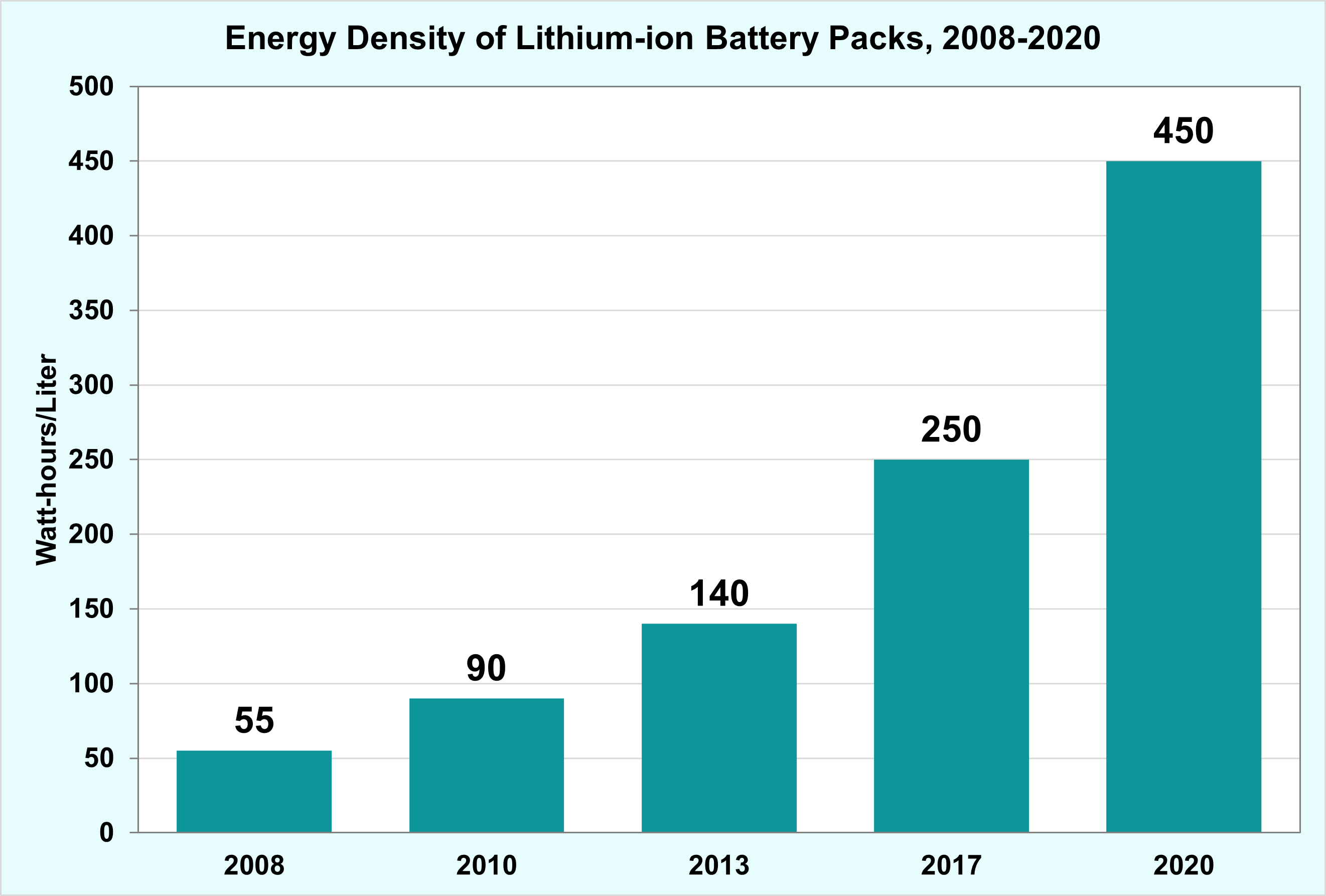
FOTW #1234, April 18, 2022: Volumetric Energy Density of Lithium-ion Batteries Increased by More than Eight Times Between 2008 and 2020
Volumetric energy density refers to the amount of energy that can be contained within a given volume.
== Doublepost prevention - post automatically merged: ==
Does that chart really suggest battery cost is nearly $0/kWh?
Nearer $200/kWh I would guess
Statista says the price in 2024 was $115 per kWh down from $715 in 2014.

Battery price per kwh 2025 | Statista
The cost of lithium-ion batteries per kWh decreased by 20 percent between 2023 and 2024. Lithium-ion battery price was about 115 U.S. dollars per kWh in 202.
 www.statista.com
== Doublepost prevention - post automatically merged: ==
The statista price chart ($715 in 2014, $115 in 2024) is the battery pack price, not the cell price.However, this - I think - is the cell price in mainland China (prices outside China tend to be higher). So this ignores all the costs associated with integrating the cells into modules, packs and the overall battery system including thermal management, power conversion and getting into a physical package that can be fitted into an 80x. Obviously the battery has to make its way from China to UK at some stage. Then there's all the one-off costs of design work, approvals and so on. Key point is that you can't get to a battery cost by multiplying [cell cost / kWh] x [desired battery size in kWh], and will also be significantly higher than high-volume automotive applications.
Last edited:
Trainbike46
Established Member
Turntides own website suggests a lower energy density for commercially available products
View attachment 175307
Presumably the turntide battery packs inlcude a whole bunch of extra stuff around the cells, including control mechanisms, protective materials, etc., which explains the lower energy density compared to the cells-only figures in the earlier sourceAnd as it says that product is ‘for energy storage in rugged applications like construction, agriculture and marine’. Looking at one particular battery for one particular application doesn’t tell you anything, you have to look across a time period.
If you don’t believe my original source here’s another:
View attachment 175350
Taken from https://arstechnica.com/science/202...y-no-batteries-are-improving-under-your-nose/
And another looking at volumetric density:
FOTW #1234, April 18, 2022: Volumetric Energy Density of Lithium-ion Batteries Increased by More than Eight Times Between 2008 and 2020
Volumetric energy density refers to the amount of energy that can be contained within a given volume.www.energy.gov
== Doublepost prevention - post automatically merged: ==
Statista says the price in 2024 was $115 per kWh down from $715 in 2014.
Battery price per kwh 2025 | Statista
The cost of lithium-ion batteries per kWh decreased by 20 percent between 2023 and 2024. Lithium-ion battery price was about 115 U.S. dollars per kWh in 202.
== Doublepost prevention - post automatically merged: ==
The statista price chart ($715 in 2014, $115 in 2024) is the battery pack price, not the cell price.
Presumably the turntide battery packs inlcude a whole bunch of extra stuff around the cells, including control mechanisms, protective materials, etc., which explains the lower energy density compared to the cells-only figures in the earlier source
It will also be a more cost competitive (read cheaper) pack due to the nature of it’s likely applications. The original graph was for ‘top tier’ batteries rather than these applications which don’t need the highest density, but it doesn’t actually matter regarding the point I was making. Lithium battery power density has steadily improved over time and continues to do so.
Nicholas Lewis
Established Member
The datasheet for the pack used under the 802's shows the the density is below 100W/kg. This is still massively below what a Kg of diesel contains but the real important point here is Turntide and Hitachi got approval for this configuration so if as the cells energy density improves its a simple change out for a new pack. Not sure the below video has been posted on here but gives a good overview of the kit and its installation.Presumably the turntide battery packs inlcude a whole bunch of extra stuff around the cells, including control mechanisms, protective materials, etc., which explains the lower energy density compared to the cells-only figures in the earlier source
Backing Batteries in the UK
The datasheet for the pack used under the 802's shows the the density is below 100W/kg. This is still massively below what a Kg of diesel contains but the real important point here is Turntide and Hitachi got approval for this configuration so if as the cells energy density improves its a simple change out for a new pack. Not sure the below video has been posted on here but gives a good overview of the kit and its installation.
Backing Batteries in the UK
Absolutely but you can also factor in the weight of all the parts associated with the diesel propulsion system and all the losses from the diesel combustion. It isn’t quite a like for like on energy density of diesel vs energy density for batteries.
I think we previously estimated the battery size at 555kWh which would equate to about $63000 for the battery pack itself at average 2024 prices. There was some discussion that the Turntide system may have been using Nissan Leaf batteries (although I not sure that was fully established?) which would be significantly cheaper but technologically date from about 15-20 years ago, so a possible reason why the density is below 100Wh/kg. For reference the battery pack in my Cupra Born, which is on the VW MEB platform and the design dates from around 2017-2019 is 168Wh/kg.
Last edited:
InTheEastMids
Established Member
- Joined
- 31 Jan 2016
- Messages
- 1,397
Thanks for posting these links. The link to your datasheet doesn't seem to be working, but for those interested, it seems clear from the video that the trial used the Gen1 battery, so folk can have a look hereThe datasheet for the pack used under the 802's shows the the density is below 100W/kg. This is still massively below what a Kg of diesel contains but the real important point here is Turntide and Hitachi got approval for this configuration so if as the cells energy density improves its a simple change out for a new pack. Not sure the below video has been posted on here but gives a good overview of the kit and its installation.
Backing Batteries in the UK
Energy Storage - Turntide
Our flexible, energy storage lithium-ion NMC batteries offer 15% more energy with improved density. They’re ideal for rugged applications.
 turntide.com
Assuming the video is showing actual trial system, it appears that the raft for installation pairs battery packs back to back (presumably cabling etc down the middle). with up to 8 battery packs each side, so 16 in total. This gives a nameplate capacity of around 576 kWh and power of 816 kW. The weight of the battery packs alone would be around 4900 kg, so guessing the entire system would be 5500-6000 kg, depending on how much steelwork, cabling and other ancilliaries are required to make it go.
For reference, the MTU datasheet linked below quotes the genset weight as between 4700 and 6750 kg with up to 700 kW power. Presumably this doesn't include diesel, which when full will be adding something like 1300 kg of more weight.
poffle
Member
The Nissan Leaf is a very early electric car design which ( with the Zoe) only has air cooled batteries. This means it can only charge on AC at quite a low charge rate. All modern EVs use water cooled batteries which allow for faster DC charging as well as low speed charging.Absolutely but you can also factor in the weight of all the parts associated with the diesel propulsion system and all the losses from the diesel combustion. It isn’t quite a like for like on energy density of diesel vs energy density for batteries.
I think we previously estimated the battery size at 555kWh which would equate to about $63000 for the battery pack itself at average 2024 prices. There was some discussion that the Turntide system may have been using Nissan Leaf batteries (although I not sure that was fully established?) which would be significantly cheaper but technologically date from about 15-20 years ago, so a possible reason why the density is below 100Wh/kg. For reference the battery pack in my Cupra Born, which is on the VW MEB platform and the design dates from around 2017-2019 is 168Wh/kg.
The Nissan Leaf is a very early electric car design which ( with the Zoe) only has air cooled batteries. This means it can only charge on AC at quite a low charge rate. All modern EVs use water cooled batteries which allow for faster DC charging as well as low speed charging.Absolutely but you can also factor in the weight of all the parts associated with the diesel propulsion system and all the losses from the diesel combustion. It isn’t quite a like for like on energy density of diesel vs energy density for batteries.
I think we previously estimated the battery size at 555kWh which would equate to about $63000 for the battery pack itself at average 2024 prices. There was some discussion that the Turntide system may have been using Nissan Leaf batteries (although I not sure that was fully established?) which would be significantly cheaper but technologically date from about 15-20 years ago, so a possible reason why the density is below 100Wh/kg. For reference the battery pack in my Cupra Born, which is on the VW MEB platform and the design dates from around 2017-2019 is 168Wh/kg.
I'd be a bit concerned if a train was using air cooled batteries given that regenerative braking would be one of the main benefits of deploying batteries. They might be ok for a trial but I wouldn't expect a real life deployment to use them.
The Nissan Leaf is a very early electric car design which ( with the Zoe) only has air cooled batteries. This means it can only charge on AC at quite a low charge rate. All modern EVs use water cooled batteries which allow for faster DC charging as well as low speed charging.
I'd be a bit concerned if a train was using air cooled batteries given that regenerative braking would be one of the main benefits of deploying batteries. They might be ok for a trial but I wouldn't expect a real life deployment to use them.
Agreed, but it’s entirely possible they’re using the cells from a Nissan Leaf in a more modern battery pack design (with better cooling). I’m also uncertain what pack is being used/proposed - the link kindly provided by @InTheEastMids has two listed; a Gen5 and further down a Gen1 (which I’m pretty certain is the same cells as a Nissan Leaf). It’s been suggested that it is the Gen1 being used but I’m not sure this is absolutely confirmed.
Last edited:
The requirements for a train differ quite significantly from those of an EV, meaning typically different battery chemistries are used, with LTO being the usual choice for rail applications. LTO cells have a slightly lower energy density than typical EV chemistries, but can be charged and discharged much more aggressively and are much less flammable. A train has a lot of kinetic energy and can go from drawing a very high current from the battery while accelerating, to charging with a very high current while braking within a fraction of a second.
tumbledown
Member
Interesting working in the small hours today:
 www.realtimetrains.co.uk
Realtime Trains | 9T73 0050 Manchester Airport to Liverpool Lime Street | 17/03/2025
Real-time train running information for 9T73 0050 departure from Manchester Airport to Liverpool Lime Street on 17/03/2025. From Realtime Trains, an independent source of train running info for Great Britain.
www.realtimetrains.co.uk
- Status
- Not open for further replies.